Anthropic's latest models available worldwide. In other words, Chinese open source models posed a serious enough threat to market share.
In a different context, an Indian customer of some of our products told me recently "A big Microsoft Office license renewal came up and they hiked the price drastically. We told them we are looking at the Zoho office suite and they dropped the price by 90%" - he thanked me for saving them big money, even without buying our office suite. If you are facing renewal of Microsoft Office license, I suggest you mention Zoho.
Some history: Microsoft is a convicted monoplist by a US Federal Court (April 2000) and the monopoly finding but not the suggested remedy was upheld by the U.S Court of Appeals (DC circuit) in 2001. Microsoft has a long illustrious history of milking the customer dry (see the AI link below for details).
Competition is always important. The fact that American AI models have serious competition from China is important for India and other countries.
Finally, I am now confident that India will catch up in AI models. There is no reason to be despondent. There are multiple efforts going on in academia and industry and the cost to train AI models is starting to fall. Recently I met people from the BharatGen team (IIT Bombay) and they are making great progress. I will write more about BharatGen soon.
Introducing Claude Science, a new app designed with every stage of research in mind.
Artifacts traced to their code, environments managed on demand, and 60+ optional scientific databases that you can connect.
Available now in beta.
Gilbert Strang, an MIT professor, taught the same linear algebra course for 62 years. When he delivered his final lecture in May 2023, students from around the world tuned in online to watch.
The course is MIT 18.06 Linear Algebra. Millions of machine learning engineers, data scientists, quants, and self-taught programmers learned the essential math behind AI from his clear, free video lectures, even though most never stepped foot on the MIT campus.
Strang joined the MIT faculty in 1962 and retired in 2023. When MIT launched OpenCourseWare in 2001–2002, he was one of the first to embrace it fully. While many professors hesitated, Strang saw it as an opportunity to share mathematics with everyone. He filmed his lectures and made them freely available.
He completely changed how linear algebra is taught. Instead of starting with abstract vector spaces and proofs, Strang began with something simple and visual: matrix multiplication. He built intuition first using concrete examples, then introduced more advanced ideas like eigenvectors and singular value decomposition. He insisted that students should be able to explain every concept with a small, tangible matrix before moving to theory.
Beyond the content, his teaching style stood out. He spoke to students with genuine respect, patience, and kindness, never using words like “obviously” or “trivially.” He regularly paused to check if anyone was lost and treated beginners as thoughtfully as he would his colleagues.
As a result, Strang became the default linear algebra teacher for much of the planet. Universities in many countries began recommending his lectures to their own students. Some even replaced their in-person courses with his videos because they could not match their clarity.
His final lecture ended with a long standing ovation. Strang seemed surprised by the applause, smiled humbly, and simply thanked everyone.
In his short comment under the YouTube video, he expressed gratitude for a wonderful life of teaching and hoped others would continue teaching the subject well. No self-promotion, no grand farewell—just quiet sincerity.
When you add up every version, every upload, help sessions, and all the different recordings MIT has shared over the years, the total has surpassed 20 million views.
Today, the full course, including all lectures, problem sets, and solutions, remains freely available on MIT OpenCourseWare. One of the most important mathematical foundations of modern AI is still just one click away.
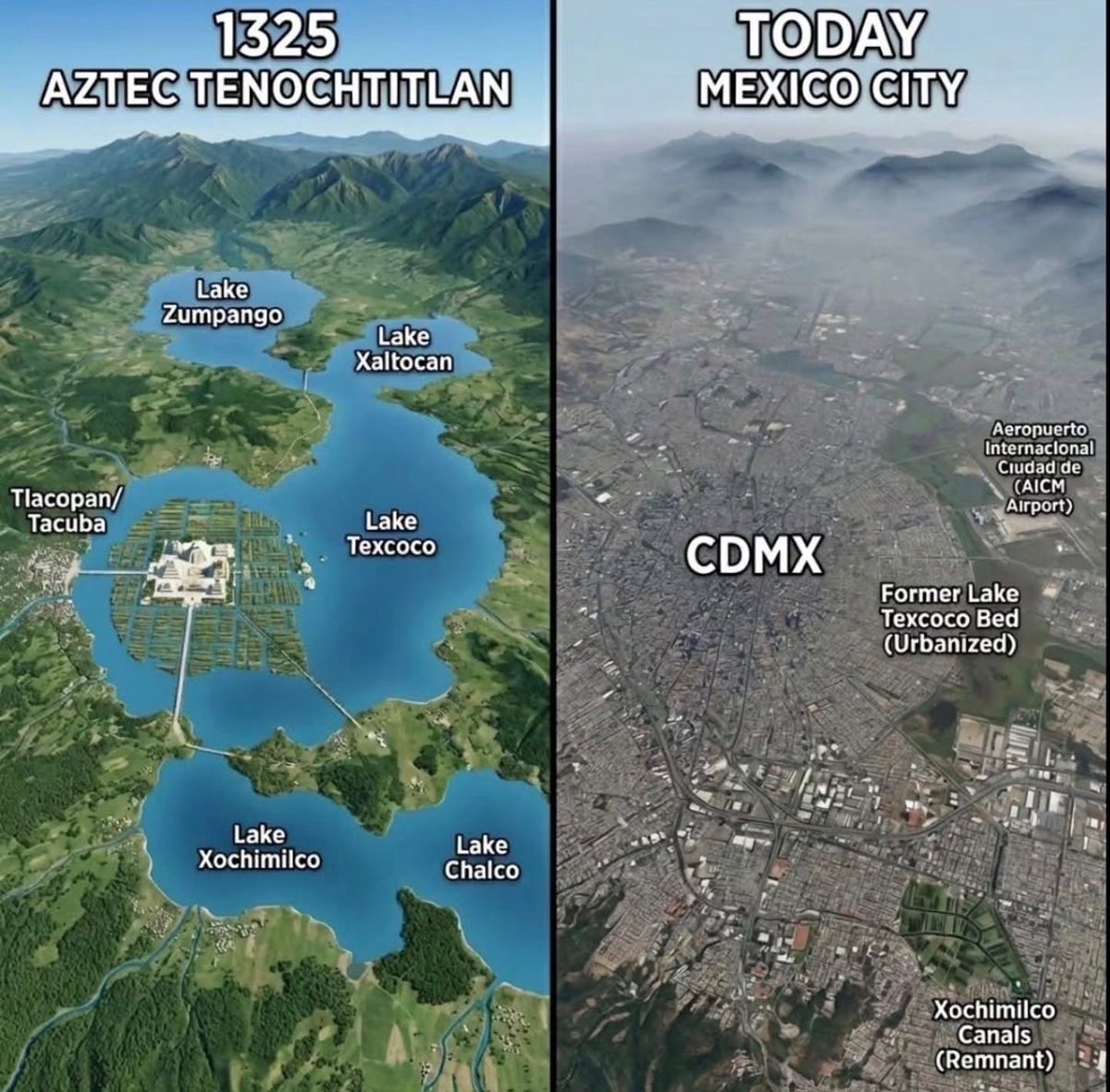
Long before Mexico City existed, the magnificent city of Tenochtitlan ruled the Valley of Mexico.
I think one of the greatest moments in history to witness would be the height of Tenochtitlan in the early 1500s, before Hernán Cortés and the Spanish conquistadors conquered and destroyed the city. Seeing one of the world’s most remarkable urban centers at its peak would be an unforgettable experience.
When the Spanish first arrived in 1519, Tenochtitlan was among the largest cities on Earth, with an estimated population of 200,000 to 300,000—larger than most European capitals of the era. Built on an island in Lake Texcoco, it was connected to the mainland by three massive causeways equipped with removable bridges for defense. A network of canals ran throughout the city, allowing canoes to transport people and goods so efficiently that Europeans often compared it to the “Venice of the Americas.”
At the heart of the city stood the Templo Mayor, an enormous twin-temple pyramid dedicated to the gods Huitzilopochtli and Tlaloc. Surrounding it were palaces, government buildings, temples, and bustling plazas. Nearby, the Great Market of Tlatelolco drew thousands of merchants each day, offering everything from food and pottery to textiles, jewelry, and luxury goods from across Mesoamerica.
The Aztecs also demonstrated extraordinary engineering and agricultural innovation. They expanded farmland using chinampas—highly productive artificial farming plots built in shallow lake waters—while aqueducts supplied the city with fresh water from nearby springs. Carefully planned neighborhoods organized by occupation and social status completed a city that combined sophisticated engineering, architecture, and urban planning, making Tenochtitlan one of the greatest achievements of the pre-Columbian world.
THIS IS HOW YOU WIN AS AN AI ENGINEER IN 2026:
> ship one real app per month, ugly counts
> master 4 things cold: prompts, tool calling, RAG, evals
> use cheap models first, scale only when you can prove ROI
> deploy everywhere users can hit it
> open-source one project this month with a real README
> own one lane: product, applied ML, or automation
everything else is just credential chasing. this is how you actually get hired and start charging by month 3
stop learning for years without actions, since it doesn't increase your potential salary
Satya just described at the enterprise level what every individual operator needs to internalize.
His core point: you can hand off tasks to AI, but you can never hand off your learning. Build a compounding loop between your judgment and AI capability, or get commoditized.
This applies to solopreneurs as much as Fortune 500s.
If your entire AI capability is knowing how to prompt one specific model, you don't own anything. That's a rental agreement. One model update and your "edge" disappears.
The operators building thinking systems that work across every model are constructing exactly what Satya calls "token capital" at the individual level. The model becomes interchangeable. The thinking architecture stays.
That's what I mean by "LLMs don't think, you do."
The model is 20% of your output. Your thinking framework is the other 80%. And unlike a model, nobody can swap it out from under you.
There’s no bigger advertisement for Test cricket than if Sooryavanshi tells the world his dream is to play red ball for India.
Our hopes sit with you young sir.