A blockchain is basically a genius locked in a room with no windows.
Hand it a problem in writing and it will reason through it flawlessly, every time, forever.
But it cannot see out.
It does not know today’s Bitcoin price, who won last night’s football match, or whether a flight actually landed. Everything it knows has to already be inside the room.
That is a real limitation.
A contract that pays out the moment a flight is delayed is useless if it can never find out the flight was delayed.
Oracle Machines are the window.
They let a Qubic smart contract ask the outside world a question, get an answer the network checks and agrees on, then act on it.
Prices. Sports results. Sensor readings.
This is not a someday feature.
Oracle Machines are live, and already doing real work: validating Dogecoin mining shares for the network.
That workload recently climbed by up to 40x across a few epochs, and the system handled it without strain.
A contract that can read reality is worth far more than one stuck guessing.
Qubic can read it.
Every April Fools' Day, someone pulls a stunt.
Today, Qubic pulled a network.
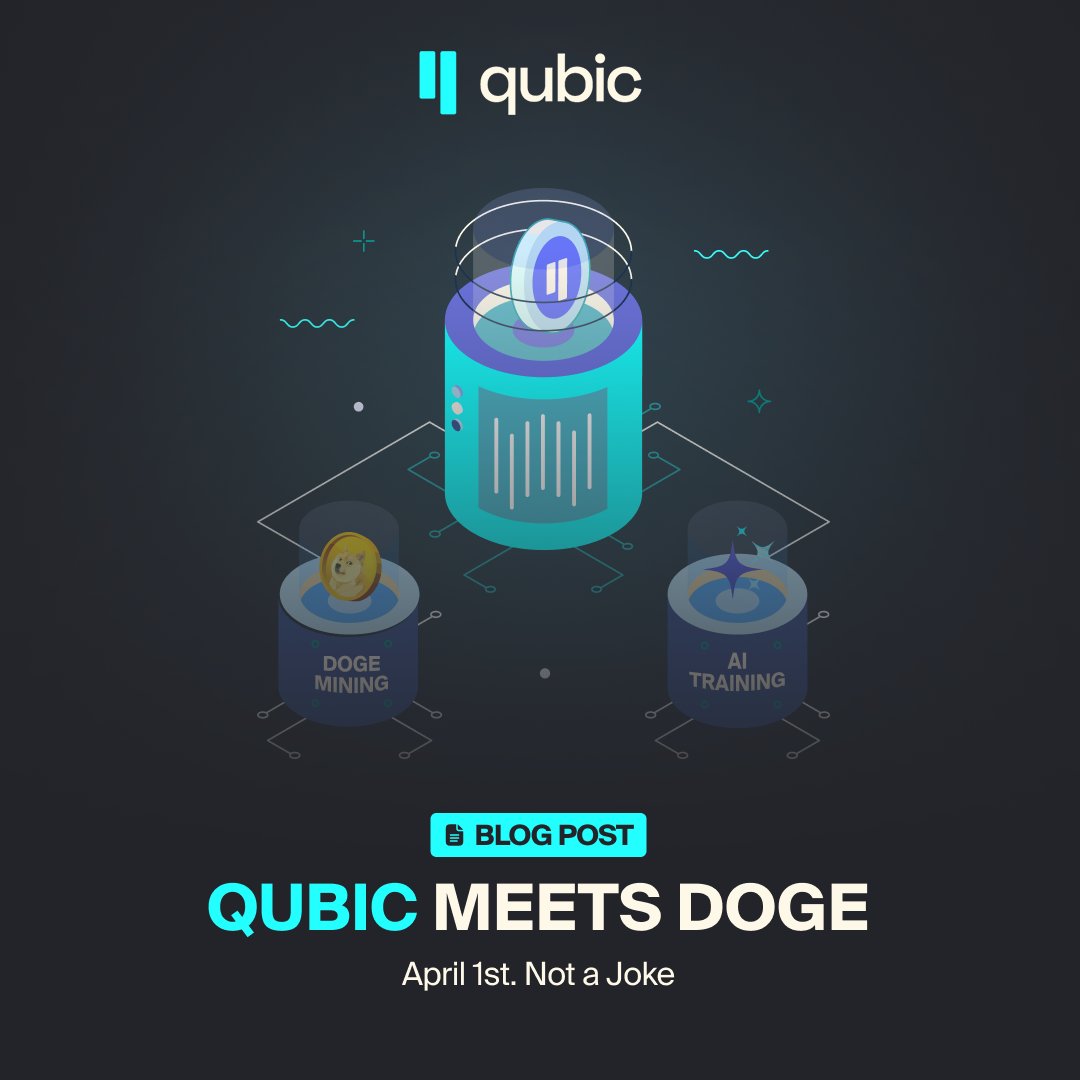
DOGE mining is live. Powered by the fastest compute network on Earth.
This is not a joke.
In less than 24 hours, DOGE mining goes live on Qubic mainnet.
Yesterday, Joetom walked through the entire architecture live.
The bridge protocol. The five-thread Dispatcher. How Oracle Machines validate every share on-chain.
He confirmed the system isn't built for one coin. It's built for any chain.
Full AMA recap on the blog.
Today.
Join DefiMomma and Joetom (Core Tech Lead) as he walks through the live architecture, the 3-phase transition, and exactly what happens on April 1st.
No marketing. No fluff. Straight from the engineer who built it, answering your questions.
11:00 AM EDT | 3:00 PM UTC
#DogeMeetsQubic
BREAKING:
Dogecoin mining network is set for a major upgrade with Qubic integration starting April 1, 2026.
Full-scale production is expected by April 30.
Remember Monero?
51%+ of the network hashrate. $3.5M+ in revenue. The crypto world watched it happen in real time.
That was the proof of concept. April 1st is the real thing.
Before it goes live, we're doing one last preview.
This Monday, March 30 at 11AM EDT | 3PM UTC
"Why DOGE? Why Now? Why Qubic?"
Joetom (Core Tech Lead) and Raika (DOGE Lead Dev) walk through everything live. The architecture, what changes for miners, the three transition phases from XMR to DOGE, and what to expect on launch day.
No script. No spin. Just the team walking through the build.
#DogeMeetsQubic
The mind behind NXT's Proof of Stake.
The mind behind IOTA's DAG.
The same person founded Qubic.
On April 1st, Qubic, CFB's biggest vision yet, starts mining Dogecoin.
5 days.
#DogeMeetsQubic
The old model made CPUs choose: mine Monero or train AI.
Not both. One or the other.
Dogecoin ends that trade-off.
ASICs handle Dogecoin. CPUs and GPUs train Aigarth.
Different hardware. Different jobs.
No more alternating. No more compromise.
This is the architecture shift.
5 days.
#DogeMeetsQubic
8 days.
Idle compute shouldn’t stay idle.
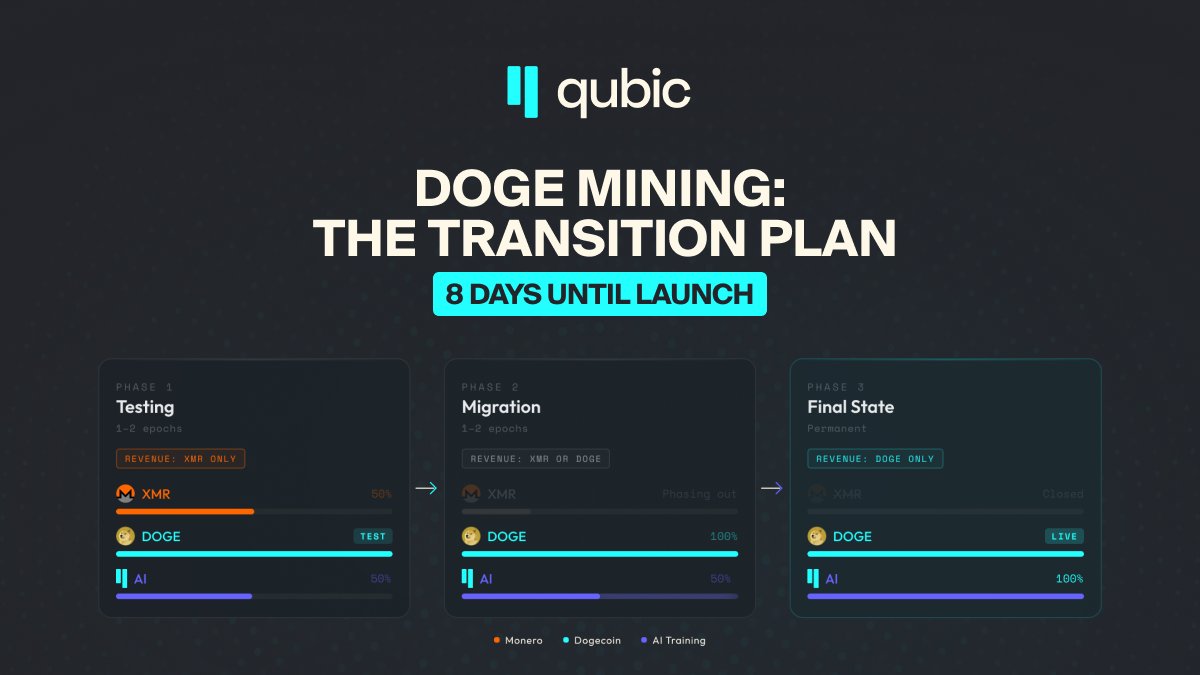
The transition from Monero to Dogecoin doesn’t happen overnight. Qubic’s core team designed a three-phase rollout. Each phase is evaluated before moving forward.
Phase 1, Testing (starts April 1st, 1 to 2 epochs):
Computor revenue stays XMR only. XMR active 50% of the time. DOGE enters test mode, active 100%, running on mainnet. AI training continues running alongside.
Phase 2, Migration (1 to 2 epochs):
Computors choose between XMR or DOGE revenue. XMR starts phasing out. DOGE phases in with top-up applied. Computors who bring DOGE are no longer eligible for XMR.
Phase 3, Final State:
Computor revenue is DOGE only. XMR dispatcher turned off completely. DOGE active 100%. AI training active 100%.
The network reaches its target: DOGE + AI, running simultaneously, full time.
No rushing. No shortcuts. Just disciplined execution.
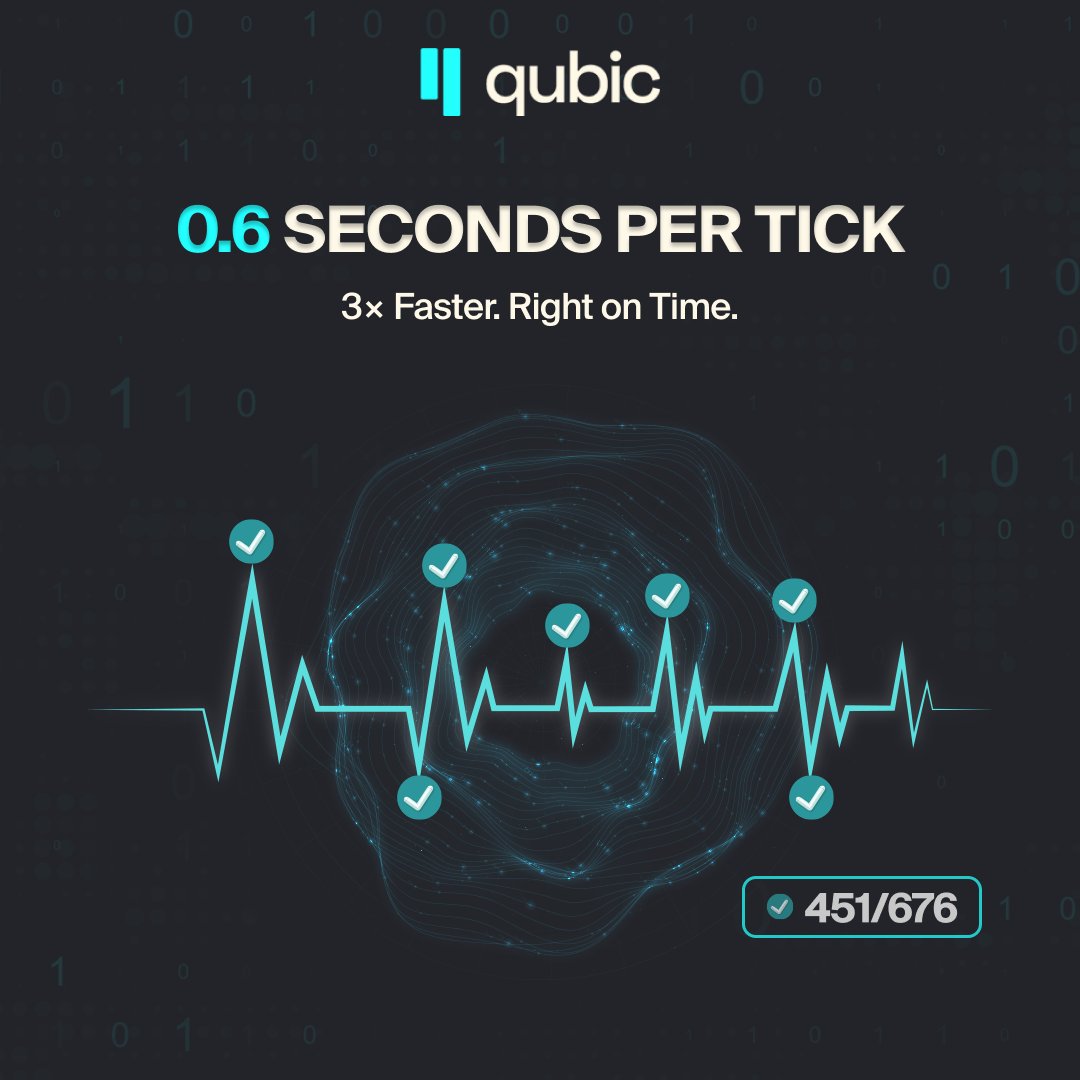
The network that launches Dogecoin mining on April 1st just got 3x faster.
Not on a testnet. On live mainnet.
A year ago, Qubic processed a tick every 2 seconds. Then 1 second.
The latest core optimization just pushed it to 0.6 seconds.
Here's why that matters for DOGE mining: every share a miner submits gets validated through Oracle Machines in a single tick. Faster ticks mean faster confirmations, a more efficient pipeline, and a network that can handle the load when April 1st hits.
The network got faster right before it needed to be.
#DogeMeetsQubic
Most mining pools trust a single operator to validate your shares.
Qubic doesn’t.
Every Dogecoin share mined through the Qubic network gets validated by Oracle Machines: independent computors spread across the network who each verify the share separately.
Up to 13 oracle commits per transaction. If the result passes the quorum’s Byzantine fault tolerance threshold (agreement from 451 of 676 computors), it’s validated on-chain. No single point of failure.
Oracle Machines went live on mainnet February 11. Dogecoin mining is the first real-world external use case built on top of this system. It won’t be the last.
The same validation framework can serve price feeds, cross-chain data, and any external information that smart contracts need to act on.
April 1st stress-tests this at scale.
#DogeMeetsQubic
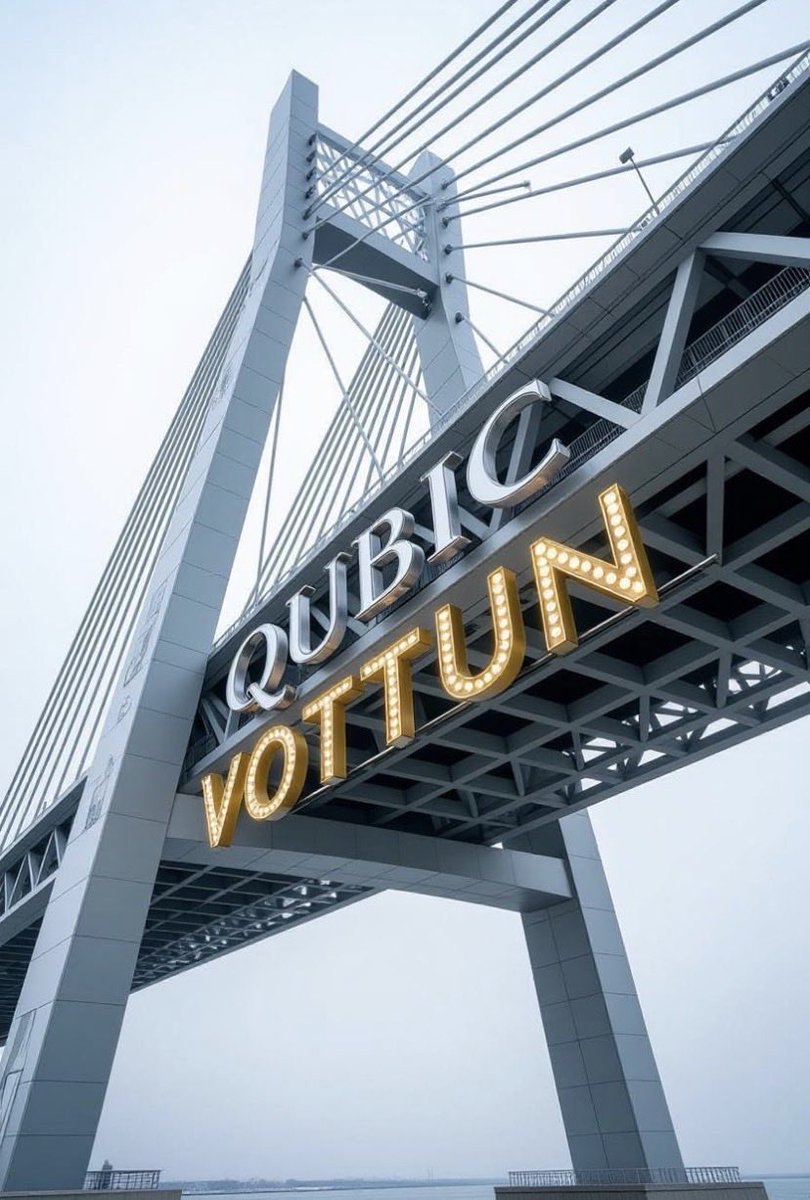
Every chain is an island until someone builds a bridge.
Qubic has been the fastest blockchain in existence for a while now. 15.5M TPS. Feeless. Bare-metal execution. But all of that power has lived inside a single ecosystem, disconnected from the liquidity and DeFi infrastructure that Ethereum commands.
QBridge changes that. For the first time, QUBIC becomes accessible as an ERC-20 on Ethereum. Every wallet. Every DEX. Every lending protocol.
This isn’t a wrapped token experiment. It’s audited infrastructure with multisig governance, and the IPO is live Now!
Another level about to unlock for $Qubic!
The @Vottun bridge proposal is now live for computor vote.
This will open the floodgates to @ethereum’s mass liquidity 🔥
https://t.co/jvfcYtEtRs