👱♀️Tar jeg feil kvinner? 🧚♀️
Er Materialismen trolldommen som har stjålet talentet deres...?
og lurt dere inn et meningsløst maskulint spill?
Når dere egentlig hadde deres egen likeverdige trone?
💡💡💡💡💡💡💡💡💡💡💡💡💡💡
@LiseSorensen_@odahaukaas@RMistereggen@trafikkfrue@OleAsbjoernNess
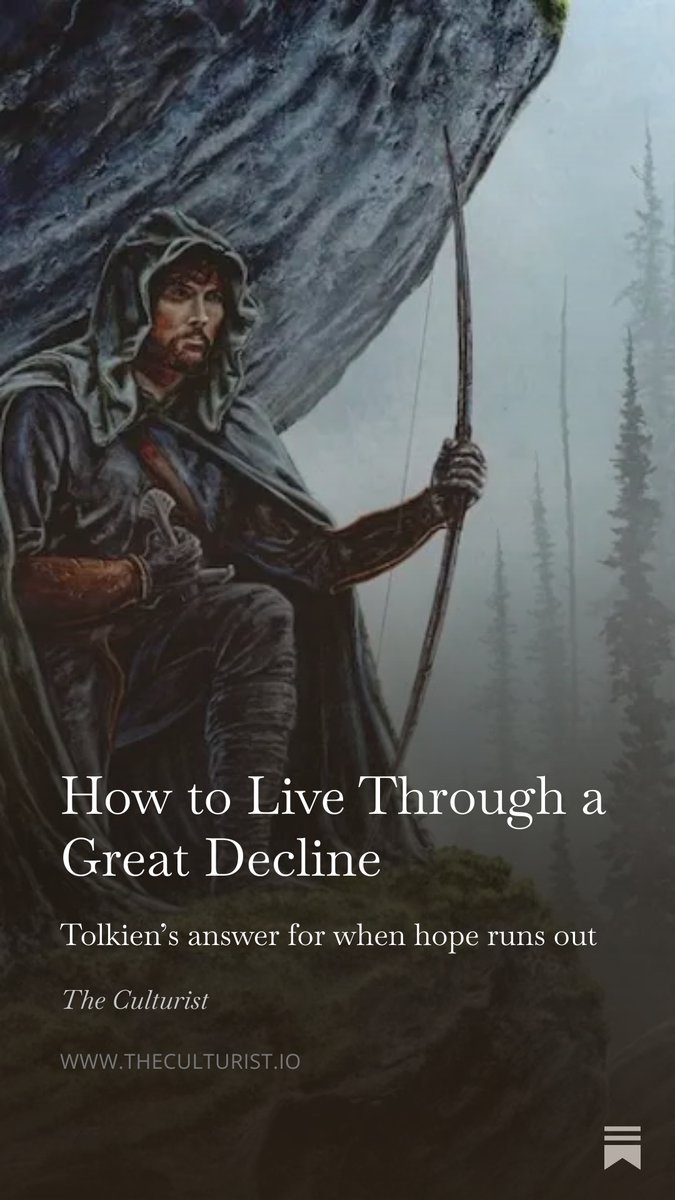
If you're living through a great decline, how should you personally live and act in the midst of it?
This is the question at the heart of "The Lord of the Rings," and it's best answered by the scene following the death of Boromir.
After Boromir gives his life to save the Hobbits from Saruman's Orcs, the Fellowship is in tatters. With time against them, Merry and Pippin swept away by the enemy, and Frodo passing out of their control, Aragorn and company make a decision that seems strange.
They pause to mourn Boromir's passing with a proper ritual.
To many readers, this feels entirely reckless. Their "best" course of action is surely to prioritize what is most urgent: that the fate of their quest hangs in the balance. We recognize that, in any "normal" context, it would be wrong to let Boromir's body lie out in the open, but the nature of their mission surely doesn’t allow for the luxury of a funeral — right?
But the fact that abandoning Boromir's body is wrong in normal times is precisely why it is wrong even now. At the heart of LOTR is the idea that moral decisions lie beyond their immediate context: some things just are wrong and others right, and once context becomes an arbiter of that distinction, you've lost your grip on what it means to be good.
Aragorn's next statement helps us understand this further:
"I would have guided Frodo to Mordor and gone with him to the end; but if I seek him now in the wilderness, I must abandon the captives to torment and death. My heart speaks clearly at last: the fate of the Bearer is in my hands no longer."
Aragorn makes yet another decision to halt progress on the greater mission in favor of that which speaks directly to his heart: he will pursue Merry and Pippin, rather than sacrifice them for the "more important" quest.
Tolkien's heroes recognize that they are not in control of everything. They cannot force the Ring to be unmade through their own will to power, and they're aware that their universe is guided by forces beyond their own and of their enemies. All they do is done in that humility, and they are bound by moral laws beyond themselves.
Indeed, Middle-earth is guided not just by the opposing wills of Good and Evil but by another, providential force beyond the material.
It is precisely because Tolkien's heroes believe in objective good that they can trust that a great, providential turn in fortune — a "eucatastrophe" — is around the corner. To believe in the objective good is to live in accordance with destiny, and to act on what is inherently good at all times, and to die for it if necessary.
To live in submission to divine providence is to recognize that the right actions also lie in the little things, and that you yourself play only a small part in the grand story.
A good world is brought into being by small acts of courage and kindness, even when they seem superfluous in the wider context of your quest...
https://t.co/HyhHZGGYde
Jeg fikk fantastiske nyheter her i dag tidlig.
Alle kontoene mine har blitt godkjent som samfunnsnyttige(public utility apps) og jeg fikk til og med en stor takk for at jeg bruker X sin API til noe fornuftig.
Ønsker alle en fortsatt god påske!