Institutions are corrupt. They manage monetary policies as they please, trying to bail out the Titanic. In the meantime, they treat us like cattle to steal our money through taxes to give it to companies that "help" them rule us with information and money for their campaigns.
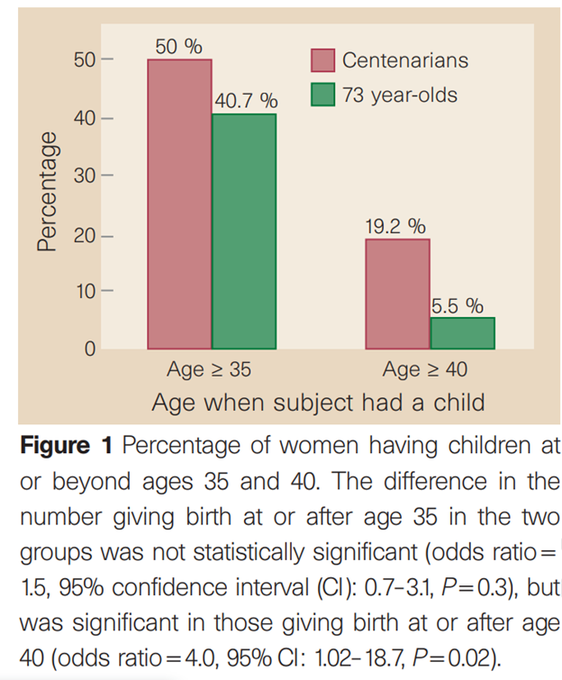
Women who gave birth at age 40+ were ~4x more likely to live to 100.
In this 1997 study, 19.2% of centenarians had kids ≥40, vs. just 5.5% of women who died at 73.
This isn’t probably causal - it’s likely that the ability to conceive at 40 signals slower biological aging and better long-term health.
Several other studies support these findings (PMID: 27854529; PMID: 24977462; PMID: 38964280)
Graph: PMID: 9296486
Deutschland ist geil.
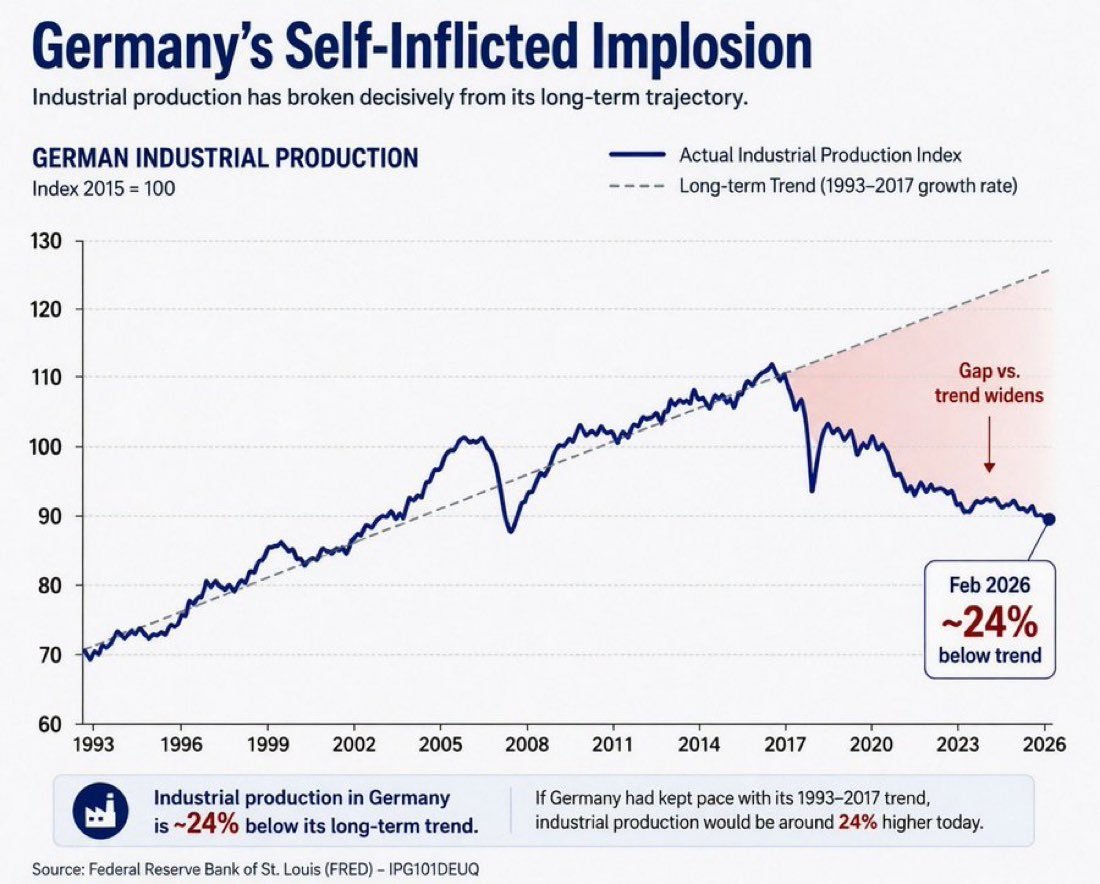
Man muss das endlich einmal positiv sehen: Die Industrieproduktion sinkt. Und zwar nicht irgendwie, sondern mit Haltung.
Während andere Länder noch rückständig produzieren, exportieren, Maschinen bauen, Chemie herstellen, Stahl kochen und Wohlstand erwirtschaften, geht Deutschland mutig voran: Wir bauen ab.
Nicht chaotisch. Nicht zufällig. Sondern wertebasiert.
Endlich kommen wir den großen Zielen näher. Weniger Industrie heißt weniger Energieverbrauch. Weniger Energieverbrauch heißt mehr Effizienz. Und wenn irgendwann gar nichts mehr produziert wird, sind wir praktisch unschlagbar energieeffizient.
Das Energieeffizienzgesetz wird dann nicht erfüllt.
Es wird übertroffen.
Natürlich gibt es ein paar kleine Nebenwirkungen: weniger Arbeitsplätze, weniger Wohlstand, weniger Know-how, weniger Steuerbasis, weniger Zukunft. Aber wer wird denn so materialistisch sein? Wohlstand ist doch ein sehr altes Konzept. Fast schon toxisch. Nach Fabrik. Nach Schichtarbeit. Nach Leistung. Nach Männern mit Werkzeugkoffer.
Heute geht es um Größeres.
Um Moral.
Um Haltung.
Um CO₂-neutrale Selbstverzwergung.
Wir produzieren vielleicht bald weniger Autos, weniger Maschinen, weniger Chemieprodukte und weniger Innovation. Aber dafür produzieren wir Weltrettungsgefühle in industriellem Maßstab. Das ist doch auch Wertschöpfung. Jedenfalls in Talkshows.
Man muss den Grünen fast dankbar sein. Sie haben verstanden: Der modernste Industriestandort ist der, der keiner mehr ist. Kein Lärm, keine Abgase, keine Energieprobleme, keine Lieferketten. Nur noch Lehmhütte, Lastenrad und ein Arbeitskreis für resiliente Postwachstumsräume.
Gut, Zelte wären auch möglich, aber die bestehen oft aus modernen Materialien. Also lieber Lehm. Regional. Nachhaltig. Kreislauffähig. Bei Regen leider etwas herausfordernd, aber das nennen wir dann Transformationserfahrung.
Das wirklich Geniale ist: Mit jeder Fabrik, die verschwindet, verschwindet auch Wissen. Und wenn das Wissen erst einmal weg ist, muss man auch nichts mehr produzieren. Dann fragt auch keiner mehr, warum wir es nicht mehr können.
Das ist deutsche Konsequenz.
Erst machen wir Energie teuer.
Dann wundern wir uns über weniger Produktion.
Dann nennen wir es Strukturwandel.
Dann erklären wir den Abstieg zur moralischen Avantgarde.
Andere Länder bauen Kernkraftwerke, Industrieparks, Chipfabriken und Infrastruktur.
Deutschland baut Haltung.
Und wenn die Kurve weiter fällt, sollten wir nicht jammern. Wir sollten feiern. Denn jede nicht produzierte Maschine ist ein kleiner Sieg gegen den alten Wohlstand. Jede geschlossene Fabrik ein stillgelegtes CO₂-Risiko. Jeder verlorene Industriearbeitsplatz ein Beitrag zur nationalen Entlastung vom Leistungsdruck.
Deutschland ist nicht im Niedergang.
Deutschland meditiert nur auf dem Weg zur Lehmhütte.
Wissen ist Macht. Wir wissen nichts, Macht nichts.
I’m a dermatologist. I’m supposed to say there is no amount of safe sun exposure.
But I won’t, because that’s a lie.
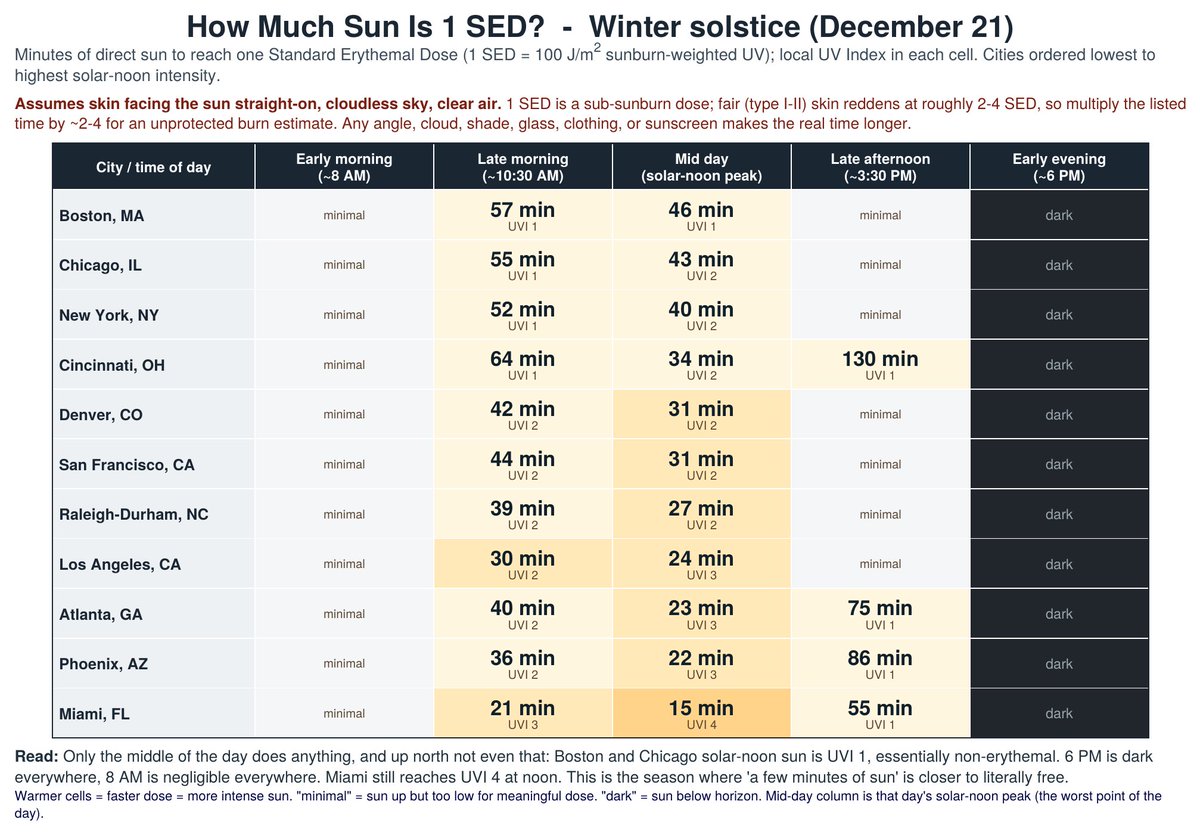
The attached shows how much sun is safe in different cities at different times of year.
What do I mean by ‘safe’?
I mean this: UV causes DNA damage and skin cancer.
But, shockingly, your body repairs that damage. As long as the damage doesn’t outpace repair and start accumulating it shouldn't increase your risk of skin cancer.
Data just came out that tells us how much UV you can get without damage accumulating.
They took the people most susceptible to DNA damage from UV and exposed them to UV, then did skin biopsies to measure the damage, then more skin biopsies to measure the repair, and repeated it daily for 4 days.
At 1.6 ‘Standard Erythemal Dose’ (SED) there was no accumulation of damage.
So, the attached charts show how much sun it takes to get 1 SED in different cities at different times of the year at different times of day.
And there are extra safety margins built in. It assumes a perfectly clear day with zero air pollution and that the sun is hitting your skin perpendicularly. Unless you’re laying flat, most sun is hitting you at an angle, which isn’t nearly as intense.
But a bigger question you might be asking is ‘Why would a dermatologist be telling you to get sun in the first place?’
Because getting sun reduces your risk of death.
Mostly by reducing your risk of heart attacks and strokes. That is very well proven.
But it’s also very likely that sun exposure reduces your risk of autoimmune disease, dementia, cancer and depression. It’s just not as well proven as the protection against heart attacks and strokes.
And before you reply and say ‘just take vitamin D!’, know that it has been ROBUSTLY proven that vitamin D has little (if any) benefit for preventing any of the above. Vitamin D is mostly useful as a marker of if you’re getting enough sun.
What do I do myself and what do I tell my patients?
Get as much unprotected sun exposure as you can without getting a burn.
That’s my GUESS as to what has the best risk/benefit ratio. Dying of skin cancer is actually really rare, especially when compared to the risk of heart attacks, strokes, autoimmune disease, dementia and other cancers.
But I’ll admit it’s not for sure best to get as much sun as possible, since sun does increase the risk of skin cancer and it might be the case the benefits plateau at a low level.
So, if you’re really worried about skin cancer stick to the charts.
The best science I can find says that amount won’t cause skin cancer.
The takeaway?
Sun is good for you, just don’t get a burn.
La Cadena SER sacó un artículo para defender el proceso de la ley de nietos, que os pongo en el segundo post.
Lo titula 'los datos frente al discurso'.
Lo he leído entero, y bueno… allá voy.
Primero, dicen que la instrucción no amplió nada, que solo aclara la ley.
Pero la ley exigía ser descendiente de un exiliado, y la instrucción la reescribió para que valga ser nieto de cualquier español, con exilio o sin él.
La propia instrucción admite por escrito que el texto va 'únicamente' para descendientes de exiliados, y aun así lo reinterpreta.
Os lo he puesto literal en la imagen.
Además, el Congreso ya había rechazado dos veces, en 2022, las enmiendas de Ciudadanos que pedían esa ampliación.
Y cinco días después de publicarse la ley, una instrucción de una Dirección General la sacó adelante.
Por eso el TSJ de Madrid tramita desde diciembre de 2022 un recurso que pide anularla.
Segundo.
Comparan con la nacionalización de sefardíes que aprobó el PP en 2015.
Aquella ley obligaba a demostrar la condición de sefardí y una vinculación real con España, hacía pasar por dos exámenes del Instituto Cervantes y exigía comparecer en persona ante notario aquí.
Un proceso caro y selectivo que dio unas 72.000 nacionalidades repartidas por medio mundo.
Y aunque la ley me parezca una chorrada, y esos sefardíes también votan, eran muchos menos, así que lógicamente a nadie se le ocurrió hablar de amaño.
Tercero.
Es verdad que la parte genealógica, la que conecta al abuelo con España, pasa ciertos controles.
Pero el exilio, que era el requisito de la ley, no hay que demostrarlo.
A quien salió de España entre 1936 y 1955 se le presume: basta con acreditar que se marchó, sin decir por qué.
Y a quien salió entre 1956 y 1978 se le da por exiliado con un certificado de un partido o un sindicato.
Así que la documentación prueba de quién desciendes, pero no que ese abuelo fuera un exiliado, que es lo que la ley decía reparar.
Cuarto, y aquí les doy la razón: es un proceso lento.
Para tramitar la nacionalidad por la ley de nietos se han pedido unos 2,5 millones de citas. De esas, alrededor de 1,2 millones de solicitudes se han presentado de verdad.
Concedidas, a 31 de marzo de 2026, unas 544.000. E inscritas ya en el registro, con derecho a voto, unas 306.000.
O sea, en tres años se ha completado menos del 15% del total.
No habrá seguramente millones de votantes nuevos para 2027. Pero quizás si para las siguientes, y sucesivas.
Junto con los regularizados que podrán votar en unos años, serán millones de nuevos españoles que le deben su nacionalidad al PSOE.
El voto exterior no siempre participó tan poco.
Antes de 2011, sin trabas, votaba con normalidad: por encima del 25%, y en 2008 llegó al 31,7%.
En 2011 se introdujo el llamado voto rogado, que obligaba a pedir la papeleta para poder votar, y la participación se hundió por debajo del 5%.
Esa traba se suprimió en 2022, y en 2023, en las primeras generales ya sin ella, rebotó al 10%.
Y con ese 10%, ojo, el voto de fuera ya cambió un escaño en Madrid.
Quinto.
Sobre la externalización, contestan con Buenos Aires, donde dicen que solo se digitalizan datos.
Ni una palabra de La Habana y de PALCO, la empresa estatal cubana a la que el consulado paga más de un millón de euros y que le coloca el personal, porque es la única que el régimen autoriza.
Sexto, la circunscripción.
Aseguran que se elige por arraigo y que no vale cualquier criterio.
Pero al parecer el propio formulario de Exteriores no obliga a acreditar ningún arraigo: basta con escribir el municipio y la provincia donde quieres votar, y para lo demás hay una casilla de ‘otros motivos’ sin mecanismo de verificación.
Si de verdad no valiera cualquier criterio, no habría nada que auditar.
Y cómo se asigna la provincia a cada nuevo votante es justo lo que se ha pedido auditar a la Junta Electoral.
Porque puede ser decisivo.
@DireStraits77 I saw them in concert with my father when I was ten years old. It was one of the best experiences of my life! I'll remember it forever. I would love to have that experience again.
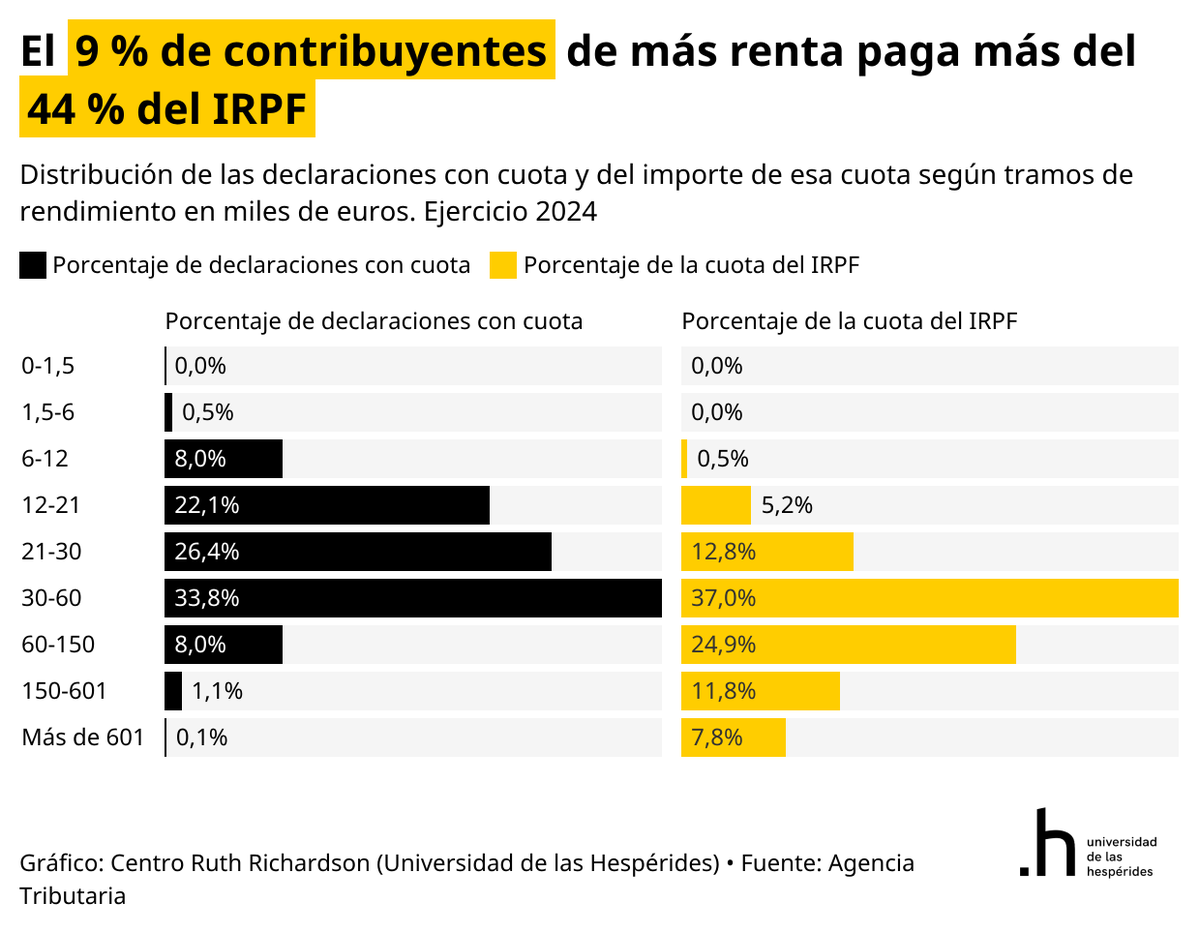
Casi la mitad del IRPF la pagan quienes ganan más de 60.000 euros, apenas un 9 % de los declarantes. Y un tercio del impuesto sale de un único tramo, el de 30.000 a 60.000 euros.
Introducing Claude Science, a new app designed with every stage of research in mind.
Artifacts traced to their code, environments managed on demand, and 60+ optional scientific databases that you can connect.
Available now in beta.
Y luego está esto:
Jaume Menéndez, de Fedea, señala que la carga fiscal supone hasta el 62% del precio final de una vivienda.
Esto evidentemente NO puede ser.
Hay que bajar la carga fiscal sobre la vivienda.
Jack Dorsey put 1.3 million dollars into it.
Vitalik Buterin gave it 128 ETH.
You have never heard of it.
It is called SimpleX. It is a messenger. It does not need a phone number. It does not need an email. It does not need a username. It does not need a user ID.
Not a hidden ID. Not a hashed ID. None at all.
Signal needs your phone number. WhatsApp needs your phone number. Telegram needs your phone number. Every messenger you have ever called "private" knows the one thing your bank, your stalker, and your country use to identify you.
SimpleX knows nothing.
It was built by Evgeny Poberezkin, a London-based engineer. Before this he wrote Ajv, the JavaScript validator that runs in 300 million downloads every month. He could have built anything.
He built the messenger with no users on the server.
Here is the trick.
Every other messenger gives you an identity. SimpleX gives you a connection. Each chat is its own one-way pipe. The server never sees who you are talking to. It does not even know you exist as a user.
11,327 stars. AGPL-3.0. Version 7.0 beta released two days ago.
iOS. Android. macOS. Windows. Linux. Free.
A 4-person team in London is the last line of defense between your conversations and every government, every advertiser, and every database breach.
The most private messenger ever built is the one you have never heard of.
(Link in the comments)