𝗖𝗼𝗿𝗲 𝗧𝗵𝗲𝗺𝗲 (𝗚𝗦-𝗜𝗜𝗜 𝗘𝗰𝗼𝗻𝗼𝗺𝘆 & 𝗘𝗻𝘃𝗶𝗿𝗼𝗻𝗺𝗲𝗻𝘁 / 𝗚𝗦-𝗜𝗩 𝗘𝘁𝗵𝗶𝗰𝘀)
Critiquing "disaster capitalism" and flawed GDP accounting where ecological destruction and post-disaster rebuilding inflate growth while depleting natural capital and deepening climate inequality ahead of COP31 in Türkiye.
𝗗𝗶𝗮𝗴𝗻𝗼𝘀𝘁𝗶𝗰𝘀
Carbon Inequality (Oxfam's Disaster Divide, Oct 27, 2026):
The richest 0.1% (~8 million people) emit more carbon than the poorest 44% (~3.5 billion people) combined, while India’s per capita CO2 emissions (~2.1 tonnes) remain far below the US (~13.4 tonnes).
Disaster-Recovery Market:
Projected to grow from $70 billion to $92 billion annually by 2029, with major asset managers (BlackRock, Vanguard) invested in 92% of the 217 firms on Oxfam's Destroy & Rebuild Index.
𝗕𝗼𝘁𝘁𝗹𝗲𝗻𝗲𝗰𝗸𝘀
Flawed GDP Accounting:
Post-disaster rebuilding boosts GDP without net wealth creation, treating natural capital depletion (e.g., melting Himalayan glaciers) as income while socialising ecological externalities.
Debt-Driven Climate Finance:
Vulnerable developing nations face recurring cycles of climate shocks and debt rather than grant-based adaptation support.
𝗪𝗮𝘆 𝗙𝗼𝗿𝘄𝗮𝗿𝗱
Green Accounting & Polluter Accountability:
Reform national metrics for natural capital depreciation, internalize corporate externalities, and ensure grant-based adaptation finance at COP31.
Sufficiency over Overconsumption:
Distinguish basic developmental needs from luxury overconsumption, anchoring policy in ecological stewardship and intergenerational equity.
𝗖𝗼𝗿𝗲 𝗧𝗵𝗲𝗺𝗲 (𝗚𝗦-𝗜𝗜 𝗣𝗼𝗹𝗶𝘁𝘆 & 𝗦𝗼𝗰𝗶𝗮𝗹 𝗝𝘂𝘀𝘁𝗶𝗰𝗲)
Re-evaluating the two-child electoral bar in Panchayati Raj Institutions (PRIs) amid below-replacement fertility, reproductive autonomy (Article 21), and grassroots gender equity.
𝗗𝗶𝗮𝗴𝗻𝗼𝘀𝘁𝗶𝗰𝘀
Judicial Relook:
On Nov 4, 2026 (Mangala Bhimrao Ingle case), the Supreme Court referred its 2003 Javed v. State of Haryana ruling to a larger bench, holding that population-control laws "have now lost their significance" under the doctrine of changed circumstances.
Demographic Shift:
India’s Total Fertility Rate fell from 3.0 (2003) to 1.9 (2024 SRS) below the 2.1 replacement level shifting concerns toward an ageing population and shrinking workforce.
𝗕𝗼𝘁𝘁𝗹𝗲𝗻𝗲𝗰𝗸𝘀
Grassroots Asymmetry:
Restricting only PRI candidates while exempting MLAs and MPs undercuts the 73rd Constitutional Amendment’s 33% women's quota.
Coercion & Agency Deficit:
Unequal marital power and son-preference deny women reproductive control, causing the norm to weaken marginalized women (2009 Ministry study) and trigger forced abortions, desertion, and paternity denial.
𝗪𝗮𝘆 𝗙𝗼𝗿𝘄𝗮𝗿𝗱
Rights-Based Jurisprudence:
Anchor the larger bench's ruling in reproductive autonomy (Article 21) and repeal punitive PRI caps across the remaining six states.
Social Policy over Coercion:
Address son-preference through maternal healthcare and behavioral reform rather than exclusionary grassroots filters.
𝗖𝗼𝗿𝗲 𝗧𝗵��𝗺𝗲 (𝗚𝗦-𝗜𝗜 𝗦𝗼𝗰𝗶𝗮𝗹 𝗝𝘂𝘀𝘁𝗶𝗰𝗲)
Scaling Eklavya Model Residential Schools (EMRS) to build tribal human capital for Viksit Bharat 2047, spotlighted on Janjatiya Gaurav Diwas.
𝗗𝗶𝗮𝗴𝗻𝗼𝘀𝘁𝗶𝗰𝘀
Reach & Equity:
Targeting every block with >50% ST population and ≥20,000 tribals (440 new schools). Enrolment stands at 1,72,953 students (with 50% seats reserved for girls, who outnumber boys).
Funding:
Capital outlays of ₹37.8–48 crore per school and ₹1,47,356/student annual recurring expenditure (since FY2026–27).
𝗕𝗼𝘁𝘁𝗹𝗲𝗻𝗲𝗰𝗸𝘀
Foundational Deficits:
First-generation learners struggle with baseline competencies and language barriers when shifting to formal English instruction.
Implementation Lag:
Legacy EMRS phases suffered from uneven remote infrastructure and management gaps.
𝗪𝗮𝘆 𝗙𝗼𝗿𝘄𝗮𝗿𝗱
Dual Governance:
NESTS sets centralized national standards while District Collector-led committees oversee local execution.
Pedagogical Support:
Institutionalize 65-day bridge courses for Class VI entrants and bilingual instruction in early grades before transitioning to English under EMRS 2.0/3.0.
𝗖𝗼𝗿𝗲 𝗧𝗵𝗲𝗺𝗲
Transitioning from piecemeal EV incentives to a coordinated National Transport Policy and National Clean Mobility Mission linking public procurement, grid readiness, and lifecycle emissions.
𝗗𝗶𝗮𝗴𝗻𝗼𝘀𝘁𝗶𝗰𝘀
Demand-Side Leverage:
Under the November 10, 2026 Department of Expenditure Office Memorandum, EVs are the default choice for central government staff cars with a ₹20 lakh Net Dealer Price ceiling (vs. ₹10 lakh for ICE vehicles).
Siloed Adoption:
EV uptake remains skewed toward 2–3 wheelers, while ministries pursue unaligned electrification and charging timelines.
𝗕𝗼𝘁𝘁𝗹𝗲𝗻𝗲𝗰𝗸𝘀
Grid-Charger Disconnect:
Procuring fleet EVs without matching charging infrastructure and distribution capacity undermines financial viability.
TCO Blind Spots:
Focusing solely on upfront price ceilings ignores Total Cost of Ownership (utilization, tariffs, maintenance, residual value).
𝗪𝗮𝘆 𝗙𝗼𝗿𝘄𝗮𝗿𝗱
Triphasic Roadmap:
Build charging/grid readiness via government fleets (2026–29), scale e-buses/commercial freight via risk-sharing (2029–35), and pivot to lifecycle "green mobility" (2035–47).
National Clean Mobility Mission:
Create an apex body to align ministries, states, and industry, backed by annual monitoring and periodic reviews in 2029 and 2035.
𝗖𝗼𝗿𝗲 𝗧𝗵𝗲𝗺𝗲
Combating India's Non-Communicable Disease (NCD) surge a threat to Viksit Bharat 2047's demographic dividend by shifting from curative care to preventive health, nutritional literacy, and lifestyle governance (World Diabetes Day 2026: "Early Action on Diabetes").
𝗗𝗶𝗮𝗴𝗻𝗼𝘀𝘁𝗶𝗰𝘀
Epidemiological Burden:
101 million Indians have diabetes and 136 million have prediabetes (ICMR-INDIAB), affecting 1 in 3 urban adults, while 12-year-olds now develop fatty liver conditions once seen at 60.
Dietary Regression:
Fibre-rich millets (ragi, bajra) and whole grains have been replaced by polished white rice, maida, refined sugar, and ultra-processed foods.
𝗕𝗼𝘁𝘁𝗹𝗲𝗻𝗲𝗰𝗸𝘀
Obesogenic Environment & Marketing:
High salt/sugar/oil intake and sedentary routines combine with unchecked junk-food advertising targeting children.
Reactive Healthcare:
Public health remains overly focused on late-stage disease management rather than early detection and behavioral prevention.
𝗪𝗮𝘆 𝗙𝗼𝗿𝘄𝗮𝗿𝗱
Universal Screening:
Mandate universal screening for all Indians over 30 and every child with obesity via Ayushman Arogya Mandirs and NP-NCD.
Regulatory & Behavioral Nudges:
Ban junk-food ads aimed at children, embed nutrition education in schools, and promote millets (Shree Anna), meal-sequencing, and post-meal walking.
𝗖𝗼𝗿𝗲 𝗧𝗵𝗲𝗺𝗲
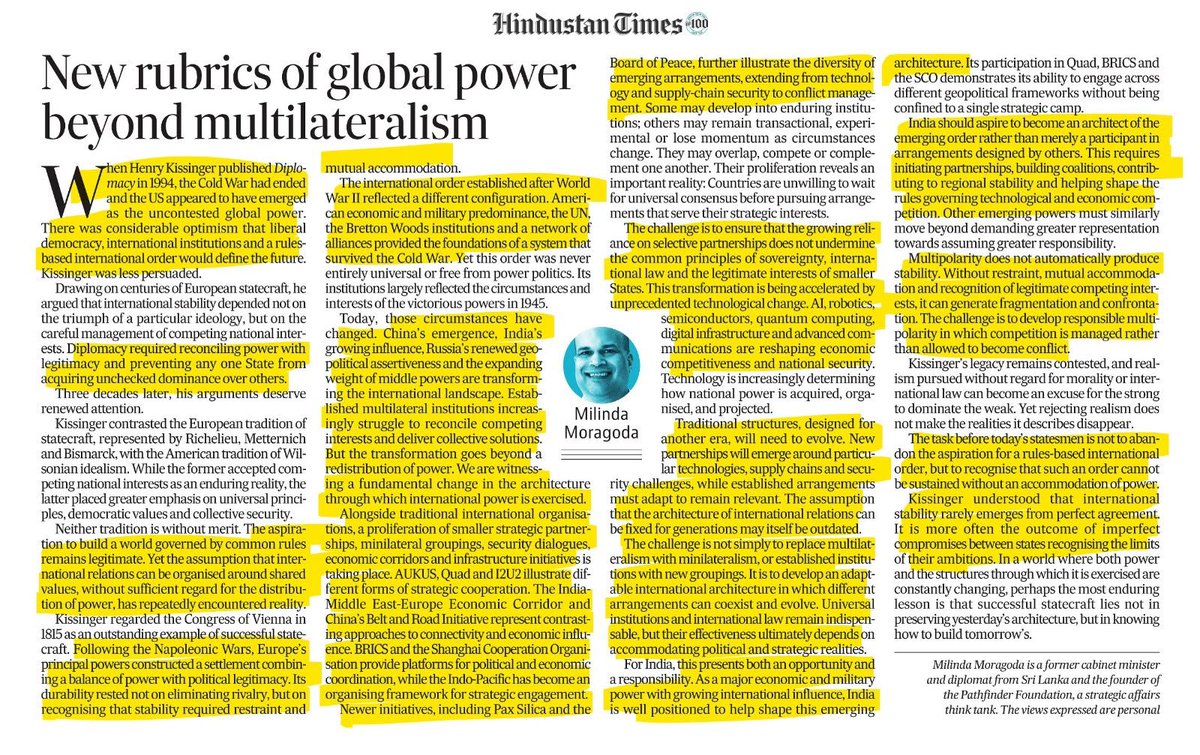
Transitioning from rigid post-1945 multilateralism toward agile minilateralism and "responsible multipolarity," requiring India to evolve from a rule-taker into a rule-shaping global architect.
𝗗𝗶𝗮𝗴𝗻𝗼𝘀𝘁𝗶𝗰𝘀
Institutional Shift:
As legacy bodies (UN, Bretton Woods) struggle with consensus, power is shifting to issue-based coalitions across security (AUKUS, Quad, I2U2), corridors (IMEC vs. BRI), Eurasian forums (BRICS, SCO), and newer tech/conflict arrangements (Pax Silica, Board of Peace).
Tech & Realpolitik:
Frontier technologies (AI, semiconductors, quantum) define national power, while stability demands Kissingerian balance-of-power realism (reconciling power with legitimacy) over pure idealism.
𝗕𝗼𝘁𝘁𝗹𝗲𝗻𝗲𝗰𝗸𝘀
Sovereignty & Fragmentation Risks:
Exclusive partnerships risk marginalizing smaller states and international law, while unrestrained multipolarity can trigger bloc confrontation rather than managed competition.
𝗪𝗮𝘆 𝗙𝗼𝗿𝘄𝗮𝗿𝗱
Rule-Shaping Multi-Alignment:
Leverage dual presence across Quad, BRICS, and SCO to move beyond seeking representation toward initiating partnerships and setting tech/economic norms.
Hybrid Architecture:
Combine universal institutions (for legal legitimacy) with adaptable, issue-specific coalitions grounded in mutual restraint.
𝗖𝗼𝗿𝗲 𝗧𝗵𝗲𝗺𝗲
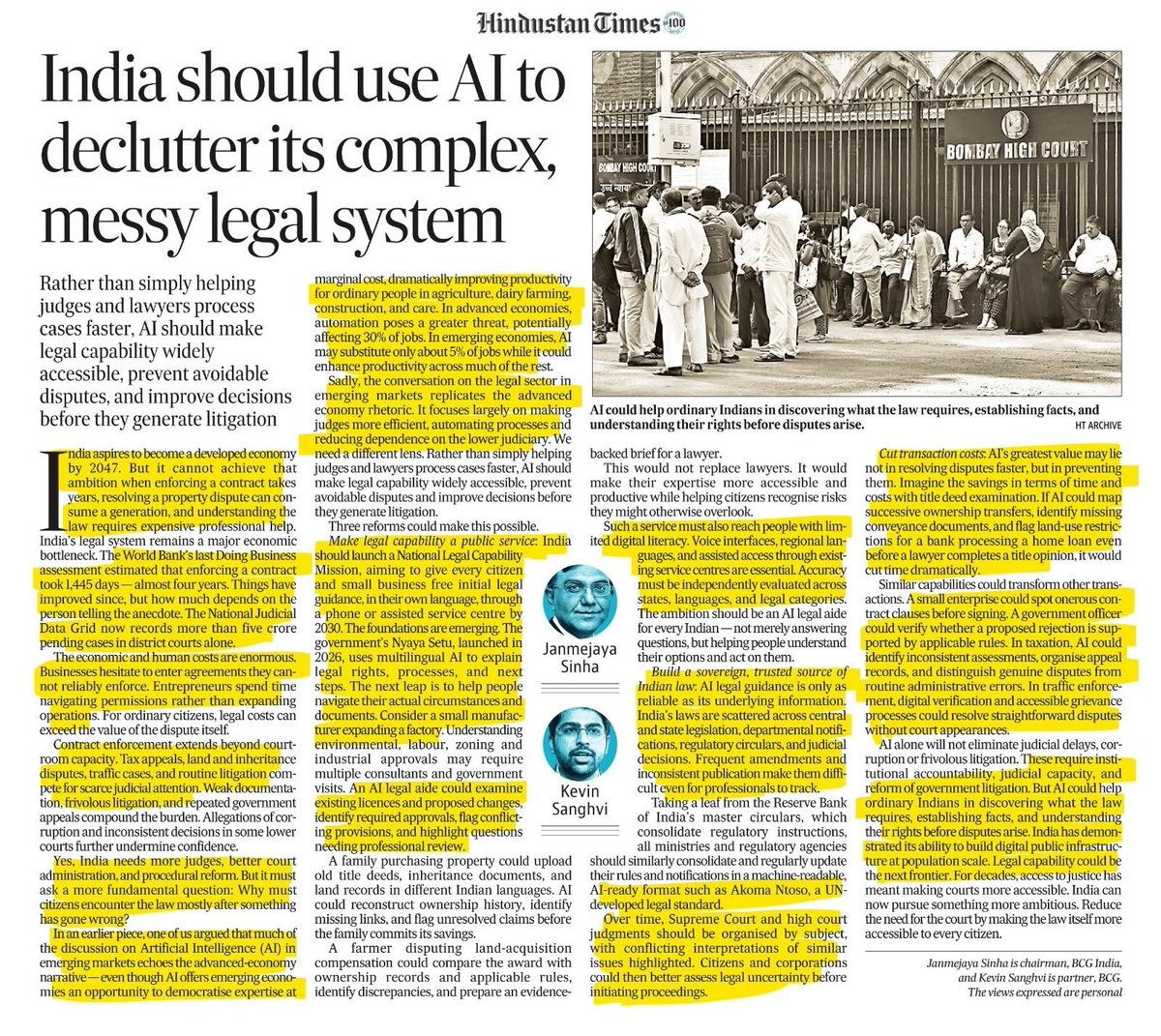
Deploying AI to prevent litigation and democratize legal capability for citizens before disputes reach court, rather than merely helping judges clear pending backlogs.
𝗗𝗶𝗮𝗴𝗻𝗼𝘀𝘁𝗶𝗰𝘀
Pendency & Delay:
Enforcing a contract takes 1,445 days (World Bank), while district court pendency exceeds 5 crore cases (5.23 crore on NJDG).
Capability Deficit:
Unlike advanced economies where AI displaces cognitive workers, emerging economies can use AI as a force multiplier to make legal rights accessible to ordinary citizens and small businesses.
𝗕𝗼𝘁𝘁𝗹𝗲𝗻𝗲𝗰𝗸𝘀
Fragmented Rules:
Laws are scattered across central/state statutes, circulars, and judgments, creating high compliance friction and transaction costs (e.g., property titles, zoning, tax appeals).
Symptomatic Focus:
Legal-tech reforms focus too narrowly on courtroom efficiency instead of upstream dispute prevention.
𝗪𝗮𝘆 𝗙𝗼𝗿𝘄𝗮𝗿𝗱
National Legal Capability Mission:
Provide free, multilingual AI legal guidance by 2030, scaling initiatives like Nyaya Setu (launched April 2026) alongside AI tools for title-deed checks and compliance verification.
Machine-Readable Law:
Mandate RBI-style consolidated master circulars in AI-ready standards (Akoma Ntoso) and subject-wise indexed judgments to reduce legal uncertainty.
𝗖𝗼𝗿𝗲 𝗧𝗵𝗲𝗺𝗲
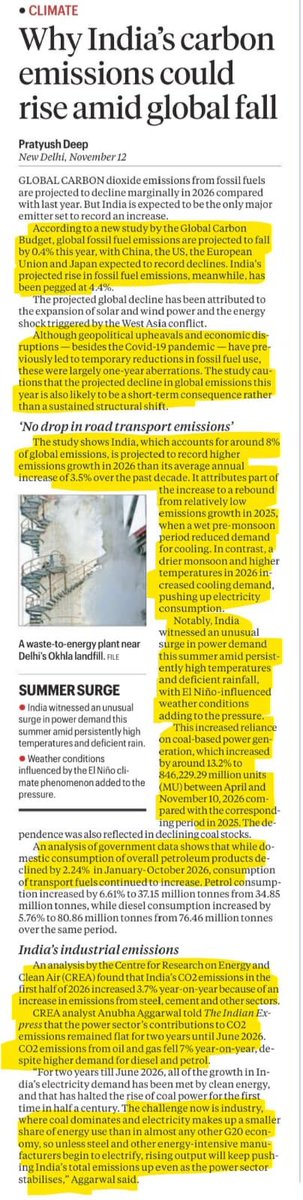
India's fossil fuel emissions are projected to rise 4.4% in 2026 (bucking a marginal global decline of 0.4%), driven by heavy industry output, transport growth, and extreme weather.
𝗞𝗲𝘆 𝗗𝗶𝗮𝗴𝗻𝗼𝘀𝘁𝗶𝗰𝘀
Global Divergence:
While major economies and global emissions drop, India (~8% of global share) stands out as the only major emitter seeing accelerated growth.
Weather-Induced Power Surge:
An El Niño-driven hot summer spiked space-cooling demand, pushing coal-based generation up by 13.2% (April–Nov 10, 2026).
Transport & Industrial Growth:
Petrol and diesel consumption climbed by 6.61% and 5.76% respectively (Jan–Oct 2026), while H1 2026 emissions rose 3.7% YoY due to surging steel, cement, and manufacturing output.
𝗕𝗼𝘁𝘁𝗹𝗲𝗻𝗲𝗰𝗸𝘀
Low Industrial Electrification:
Indian manufacturing relies heavily on direct coal combustion rather than electricity compared to G20 peers, causing industrial growth to directly inflate emissions.
Cooling Vulnerability:
Climate extremes trigger immediate reliance on thermal coal fallback due to lagging storage capacity.
𝗪𝗮𝘆 𝗙𝗼𝗿𝘄𝗮𝗿𝗱
Industrial Decarbonization:
Prioritize direct electrification of heavy industries (steel, cement) and scale green hydrogen and CCUS.
Grid Storage & Freight:
Rapidly expand utility-scale battery/pumped-hydro storage for peak summer loads and accelerate freight electrification and rail modal shifts.
𝗖𝗼𝗿𝗲 𝗧𝗵𝗲𝗺𝗲
Securing domestic critical mineral supply chains by banning "black mass" exports (DGFT Notification No. 49/2026-27) and closing the circular battery economy loop.
𝗗𝗶𝗮𝗴𝗻𝗼𝘀𝘁𝗶𝗰𝘀
Global Dominance & Contradiction:
China controls >75% of pre-treatment and 90% of material recovery capacity. India previously exported domestic black mass while local refiners faced feedstock shortages.
Policy & Capacity Gap:
The DGFT export ban (Nov 2026) aligns with the ₹1,500 crore Critical Mineral Recycling Scheme (Sept 2025) under NCMM
However, IEA warns announced Indian capacity will handle only 10% of battery waste by 2040.
��𝗕𝗼𝘁𝘁𝗹𝗲𝗻𝗲𝗰𝗸𝘀
Price Depression Risk:
Export bans can depress domestic scrap prices and weaken collection incentives unless local refiners prove large-scale lithium recovery.
Collection Deficit:
Extracting dead batteries from household drawers into formal licensed plants remains the hardest logistical hurdle.
𝗪𝗮𝘆 𝗙𝗼𝗿𝘄𝗮𝗿𝗱
Refining Scale & Customs Vigilance:
Prove commercial-scale domestic mineral extraction and prevent tariff misclassification at ports.
Reverse Logistics:
Institutionalize formal e-waste collection channels and rapidly scale recycling infrastructure ahead of the 2040 surge.
𝗖𝗼𝗿𝗲 𝗧𝗵𝗲𝗺𝗲
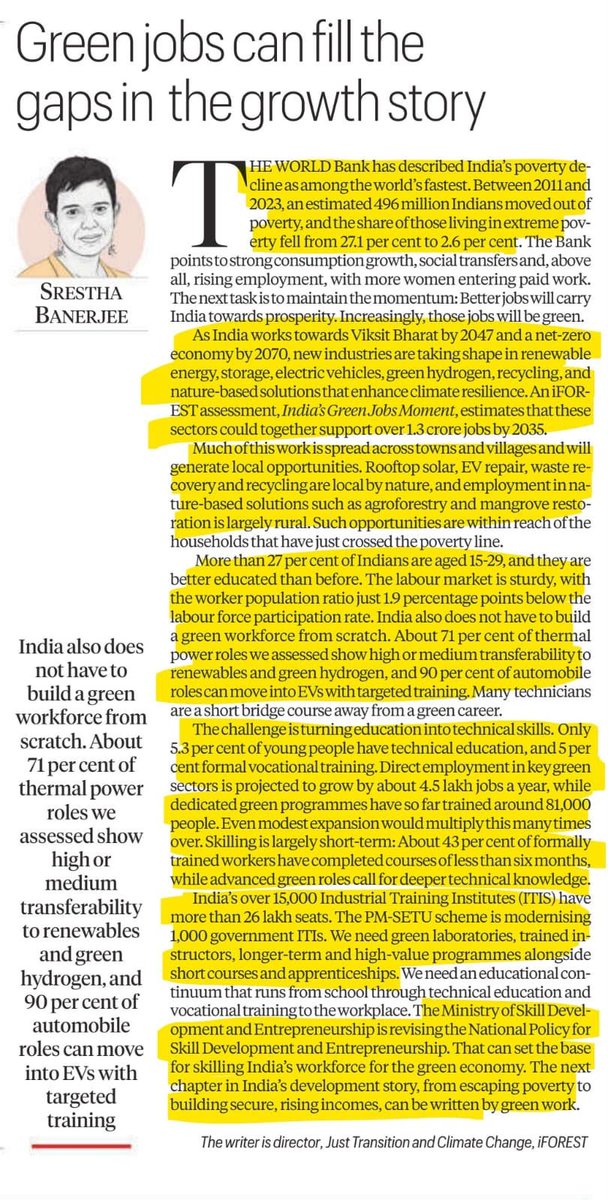
Leveraging the Net-Zero transition to generate >1.3 crore decentralized green jobs by 2035 (iFOREST) and sustain post-poverty income growth through targeted vocational skilling.
𝗗𝗶𝗮𝗴𝗻𝗼𝘀𝘁𝗶𝗰𝘀
High Skill Transferability:
71% of thermal power roles and 90% of automobile roles can transition to renewables/EVs via short bridge courses.
Decentralized Reach:
Rooftop solar, EV repair, recycling, and agroforestry create localized rural and semi-urban jobs for neo-middle-class households.
𝗕𝗼𝘁𝘁𝗹𝗲𝗻𝗲𝗰𝗸𝘀
Skilling & Training Deficit:
Only 5.3% of youth have technical education and 5% hold formal vocational training; green programs have trained just ~81,000 workers against an annual demand of 4.5 lakh jobs.
Short-Course Bias:
43% of trained workers complete courses under 6 months, whereas advanced green roles require deeper technical competencies.
𝗪𝗮𝘆 𝗙𝗼𝗿𝘄𝗮𝗿𝗱
ITI Modernization:
Upgrade India’s >15,000 ITIs via the ₹60,000-crore PM-SETU scheme(200 Hub & 800 Spoke ITIs) to integrate green labs, industry-led governance, and long-term apprenticeships.
Policy Integration:
Embed a dedicated green skilling pipeline within MSDE’s revised National Policy for Skill Development and Entrepreneurship.
𝗖𝗼𝗿𝗲 𝗧𝗵𝗲𝗺𝗲
Converting End-of-Life (EoL) EV batteries into a domestic critical mineral buffer (Li, Ni, Co) to counter supply chain weaponisation.
𝗗𝗶𝗮𝗴𝗻𝗼𝘀𝘁𝗶𝗰𝘀
Demand Offset:
8.7M EVs (FY25–26) create spent-battery feedstock capable of meeting 10–12% of India's EV lithium demand.
Efficiency Gap:
Formal plants recover >90% of minerals vs. 10–20% in informal scrap channels.
𝗕𝗼𝘁𝘁𝗹𝗲𝗻𝗲𝗰𝗸𝘀
Feedstock & "Black Mass" Trap:
Informal leakage and black-mass exports starve local refiners (November 2026 DGFT export ban directly targets this); formal plants often stop short of full-purity mineral extraction.
Capex & Standards:
Low current EoL volumes cause plant under-utilization, compounded by diverse battery chemistries and missing second-life/recycling standards.
𝗪𝗮𝘆 𝗙𝗼𝗿𝘄𝗮𝗿𝗱
Demand & Capex Anchors:
Mandate recycled mineral quotas in the National Critical Mineral Stockpile, scale the ₹1,500-crore NCMM recycling incentive scheme, and provide patient capital.
Ecosystem Standards:
Enforce eco-design norms, high-purity recovery R&D, and paid OEM dealer buy-back schemes.
𝗖𝗼𝗿𝗲 𝗧𝗵𝗲𝗺𝗲
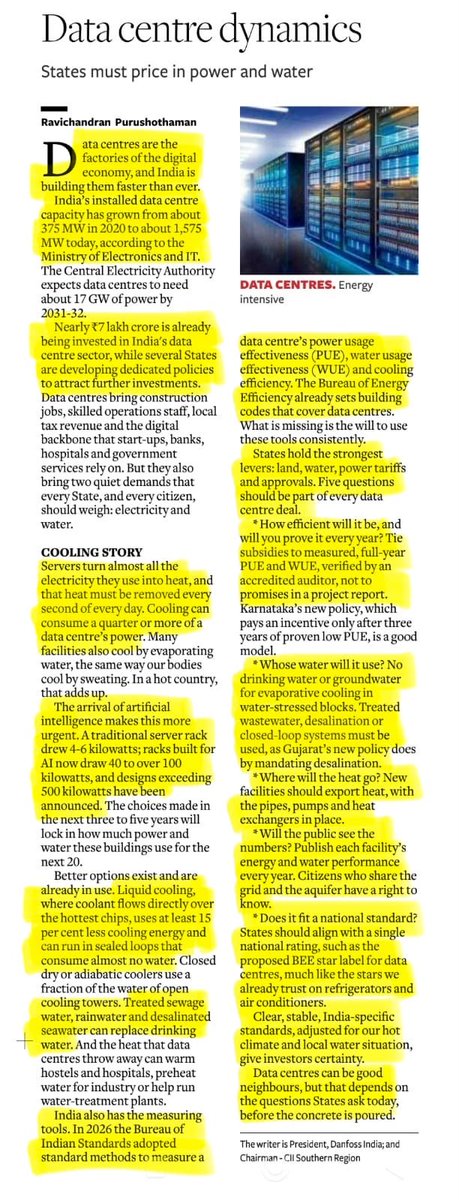
Enforcing power, water, and heat-recovery standards in state data centre policies to prevent local grid and aquifer stress during rapid AI expansion.
𝗞𝗲𝘆 𝗗𝗶𝗮𝗴𝗻𝗼𝘀𝘁𝗶𝗰𝘀
Power & Capacity Surge:
Installed capacity jumped from 375 MW (2020) to ~1,575 MW (2026) with ₹7 lakh crore in investments. CEA projects demand hitting ~17 GW by 2031–32.
AI Rack Density:
AI racks draw 40 to >100 kW(vs. 4–6 kW for traditional racks), with cooling consuming ≥25% of total facility electricity.
𝗞𝗲𝘆 𝗕𝗼𝘁𝘁𝗹𝗲𝗻𝗲𝗰𝗸𝘀
20-Year Resource Lock-in:
Cooling and infrastructure choices made in the next 3–5 years will lock in regional power and water consumption for two decades.
Freshwater Stress:
Evaporative cooling towers deplete potable water and groundwater in water-stressed blocks, while existing BIS (PUE/WUE) and BEE codes lack strict state-level enforcement.
𝗪𝗮𝘆 𝗙𝗼𝗿𝘄𝗮𝗿𝗱
Performance-Linked Subsidies:
Tie incentives to audited annual PUE/WUE performance rather than project estimates (e.g., Karnataka’s 3-year proven low-PUE payout model).
Zero-Freshwater Mandates:
Ban groundwater/potable water for cooling in water-stressed areas; mandate closed-loop liquid cooling, treated wastewater, or desalination (Gujarat’s policy).
Circular Heat & Standards:
Mandate waste-heat export infrastructure, annual public disclosure of water/power metrics, and a national BEE star-rating label.
Beyond the endless lectures, late-night doubt sessions, and the constant chase toward our goals, this place has quietly become our second home. 🪔✨
Celebrating Diwali together reminded us that no matter how tough the journey gets, having the right people around makes every challenge worth it.
Here’s a glimpse of the warmth, laughter, and light we shared.
P.S. So grateful to be walking this path with all of you.
Lots of love,
Sleepy Classes Team 💫❤️
#HappyDiwali #DiwaliVibes #FestivalOfLights #DiwaliFun #DiwaliCelebration #UPSCPreparation #ias #Prelims #SleepyClasses
𝗖𝗼𝗿𝗲 𝗧𝗵𝗲𝗺𝗲
Aligning AI policy with the "democratic bargain" to safeguard entry-level jobs, social mobility, and youth employment.
𝗞𝗲𝘆 𝗗𝗶𝗮𝗴𝗻𝗼𝘀𝘁𝗶𝗰𝘀
Middle-Class Risk:
Automation of entry-level cognitive and IT services jobs threatens the consuming middle class.
Demographic Contradiction:
Unlike aging economies leveraging AI for labor shortages, India needs tech to create jobs for its massive youth population.
Broken Skill Pipeline:
AI replacing routine tasks removes the traditional training ground for junior professionals.
𝗞𝗲𝘆 𝗕𝗼𝘁𝘁𝗹𝗲𝗻𝗲𝗰𝗸𝘀
Hidden Impact:
Disruption appears as underemployment and lower-quality work rather than visible mass layoffs.
Fiscal Constraints:
Lack of redistributive buffers like UBI or state equity in AI firms leaves workers without a safety net.
𝗪𝗮𝘆 𝗙𝗼𝗿𝘄𝗮𝗿𝗱
National AI & Work Observatory:
Establish a tracking body for entry-level hiring, wage trends, and career progression.
Apprenticeships & Human Oversight:
Mandate supervised AI-assisted work placements and human review for automated workplace decisions.
Parliamentary Oversight:
Form a dedicated committee to give workers, youth, and states a say in AI deployment terms.
𝗖𝗼𝗿𝗲 𝗧𝗵𝗲𝗺𝗲
Capping the Net-Zero transition to build domestic technology ownership (IPR, design, know-why) instead of relying on imported equipment assembly.
𝗞𝗲𝘆 𝗗𝗶𝗮𝗴𝗻𝗼𝘀𝘁𝗶𝗰𝘀
True Atmanirbharta:
Demands progressing from know-how to know-why (generating IPRs), how-in-India (design), and improve-in-India rather than basic "Make in India" assembly.
TRL Gap:
Academia operates at TRL 3–4 (lab validation), while industry demands TRL 7+ (proven tech), leaving the pilot-demonstration stage (TRL 5–6) underfunded.
𝗞𝗲𝘆 𝗕𝗼𝘁𝘁𝗹𝗲𝗻𝗲𝗰𝗸𝘀
Risk-Averse Capital:
Industry avoids risking production on untested domestic processes, leaving early-stage innovations without takers.
Siloed Ecosystem:
Disconnect between academic research, equipment makers, plant operators, and public policy.
𝗪𝗮𝘆 𝗙𝗼𝗿𝘄𝗮𝗿𝗱
State-Led Risk Sharing:
Government must shoulder early-stage financial risk (TRL 4–6) via deep-tech incubators and demonstration centers before private industry steps in.
Mission-Driven Models:
Replicate the atomic energy model combining mission-mode engineering, high risk tolerance, and joint academia-industry consortia to build homegrown industrial hardware.
🪔 Diwali Special | UPSC Prelims PYQ eBook
UPSC Prelims often revisits concepts from previous years. Make PYQ practice an essential part of your preparation!
📚 Special Diwali Price: ₹499
₹999
Revise PYQs. Identify patterns. Strengthen your preparation.
Shop Now: Add link for the PYQ book
Happy Diwali from Sleepy Classes IAS!
🪔 Happy Diwali from Sleepy Classes IAS!
With APFC 2026 around the corner, make every revision count!
This Diwali, brighten your preparation with 25% OFF on all APFC e-books.
🎁 Use Coupon Code: DEEP25
📚 Explore the Diwali Offer:
https://t.co/GdsUO7oEbZ
Wishing you a Diwali filled with light, success, and a confident step towards your goals! ✨
Happy Diwali from Sleepy Classes IAS! 🪔
APFC 2026 is getting closer, and good revision material makes all the difference now.
This Diwali, get *25% off on all our APFC e-books*.
Use code: *DEEP25*
Claim Diwali Offer:
https://t.co/GdsUO7oEbZ
Wishing you a bright Diwali and a strong prep ahead ✨
𝗖𝗼𝗿𝗲 𝗧𝗵𝗲𝗺𝗲
Transitioning air quality management from reactive emergency triggers (GRAP) to regional, airshed-based planning and geostationary satellite monitoring.
𝗞𝗲𝘆 𝗗𝗶𝗮𝗴𝗻𝗼𝘀𝘁𝗶𝗰𝘀
GRAP Limitations:
GRAP functions as short-term emergency care for acute spikes rather than a cure for chronic emission sources.
Monitoring Blind Spot:
Polar-orbiting MODIS satellites miss >90% of stubble burning (occurring post-3 PM); continuous geostationary satellites (e.g., GEO-KOMPSAT-2A) capture accurate fire counts.
𝗞𝗲𝘆 𝗕𝗼𝘁𝘁𝗹𝗲𝗻𝗲𝗰𝗸𝘀
Boundary-Jurisdiction Mismatch:
City-centric plans address only 50–70% of pollution sources, ignoring cross-boundary airshed transport across the Indo-Gangetic Plain.
Symptomatic Dependence:
Repeated emergency bans cause recurring economic disruption without tackling root causes like crop residue or traffic congestion.
𝗪𝗮𝘆 𝗙𝗼𝗿𝘄𝗮𝗿𝗱
AIRSHEDEM Framework:
Adopt regional airshed-based master planning to cover ~100% of pollution sources beyond administrative limits.
Upgraded Surveillance & Structural Cuts:
Integrate real-time geostationary data into forecasting models and enforce sustained, year-round emission reductions.