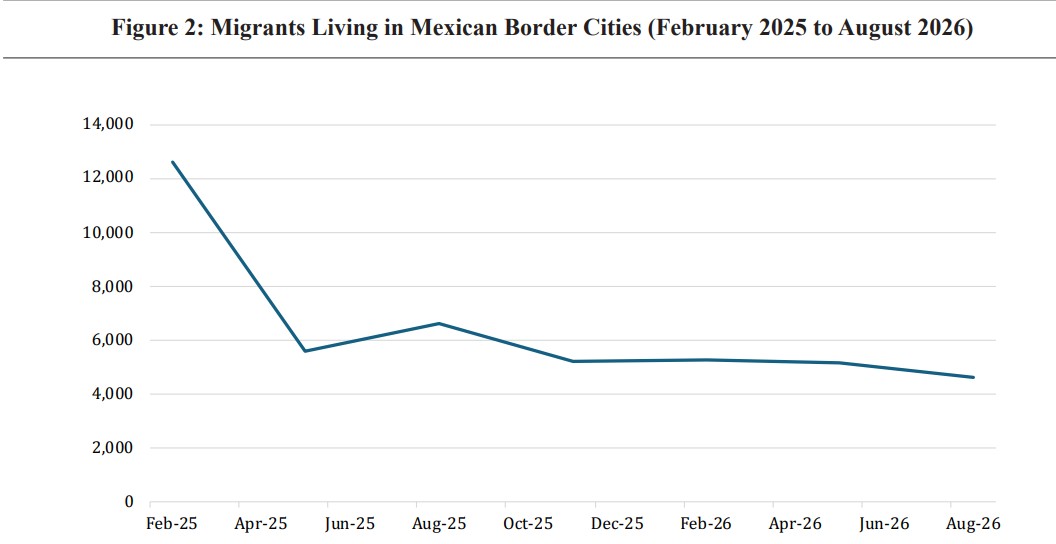
@emilioglezg@StraussCenter@yatescait It estimates the population residing in the city. So this is the shelter population plus civil society groups’ estimate of the migrant population that is now living in rented spaces.
*In some cities, the shelter population may include recent deportees and clandestine migrants.
The August 2026 @StraussCenter migration dynamics report with @yatescait is now out!
We estimate less than 5,000 migrants reside in Mexican border cities, and they are concentrated in Tijuana and Mexicali.
Read the full report here: https://t.co/HVyvWETr2M
ICYMI, the #StraussCAMPI August 2026 update on "Migration Dynamics and Conditions at the U.S.-Mexico Border" is now live.
Read CAMPI Director @Sleutert and Fellow @yatescait's findings here: https://t.co/BgA9I4e63B
ICYMI, the #StraussCAMPI May 2026 update on "Migration Dynamics and Conditions at the U.S.-Mexico Border" is now live.
Read CAMPI Director @Sleutert and Fellow @yatescait's findings here: https://t.co/bBgPsCfnoR
Here is the latest @StraussCenter report with @yatescait on migration dynamics along the US-MX border!
Over the last year, the # of migrants living in MX border cities has been steady
But since April, the # of deportees sent to these cities has dropped
https://t.co/X30641l01D
The May 2026 @StraussCenter Migration Dynamics report with @Sleutert is up.
In mid-April 2026, most land-based deportations halted.
However, several cities continue to report small numbers of Mexican & third-country national deportations
https://t.co/IsNH5inzl3
Recently, #StraussCAMPI Director @Sleutert and @TheLBJSchool students visited the Texas DPS and Texas National Guard museums, where they learned more about these entities' historical roles in border security enforcement.
U.S. deportations through Mexican border cities also continue - including both Mexican nationals and third-country individuals.
From Jan 2025 to Dec 2025, U.S. authorities sent nearly 160,200 Mexican citizens to Mexico. Along with at least 12,983 non-Mexican individuals.
The February 2026 @StraussCenter border conditions report with @yatescait is now out. We estimate that ~5,260 migrants continue to live in Mexican border cities.
Currently, there are no encampments, and most migrants live in apartments or rented rooms.
https://t.co/HRuiarEtoV
Many of these migrants are now trying to regularize their status in Mexico, navigating a slow asylum application process (often ~2 years), or facing limited legal work options.
These challenges come amid shrinking support from migrant shelters and NGOs.
In the @StraussCenter Feb 2026 Migration Dynamics & Conditions report, @Sleutert & I find:
🔒13+ months w/o access to asylum processing at U.S. border.
📈 Mexican border cities increasingly receiving third-country national removals.
🚧 New buoys/barriers in the Rio Grande Valley.
The #StraussCAMPI February 2026 update on "Migration Dynamics and Conditions at the U.S.-Mexico Border" is now live.
Read CAMPI Director @Sleutert and Fellow @yatescait's findings here: https://t.co/E58RILuuk6
ICYMI, #StraussCAMPI Director @SLeutert and her fellow researchers' article on "Rescue Beacons and Migrant Deaths in Southern Arizona" was recently published in the Center for Migration Studies' International Migration Review journal.
Read here: https://t.co/fsMC2Nb5Ai
The #StraussCAMPI November 2025 report on migration dynamics and conditions at the US-Mexico border, from program director @SLeutert and fellow @YatesCait, is available now.
Learn more with this essential update: https://t.co/CyCmGwX3Or
Out now: #StraussCAMPI Director @SLeutert and Fellow @yatescait's August 2025 report detailing current U.S. asylum restrictions in ports of entry and migrant experiences in Mexican border cities.
Read their findings here: https://t.co/clwUk0Fe5g
These migrants are less visible than in the past. Many have moved out of shelters and into rented rooms and apartments, and there are no longer any tent encampments along the border.
Non-Mexican migrants are often seeking to obtain some type of legal status in Mexico.
The new August 2025 @StraussCenter border update with @yatescait is out!
In recent months, the number of migrants waiting at the U.S.-Mexico border has dropped dramatically. We estimate that only ~6,600 asylum seeking migrants remain in MX border cities.
https://t.co/wCNjC86RgL
These individuals are concentrated in Tijuana, Mexicali, and Ciudad Juárez, with these three cities hosting roughly 80 percent of the border’s estimated migrant population.
The August 2025 @StraussCenter Asylum Processing report with @Sleutert is out.
Asylum processing remains closed. Seven years into these quarterly reports, we estimate that roughly 6,600 migrants remain in Mexican border cities, the lowest # since 2019.
https://t.co/S1KP1ZkiR7
My @StraussCenter@TheLBJSchool students wrote four reports about migration along the US-Mexico border. Here is the first one on California. It tracks clandestine migration routes, migrant risk and mortality, and smuggler demographics in the region.
https://t.co/NzC6duLmVE