An AI agent can crawl 38,000 of your pages and refer you one visitor.
That ratio is documented, not theoretical.
The web is being consumed at machine scale — cited, summarized, moved on from. The people who wrote it earn nothing from that consumption.
That's the problem. 🧵
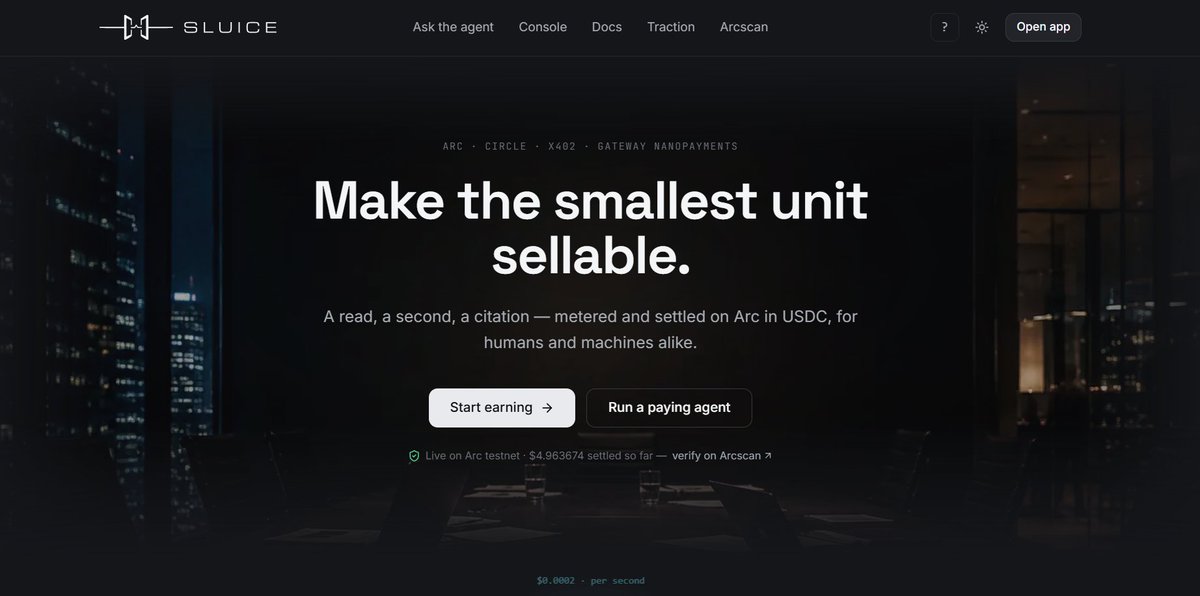
Sluice lets creators price the smallest unit of what they make, while agents decide what’s worth paying for; a citation, request, read, stream or API call, with USDC settlement on Arc.
The deadline passed, but the product kept moving.
Thank you @thecanteenapp@circle
We built Sluice around one question: what should payments look like when AI agents become customers of the web?
Today, Canteen recognized Sluice twice — Standout + Committed Builder.
A strong signal for the thesis: digital work should be measurable, payable and verifiable.
What comes next is bigger than paid citations.
Think: agents buying data, APIs, compute, audio, research and services under explicit budgets — with providers putting reputation and capital behind delivery.
That’s the economy Sluice is being built for.
@BuildOnCircle
The next web won’t just have human visitors. It will have machine customers.
That changes the primitive: from subscriptions and ads to metered access.
With Sluice, creators can price a citation, request, read or second, and agents can pay only when it’s useful.
#BuildOnCircle
New Sluice ship🌊
We sharpened the landing experience across Graphite + Marble modes, with responsive art direction for desktop, tablet & mobile while keeping the live Sluice settlement rail intact.
Still building.
Arc · USDC · x402 · @circle Gateway
https://t.co/kMmixdxFaO
Discovery is generated directly from the live Sluice registry—no scraped or seeded listings. It supports filtering by recipient, scheme, network and resource type, plus bounded pagination..
🔗 Docs: https://t.co/HqurnefVNA
Sluice keeps flowing 🌊
We shipped native x402 v2 discovery.
Agents can now enumerate 258 live paid resources—with exact price, asset, recipient, network and endpoint—from one machine-readable Bazaar feed.
Try it ↓
https://t.co/zdjNjum7sd
#BuildOnArc@BuildOnCircle
Every subscription is a small confession.
It means whatever you actually wanted was too cheap to sell on its own, so someone bundled it with eleven things you didn’t.
We think the actual unit should just be sellable.
@arc@circle#BuildonArc
An AI agent can crawl 38,000 of your pages and refer you one visitor.
That ratio is documented, not theoretical.
The web is being consumed at machine scale — cited, summarized, moved on from. The people who wrote it earn nothing from that consumption.
That's the problem. 🧵
Cycles nets obligations down and settles the residual. We accrue units and settle the batch.
Different problem, same insight: the payment you send should not have to match the payment you owe, one for one.
Good to see netting arrive on Arc.
Six weeks until @arc mainnet.
We spent the last one making sure the number you see moving is the number that settles. No estimates, no rounding, no catching up later.
Watch it tick.
#BuildonArc@thecanteenapp
502M transactions on @arc. 106% quarter on quarter.
Somewhere in that number are 422 of ours, each one a fraction of a cent paid to a creator by an agent that decided it was worth paying.
Small units. Real volume. That is the whole thesis.
#BuildonArc@thecanteenapp
Q2 results are out.
→ Arc Mainnet launches September 16.
→ Founding validators joining Circle include BlackRock, DTCC, Galaxy, Global Payments, ICE, Mastercard, MoneyGram, SBI Group, Standard Chartered, Sumitomo Corporation, and Visa.
→ We received our federal trust bank charter from the OCC to establish Circle National Trust, one of the first stablecoin issuers to hold a federal bank charter.
→ USDC captured nearly 70% of stablecoin transaction volume in June, according to Visa Onchain Analytics.
Full results: https://t.co/v1jSV7zRFs
Q2 results are out.
→ Arc Mainnet launches September 16.
→ Founding validators joining Circle include BlackRock, DTCC, Galaxy, Global Payments, ICE, Mastercard, MoneyGram, SBI Group, Standard Chartered, Sumitomo Corporation, and Visa.
→ We received our federal trust bank charter from the OCC to establish Circle National Trust, one of the first stablecoin issuers to hold a federal bank charter.
→ USDC captured nearly 70% of stablecoin transaction volume in June, according to Visa Onchain Analytics.
Full results: https://t.co/v1jSV7zRFs
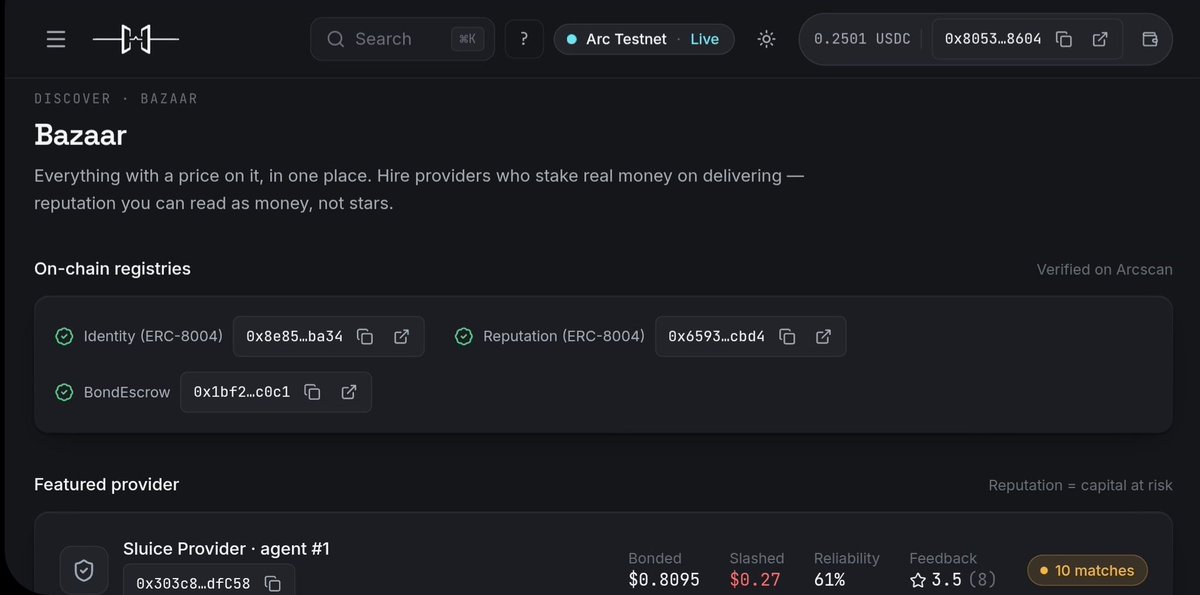
Our featured provider shows 61% reliability and $0.27 slashed — right at the top of the page.
A reputation system where nobody ever loses is decoration. Bonds slash on @arc when providers underdeliver, and that’s the whole point.
https://t.co/gZrVArxkXQ
#BuildonArc@circle
Look closely at the featured provider on the Sluice Bazaar: 61% reliability. $0.27 slashed.
We could have hidden that. Most marketplaces would. Instead it sits at the top of the page, because a reputation system where nobody ever loses is a decoration, not a signal.
Here’s how it works. Providers post a real USDC bond before taking a job. Deliver on spec and it releases back to them. Underdeliver and it slashes automatically, on Arc, recorded on an ERC-8004 registry anyone can read.
That number went down because a provider failed to deliver and the system did exactly what it promised. The mechanism works precisely because it hurts.
Compare that to five-star ratings, which can be farmed, bought, or reset by making a new account. Bonds can’t be gamed the same way; faking a good reputation means repeatedly staking real capital and repeatedly delivering. At that point you’re not gaming the system, you’re just doing the job.
258 priced resources are listed. Every one of them is payable per unit, per request, per citation, per second. Every provider behind them has something to lose.
Reputation you can read as money, not stars.
#BuildonArc
Good to see the nanopayments lane filling out.
AIsa is working the API side of this. We have been working the content and citation side. Both need the same thing from Arc: sub second settlement and a gas token you can actually budget against.
Worth the replay.👌🏼
Real time is the part that changes what you can build.
When settlement takes seconds, an agent has to batch and reconcile. When it takes under a second and costs a fraction of a cent, the agent can just pay per unit as it goes.
#BuildOnArc
AI agents need infrastructure that can move at the speed and determinism of software.
Arc gives developers a more usable foundation for the agentic economy.
That makes it easier to build systems where agents can transact, coordinate, and settle value in real time.
AI agents need infrastructure that can move at the speed and determinism of software.
Arc gives developers a more usable foundation for the agentic economy.
That makes it easier to build systems where agents can transact, coordinate, and settle value in real time.
Raw model output should never be able to move money.
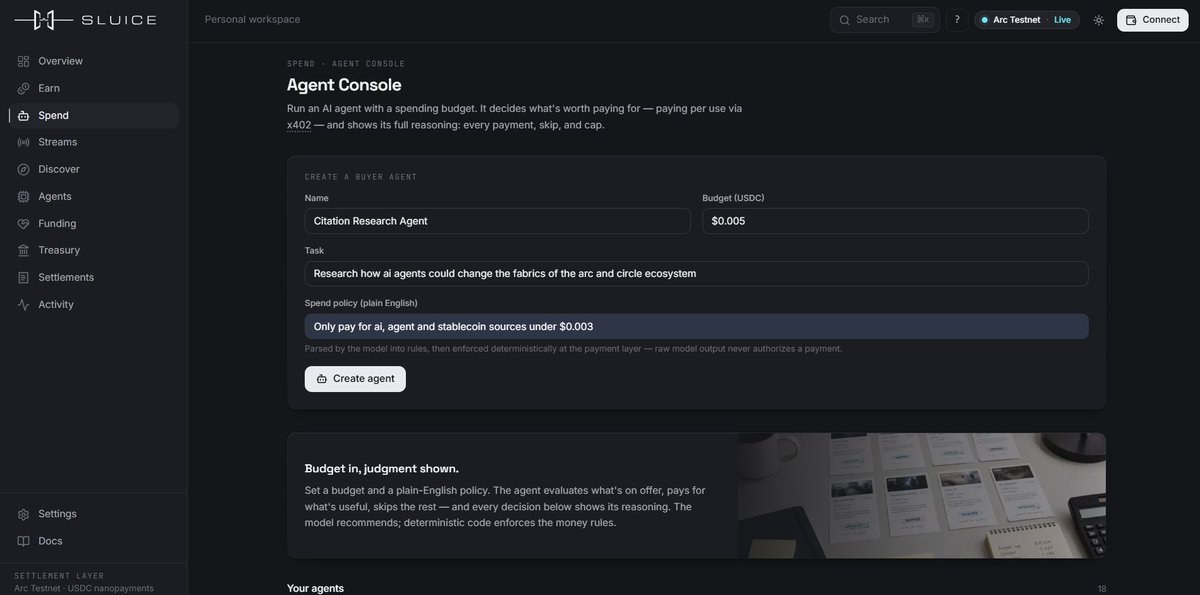
On Sluice, the model parses your policy into rules — then deterministic code enforces them at the payment layer. Paid, skipped, or capped, always with the reasoning attached.
https://t.co/BQQqzwlBHj
The scariest sentence in agentic payments is "the AI decided to pay for it."
Not because agents shouldn't spend — because most implementations let the model's output be the authorization. The LLM says pay, so the money moves. That's not autonomy, that's an unsecured endpoint with a personality.
We built @Sluiceflow's Agent Console around a hard separation:
You give the agent a budget and a plain-English policy — "only pay for AI, agent and stablecoin sources under $0.003." The model parses that into structured rules. Then deterministic code enforces those rules at the payment layer.
The model recommends. Code decides what's allowed to move.
So when the agent runs, every outcome is one of three things, and every one of them is on the record:
Paid — relevant, within policy, worth the price.
Skipped — evaluated and rejected, with the reason attached.
Capped — genuinely useful, but it would breach the budget. Passing.
That third one is where most systems quietly fail. An agent that can't say "this is good and I still can't afford it" isn't operating on a budget — it's operating on hope.
Budget in, judgment shown.
#BuildonArc @circle