India’s next big power story isn’t solar
it’s NUCLEAR ⚛️
We’re entering a multi-decade capex cycle — and almost no one is talking about it yet.
🇮🇳 100 GW target by 2047 (vs ~8 GW today)
💰 ~₹19 lakh crore investment opportunity
⚡ AI + EVs = 24x7 baseload demand
Renewables are growing fast — but they’re intermittent.
Nuclear = low carbon + reliable + scalable
And now, the real inflection 👇
* SHANTI Act 2025 → private sector entry
* Liability reforms → supplier ecosystem unlock
* SMR push + ₹20,000 Cr allocation
* Execution pipeline finally building up
This is a high-entry-barrier sector
→ 7+ year approvals
→ Limited qualified vendors
→ Deep, durable moats
Which means:
The real winners may be a handful of suppliers most investors aren’t tracking.
From EPC to critical components —
this is a full ecosystem play.
We’ve decoded it all:
Value chain. Policy shift. Key beneficiaries. Risks.
👉 Full 38-page detailed report covering value chain, players & risks:
https://t.co/xGUw7UDKsV
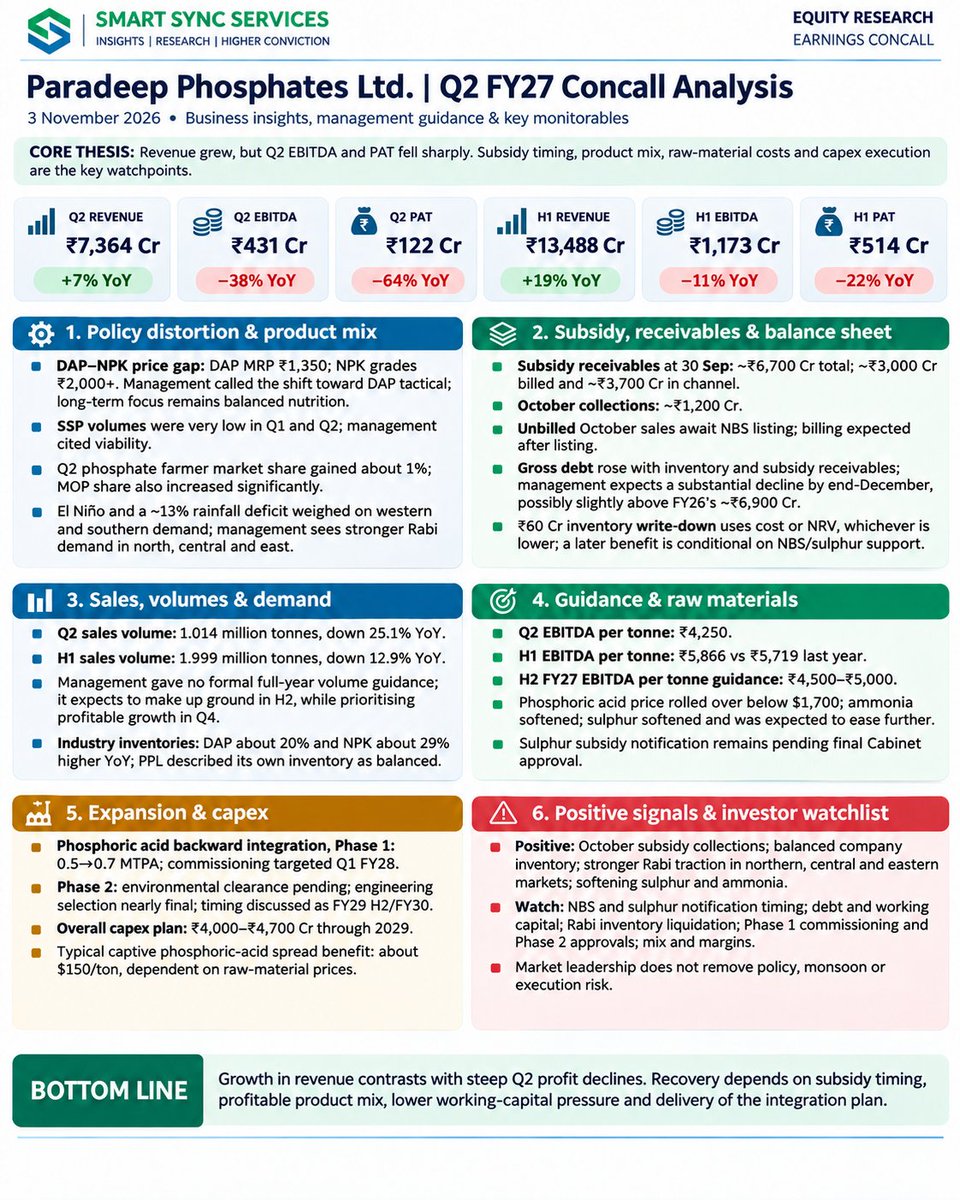
Paradeep Phosphates Ltd. | Q2 FY27 Concall Takeaways
- Revenue grew 7.2% YoY to ₹7,364 crore, but EBITDA fell 38% to ₹431 crore and PAT declined 64% to ₹122 crore. H1 revenue rose 18.6% to ₹13,488 crore, while EBITDA fell 10.7% to ₹1,173 crore and PAT declined 22% to ₹514 crore.
- Policy-driven demand shifted toward DAP, priced at ₹1,350 versus ₹2,000+ for NPK grades. Management described this as tactical, with its long-term focus remaining on balanced nutrition. H1 sales volume was about 2.0 million tons, down 12.9%; Q2 EBITDA per ton was ₹4,250, with H2 guidance of ₹4,500–₹5,000.
Key monitorables are NBS and sulphur subsidy timing, elevated subsidy receivables and borrowings, inventory liquidation through the Rabi season, product-mix and margin recovery, and execution of the phosphoric-acid integration and capacity expansion projects.
EFC Ltd. | Q2 FY27 Concall Takeaways
- Revenue grew 30% YoY to ₹332 crore, led by strong performance across leasing (+30%), Design & Build (+16%) and furniture (+149%). Occupancy remained above 90%, while the Design & Build order book exceeded ₹300 crore, providing visibility for H2 FY27.
- Management expects Design & Build revenue to grow 50–60% in FY27, with leasing occupancy maintained above 90%. The company is also expanding its furniture manufacturing and external B2B business, moving towards an integrated workspace solutions platform.
The key monitorables are Design & Build order execution, segment-level margin sustainability, working capital cycle, cash conversion and integration of the Ultrafresh acquisition.
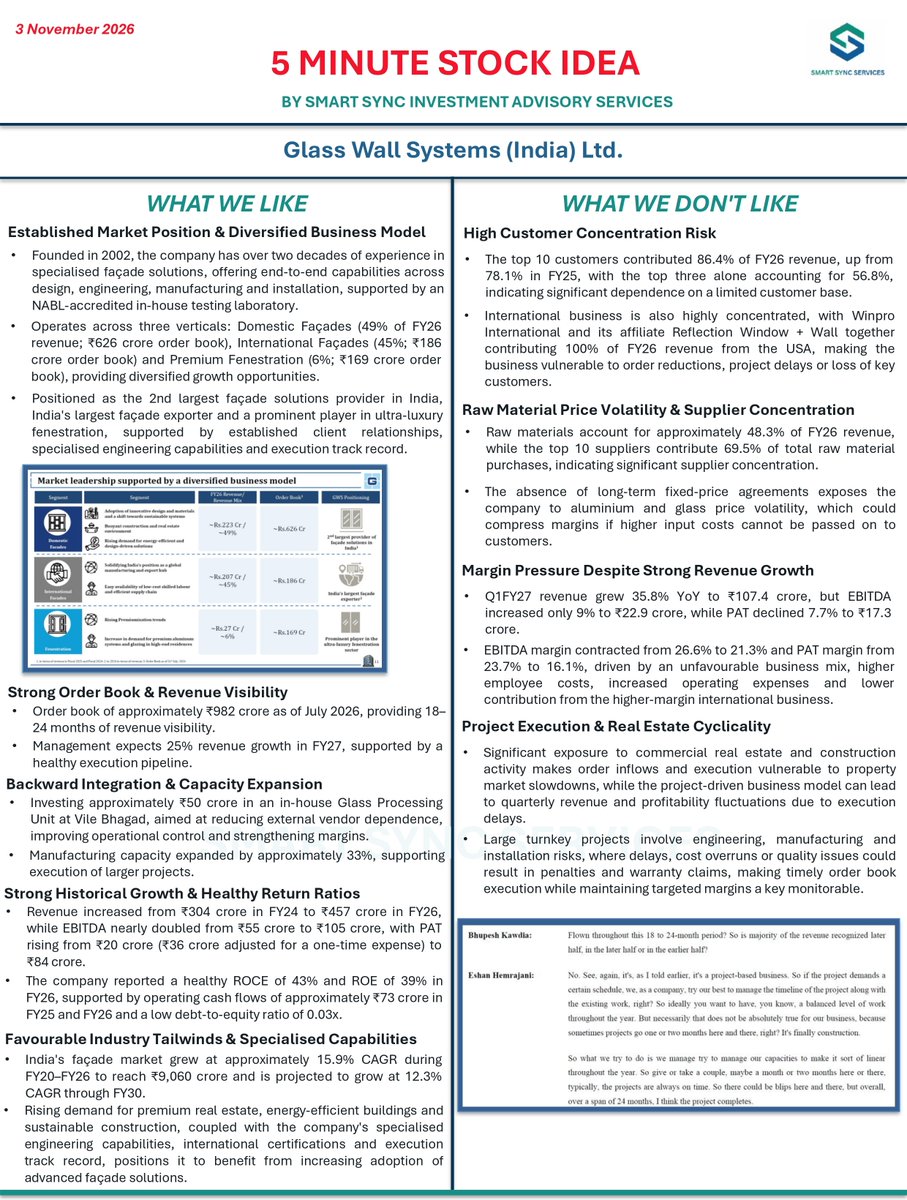
5-Min Stock Idea
Glass Wall Systems(India) Ltd
Our team puts in a lot of efforts to read ARs, ppts, concall transcripts & credit rating reports to write 1-page crisp report for our community.
If you find value, plz "Retweet" to help us reach out and educate max investors.🙏
Disclaimer: This content is intended solely for educational purposes and does not constitute a recommendation.
@apextoerchina Absolutely. Industrial refrigeration and process cooling are often overlooked compared with residential ACs. The interesting opportunity lies in companies that can deliver reliable performance, energy efficiency and long-term maintenance, rather than just selling equipment.
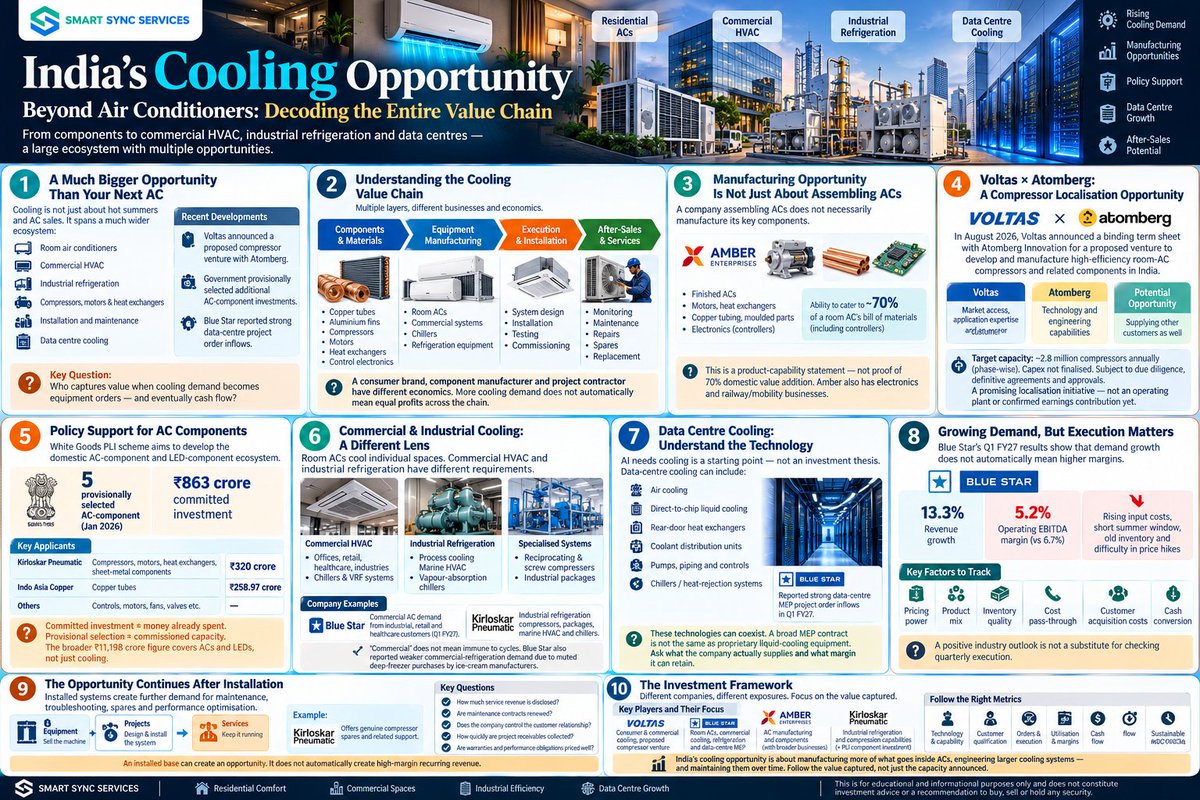
India’s Cooling Opportunity: Beyond Air Conditioners 🧵
When investors hear “cooling”, they usually think of summer demand and AC sales.
But the opportunity goes much further—from compressors and components to industrial refrigeration, commercial HVAC, data-centre cooling and after-sales services.
As India’s cooling needs expand, different businesses could benefit in different ways.
The key question: Which companies can turn rising demand into profitable growth and sustainable cash flow?
Let’s break down the value chain. 👇
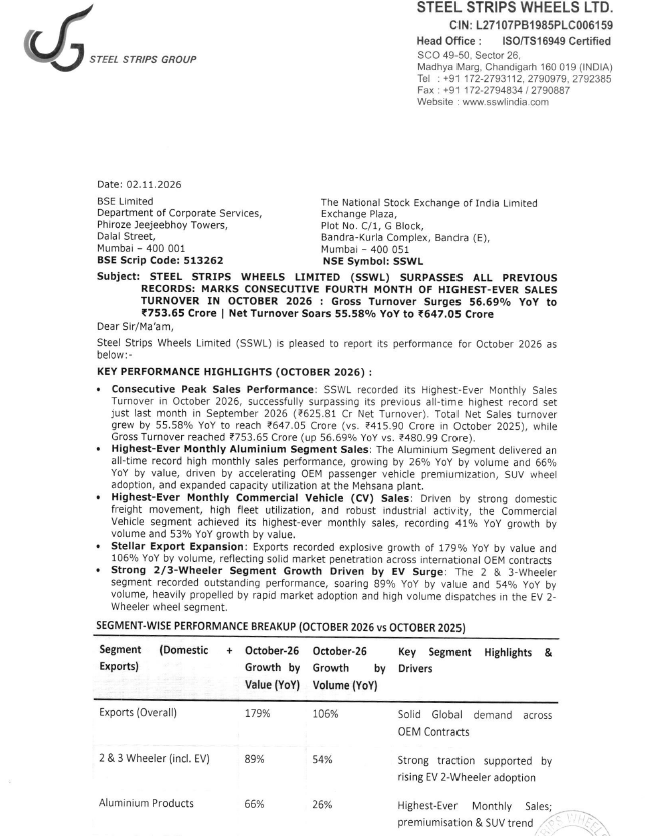
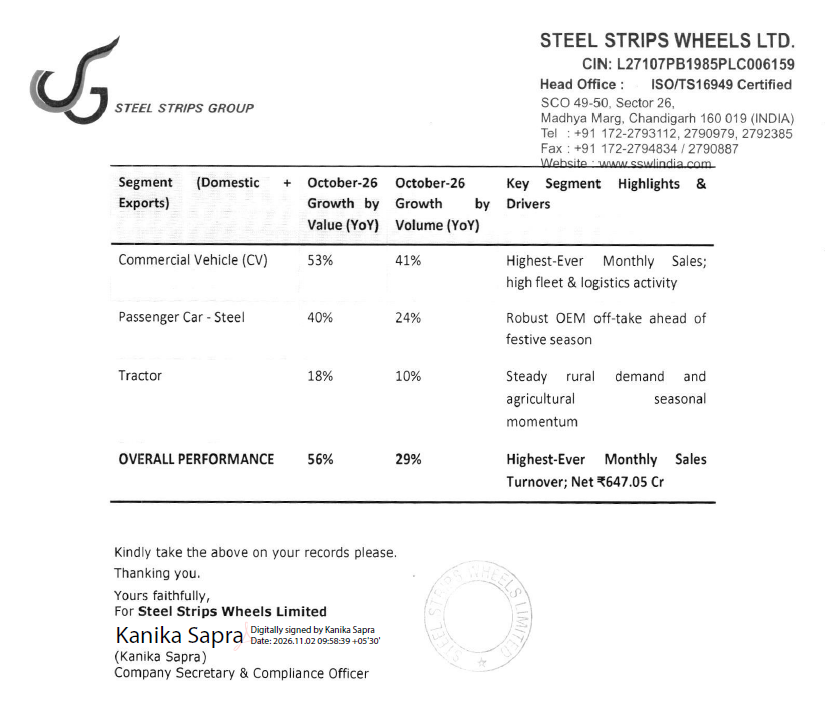
Steel Strips Wheels (SSWL) hits a fourth consecutive monthly sales record — October growth jumps 56% YoY.
Headline Growth 🚀
- Net turnover: ₹647.05 Cr (+55.58% YoY)
- Gross turnover: ₹753.65 Cr (+56.69% YoY)
- Overall volume growth: +29% YoY
What's driving the acceleration?
Exports make a strong comeback 🌍
- +179% value | +106% volume
- Strong global demand across OEM contracts.
2W & 3W — EV momentum continues ⚡
- +89% value | +54% volume
- Strong dispatches in the EV 2-wheeler segment.
Aluminium wheels — Premiumisation play
- +66% value | +26% volume
- Record monthly sales, supported by SUV wheel adoption and higher capacity utilization at Mehsana.
Commercial Vehicles — Record performance
- +53% value | +41% volume
- Driven by strong freight movement, fleet utilisation and industrial activity.
Other segments remain positive
- Passenger Car (Steel): +40% value | +24% volume
- Tractor: +18% value | +10% volume
Big Picture
- Fourth consecutive month of record sales turnover.
- Export recovery is adding a strong growth lever.
- EV-led 2W/3W demand and aluminum wheel premiumization are strengthening the business mix.
- Broad-based growth across key segments, with volumes rising 29%.
Bottom Line: SSWL isn't just delivering higher sales — it's benefiting from multiple growth engines across exports, EVs, premium wheels and commercial vehicles. The next monitorable is whether this strong volume momentum translates into sustained profitability.
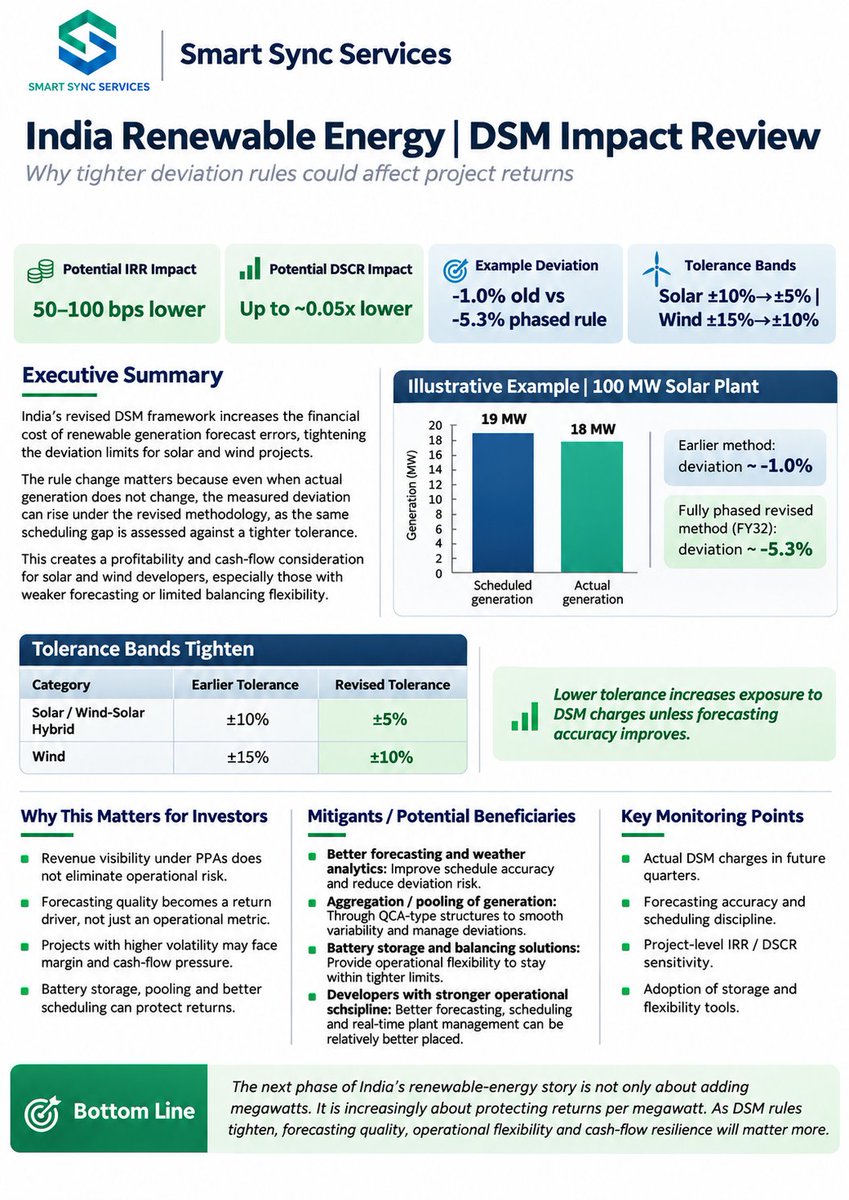
India's Renewable Energy Boom Has a Hidden Profitability Risk.
Solar and wind capacity are expanding rapidly, but a change in electricity-market regulations could put pressure on project returns.
Unmanaged generation deviations could reduce project IRRs by 50–100 basis points.
Why is this happening, and what does it mean for renewable developers?
5/5 — Investor Takeaway
India's renewable-energy story is no longer only about installing more megawatts.
It is increasingly about the quality and profitability of each megawatt.
Investors should monitor project IRRs, DSM charges, forecasting accuracy, storage economics and debt-service coverage.
Bottom Line: Renewable developers with stronger operational control and better forecasting capabilities may be positioned to protect returns as grid regulations tighten.
#RenewableEnergy #SolarEnergy #Investing
India has been importing the machines that build its factories. Now, that import bill could become a growth opportunity for domestic manufacturers.
And LMW could be sitting right in the middle of this transition.
Here's why this shift matters.
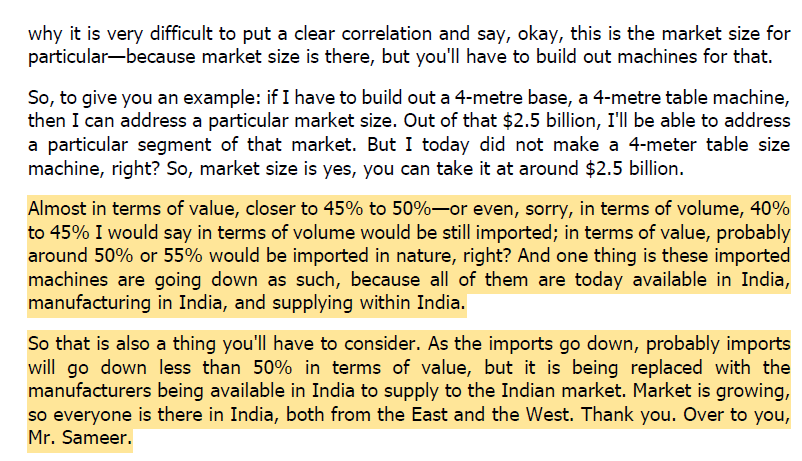
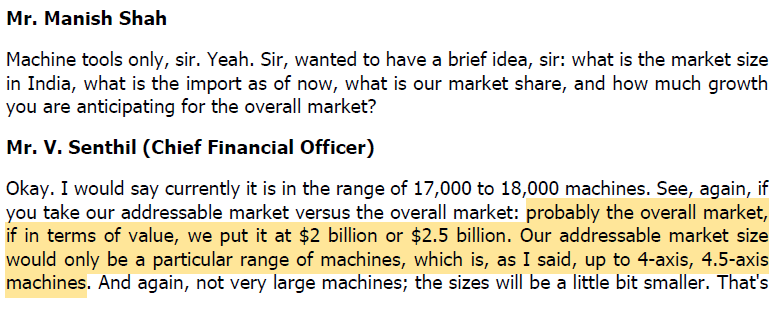
India's machine tool market is estimated at $2–2.5 billion. Historically, imports accounted for 50–55% of the market by value.
But as domestic manufacturing capabilities improve, Indian companies are increasingly finding local alternatives to imported machines.
LMW is already seeing the impact.
Its Machine Tool Division, along with Foundry, reported H1 FY27 revenue of ₹794 crore, growing ~43% YoY. Management expects growth to approach 50% for FY27.
And this isn't just an automotive story anymore.
Demand is expanding into electronics manufacturing, defence, tooling and general engineering. LMW's capacity utilisation is already at 75–80%, with assembly expansion underway.
There's another interesting opportunity.
LMW entered the auto-winder market through its Lakshmi Winder product. A segment that was previously entirely import-dependent now has a domestic manufacturer.
The bigger picture?
India's manufacturing ambitions need more than factories. They need the machines, technology and precision equipment that make those factories productive.
That's where the import substitution opportunity lies.
For LMW, the opportunity is significant — but execution will matter. Global machine tool manufacturers are also strengthening their local presence in India.
The question investors should watch: Can LMW convert India's manufacturing push into sustained market share gains and profitable growth?
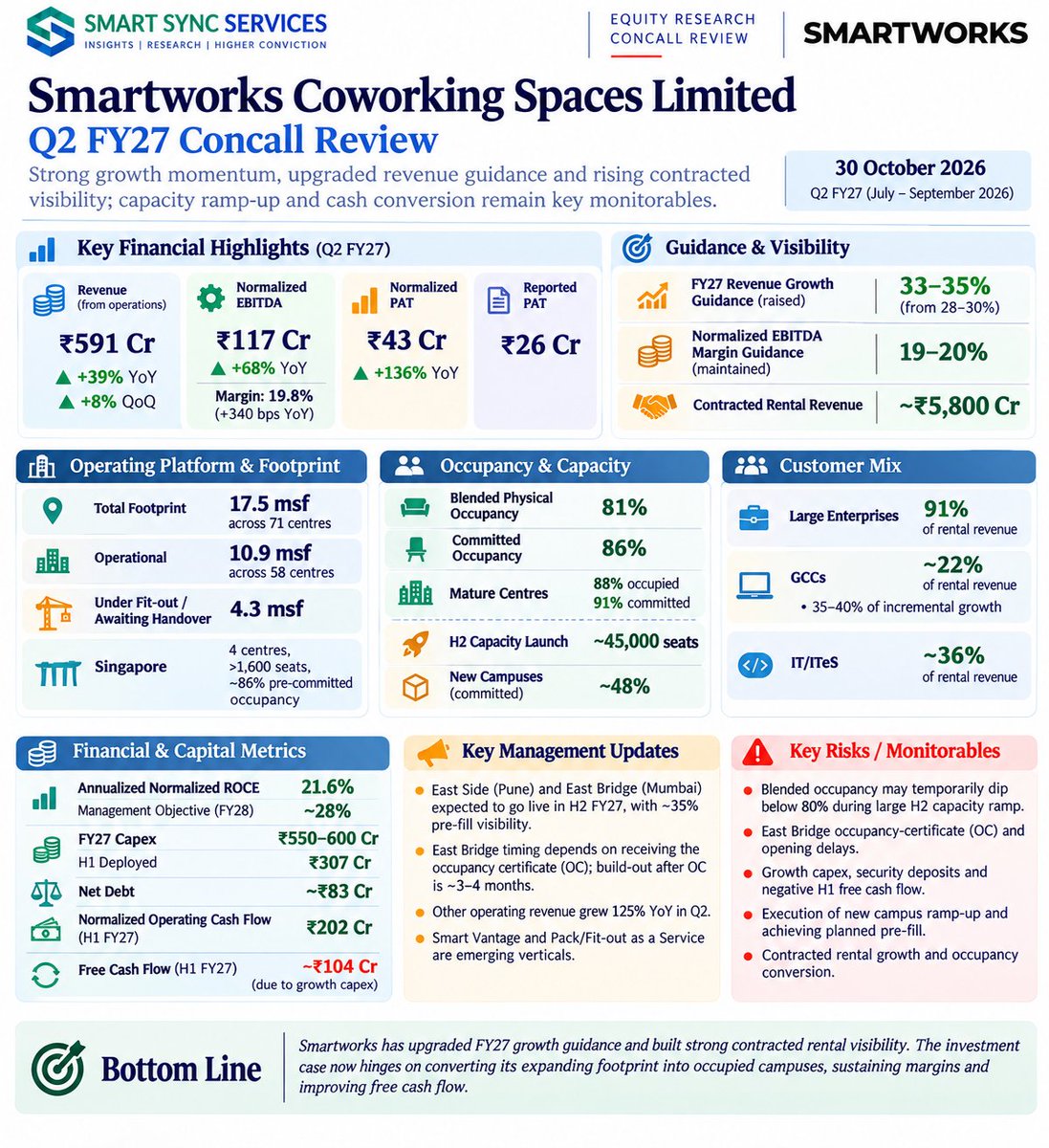
Smartworks Coworking Spaces Ltd. | Q2 FY27 Concall Takeaways
- Revenue grew 39% YoY to ₹591 crore, while normalized EBITDA and PAT increased 68% and 136%, respectively, supported by strong demand for flexible workspaces and higher other operating revenue. Contracted rental revenue increased to ~₹5,800 crore, strengthening long-term revenue visibility.
- Normalized EBITDA margin expanded 340 bps YoY to 19.8%, while management upgraded FY27 revenue growth guidance to 33–35%, retaining EBITDA margin guidance of 19–20%. The company plans to launch ~45,000 seats in H2 FY27 across its upcoming mega campuses.
The key monitorables are occupancy ramp-up, execution timelines for new campuses, sustainability of margins, cash-flow conversion and the transition towards positive free cash flow.