India’s next big power story isn’t solar
it’s NUCLEAR ⚛️
We’re entering a multi-decade capex cycle — and almost no one is talking about it yet.
🇮🇳 100 GW target by 2047 (vs ~8 GW today)
💰 ~₹19 lakh crore investment opportunity
⚡ AI + EVs = 24x7 baseload demand
Renewables are growing fast — but they’re intermittent.
Nuclear = low carbon + reliable + scalable
And now, the real inflection 👇
* SHANTI Act 2025 → private sector entry
* Liability reforms → supplier ecosystem unlock
* SMR push + ₹20,000 Cr allocation
* Execution pipeline finally building up
This is a high-entry-barrier sector
→ 7+ year approvals
→ Limited qualified vendors
→ Deep, durable moats
Which means:
The real winners may be a handful of suppliers most investors aren’t tracking.
From EPC to critical components —
this is a full ecosystem play.
We’ve decoded it all:
Value chain. Policy shift. Key beneficiaries. Risks.
👉 Full 38-page detailed report covering value chain, players & risks:
https://t.co/xGUw7UDKsV
Disclaimer: For educational and informational purposes only. The stock was recommended to our HNI Advisory clients based on our research. Our views may be biased.please do your own due diligence.
Is India's Capex Boom Losing Momentum? The Data Reveals a Surprising Divide.
India's investment cycle is becoming increasingly selective.
A sector-wise analysis of gross fixed assets reveals:
→ 9 of 11 sectors witnessed slower growth in FY26.
→ 3 sectors recorded negative growth.
→ Only electricity generation and transmission & distribution showed acceleration.
After several years of strong capacity additions, the investment landscape appears to be changing.
The big question for investors: Which sectors are positioned to benefit from the next phase of capital investment?🧵👇
7/7 — The Investment Takeaway: Follow Returns, Not Just Capex Announcements
The central message is clear: India's investment cycle is not moving uniformly across industries.
Power infrastructure is showing improving momentum, while several manufacturing sectors are digesting earlier investments or facing industry-specific challenges.
What investors should monitor:
→ Fresh order inflows and project execution.
→ Actual capacity additions versus announced plans.
→ Plant utilisation and incremental asset turnover.
→ EBITDA margins and return on capital.
→ Debt, working capital and free cash flow.
→ Government project execution and private-sector investment commitments.
Bottom Line:
A slowdown in fixed-asset growth does not necessarily mean the end of an investment cycle.
For some industries, the next stage may be about generating returns from capacity already created. For others, new investments could still drive growth.
The real investment opportunity lies in identifying where capital spending translates into sustainable earnings and cash flows.
#IndiaCapex #CapitalGoods #PowerInfrastructure #EquityResearch
1/7 — The slowdown is broad, but not uniform
Several industries that witnessed aggressive expansion in FY25 experienced significant moderation in FY26.
Fixed-asset growth (FY25 → FY26):
→ Automobiles & Ancillaries: 35.4% → 11.3%
→ Hotels & Tourism: 27.3% → 4.1%
→ Machinery: 21.0% → 4.5%
→ Construction Materials: 19.6% → 9.2%
Importantly, these sectors are still reporting positive fixed-asset growth.
The decline in growth rates largely follows substantial additions in earlier years.
Investor insight: Slower expansion does not necessarily indicate weaker businesses. The key is whether previous investments are now generating higher utilisation, operating cash flows
and returns on capital.
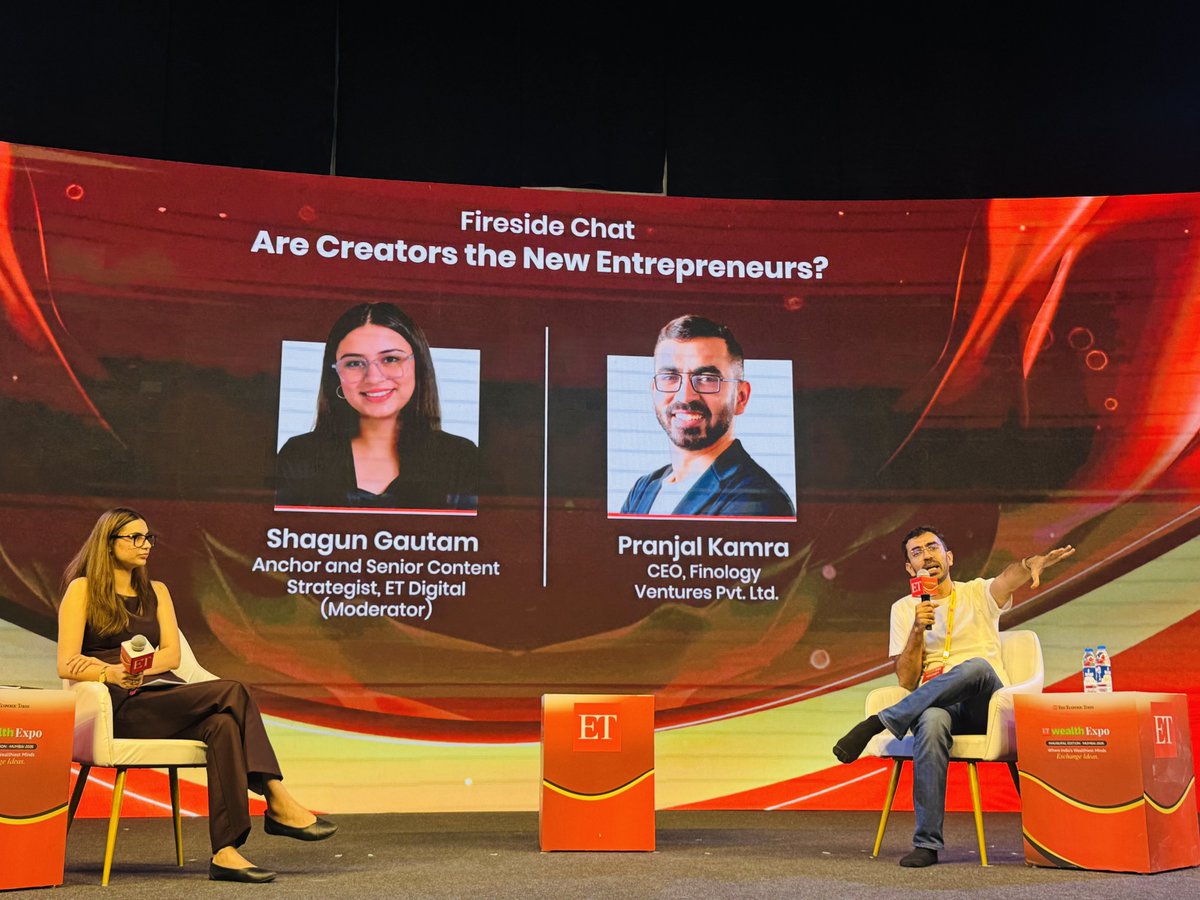
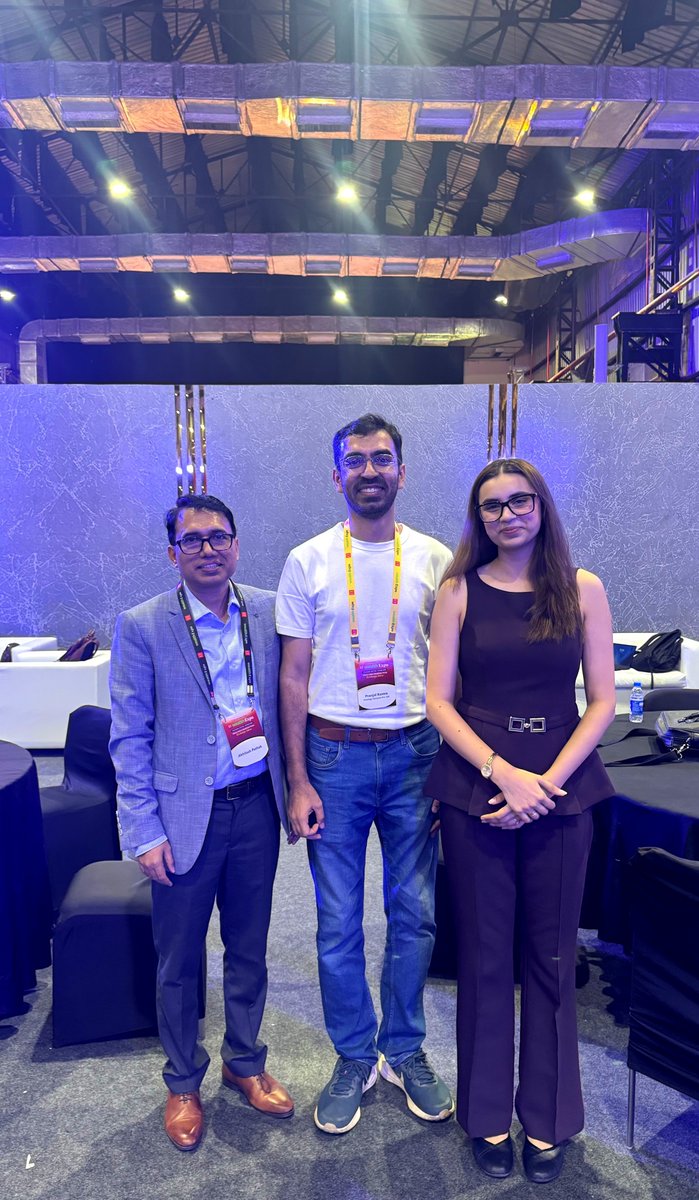
Age-old ideas still work especially when shared with honesty. It was refreshing to hear @pranjalkamra of @myfinology , financial wisdom presented by a creator who values trust over hype.
Good and truthful advice does not need to be complicated.
Disclaimer: For educational and informational purposes only. The stock was recommended to our HNI Advisory clients based on our research. Our views may be biased.please do your own due diligence.
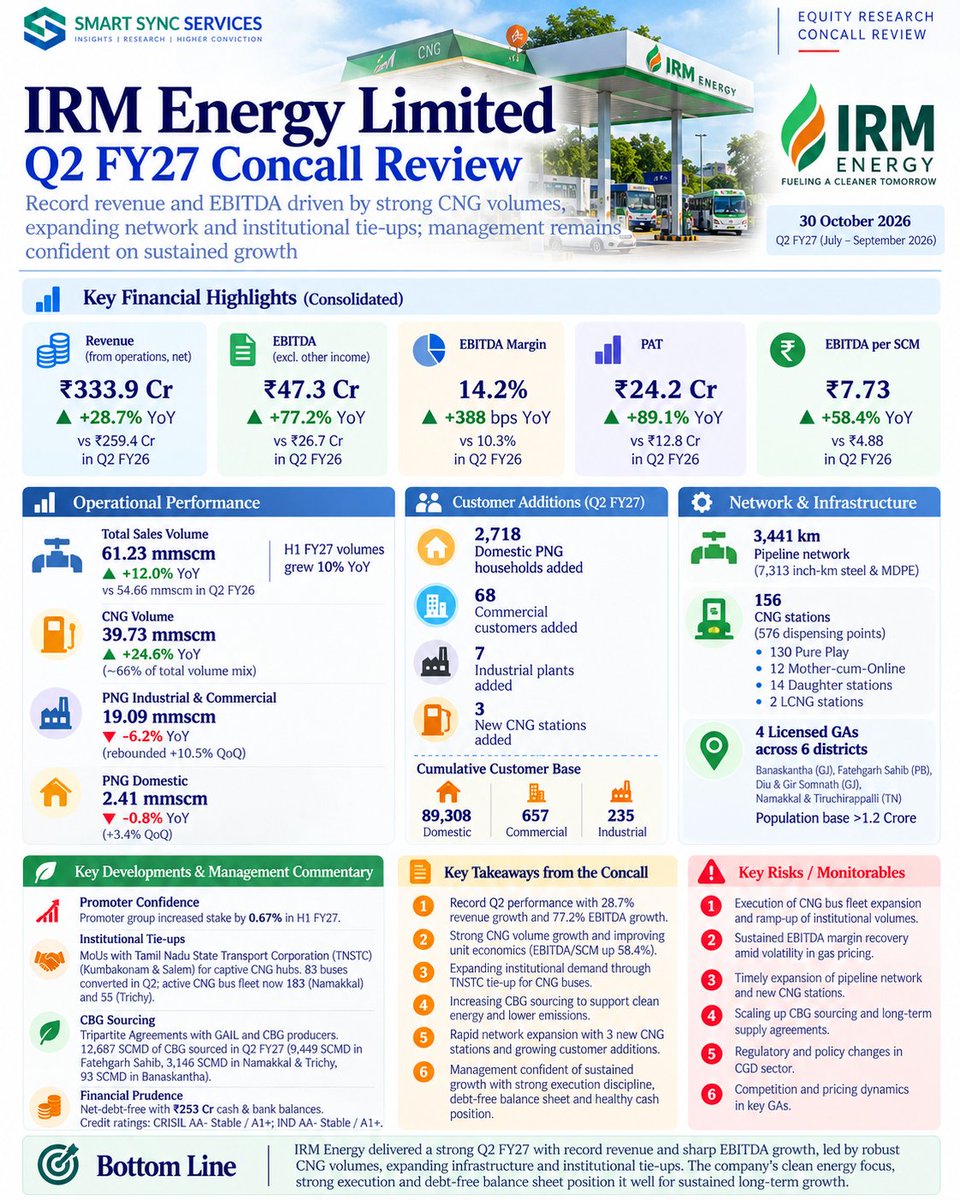
IRM Energy Ltd. | Q2 FY27 Concall Takeaways
- Revenue grew 28.7% YoY to ₹333.9 crore, while EBITDA and PAT increased 77.2% and 102.5%, respectively, supported by 12% growth in total gas volumes and strong 24.6% growth in CNG volumes.
- EBITDA margin expanded 388 bps YoY to 14.2%, reflecting improving unit economics and operating leverage. Institutional tie-ups with TNSTC, expanding CNG infrastructure and a net-debt-free balance sheet support the company's growth outlook.
The key monitorables are sustained margin improvement, CNG volume growth, execution of network expansion, CBG sourcing and regulatory developments in the CGD sector.
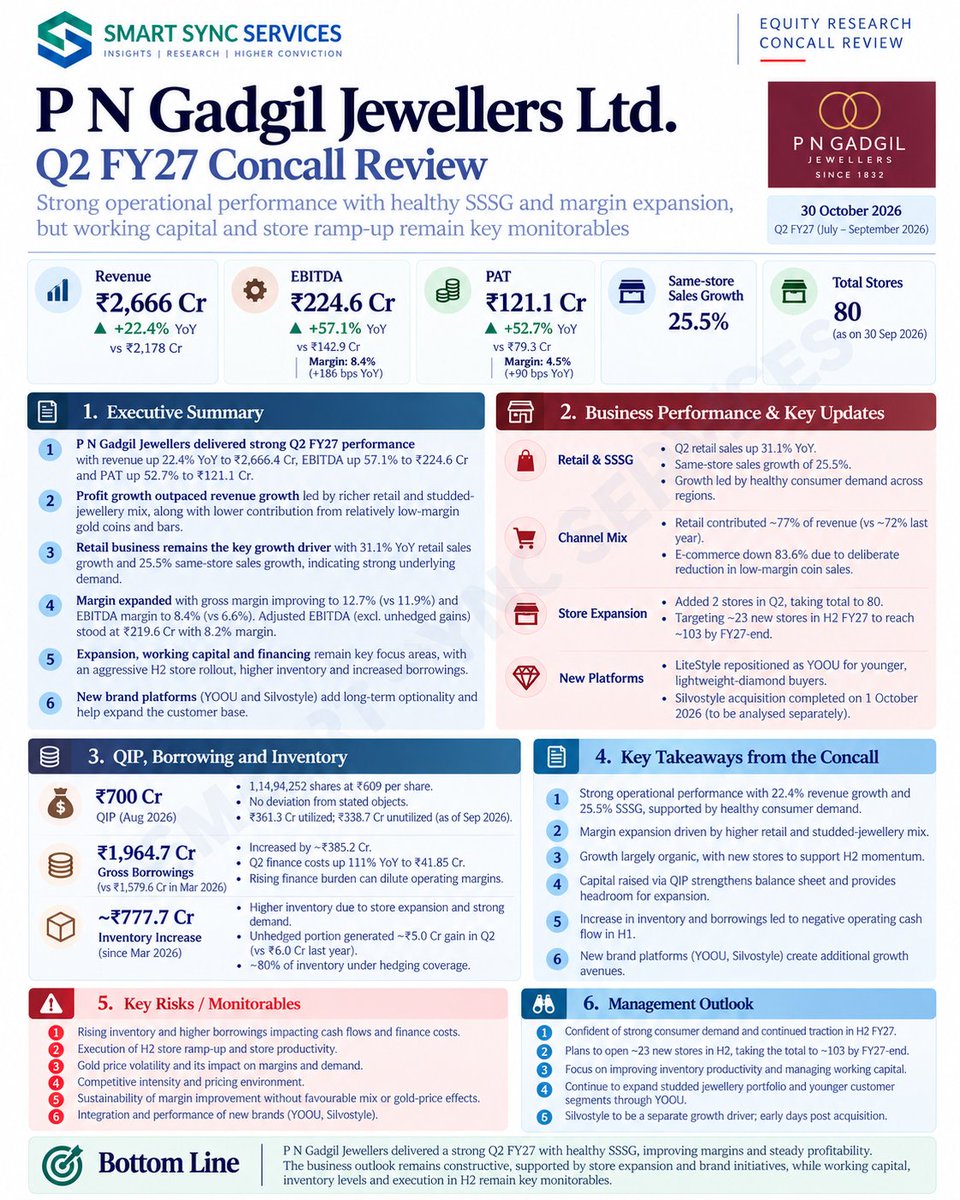
P N Gadgil Jewellers Ltd. | Q2 FY27 Concall Takeaways
- Revenue grew 22.4% YoY to ₹2,666.4 crore, while EBITDA and PAT increased 57.1% and 52.7%, respectively, supported by healthy retail demand, 25.5% same-store sales growth and an improved jewellery mix.
- EBITDA margin expanded 186 bps YoY to 8.4%, driven by higher retail contribution and a richer studded-jewellery mix. Management is targeting ~23 new store additions in H2 FY27.
The key monitorables are inventory build-up, rising borrowings, working capital management, H2 store execution and sustainability of margin expansion.
A rare Market Masterclass for retail investors, straight from the legendary @VijayKedia1 ji, in his unmistakable style, at ET Wealth Expo 2026, NESCO, Mumbai.
Vijay Kedia ji’s core message is that market success rests on knowledge, courage & patience and that long-term wealth comes to those who can sit through noise & uncertainty.
@EconomicTimes@ETMarkets
Indian Energy Exchange (IEX) | Q2 FY27 Concall Takeaways
- Electricity trading volume grew 12.7% YoY to 39.7 BU in Q2 FY27, while Real-Time Market (RTM) contributed ~41% of H1 trading volumes, strengthening market diversification.
- IGX continued to emerge as a growth driver, with gas trading volume surging 160% YoY to 42 Mn MMBtu. PAT grew 12.9% YoY to ₹139.2 crore, supported by higher trading volumes and improved IGX contribution.
The key monitorables are EBITDA margin pressure, the proposed market-coupling framework, regulatory developments and sustainability of trading volumes.
What will work in 2026 and thereafter ? : MFs, PMS, AIF or Direct Stocks.
The critical aspect of finding out a multi-bagger business is the management (the people), then quality of earnings, emotional control & remaining invested for a long time ( patience) @vikaskhemani
# ET Wealth Expo
@EconomicTimes@ETMarkets
We appreciate you raising this. GRP’s gross debt was around ₹219 crore at the end of September, with most of it in short-term working-capital borrowings.
EBITDA growth has improved interest coverage, but debt has increased and cash flow remains an important watch point. How quickly the new capacity ramps up will matter for future cash generation.
GRP Limited’s Q2 and H1 FY27 results: good growth, and a few things to keep an eye on
GRP had a strong September quarter. Revenue grew, profits rose, and EBITDA margins improved—even as raw-material costs put pressure on gross margins.
Here’s the quarter at a glance:
> Revenue from operations was ₹172.3 crore, up 30% year on year.
> EBITDA came in at ₹18.2 crore, up 60%.
> EBITDA margin improved to 10.5%, from 8.6%.
> PAT rose to ₹6.4 crore, compared with ₹2.0 crore last year.
> Gross margin fell to 45.8%, from 51.1%, as input costs increased.
The H1 numbers were strong too: revenue grew 29% to ₹329.2 crore, EBITDA rose 60% to ₹35.6 crore, and PAT increased 185% to ₹10.6 crore.
What stands out is that EBITDA margins improved even while gross margins came under pressure. That suggests efficiencies and scale helped—but it’ll be worth watching whether GRP can keep that up if input costs remain high.
The company is also investing in growth beyond reclaim rubber, including adjacent tyre-recycling and plastics operations. It plans ₹90–100 crore of capex in FY27 and aims to increase reclaim-rubber capacity from around 88 KTA to 110 KTA, while expanding adjacent EOL tyre and plastics capacity from around 39 KTA to 130 KTA by FY30.
Those plans could open up new revenue streams, but the next step is execution: getting facilities commissioned, building utilization and turning the added capacity into profitable growth.
The numbers are encouraging. The things I’d watch next are margins, project ramp-up and cash generation as the business expands.
#GRPLimited #Q2FY27 #Earnings #Recycling #CircularEconomy #IndianMarkets
Disclaimer: For educational and informational purposes only. The stock was recommended to our HNI Advisory clients based on our research. Our views may be biased.please do your own due diligence.
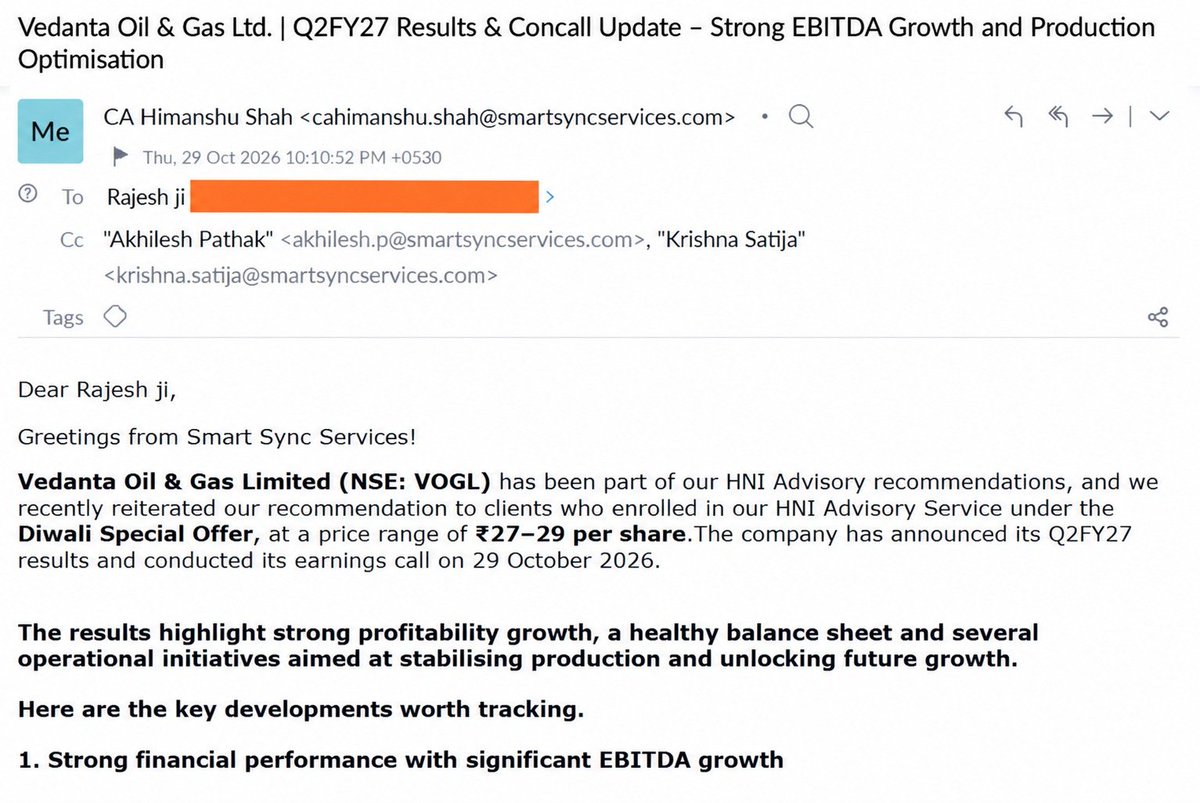
Vedanta Oil & Gas is up 14% today post results and concall yesterday
We recently recommended Vedanta Oil & Gas to clients who joined our HNI Advisory Service under the Diwali Special Offer at ₹27–29.
What stood out in the results and concall?
• EBITDA grew 34% YoY to ₹1,393 Cr, with a strong 56% margin.
• PAT from continuing operations stood at ₹746 Cr.
• Ravva production improved to 8.1 kboepd from 7.0 kboepd in the previous quarter.
• Management highlighted production stabilisation efforts, three new Rajasthan discoveries and the upcoming Ambe Phase 2 project.
Additionally, the company has ₹2,639 Cr in cash and liquid investments, with almost zero net debt.