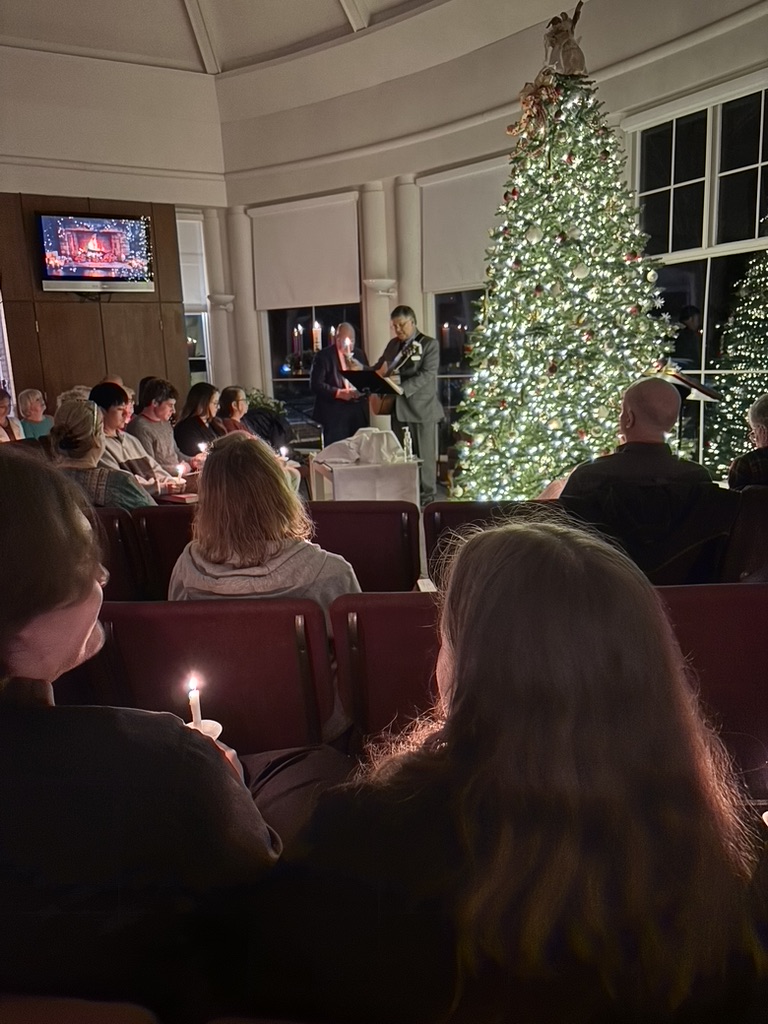
This has been my favorite for as long as I can remember, and still I just learned something new. When Linus recites Luke: 8-14, it’s the one time he isn’t holding his security blanket. Because in that moment, he doesn’t need it.
"My husband thinks I'm wasting my time.
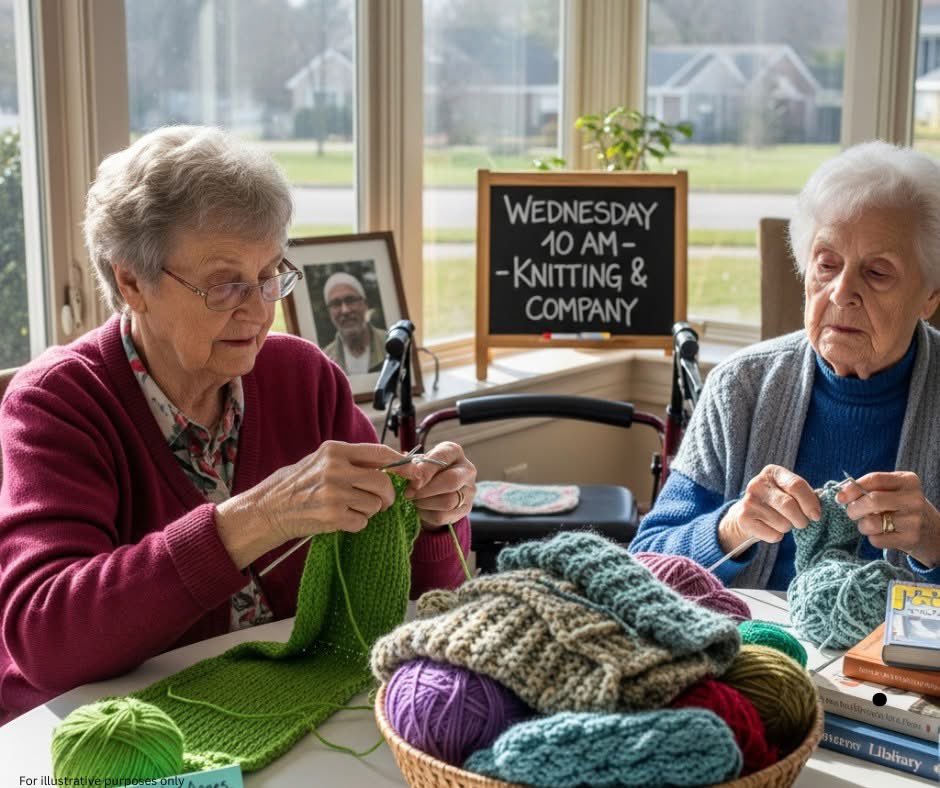
Every Wednesday morning, I drive to Riverside Nursing Home. Not to visit anyone. I don't know a soul there. I go to sit in the lobby and knit. Been doing it for three years now. I'm 67, retired teacher, got nothing but time.
The staff thought I was confused at first. "Ma'am, who are you here to see?"
"Nobody," I said. "Just sitting."
They let me stay. I think they felt sorry for me.
But I noticed something. Residents would shuffle past, some in wheelchairs, most alone. They'd see me knitting and slow down. Stop. Watch.
One woman, Agnes, finally asked. "What are you making?"
"Scarf. For nobody in particular."
"That's a waste," she said.
"Probably," I agreed. "Want to help?"
She looked startled. Like I'd offered her the moon. "I haven't knitted in 40 years."
"Good. Then you won't criticize my terrible stitches."
She sat. I handed her needles. Her fingers remembered what her mind had forgotten.
Next week, Agnes brought two friends. Then five. Then eight. The nursing home staff moved us to the sunroom. Called us "the knitting circle," though we mostly just sat together, hands moving, talking about nothing important. Grandchildren. Weather. The awful meatloaf they served on Tuesdays.
But here's what I noticed, these women started showing up to meals. Getting dressed instead of staying in robes. One woman, Clara, hadn't spoken in months according to staff. Started telling stories about knitting blankets during the Depression.
The scarves piled up. Terrible, uneven scarves in every color. "What do we do with these?" Agnes asked.
"Give them away," I said.
We donated them to the homeless shelter. Every month, a pile of scarves made by women everyone had forgotten about.
Then last winter, something happened. A homeless man came to the nursing home. Asked to meet the knitters. Staff was confused but brought him to our circle.
He held up a green scarf, terribly made, one end wider than the other. "I got this at the shelter in November. Wore it every night. There was a note in the pocket. 'Made by Agnes, age 81. Stay warm, friend.'"
Agnes's hands flew to her mouth.
"I'm in an apartment now," he continued. "Got a job. Saved that scarf. Wanted to say thank you. Nobody ever made me something before. Made me feel like I mattered enough to keep living."
Agnes cried. We all did.
My husband still thinks I'm wasting my time. Driving across town to knit with strangers.
But Agnes died last month. Peaceful, in her sleep. At her memorial, her daughter found me. "Mom talked about Wednesdays constantly. Said it gave her a reason to wake up. You gave her three good years."
The circle still meets. Eight women, ages 74 to 93, making terrible scarves for people who need to know someone cares.
I'm not saving the world. Just sitting in a sunroom, knitting with lonely women.
But sometimes that's exactly what saving the world looks like."
.
Let this story reach more hearts....
.
AI image is for Demonstration purpose only.
.
By Mary Nelson
🏆🏆Brilliant take down … from the real Miss Piggy
Dearest Donald,
It is moi, Miss Piggy, and I am writing because you have committed a sin so grotesque, so tasteless, so fundamentally idiotic that even the Muppet chickens gasped. You called a reporter—an intelligent, courageous, unflinching professional—“piggy.”
Let’s pause, darling.
Let’s breathe.
Let’s let the stupidity of that choice settle into the air like the unmistakable scent of a bargain-bin cologne worn by a man who thinks intimidation is a personality.
You were asked about the Epstein files. A serious question. A necessary question. A question every decent human with a pulse should want answered. And instead of behaving like anything resembling an adult, you snapped. You barked. You lashed out like a startled sewer rat cornered under a bridge with too much hairspray and not enough self-control.
You didn’t insult her.
You exposed yourself.
She stood there in the truth.
You stood there in panic.
She held the line.
You lost your mind.
And then—mon dieu—you invoked moi.
You said “piggy.”
At a woman who was doing her job with more professionalism in one sentence than you have shown in your entire, overcooked, chaotic lifetime.
There is ONE Piggy.
ONE.
And she does not answer to you.
I built that name with talent, beauty, star power, and a legendary karate chop feared by icons and monsters alike. You? You hurl it as an insult because a woman dared to speak to you without bowing first. How fragile you must be to crumble under the weight of a question delivered by someone infinitely stronger than you have ever been.
That reporter showed courage. She showed integrity. She showed the world what a real professional looks like. Meanwhile, you flailed like a collapsing parade float struggling to stay inflated. You weren’t “fighting back.” You weren’t “being tough.” You were simply terrified. Terrified of a woman, a microphone, and the truth you keep trying to stuff into a closet full of your old scandals.
Calling her “piggy” didn’t diminish her. It diminished you.
It made you look cheap.
It made you look weak.
It made you look like a coward thrashing in quicksand of your own making.
And let’s be clear: A man who calls a woman “piggy” because he cannot withstand a factual question is not strong. He is not clever. He is not bold.
He is a big, loud, pathetic problem. A problem the size of a collapsing casino.
A problem wrapped in insecurity, hairspray, and whatever the hell those suits are made of—polyester? denial? both?
So here is your final lesson from moi:
The reporter you tried to belittle stands taller today than you ever have.
She asked for truth.
You served up fear.
She did her job.
You embarrassed yourself.
She kept her dignity.
You lost yours somewhere between the plane door and your next tantrum.
My name is not your shield.
My title is not your insult.
You are not worthy to utter the word “Piggy” unless you are referring to your own reflection.
Consider this your warning, your education, and your verbal karate chop to the soul:
Do not use my name to attack a woman who is braver than you.
Do not weaponize my legacy to mask your cowardice.
And do not mistake your insecurity for strength.
You wanted to shame her.
Instead, you shamed yourself.
Furiously, fabulously, and forever out of your league,
Miss. Piggy
A message from a Kindergarten teacher:
After forty years in the classroom, my career ended with one small sentence from a six-year-old:
“My dad says people like you don’t matter anymore.”
No sneer. No malice. Just quiet honesty — the kind that cuts deeper because it’s innocent. He blinked, then added, “You don’t even have a TikTok.”
My name is Mrs. Clara Holt, and for four decades, I taught kindergarten in a small Denver suburb. Today, I stacked the last box on my desk and locked the door behind me.
When I started teaching in the early 1980s, it felt like a promise — a shared belief that what we did mattered. We weren’t rich, but we were valued. Parents brought warm cookies to parent nights. Kids gave you handmade cards with hearts that didn’t quite line up. Watching a child sound out their first sentence felt like magic.
But that world slowly slipped away. The job I once knew has been replaced by exhaustion, red tape, and a kind of loneliness I can’t quite describe.
My evenings used to be filled with construction paper, glitter, and glue sticks. Now they’re spent filling out digital reports to protect myself from angry emails or lawsuits. I’ve been yelled at by parents in front of twenty-five children — one filming me with his phone while I tried to calm another child mid-meltdown.
And the kids… they’ve changed too. Not by choice.
They arrive tired, anxious, overstimulated. Their tiny fingers know how to swipe a screen before they can hold a crayon. Some can’t make eye contact or wait in line. We’re expected to fix all of it — to patch the gaps, heal the trauma, teach the curriculum, and document every move — in six hours a day, with resources that barely fill a drawer.
The little reading corner I once built, full of soft beanbags and paper stars, was replaced by data charts and “learning metrics.” A young principal once told me, “Clara, maybe you’re too nurturing. The district wants measurable results.”
As if kindness were a weakness.
Still, I stayed. Because of the small, holy moments that no spreadsheet could measure —
a whisper of, “You remind me of my grandma.”
a shaky note that read, “I feel safe here.”
a quiet boy finally meeting my eyes and saying, “I read the whole page.”
Those tiny sparks were my reason to keep showing up.
But this last year broke something in me.
The aggression grew sharper. The laughter in the staff room turned to silence. The light went out of so many eyes. I watched brilliant teachers — my friends — vanish under the weight of burnout, their joy replaced by survival.
I felt myself fading too, like chalk on a board that’s been wiped one too many times.
So today, I began my goodbye. I pulled faded art off the walls and tucked thirty years of handmade cards into a single box. In the back of a drawer, I found a letter from a student from 1998:
“Thank you for loving me when I was hard to love.”
I sat on the floor and cried.
No party. No applause. Just a handshake from a young principal who called me “Ma’am” while checking his notifications.
I left my rocking chair behind, and my sticker box too. What I carried with me were the memories — the faces of hundreds of children who once trusted me enough to reach out their hands and learn. That can’t be uploaded. It can’t be measured. It can’t be replaced.
I miss when teachers were partners, not targets. When parents and educators worked side by side, not in opposition. When schools cared more about wonder than numbers.
So if you know a teacher — any teacher — thank them. Not with a mug or a gift card, but with your words. With your respect. With your understanding that behind every test score is a heart that cared enough to try.
Because in a world that often overlooks them, teachers are the ones who never forget our children.