Our #OpenAccess@natcomms paper on metals in air and racial segregation: https://t.co/2Sdked6CAf
Take home 1/5:
1. Racial/ethnic disparities in exposure to toxic metals (in air) is much worse than what has been reported for PM2.5 mass (up to 300% worse). That's really bad.
Multiple TT positions in engineering using artificial intelligence. Come work at #CSU in a great city and with awesome colleagues! Colorado State University | Engineering with Artificial Intelligence Assistant/Associate Professor - All Fields https://t.co/BayKis0DhN
After decades of decline in US air pollution, 2023 became the worst Summer on record for PM2.5 this century. #wildfire is here and it’s here to stay.
https://t.co/vkHi5OHLAk
@gould_cf I had a PhD student win best paper of the year in journal #4, following rejections by 1, 2 & 3. The best science is often different from all that came before and that can be hard for the establishment to acknowledge. Keep at it!
Dr. Wall told me she created SOGES at CSU so that faculty had a refuge where scholarly conversation and collaboration could flourish, unhindered by academic barriers. She succeeded in that vision, in a space where many before her did not. Thank you, Diana.
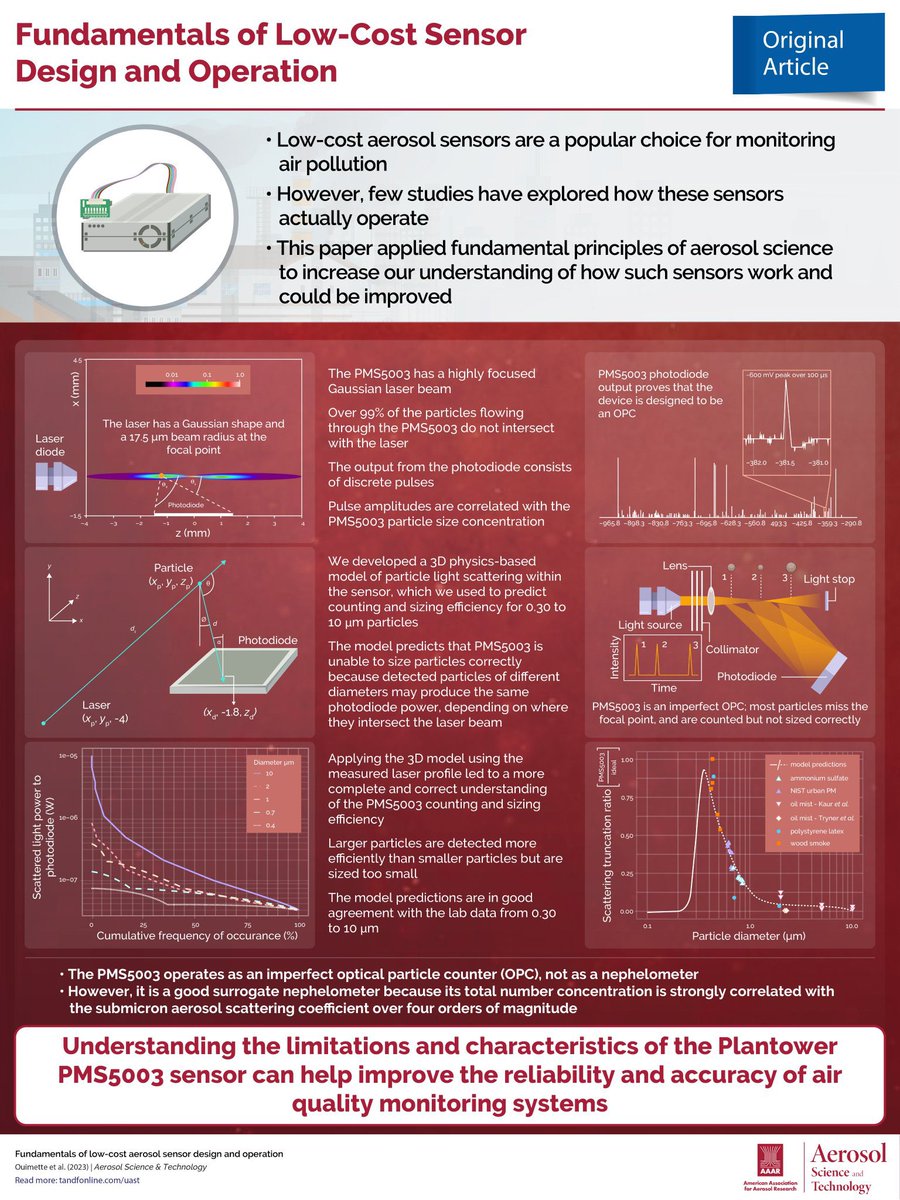
Most evaluations of low-cost #aerosol sensors have focused on their measurement bias compared to regulatory monitors. Few evaluations have applied fundamental principles of aerosol science to increase our understanding of how such sensors work and could be improved... READ MORE🔎
Boom. This new annual PM2.5 limit (9 ug/m3) chosen by EPA represents great progress towards cleaner, healthier air for everyone. In Colorado, you can expect visibility to improve along the Front Range as a result. https://t.co/cAf4i4vW4P
Come work with us! @CSUMechEngr is hiring in Sustainable Engineering (tenure track, asst or assoc prof). We have strengths in energy, air quality, climate, health & materials. Colorado (esp Fort Collins) is an awesome place to live. https://t.co/CBt53uIw1W @CSUEnergy
Teardown-> model of the #PMS5003 PM sensor shows
1. It’s a PM counter, not a nephelometer.
2. It can count 0.3-0.5 um particles and that’s about it.
3. It CANNOT report PM size distributions, PM coarse, PM10
@Jess_Tryner@ASTJournal@SureshDhaniyala https://t.co/N52HjJpwgk
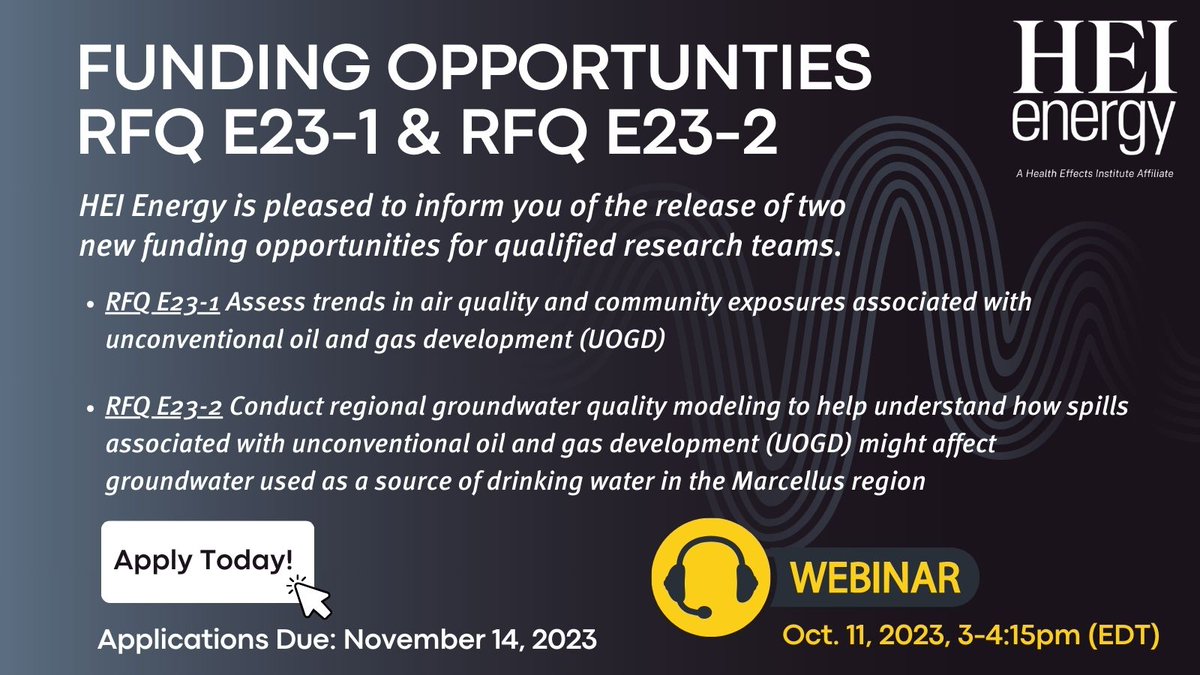
We are pleased to inform you of two new funding opportunities for qualified research teams.
RFQ E23-1: Study #AirQuality trends associated with oil & gas development.
RFQ E23-2: Explore #groundwater quality in the Marcellus region.
Learn more: https://t.co/TqFZc982hh
@EHPonline@CSUMechEngr@NIEHS Our commentary on disaster response research. Bottom line: we’re seeing more disasters every year and we need to do better.
NEW COMMENTARY: Health Research in the Wake of Disasters: Challenges and Opportunities for Sensor Science ➡️ https://t.co/Ab2nc3MmWr @CSUMechEngr@NIEHS@Smogdr
@ukhadds I noticed you used MEM + FBS for the suspension. The composition of the respiratory epithelial lining fluid is very different than than a basal medium like the one you used. This may impact results. Have you tried these expts with simulated lung surfactant or bronchial epi fluid?
Buildings breathe. If it's smoky outside, you should be taking precautions to protect your health indoors as well as out. I walked through every possible home configuration I could think of with @Smogdr (window a/c? central a/c?) to find out what to do. https://t.co/DB8QKkPVf9