Piece of pricey Chinese cheapskate imitations of Western Technology,
Huawei, Xiaomi and the like!
A mind of their own. They lack essential mathematical symbols and on unexpected moments, the picture freezes, enlarges itself or they log by themselves out of an app!
The Physicist Who Invented Two Elements — Then Got Forty Labs to Agree
Fred Allison was a physics professor at Alabama Polytechnic Institute who, in 1930, built a machine that could detect any element in any substance. He used it to find two that no one had located before. He named them after his home states: virginium (element 87, after Virginia) and alabamine (element 85, after Alabama). Time magazine ran the story. The American Chemical Society Journal published it. Other chemists built their own versions of the device and reported confirming his results — including Wendell Latimer at Berkeley, who used the same method to claim discovery of tritium in 1933.
The device worked by shooting polarized light through a liquid sample while an electromagnet switched on. Each element, Allison claimed, produced a unique time delay between the throwing of the switch and the resulting shift in the light beam — a delay measurable to billionths of a second. The measurement had one critical flaw. There was no instrument reading. Allison measured the delay by eye, watching for a faint change in light intensity as the switch was thrown.
Francis Slack at Vanderbilt spent three years building his own device and failing to see what Allison saw. His eventual conclusion: the delay wasn't in the light. It was in the observer. When you stare long enough at the edge of detectability for a flicker you expect to see, you see it.
Allison and his students had been, without realizing it, confirming one another's expectations for years — a textbook case of what Irving Langmuir would later call "pathological science."
Meanwhile, Allison's machine had briefly pointed at something real. His readings from certain water samples were anomalous in ways consistent with the presence of deuterium, the heavy isotope of hydrogen. He noted the anomaly and moved on. Harold Urey identified deuterium by spectroscopy in 1931, confirmed it, and received the Nobel Prize in Chemistry in 1934. Allison is not credited.
In 1953, Langmuir — a Nobel laureate — gave a famous lecture cataloguing the defining features of pathological science and used Allison's work as the canonical example. Allison continued running experiments until one month before his death in 1974, at the age of 92. Auburn University still calls its physics building the Allison Laboratory.
He made forty chemists see elements that weren't there. The Nobel went to the man who used an instrument.
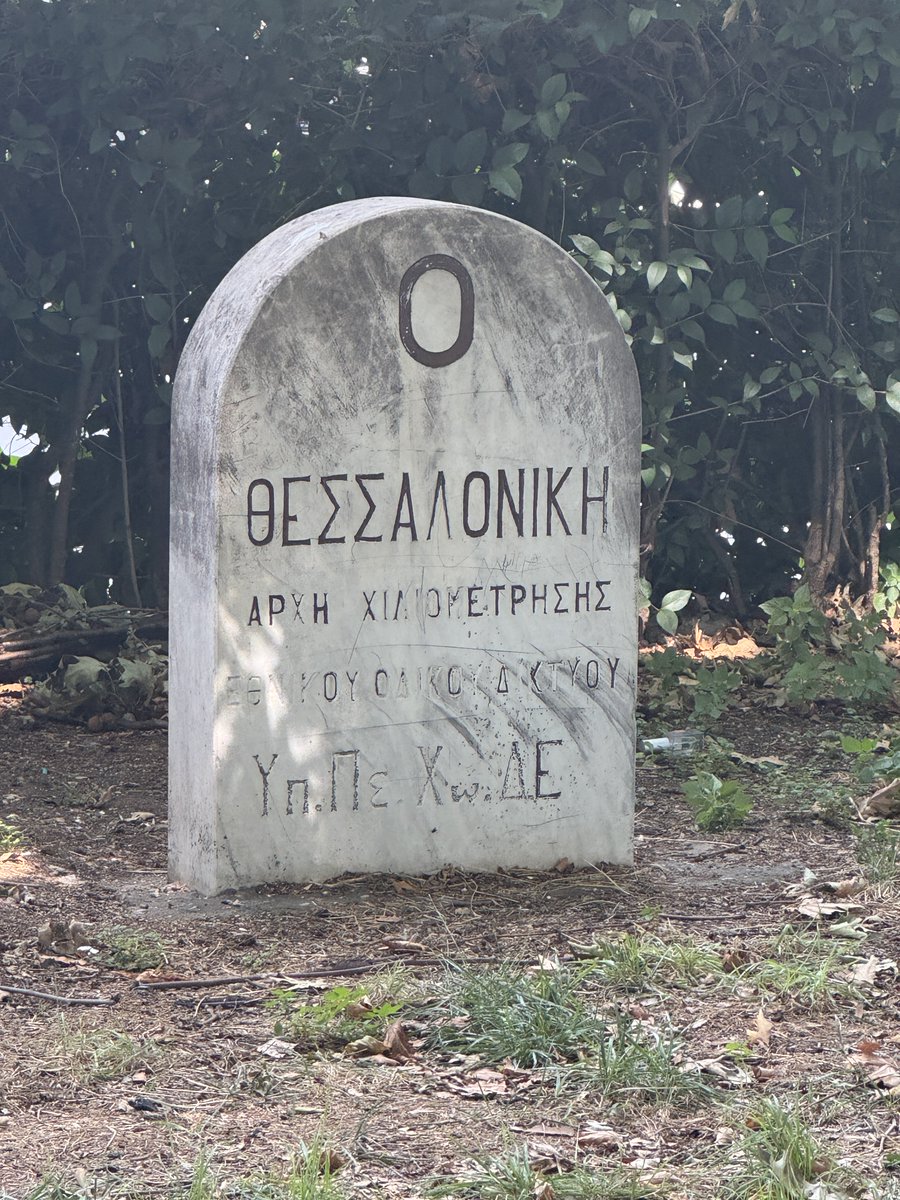
Point 0 in Thessaloniki, from where all the distances of the city were historically measured. It’s also at the point of the ancient city walls.
The plaque was just recently rediscovered due to the construction of the metro station
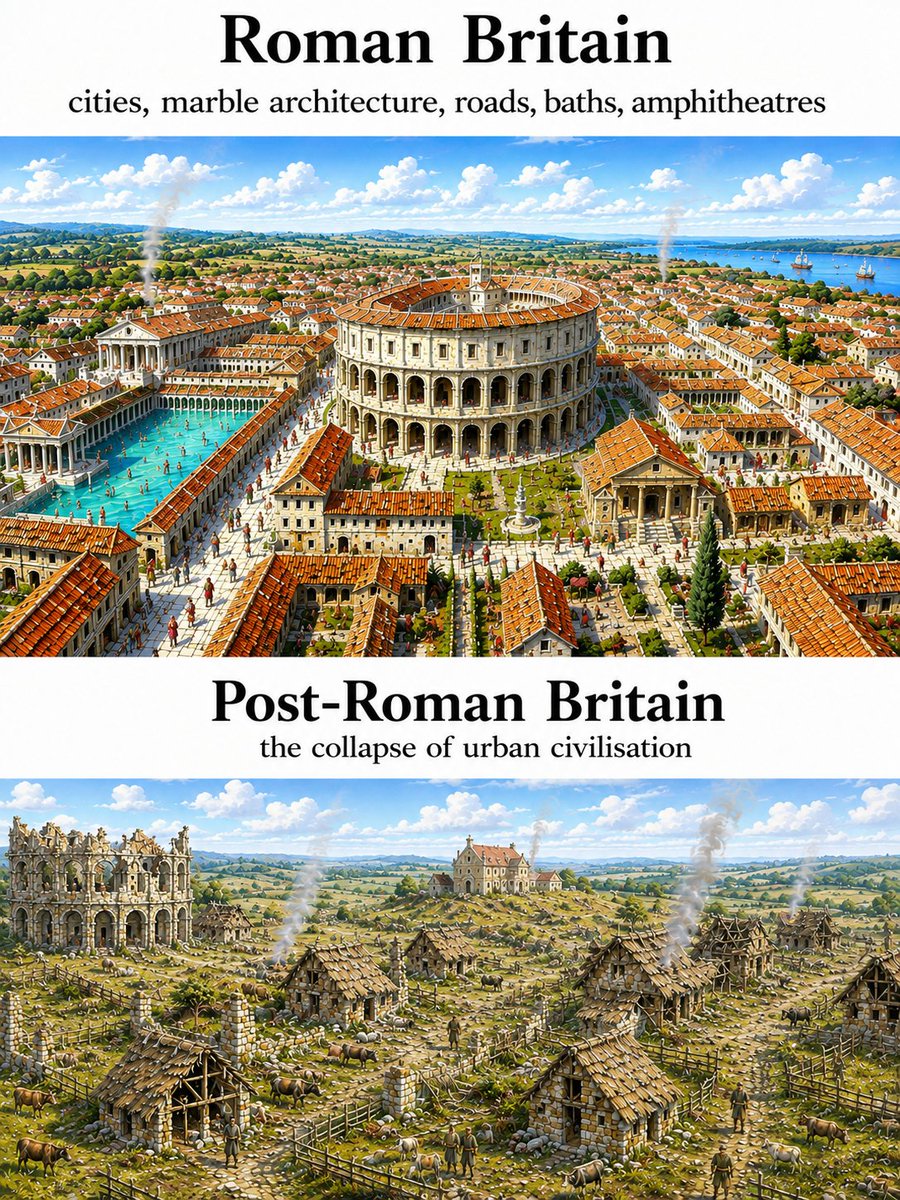
Roman Britain was built around urban centres and infrastructure the island had never seen before.
Planned cities, paved and engineered roads, stone bridges, monumental public buildings, marble and decorative stonework, civic halls and law courts, forums, amphitheatres, bath complexes, aqueduct-fed and piped water systems, organised sewers and latrine networks, hypocaust underfloor heating, and an integrated network of ports and roads connecting Britain to the wider Roman world.
When Roman authority withdrew in the early 5th century, the administrative and economic structures that sustained these cities collapsed. Without imperial coordination and resources, baths, drainage systems, and urban infrastructure gradually fell into disrepair. Across much of Britain, many towns declined or were abandoned, and the complex urban systems that had supported them disappeared.
The Roman Empire conquered a predominantly rural Iron Age Britain and transformed it into an urbanised province. After Roman rule ended, much of that urban world disappeared, and across large parts of Britain life once again became predominantly rural and localised.
Two thousand years ago, people sat on these stone seats watching performances with the Mediterranean stretching behind the stage.
Antiphellos Theatre has survived for nearly two millennia because its builders worked with the landscape rather than trying to dominate it.
In the 1640's the Dutch inhabitants of New Amsterdam built a 12 foot wall to keep the
"bad people" out. In 1664 the British ignored the wall and took New Amsterdam by sea. It's now called New York. They took down the wall and built a street, which is now called Wall Street.
British Islamic scholar Abu Waleed says:
“No integration, no multiculturalism, no diversity and no tolerance. You have democracy, we have Sharia.”
He lives in council housing in London, doesn’t work, and claims benefits for himself, his wife, and their three disabled children - paid for by British taxpayers.
“Italians on paper, Greeks at heart”
80-year-old Gaetano speaks Greek in the Greek-speaking village of Sternatia in Puglia, Southern Italy.
We didn’t know Italian, we only spoke Greek.
I wish him good health and that they keep the Greek language alive.
Once a Beatle: When Ringo Starr came down with tonsillitis, Jimmie Nicol filled in on drums for eight concerts and lived the life of a superstar for ten days. In this photo, Jimmie Nicol is seen sitting alone at the Melbourne airport, waiting for the plane that will take him back to anonymity (June 1964)
This is what the internet has on you. Your address, your history, your relationships, your views — all filed, all accessible, all without your permission.
Serus shows you what's inside the folders.
Explore for free, today.
Before Sean Connery was James Bond, he was a boy from a tenement flat in Fountainbridge, Edinburgh, where his cot was the bottom drawer of a cupboard.
His father drove vans.
His mother cleaned houses.
By thirteen, Sean had left school. Before sunrise, he delivered milk. Then came jobs as a bricklayer, truck driver, lifeguard, coffin polisher, and even an art model.
At sixteen, he joined the Royal Navy.
By nineteen, stomach ulcers ended his service.
Two tattoos remained.
"Mum and Dad."
"Scotland Forever."
Nobody looked at him and saw a future movie star.
But they couldn't ignore his presence.
Bodybuilding led him to the 1953 Mr. Universe contest. He didn't win, but one conversation led him to an audition for *South Pacific*.
He got the role.
That one decision changed everything.
By 1962, he was James Bond.
The world saw style, confidence, and effortless cool. Directors saw something deeper—a quiet strength the camera seemed to trust.
Fame never sat comfortably with him.
He refused to be defined by Bond alone. He battled producers, walked away more than once, and kept searching for roles that demanded more.
Then, in 1970, everything changed again.
At a golf tournament in Morocco, he met Micheline Roquebrune.
She didn't recognize him.
She simply noticed a man with an impressive physique.
That night, she dreamed of him.
The next day, she returned.
Language should have been a barrier.
She spoke French and Spanish.
He spoke English with a thick Scottish accent.
Neither seemed to mind.
Two years later, he asked her to meet him in Spain.
She went.
"I've missed you," he told her.
They married in 1975.
She kept painting. He kept acting.
She was never just the wife of a superstar.
She remained an artist with a life of her own.
For forty-five years, they stayed together.
Not because life was perfect.
Because love endured.
In his final years, dementia slowly silenced the man who had once filled every room.
Micheline never left his side.
When Sean Connery died peacefully in 2020, she was there.
The world remembered James Bond.
She remembered the man.
And in the end, that was the role that mattered most.
In 2000, Leonardo DiCaprio starred in "The Beach," filmed on a hidden cove in Thailand called Maya Bay. The movie made it famous. Fame made it collapse. Within a decade, over 5,000 tourists a day were arriving, boats were anchoring directly on the coral, and the reef that made the place worth filming was dying. In 2018, Thailand closed Maya Bay completely not for a season, for four years. When it reopened in 2022, the rules were permanent: no anchoring, a hard cap on visitors, and a mandatory closure every monsoon season so the bay never gets pushed that far again. The blacktip reef sharks came back. So did the coral. Hollywood found it. Overtourism nearly killed it. Thailand chose to save it anyway.
Yes, the story is true. In late 2016, 13-year-old Cindy Redmond from Wilmington, Delaware, had an air horn blasted directly into her ear by her friend’s stepfather after she stayed on a phone call. It caused severe, permanent hyperacusis—making everyday sounds painfully intense. She had to leave regular school and has been documented in People, Delaware Online, and Hyperacusis Research efforts. The photo matches her.
@MrPitbull07 So merely informing her to please put the phone away for dinner was too complicated for him. Should’ve sued him, whether he has a large family or a small family. Bet he’d do it again because his only consequence was a talk