The SOS position: Sleep On Side. It is the gentle acronym OBs and midwives use with #pregnancy patients for a good reason. From the second trimester on, side sleeping, especially the left side if comfortable, is often recommended 💙
The reasoning is mechanical. In late pregnancy, back sleeping can compress the inferior vena cava, the large vein that carries blood back to the heart. Side sleeping takes pressure off that vein and supports steadier circulation for both mom and baby. A little pillow setup goes a long way: one between the knees for hip alignment, one under the belly for support, one behind the back for a gentle reminder to stay on your side.
Right side is a reasonable alternative if the left is uncomfortable. And every #pregnancy is different, so your OB or midwife is always the best personalized guide 🧑🏻⚕️
Read the full breakdown: https://t.co/reBCPHI7NU 👉
#PregnancyTips #SleepHealth
Your heart rate and blood pressure are supposed to drop while you #sleep. Cardiologists call it nocturnal dipping, and it is one of the most quietly restorative things your body does at night 💤
That is why sleep quality and sleep position both matter for cardiovascular health. For most healthy adults, sleeping on the left side may be best. Gravity aids circulation and lymphatic drainage, and it can reduce acid reflux. Sleeping on the back is a reasonable option, though it tends to worsen #snoring for some people. Sleeping on the stomach is the one worth phasing out: it strains the neck and spine, compresses the chest, and usually makes snoring louder.
If you have a diagnosed heart condition, including heart failure, sleep position guidance can look different and your cardiologist is the right conversation 💙
Read the full breakdown: https://t.co/MgyarNJPti 👉
#HeartHealth #SleepHealth
If you smoke and snore, it is almost never a coincidence. One habit is quietly working on your nights from two directions 😔
First, from the airway. Tobacco smoke causes chronic inflammation of the upper airway, which narrows the space air moves through. Narrower space, more tissue vibration, louder #snoring. Smokers are consistently found more likely to snore than non-smokers in sleep research. Second, from the brain. Nicotine is a stimulant. It raises heart rate and blood pressure, lengthens sleep latency, and fragments sleep throughout the night. Vaping counts, since it delivers nicotine without the smoke damage but keeps the stimulant effect intact.
The honest upside is real. Airway inflammation can subside after quitting, and many people report measurably better #sleep within weeks to months. Doctors and smoking cessation counselors have the tools 🧑🏻⚕️
Read the full breakdown: https://t.co/yQqitYPYQV 👉
#SleepHealth #QuitSmoking
Research keeps finding links between poor #sleep, obstructive #SleepApnea, and higher Alzheimer’s risk. The honest state of the science: four pathways researchers are actively studying 🕯️
Beta-amyloid clearance happens during healthy sleep, and fragmented or oxygen-poor sleep appears to interfere with that process. Chronic inflammation, which poor sleep is associated with, is studied as a pathway in neurodegeneration. Intermittent hypoxia (the repeated oxygen drops in untreated sleep apnea) is the most direct biological bridge. And circadian rhythm disruption is independently linked to cognitive risk. These are correlations, not proof of cause, and much is still being worked out.
What this is not: a reason to panic about every snore. What it is: a reason to take witnessed breathing pauses or heavy daytime sleepiness seriously enough to see a doctor 🧑🏻⚕️
Read the full breakdown: https://t.co/hgLyATjocy 👉
#BrainHealth #SleepHealth
Mouthpiece or #CPAP? Different strengths. Start with your diagnosis, not the device 🙂↕️
For diagnosed obstructive #SleepApnea, CPAP generally reduces breathing events more effectively than an #OralAppliance, especially for moderate to severe cases. That is where the research consistently lands. What CPAP also comes with is a mask, a hose, a nightly machine routine, and real adherence challenges. Studies have found that 40-60% of patients discontinue CPAP within the first year.
Custom titratable oral appliances, fitted and managed by a qualified dentist, can be a clinically recognized alternative for mild to moderate OSA or for people who cannot tolerate CPAP. They are smaller, quieter, easier to travel with, and some patients wear them more consistently. Different strengths, different trade-offs. The right conversation is with a sleep professional who knows your diagnosis 🧑🏻⚕️
Read the full breakdown: https://t.co/ifr2wXsj3l 👉
#SleepHealth
The honest take on #Sleepbuds from a brand that wants both of you to sleep well. They help the listener. They do not touch the #snoring itself. Which is why the most effective setup is almost always both 🎧
Sleepbuds use masking audio to turn down the contrast between silence and snoring, so your brain stops tracking every change. For side sleepers, their smaller profile is genuinely more comfortable than regular earbuds. But snoring also fragments the snorer’s own sleep, often without them realizing it. Addressing only the sound you hear leaves half the problem running every night.
Pair #SleepTech with an anti-snoring approach aimed at the cause (jaw position, nasal airflow, sleep position) and you address both sides of the bed. If the snoring comes with breathing pauses or heavy daytime fatigue, that is a doctor conversation first 🌙
Read the full breakdown: https://t.co/1Fxm3agCmJ 👉
#SleepDivorce #SnoringSolutions
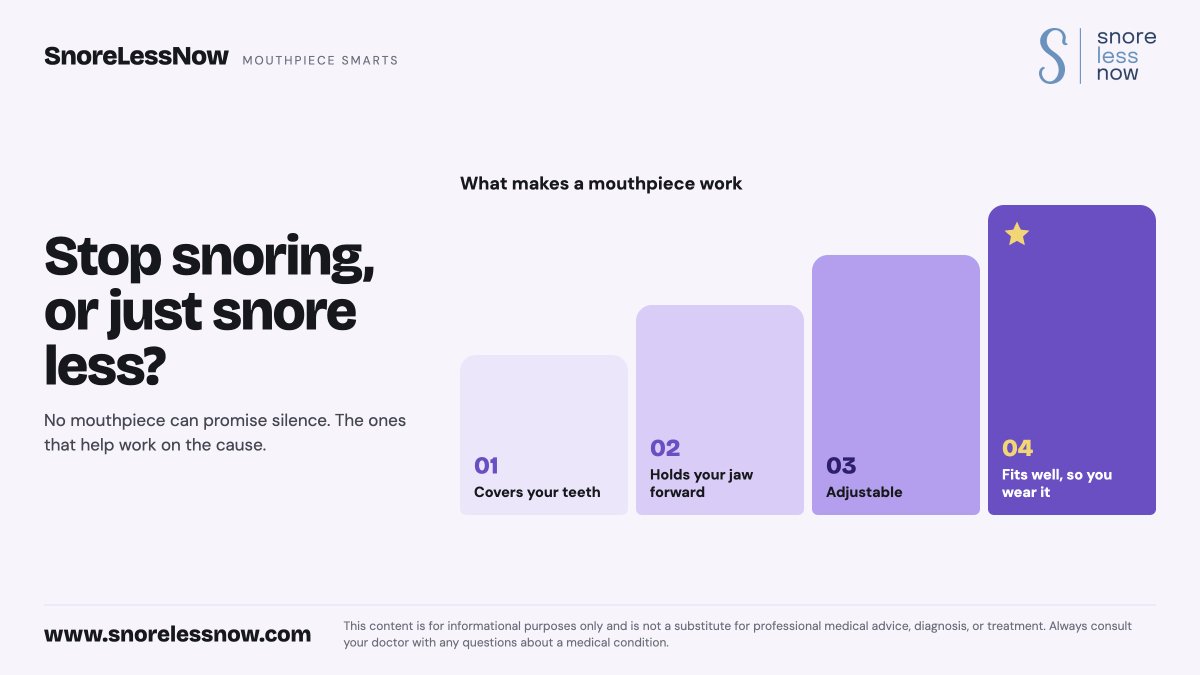
Stop #snoring, or just snore less? That distinction matters more than any product page will admit. No #OralAppliance can promise silence, and the ones that promise it the loudest tend to deliver it the least ⭐
Here is what actually makes a snoring mouthpiece work. One: it covers your teeth securely so it stays in place. Two: it holds your lower jaw gently forward, which is the actual mechanical change that quiets the airway. Three: it is adjustable so you can titrate the advancement to what your mouth tolerates. Four, and this is the one most buyers underestimate: it fits well enough that you actually keep wearing it. A mouthpiece that works great on paper and lives in a drawer is not a working mouthpiece.
Research supports mandibular advancement devices for primary snoring. The honest frame is reduction, not silence 💙
Read the full breakdown: https://t.co/Cnpowy8KnD 👉
#SnoringSolutions #SleepHealth
Your 5 minute #snore workout. One minute per move, every night. Here is the full routine from our new infographic, no equipment needed 🤓
1. Tongue press. Press the whole tongue against the roof of your mouth, hold a few seconds, release, repeat.
2. Tongue push. Stick your tongue straight out as far as is comfortable, hold, release, repeat.
3. Strong swallow. Take a small sip of water and swallow with your tongue pressed against the roof of your mouth. Repeat.
4. Vowel sounds. Say A, E, I, O, U slowly, with exaggerated mouth movements.
5. Tongue holds. Press and hold your tongue against the roof of your mouth, keeping your jaw relaxed.
One minute each. Honest caveat: results from these #TongueExercises may take weeks or months, and they will not reach every cause of snoring. But as a #BedtimeRoutine upgrade, it is nearly free 🌙
Read the full breakdown: https://t.co/xgX6oQ0sG2 👉
#MyofunctionalTherapy #SleepHealth
A quick five-row map that explains more about #snoring than most product pages will. Match the symptom to the cause. Then the fix becomes obvious 🎯
Worse when stuffed up → nose. The congestion is narrowing your nasal airway and often pushing you into mouth breathing. Much worse on your back → position. Gravity is pulling the tongue and soft tissue toward the back of your throat. Louder after a drink → habits. Alcohol relaxes airway muscles beyond what sleep already does. No better after you have tried the basics → jaw. Your lower jaw is relaxing backward during sleep and narrowing the space behind your tongue. Gasping, choking, or breathing pauses → see a doctor.
One tool rarely fits every cause. The useful first step is pattern recognition, not product shopping 🌙
Read the full breakdown: https://t.co/fkVOidAvT2 👉
#SleepHealth #SnoringSolutions
Picking between a jaw mouthpiece and a tongue device for #snoring comes down to one question most product pages do not ask: what is your mouth actually working with? 🔍
A jaw mouthpiece (mandibular advancement device) holds your lower jaw forward during sleep and brings the tongue with it. It needs healthy, secure teeth to anchor to. It has the larger research base behind it, with a randomized trial finding snoring eliminated in 40.9% of users compared to 27.3% for tongue devices. It may suit you if advancing the jaw forward feels comfortable and your teeth are in good shape.
A tongue device uses gentle suction to hold the tongue tip forward without touching the jaw. No teeth needed. More limited research, but may suit you if jaw advancement is not an option, if you have dentures or extensive dental work, or if you have tried a jaw mouthpiece and could not tolerate it. The right fit depends on your mouth, not on which product has more marketing 🙂↕️
Read the full breakdown: https://t.co/JKfbgY56B9 👉
#OralAppliance #SleepHealth
If you have scrolled TikTok lately you have probably seen #mewing content promising a sharper jawline from pressing your tongue to the roof of your mouth. The underlying idea has a quieter, more research-backed cousin: #MyofunctionalTherapy 🧑🏻⚕️
This is a structured program of tongue, lip, cheek, and throat exercises originally used for swallowing and speech, now studied as a #snoring aid. A 2018 meta-analysis in European Archives of Oto-Rhino-Laryngology found that oropharyngeal and tongue exercises reduced snoring frequency and intensity in adults. Most people see noticeable improvement around 6 to 8 weeks of consistent practice. There is even a 2020 study where participants played the didgeridoo for four months and saw real reductions in snoring.
What it will not do is clear a blocked nose, change your jaw anatomy, or treat sleep apnea on its own. For jaw-driven snoring, you need a different tool. But as a complement, mouth training has earned its spot ☝🏻
Read the full breakdown: https://t.co/Mb0SKBMwAc 👉
#SleepHealth #SnoringSolutions
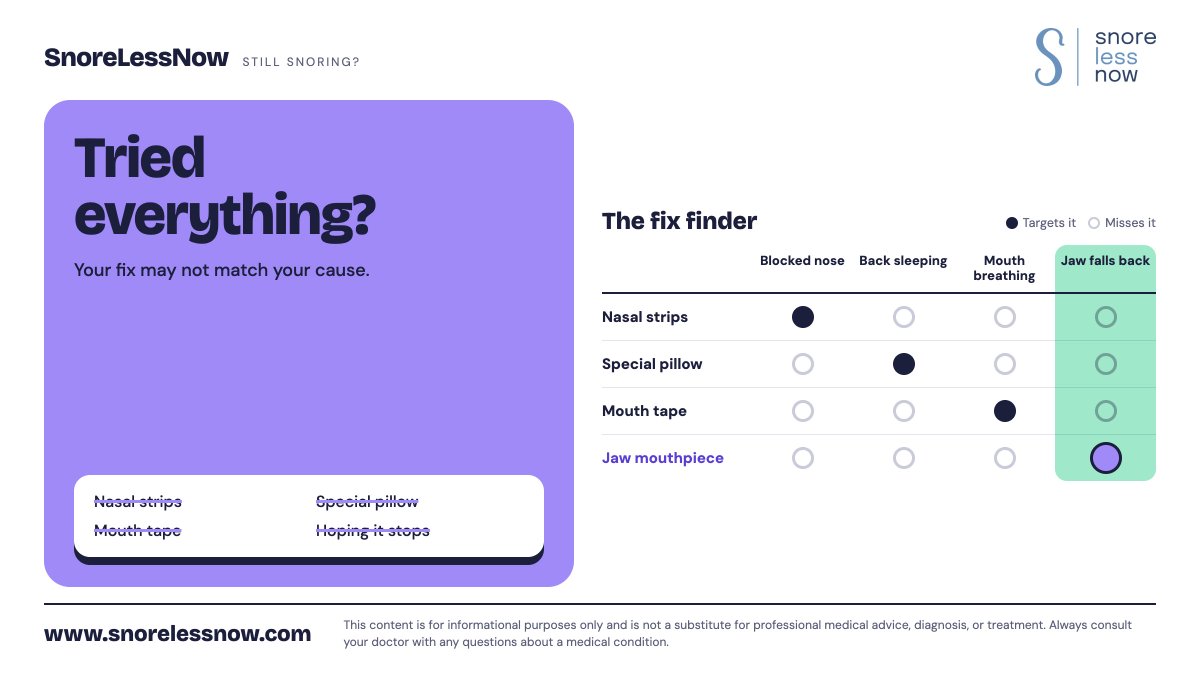
Before considering a #SleepDivorce, worth checking something. Most people who have “tried everything” for #snoring have actually tried four things aimed at three causes. The fourth cause rarely gets touched 💤
Nasal strips target a blocked nose. A special pillow targets back sleeping. Mouth tape targets mouth breathing. Each one works, but only for the specific cause it was designed for. If none of them have quieted your snoring, your cause may be the fourth one on the list: a jaw that relaxes backward during sleep, narrowing the airway behind your tongue. No strip, pillow, or tape reaches that. A mandibular mouthpiece does.
This is why so many couples move to separate rooms before they have actually matched the fix to the cause. The products did not fail. They were just aimed at a different problem 🌒
Read the full breakdown: https://t.co/Drm5rKzx4o 👉
#SleepHealth #SnoringSolutions
If you have been chalking up your constant morning fatigue to stress, age, or just needing more coffee, there is one quiet possibility worth considering. #Snoring. Even your own, even when it does not fully wake you 🔋
Here is the mechanism in plain terms. Each time your airway narrows during sleep, your brain triggers a tiny arousal to restore breathing. You never remember these moments, but they fragment the deep and REM sleep your body needs to actually feel rested. Over a full night, dozens or hundreds of these micro-interruptions can turn 8 hours of in-bed time into a fraction of real recovery. Same hours. Depleted battery.
If #WakeUpTired is your normal, better airflow is often the piece worth checking before more supplements or longer nights. And if snoring comes with gasping or breathing pauses, that is a doctor conversation 🩺
Read the full breakdown: https://t.co/xYIcsixkaT 👉
#SleepQuality #MorningFatigue
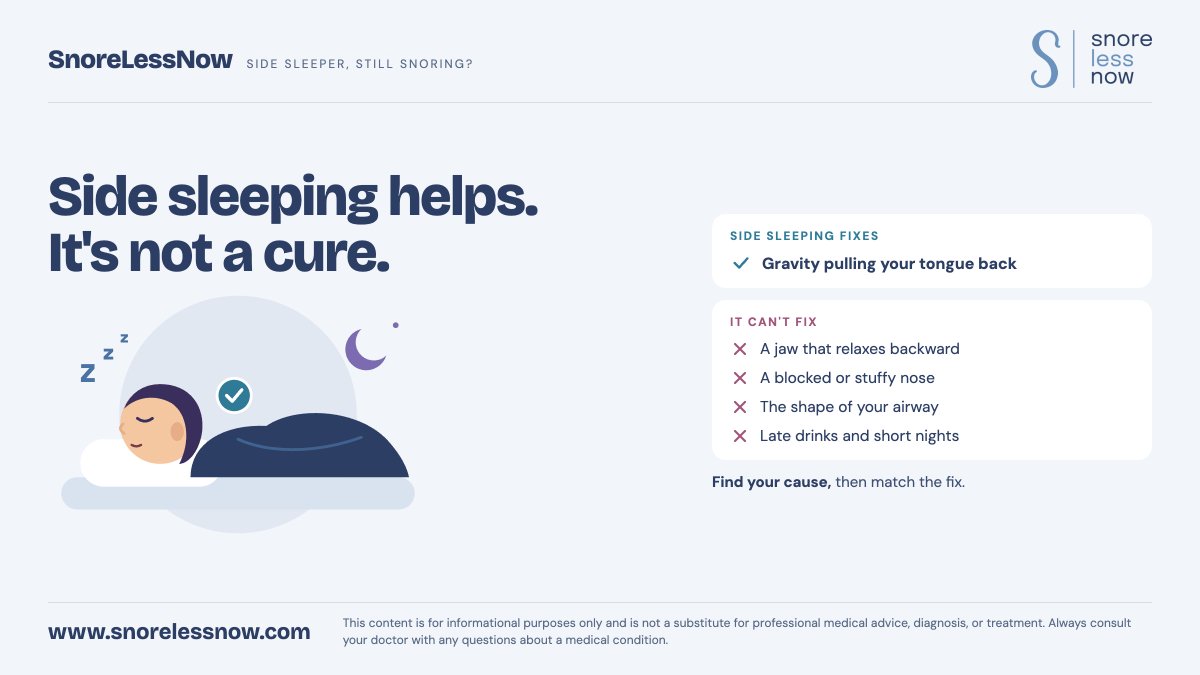
Side sleeping helps. It is not a cure. If you are a #sidesleeper and still waking your partner, that reframe is probably the most useful thing you can read today 🌙
Side sleeping genuinely addresses one specific cause of #snoring: gravity pulling your tongue and soft tissue toward the back of your throat. That is why rolling off your back can meaningfully quiet the noise. But it cannot fix a jaw that relaxes backward during sleep, a blocked or stuffy nose that forces mouth breathing, the shape of your airway, or the late drinks and short nights that amplify everything else.
This is why #Sleepmaxxing culture gets snoring wrong. There is no single hack that works for everyone. The useful question is not “what sleep trend should I try next?” It is “what is actually narrowing my airway, and what matches that cause?” Find your cause, then match the fix 🩺
Read the full breakdown: https://t.co/kl1LDRuQh2 👉
#SleepHealth #SnoringSolutions
If your #snoring started during #pregnancy or showed up for the first time in #perimenopause, you are not imagining it. Research suggests roughly 28% of adult women snore regularly, and the number climbs significantly after menopause. The hormonal connection is real 😮
During pregnancy, increased blood flow and fluid retention commonly cause nasal congestion. One study of nearly 1,700 pregnant women found 34% snore, with 25% developing pregnancy-onset snoring. It often resolves after delivery.
Around menopause and perimenopause, declining estrogen and progesterone affect upper airway muscle tone and shift fat distribution. One study found 47 to 67% of postmenopausal women show signs of obstructive sleep apnea. The most alarming piece: as many as 93% of women with OSA are undiagnosed, partly because snoring has long been treated as a male issue and partly because symptoms in women can look different (fatigue, insomnia, mood changes rather than loud nighttime noise) 😮💨
If this sounds familiar, it deserves a conversation with a doctor rather than silence.
Read the full breakdown: https://t.co/hbpD7mBz6N 👉
One honest thing to know before buying any #snoring product. No single snoring cure works for everyone. The reason so many products disappoint is not because they are bad. It is because they were aimed at the wrong cause 🎯
Match the fix to the cause. Jaw slips back during sleep, narrowing the airway behind the tongue? A mandibular mouthpiece holds it forward. Blocked nose from allergies or structure forcing you into mouth breathing? A nasal dilator opens the airway at the source. Snoring loudest on your back? Positional aids keep you on your side. Daily habits amplifying everything else, like late alcohol or inconsistent bedtimes? Small daily changes reach what no device can.
The honest answer is often not one product but the right combination for your actual pattern. Start by understanding why you snore. Everything useful follows from there.
Read the full breakdown: https://t.co/Vm2tx3dfBd 👉
#SleepHealth #SnoringSolution
Strange is normal. Pain is not. If you are new to a #snoring mouthpiece, that one line is probably the most useful thing to hold on to ‼️
Normal at first means noticing the device in your mouth, producing more saliva than usual, and mild jaw awareness as your mouth adapts. These sensations are part of adjustment, not signs something is wrong. Check the fit if the device slips during the night, feels tight enough to pinch, or makes you gag. Those are fixable with proper fitting instructions and sometimes a different size, not something to tolerate.
Stop and get professional help if you notice ongoing tooth or gum pain, changes to how your bite feels, significant jaw discomfort that does not improve, or trouble breathing. Those are not adjustment issues. They are signals that the device or your situation needs a professional eye before you continue. The goal is a mouthpiece you can comfortably wear every night, not one you push through 💤
Read the full breakdown: https://t.co/3HyouNj7gn 👉
#SleepHealth #SnoringSolutions
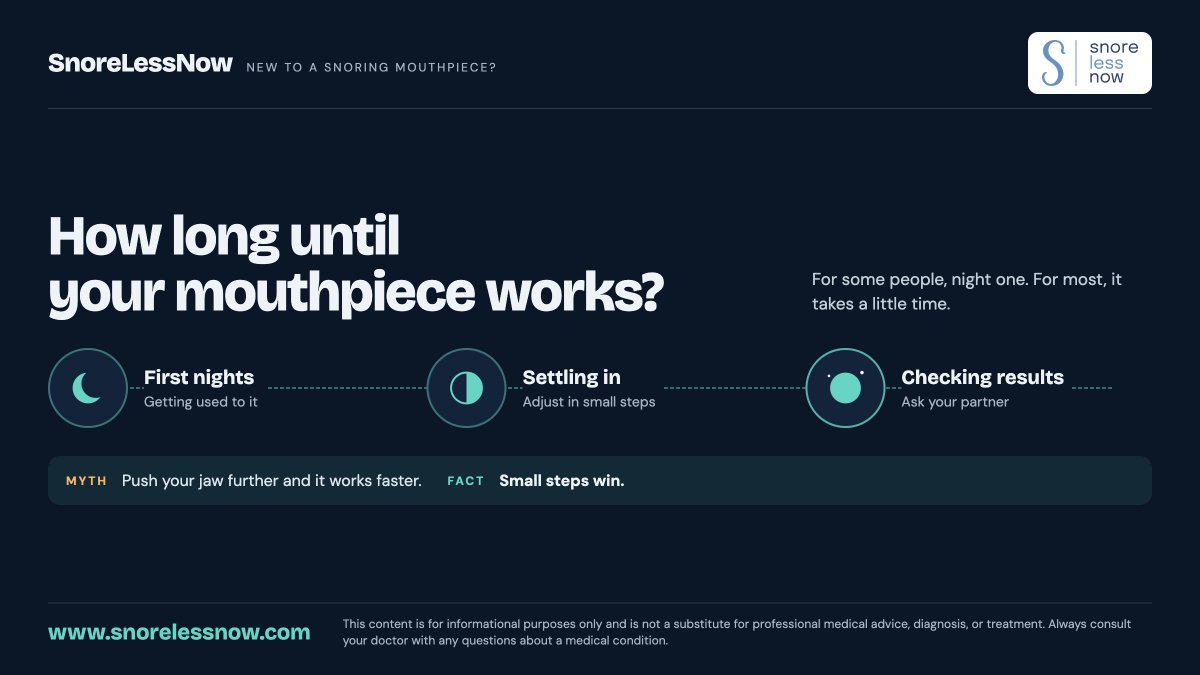
How long until your #snoring mouthpiece actually works? The honest answer is one most product pages skip. For some people, night one. For most, it takes a little time 😴
Two separate timelines are at play, and conflating them is where frustration starts. The first is comfort. Your mouth and jaw need a few nights to adapt to wearing something new overnight. Mild awareness, extra saliva, and jaw sensation during that period are normal. The second is effectiveness. That is about whether the device is addressing the actual cause of your snoring, which is harder to judge yourself because you are asleep when it is happening. The most reliable signal is asking your partner whether the sound has changed.
One important myth to retire. Pushing the jaw further forward does not make the device work faster. Small adjustments within the manufacturer’s recommended range tend to outperform aggressive ones, both for comfort and for finding your effective position 💙
Read the full breakdown: https://t.co/HsphwDjG91 👉
#SleepHealth #SnoringSolutions
Two oral appliances for #snoring and sleep apnea can look similar from the outside but work on completely different principles. Knowing the distinction matters if you are weighing options with your dentist 🦷
A standard mandibular advancement device, or MAD, uses upper and lower components to gently move the lower jaw forward during sleep. That forward position also brings the tongue with it, which helps keep the upper airway open. The Full Breath Solution takes a different design route. It is a single arch appliance with a posterior tongue restrainer that limits backward and upward tongue movement directly, without relying on mandibular advancement.
Both aim to support airflow during sleep. The right one depends on your anatomy, your diagnosis, and which mechanism your dentist or sleep professional thinks fits your case. Neither should be self prescribed, especially if obstructive sleep apnea is involved 😴
Read the full breakdown: https://t.co/lUlrNQpued 👉
#OralAppliance #SleepApnea
If you have been quietly wondering why your morning breath is especially rough on nights you snored a lot, there is a specific chain reaction behind it. Worth knowing because once you see it, breaking it gets easier 💧
You snore with your mouth open. Your mouth dries out. Saliva, which is your mouth’s natural rinse, runs low. Without enough of it, bacteria on the tongue multiply and produce the volatile sulfur compounds behind the smell. By morning, you have the dry, funky taste that no amount of brushing the night before quite prevents.
Three small habits break the chain. Encourage nose breathing with a nasal dilator or by addressing nasal congestion so your mouth has less reason to fall open overnight. Keep water on the nightstand to sip if you wake up dry. And tackle the #snoring itself, since fixing the source saves your mouth from drying out in the first place 😴
Read the full breakdown: https://t.co/2wIz9hQDfZ 👉
#OralHealth #SleepHealth