Healthcare decisions are based on 63 minutes of clinical data each year.
But the other 525,000 minutes of someone’s life shape outcomes just as much.
Trenor Williams shares why social risk insights are essential to delivering effective care.
So why does healthcare keep doing the same things with the same old datasets? There’s a better way—one that improves patient outcomes and strengthens financial performance.
Social risk factors are measurable, addressable, and essential for breaking the cycle.
#SDOH
It’s hard to put a cost on what you don’t know. But ignoring social risk carries a steep one.
We know that 50–80% of health outcomes are shaped by social factors. Yet in healthcare, we spend most of our time treating the symptoms of specific diseases.
We've built programs for diabetes, hypertension, heart disease…
But if look at the big picture, something’s not working. Despite all that investment, as a country, we’re getting less healthy. More ER visits. More hospitalizations. More readmissions.
And the data universe is only expanding:
Wearables
Climate trends
Environmental factors
Just think about Arizona’s 21 straight days of 105°+ heat and what that means for managing chronic illness.
We’re excited to announce https://t.co/rhCrhVmGv4 has engaged us to integrate social risk data into their platform, Implify®, helping them focus their efforts to identify and prioritize high-risk members for social care intervention.
https://t.co/HkpdrVfRyh
“Individual-level measures of SDOH are critical for studying the impact of #SDOH on health outcomes.” They suggest z-code capture as an answer, but why stop there? And why wait when you can use SocialScape for individual risk data to intervene sooner?
https://t.co/at6MVQeO6F
We're on an incredible journey thanks to the input of our clients. SocialScape delivers a proven outcome and cost savings ROI across sectors. In that spirit, and as the industry experts in #SDOH data, we’re excited to share our latest rounds of updates!
https://t.co/Gvf1UilE6u
Measuring an SDOH ROI is one of the biggest challenges in healthcare. We love a challenge though, so we set to work and did it. Download our white paper to see our real-world, third-party validated report on savings and health outcomes that we delivered.
https://t.co/Ba6uMTDw6a
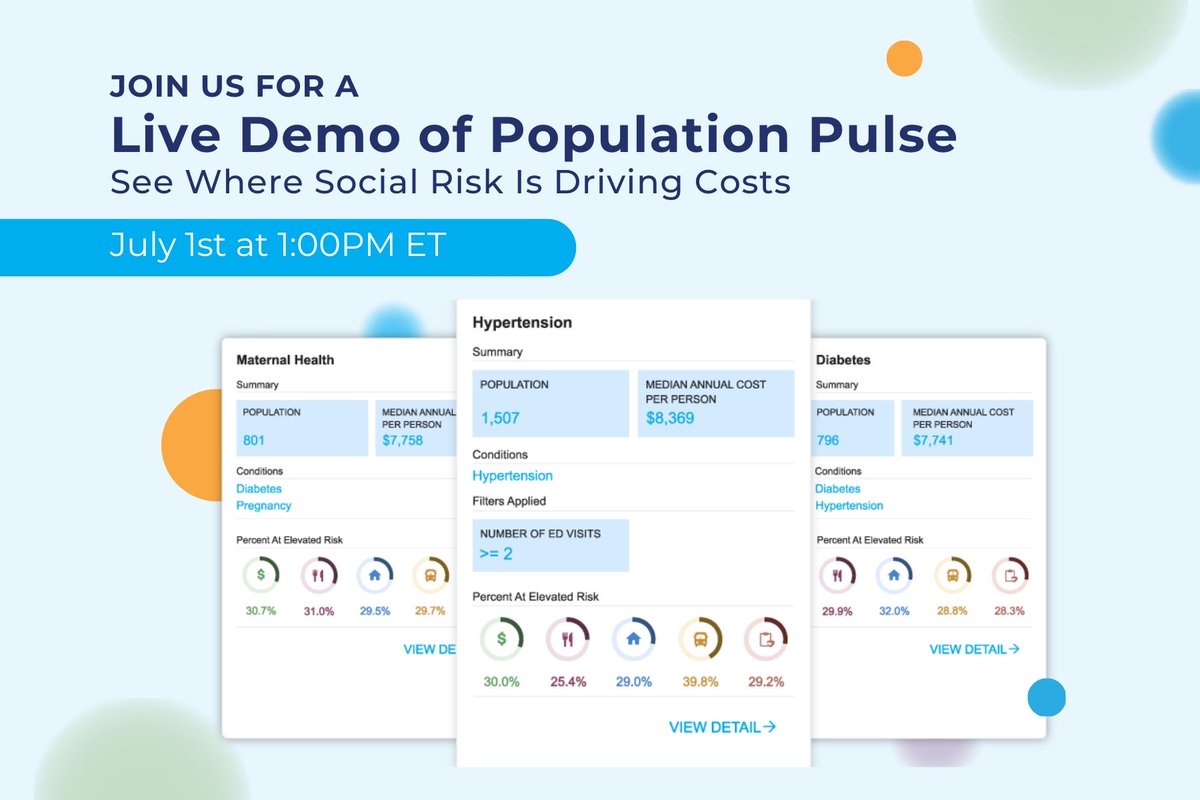
Social risk affects cost and outcomes. But tying those risks to financial impact is the hard part.
Population Pulse integrates your claims data with social risk insights, helping you pinpoint which members are driving costs.
https://t.co/mIitNv9aqc
With Netrin Health, we supported research identifying patients at risk of avoidable high-cost care, driven by clinical + social factors. Netrin used the insights to target outreach, improve outcomes, and cut costs.
🔗 https://t.co/fZIY2oLW4e
Exciting to see commercial & benefit management spaces engage with the impact of SDOH. By leaning into wellness offerings aligned to SDOH, the quality of life for commercial beneficiaries improves & premiums are managed as effectively as w/ VBC populations
https://t.co/VafRfjbTIj
New Blog: Last week we outlined where traditional approaches to #SDOH data can limit or block interventions. Today we talk about doing it right and how it affects clinical and financial outcomes.
https://t.co/kztR7Xs8zX
You know social risk affects cost and outcomes. But tying those risks to financial impact? That's the hard part.
Population Pulse integrates your claims data with social risk insights, helping you pinpoint which members are driving costs.
Register here: https://t.co/TZiH35yhiX
Social risk drives costs. But without the right data, it’s hard to see where to act. Population Pulse integrates your claims data with social risk insights, helping you pinpoint which members are driving costs.
👉 Register here https://t.co/vmxiMLCNNP
Let’s talk about #SDOH surveying and where it falls short in capturing all of the social challenges people face, unnecessarily making them sicker and costing millions of dollars in reactive approaches to intervention.
https://t.co/Q98xOIiL5r