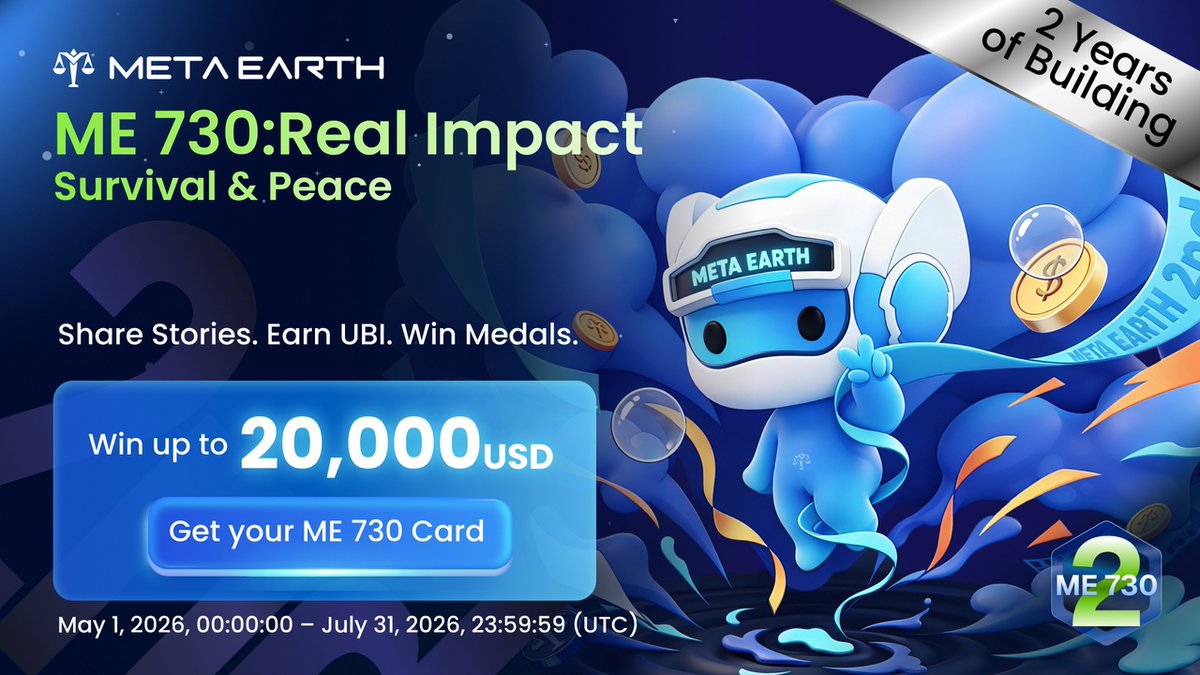
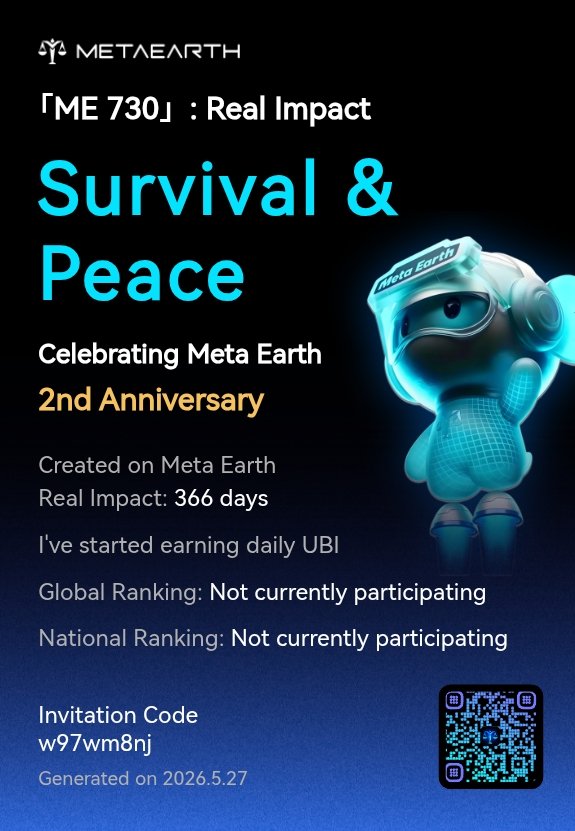
#ME730 is LIVE. Win up to $20,000 USD.
🗓️ Duration: May 1, 2026 – July 31, 2026 (UTC)
Two years ago, we started with one simple belief: 𝘌𝘷𝘦𝘳𝘺 𝘱𝘦𝘳𝘴𝘰𝘯 𝘥𝘦𝘴𝘦𝘳𝘷𝘦𝘴 𝘢 𝘣𝘢𝘴𝘦𝘭𝘪𝘯𝘦 𝘰𝘧 𝘴𝘵𝘢𝘣𝘪𝘭𝘪𝘵𝘺, 𝘯𝘰 𝘮𝘢𝘵𝘵𝘦𝘳 𝘸𝘩𝘦𝘳𝘦 𝘵𝘩𝘦𝘺 𝘢𝘳𝘦, 𝘯𝘰 𝘮𝘢𝘵𝘵𝘦𝘳 𝘸𝘩𝘢𝘵 𝘵𝘩𝘦 𝘸𝘰𝘳𝘭𝘥 𝘵𝘩𝘳𝘰𝘸𝘴 𝘢𝘵 𝘵𝘩𝘦𝘮.
Today, over 5 million real people are already receiving daily #UBI through #MetaEarth.
Not promises. Not hype. Real income that arrives every single day.
ME 730 is our way of making that impact visible:
✔️ Generate your achievement card.
✔️ Share your story.
See how many lives you’ve already helped steady. Compete on the global leaderboard to share $47900USD
This is not just another campaign.
This is the record of what we’ve built, together.
From survival… toward peace.
Generate your card now 👉 https://t.co/NJLrOs0Z8I
Please refer to this announcement for the detailed rules 👉 https://t.co/k6NgeTgeUx
#MyMetaEarthStory
「ME 730」: Real Impact I’ve started earning daily unconditional basic Income and helping more people do the same. Create your impact with us and win up to $20,000 in rewards! Join here:... Read more:
https://t.co/AGiGlvmx1m
Signals can help once.
Understanding the market can help for a lifetime.
Metatronics Crypto Academy is designed to teach users how professional traders think about market structure, risk, hedging, OTC opportunities and disciplined execution.
The real edge is not a signal.
The real edge is knowledge.
Choose your level soon: Starter, Core or VIP.
Enter the Grove 🌳
For the first time, Grove's institutional credit infrastructure is welcoming wider community participation.
Deposit USDS or USDC, access @Skyecosystem Savings Rate, and put your early participation on record.
The Grove App is live: https://t.co/a3VakCkshd
Meet Bradley Peak, CEO of METATRONICS 🟣
Cambridge. Sumsub. CoinDesk contributor. Bitcoin Conference 2026 speaker. A public leader with a verified professional track record
In this video, Bradley personally breaks down the product, the tech, and our vision for the next 6 months. No anonymity, no fluff
[https://t.co/tMnHl8Hxri]
[https://t.co/sSyVhLIIZC]
[https://t.co/ObphZGlcQm]
Watch below 👇
Not financial advice. Trading involves risk
💊 Community Question:
Can AI help discover and develop new medicines much faster and cheaper than traditional methods?
Viewpoint A:
Yes. AI can rapidly test millions of drug ideas, cut early research time and costs dramatically, and in some cases bring medicines to patients years faster.
Viewpoint B:
Not fully. AI helps at the start, but human trials are still slow, expensive, and unpredictable, keeping overall drug development costly and time-consuming.
If AI is expected to change how medicines are made, is the impact already real or mostly promise?
👇 Drop A, B, or share your perspective.
💊 Community Question:
Can AI help discover and develop new medicines much faster and cheaper than traditional methods?
Viewpoint A:
Yes. AI can rapidly test millions of drug ideas, cut early research time and costs dramatically, and in some cases bring medicines to patients years faster.
Viewpoint B:
Not fully. AI helps at the start, but human trials are still slow, expensive, and unpredictable, keeping overall drug development costly and time-consuming.
If AI is expected to change how medicines are made, is the impact already real or mostly promise?
👇 Drop A, B, or share your perspective.
Healthcare affects your life.
Your thoughts should affect healthcare.
Discuss with me: https://t.co/X0GKVEf2jn
Code: MAOYF2X
#LifeAITestnet#HealthcareAI
🩺 Community Question
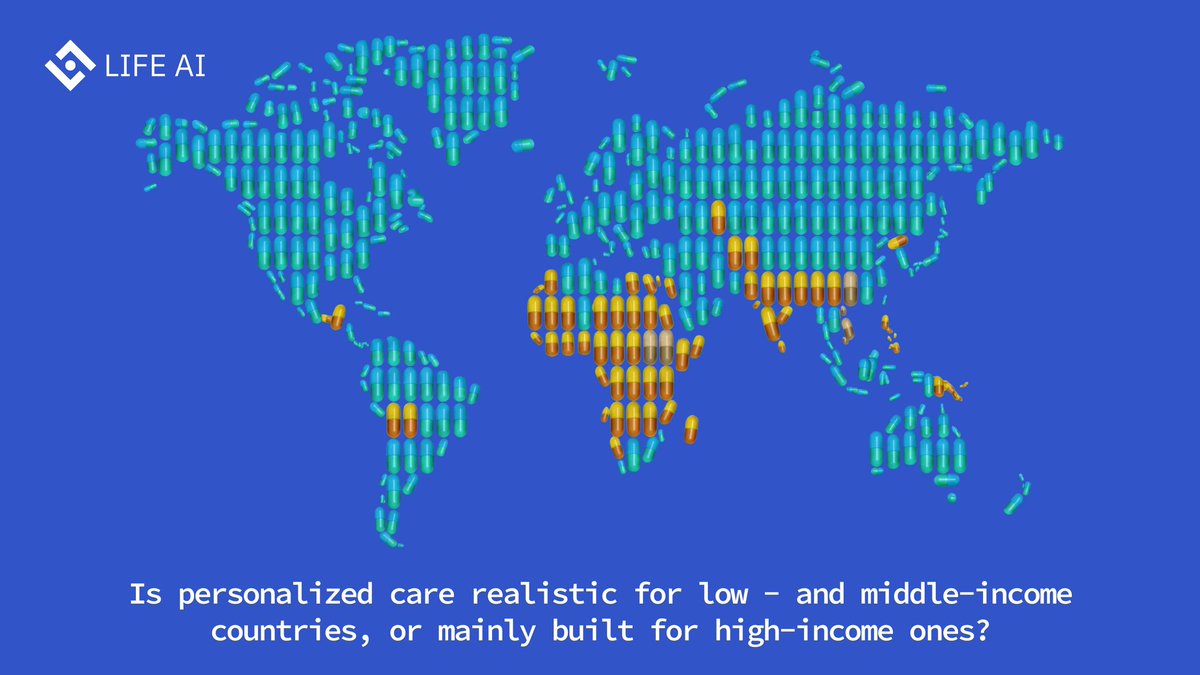
Is personalized care realistic for low- and middle-income countries (LMICs), or is it still a model built mainly for high-income countries (HICs)?
Viewpoint A: Gradually achievable in LMICs
Personalized care can scale over time. Costs of genetic and digital tools are falling, AI-driven insights are becoming more accessible, and hybrid models already work in areas like oncology and chronic care. With the right partnerships and focus, personalization doesn’t have to remain a luxury.
Viewpoint B: Not practical for most LMICs
For many LMICs, personalized care remains unrealistic. High costs, limited infrastructure, workforce gaps, and unequal access make large-scale adoption difficult. Healthcare systems should prioritize proven, low-cost interventions like vaccination, screening, and basic prevention.
Or is the future of healthcare built by combining both approaches?
👇 Drop A, B, or share your perspective.
Tag someone who should weigh in on this.
Future healthcare should feel personal, not mechanical.
Your insight can help shape that shift.
Join the debate with @LifeNetwork_AI: https://t.co/X0GKVEf2jn
Code: MAOYF2X
#LifeAITestnet#HealthcareAI
🩺 Community Question
Is personalized care realistic for low- and middle-income countries (LMICs), or is it still a model built mainly for high-income countries (HICs)?
Viewpoint A: Gradually achievable in LMICs
Personalized care can scale over time. Costs of genetic and digital tools are falling, AI-driven insights are becoming more accessible, and hybrid models already work in areas like oncology and chronic care. With the right partnerships and focus, personalization doesn’t have to remain a luxury.
Viewpoint B: Not practical for most LMICs
For many LMICs, personalized care remains unrealistic. High costs, limited infrastructure, workforce gaps, and unequal access make large-scale adoption difficult. Healthcare systems should prioritize proven, low-cost interventions like vaccination, screening, and basic prevention.
Or is the future of healthcare built by combining both approaches?
👇 Drop A, B, or share your perspective.
Tag someone who should weigh in on this.
🩺 Community Question
Is personalized care realistic for low- and middle-income countries (LMICs), or is it still a model built mainly for high-income countries (HICs)?
Viewpoint A: Gradually achievable in LMICs
Personalized care can scale over time. Costs of genetic and digital tools are falling, AI-driven insights are becoming more accessible, and hybrid models already work in areas like oncology and chronic care. With the right partnerships and focus, personalization doesn’t have to remain a luxury.
Viewpoint B: Not practical for most LMICs
For many LMICs, personalized care remains unrealistic. High costs, limited infrastructure, workforce gaps, and unequal access make large-scale adoption difficult. Healthcare systems should prioritize proven, low-cost interventions like vaccination, screening, and basic prevention.
Or is the future of healthcare built by combining both approaches?
👇 Drop A, B, or share your perspective.
Tag someone who should weigh in on this.
🩺 Community Question
Is personalized care realistic for low- and middle-income countries (LMICs), or is it still a model built mainly for high-income countries (HICs)?
Viewpoint A: Gradually achievable in LMICs
Personalized care can scale over time. Costs of genetic and digital tools are falling, AI-driven insights are becoming more accessible, and hybrid models already work in areas like oncology and chronic care. With the right partnerships and focus, personalization doesn’t have to remain a luxury.
Viewpoint B: Not practical for most LMICs
For many LMICs, personalized care remains unrealistic. High costs, limited infrastructure, workforce gaps, and unequal access make large-scale adoption difficult. Healthcare systems should prioritize proven, low-cost interventions like vaccination, screening, and basic prevention.
Or is the future of healthcare built by combining both approaches?
👇 Drop A, B, or share your perspective.
Tag someone who should weigh in on this.