Being a dev , I’ve always wish there was a way to send someone an onchain bug report they could actually run. So that’s the idea I’d like to see built on X Layer with @TapeOutWorld.
Say a user deposits 100 units into a vault. They withdraw 30, receive a reward of 10, and the vault reconciles their balance to 80. Then they try to withdraw another 50, and the transaction reverts.
The transaction hash gets the developer to the revert. The next step is figuring out how the vault got there. What failed , Which transactions changed the balance before the withdrawal? Which version of the contract was running? What did the reconciliation update? By the time a second developer picks up the issue, they may have to reconstruct the whole sequence before they can try a fix.
I’d call the tool DSRN, short for Deterministic State Replay Network. The main thing it would produce is a file called a Replay Capsule.
A developer could attach it to an issue so the next person has the starting state, the ordered transactions, the relevant contract versions, and a description of what was expected.
A replay adapter would use that information to run the scenario against the actual contracts in a compatible local environment.
The capsule would also say where its information came from. Maybe the transactions came directly from the chain, the starting state was reconstructed from an earlier block, and a response from an offchain service was unavailable.
The developer opening the capsule can see those gaps and judge how much of the original run they can reproduce.
This is where I’d use TapeOut. The protocol team could encode the vault’s withdrawal rule in a versioned TapeOut circuit. Give the contract and the circuit the same modeled starting state and withdrawal request.
If the circuit says the request should succeed and the balance should end at 30, while the contract reverts and leaves it at 80, the comparison points the developer to the first event where the two results differ. The result would name the circuit version and the rule it checked, so another developer can repeat that comparison against the same reference.
I’d start with one vault on X Layer, one replay adapter, and one scenario that goes all the way from a reported revert to a repeatable test.
After a fix, the team could keep the capsule in CI and run it before each contract upgrade. The reviewer on the next upgrade would have a concrete case to run, with the same inputs and expected behavior that exposed the original bug.
I can see the same workflow helping a lending team investigate a liquidation that happens only after an oracle update and an interest accrual.
They could share the sequence with an auditor or run it against a proposed upgrade. Both people would start with the same case and see exactly which part of the behavior the reference model covers.
If you maintain or audit contracts, what’s one failure you’d want to hand someone as a runnable file?..
Pitching DRSN for the @TapeOutWorld x @XLayerOfficial Idea to be built Onchain..
Little explainer of what DRSN would do 👇
Most crypto wallets show you what happened. Mind helps you understand what it means.
Introducing Mind.
Your financial life, remembered.
One of the biggest limitations of onchain financial tools is that they understand transactions, but very little about the person making them.
Your wallet accumulates years of activity: assets you hold, protocols you interact with, patterns in your behaviour and the financial decisions you make over time.
But most tools treat every interaction as a fresh start.
They show balances, transaction histories, charts and analytics. Ask a question today, and you might get an answer based on your current wallet data. Come back tomorrow, and much of the context behind your previous conversations is gone.
There is no continuity. No lasting understanding of your financial behaviour. No real sense of how your activity has evolved.
That’s the problem we’re solving with Mind.
Mind is a Sui-native financial intelligence companion designed to understand your onchain activity, remember meaningful financial context and make its analysis more personal over time.
Here’s how it works:
→ Tatum provides the onchain data. Mind uses Tatum’s Sui RPC infrastructure to access real blockchain activity and understand what’s happening across your wallet.
→ Walrus Memory provides persistence. Instead of treating every session independently, Mind preserves meaningful insights and context so they can be retrieved and used in future interactions.
→ Mind AI brings everything together. It reasons over current wallet activity and relevant historical memories to deliver financial analysis that takes your behaviour and history into account.
But what makes Mind different isn’t simply that it uses AI or stores memories.
It’s the combination of onchain intelligence and persistent personal context.
Mind is designed to understand more than what you hold. It aims to recognise how you use your assets, which protocols you interact with, the patterns in your activity and how your financial behaviour changes over time.
That context matters.
For example, two people can have similar wallet balances and completely different financial behaviours. A generic wallet analyzer might give them similar observations. Mind aims to provide analysis that reflects their individual history.
And there’s another important part: Memory Replay.
We wanted to demonstrate the actual value of persistent memory, not simply claim that Mind remembers.
Memory Replay compares the analysis generated from the same wallet snapshot with and without retrieved user memories. It makes the difference between generic analysis and context-aware analysis visible.
The goal is simple:
A financial intelligence system that doesn’t forget everything it has learned about you every time you close the app.
Tatum helps Mind understand what’s happening onchain.
Walrus helps Mind remember what matters.
Mind uses both to understand your financial journey with greater context.
We’re building beyond transaction dashboards and one-off AI answers.
We’re building financial intelligence that gets more meaningful as it remembers more of your journey.
This is Mind.
Your financial life, remembered.
AI agents are becoming capable of researching, planning, coordinating tasks and taking action on our behalf.
But there’s one important question we haven’t solved well enough:
How much authority should an AI agent actually have over your money?
Giving an agent access to a wallet is easy. Giving it permission to spend responsibly, within clear boundaries, is a much harder problem.
That’s what we’re building with Mandate.
Mandate is an autonomous spending and agent orchestration platform built around a simple idea: users should be able to delegate financial tasks without surrendering control.
You define the mandate, set the budget, establish the rules and decide what requires approval.
AI agents can then break objectives into tasks, coordinate with other agents, use external tools and execute eligible transactions when your conditions are satisfied.
Every action operates within the authority you’ve granted. Spending is governed by your policies, not by whatever an AI decides it wants to do.
We’re building this on @NEARProtocol , with OutLayer providing the trusted execution environment.
The goal isn’t to give AI unlimited access to money.
It’s to make financial delegation programmable, governed and verifiable.
AI proposes. Mandate enforces. The user controls. OutLayer executes.
Watch as we bring AI spending Limits to near.. More soon.
#BUILDINPUBLIC #NEARHackathon
Day 2 of building Mandate in public:
One of the biggest challenges with autonomous AI isn’t getting agents to perform tasks. It’s deciding how much financial authority they should have while doing them.
Giving an AI agent access to your main wallet and hoping it behaves responsibly isn’t a solution.
So we’re building something different with Mandate.
Capped Virtual Spending Cards for AI Agents.
Each agent can be issued an isolated virtual spending card backed by OutLayer TEE custody on NEAR.
Instead of giving an agent unrestricted access to funds, you give it a defined spending allowance with rules it cannot simply override.
Each card can enforce:
• A hard spending budget.
• Per-transaction limits.
• Human approval thresholds.
• Approved recipient allowlists.
• Isolated spending authority.
• An instant kill switch to revoke access.
For example, a DeFi research agent can receive its own card with a 0.5 NEAR budget, a 0.1 NEAR transaction limit and approved recipients.
The agent can perform eligible operations within those boundaries without needing access to your master seed phrase.
And if you need to stop it, you can revoke its spending authority.
The idea is simple: Give your agents the ability to spend, not the ability to take control of your wallet.
We���re working towards a future where AI agents can handle real financial tasks while every unit of spending authority remains defined, restricted and accountable.
That’s one of the things we’re building with Mandate.
AI proposes. Mandate enforces. You stay in control.
#BuildInPublic #NEARHackathon
WIF WORLDS: The Living Map
What if $WIF was more than something you held in your wallet? What if it became the foundation of an entire world you could build, shape, and explore?
That’s the idea behind WIF WORLDS, a persistent multiplayer civilization strategy game built on Robinhood Chain, where players turn an open world into their own growing civilization.
Claim land. Establish settlements. Build structures. Gather resources. Upgrade your territory. Expand into new regions. Complete missions and take part in shared world events alongside other players.
But WIF WORLDS isn’t a world where your actions exist only on a screen. The game brings $WIF into the actual gameplay. Players use $WIF for meaningful in-game actions, with real onchain transactions and persistent game activity.
Every settlement starts somewhere. Every structure contributes to your progress. Every player has a place in a world that continues to grow through the actions of its community.
You aren’t simply watching a world develop. You’re helping build it.
Our goal is to create an experience where the community has more to do with $WIF than simply hold it, where ownership, progression, strategy, and multiplayer interaction come together in one living world.
Welcome to WIF WORLDS.
Claim your land. Build your civilization. Shape the living map.
The world is yours to build.
Built for the world is flat hackathon..
Hello @solanamobile@solana ,
Ever had a counter payment for physical products??..
That’s blink and we’re continuing building for @solanamobile.. new features rolling out soon.
Already got on:
NFC Tap to Pay
Scan To On Physical Stores
Printable Store Payments..
More soon…
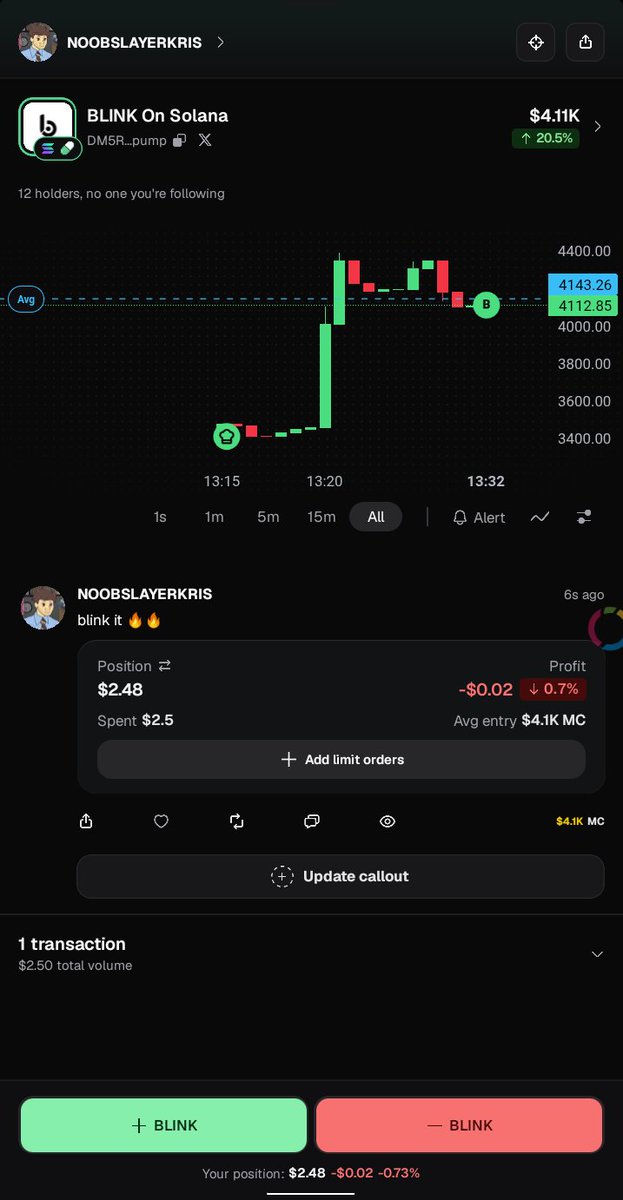
aped in on $BLINK on Pumpfun..
the coin was created by @yemigraffix to support the new launch @solanaBlink
Official CA: DM5R2btqS7bz29mshCmd211RcdpACNdFUHEhnuPQpump
let’s see where this goes. 👀
aped in on $BLINK on Pumpfun..
the coin was created by @yemigraffix to support the new launch @solanaBlink
Official CA: DM5R2btqS7bz29mshCmd211RcdpACNdFUHEhnuPQpump
let’s see where this goes. 👀