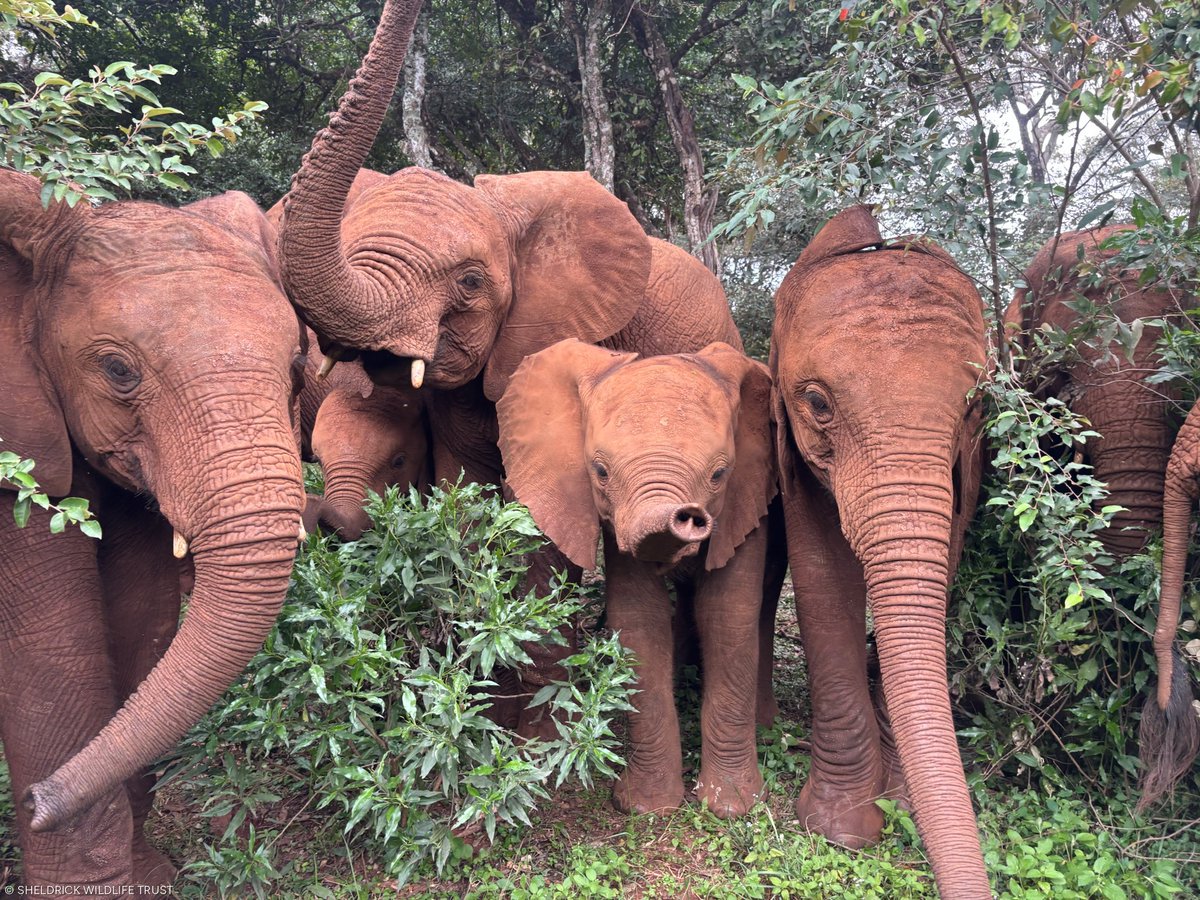
While Weka and Loldaiga were all business heading back to their bedroom, Kitich made a real song and dance of it. Thrilled to see so many visiting wild elephants, the affable youngster wanted to greet each and every one. Some of the big bulls seemed a little taken aback by his friendliness!
Kitich, Weka and Loldaiga are orphans growing up at our Ithumba Reintegration Unit, where they spend their days learning from wild elephants before returning to their secure stockades at night. One day, they too will reclaim their place among Tsavo’s elephants.
Meet the orphans in our care and support their journey back to the wild: https://t.co/CooVpdJj7e
Baby on board! If our maths is correct, Tagwa will have a baby before the year’s end. She is getting bigger and slower – all signs that she’s in the final phases of her pregnancy. While some of our expectant mums are famous for their mood swings (ahem, Murera), Tagwa has been as calm as ever. We can’t wait to meet her baby, whenever it arrives!
In January 2025, a wild bull showed up at Voi and spent several days courting Tagwa. The gestation period of an elephant is 22 months, which means that her due date is drawing ever closer.
Learn more about Tagwa, a ten-year-old orphan rescued, raised, and rewilded through our Orphans’ Project: https://t.co/MsgM6tt9uk
An elephant's trunk contains around 40,000 muscles, allowing the trunk to twist, shorten, elongate, and bend in any direction.
Enkesha proved it as a yearling: after a poacher's snare almost severed her trunk, three vets spent three hours stitching it back together – within two days she had popped every stitch, her trunk simply too mobile for sutures to hold.
It was left to heal naturally, and now she uses those same muscles to close the whole in her trunk, caused by the snare, when filling her trunk with water!
Discover Enkesha's story: https://t.co/83i56mm6vR
Kanjoro has been back to visit. Poaching orphaned him in Laikipia in 2012, when he was not yet two – we raised him, and years ago he returned to the wild. Now he is a grown bull who roams Tsavo on his own terms, passing through the Ithumba stockades every so often to check in with the family who raised him.
Orphaned by poaching, raised by hand, wild once more: that is a legacy worth protecting.
Support the work behind a lifetime like his: https://t.co/NVpsbuFaAn
Wherever Zuri turns, she finds a nanny.
The Nursery's newest and smallest arrival is looked after in shifts by five older girls, usually with two or three at her side at any given moment – a rota of devoted big sisters who take turns escorting, comforting and keeping an eye on her.
Rescued from a septic tank in Tsavo East in May, little Zuri now wants for nothing: milk around the clock, nannies during the day, and a Keeper by her side throughout the night. Like a wild elephant herd, this is how our human-elephant family looks after its youngest – never a moment without someone watching over them.
Become a part of Zuri's care network by adopting her today: https://t.co/RBNyett5B7
A routine anti-poaching patrol. A tiny calf spotted alone in the Tsavo bush. Two pilots watching from the air for nearly two hours, hoping his family would return. They never did.
Today, Arthi turns two.
In this video from the month of his rescue, he was still finding his feet at the Nursery – getting used to his Keepers, his new herd, and the safety of knowing where his next meal would come from.
Now he's an easygoing, independent young bull who enjoys doing his own thing but appreciates the company of gentle friends. He prefers play-wrestling with Taroha and Olomunyak over rougher characters like Pardamat – and that calm, confident nature has made him a favourite among the Nursery herd.
His rescue led to another life saved that day. Two for the price of one. Happy birthday, Arthi.
Adopt Arthi: https://t.co/IiCJ2Ibq7N
Kenze was two years old when he became an orphan of poaching in 2006. Today, he's a wild-living bull, roaming Tsavo on his own terms. Fortunately for us, he still chooses to circle back to the Ithumba stockades every now and then – checking in on the family that raised him, and taking full advantage of the lucerne he knows he'll be offered!
Every visit is a quiet reminder of the difference we can make: an orphan who lost everything, given a second chance, now living fully wild in a vast, protected wilderness.
To every adopter, monthly donor, fundraiser, and friend who stands with us — thank you 🙏
Read Kenze's full story: https://t.co/Vya1nFH6U8
Elephants love babies. Nsimba is no exception.
When ex-orphan Naipoki and her calf, Nsimba, stopped by the Voi stockades for a visit earlier this year, deep rumbles ran out and outstretched trunks from herd of orphans tried to touch her tiny baby. A little overwhelmed, Nsimba dived for cover between her legs – his safe place.
Nsimba's first ever visit to Voi was a similar story: Elephants big and small surrounded the calf with great fanfare, relishing every minute with the tiny baby. And, it seemed, it sparked baby fever among our ex-orphans too, leading to one of the biggest kidnappings we've ever seen (spoiler: everyone is fine!): https://t.co/5nGMVETg1D
It was the community that found Maktao first. Teams mobilised in the hope they'd intercept the lone young calf before he succumbed to predators or human-wildlife conflict. They got lucky.
Nine years on from his rescue, Maktao is a strapping young male living wild in the Kibwezi Forest – a bull who, we hope, might eventually sire calves of his own.
That journey from vulnerable baby to stately bull took many many milk feeds, Keepers sleeping beside him, and years of reintegration at our Umani Springs Unit. Now he disappears into the forest for a week at a time, returning to his human family on his own terms.
Today is his rescue-versary. Celebrate with us by offering your pearls of wisdom for living a fulfilled life in the comments.
Meet three of our extended families at Ithumba. Which family's story would you like to hear more about?
1. Kalama and Kapuki. Kalama fell into a well in Samburu as a four-month-old in 2009. She brought her newborn daughter to the stockades at dawn on 1 July last year, introducing her to the family who raised her.
2. Mutara with Mambo and Mango, surrounded by red soil. Rescued at a week old in 2009 after her herd was poached, Mutara now leads her own ex-orphan herd – and young Mambo has a habit of pushing the dependent orphans around whenever his mother is close enough to back him up.
3. Sities with Sunni and Sullivan. Sities was two months old when poachers left her orphaned in 2010. She arrived at the stockades with newborn Sunni in March last year, escorted by Kainuk and Turkwel.
Every calf pictured here was born wild, to a mother we raised and rewilded. Meet the next generation: https://t.co/gAYG28HymE
When orphaned elephants lose their mothers, they lose everything. That’s where we step in. Our Keepers guide them, as their lost mothers would have done, hand-feed bottles of milk and even sleep bedside them. Walking, side by side, until the orphans are ready to return to the wild.
Adopt an orphaned elephant in our care and you can become a part of their family, helping us to provide care, comfort and protection to wildlife in need. Adopt for yourself at: https://t.co/CooVpdJQWM
This handsome chap is proof that our orphans might be raised by humans, but in adulthood, this matters little to the wild elephants they encounter.
Wild bulls have been arriving at our Umani Springs Reintegration Unit in recent months, drawn through the Kibwezi Forest by our ex-orphans Lima Lima and the other female elephants at Umani. During their flirtations, these bulls don't seem to mind or care about our orphans' more unusual route to the wild – the 94 wild-born calves we know of are testament to this!
One of these offspring is Moon, delivered last month. Meet her: https://t.co/WjZQtajvUC
Six weeks ago, Zuri was rescued in a harrowing nighttime operation after being found trapped inside a septic tank. Since then, she's had round-the-clock care from her Keepers – and a security detail all her own.
Muridjo leads the way and clears her path while Mzinga brings up the rear, sweeping for any threats. This "nanny sandwich" mirrors wild elephant behaviour, where the youngest and most vulnerable are placed at the centre of the herd. Between her Keepers and her new herd, Zuri is quite literally surrounded by love and protection.
She still has a long road ahead – milk feeds, veterinary care, and years of Keeper support before she's ready to return to the wild. By adopting Zuri, you become part of that journey with her: https://t.co/RBNyett5B7
Ithumba isn't only a home for the orphans we raise. Wild bulls drift through all the time – drinking at the troughs, sharing a mouthful of lucerne with the dependent orphans, some lingering to spar with the ex-orphans before heading back out into Tsavo.
They come because, over the years, they've learned it's safe. The clearest proof is a bull we call Dad, a great tusker who has fathered at least two of our wild-born calves. Back in 2015, Dad arrived carrying wounds from a poisoned arrow – and he'd brought two injured companions with him. It's not hard to conclude he led them to Ithumba because he understood they'd be helped there. All three were treated and recovered.
It remains a great privilege each time we see a wild elephant take sanctuary around Ithumba and each visit reaffirms a bond of trust we have with them.
Have you had the privilege of seeing an elephant in the wild – and if so, how did it change the way you see them?
Why do our ex-orphans bring their wild-born calves home to the Keepers?
We can't know exactly what's in their heads. But after ex-orphan Yatta first made the pilgrimage many years ago, nearly every ex-orphan mother has followed suit, and walked her newborn to the stockades, often within hours of giving birth, and introduce the calf to the people who raised her.
It's likely a mix of trust (the Keepers were her family for years), safety (the stockade compound is calm and predictable), and recognition (these are the people she knows). Whether she's actively imprinting her calf with that knowledge or just following her own instinct to come home, the calf grows up understanding that our Keepers and the dependent orphans are a part of their family too.
Meet our newest wild-born calf, baby Moon: https://t.co/WjZQtajvUC
Serenget is an orphan who is very particular about how she drinks her milk: sip by sip, through the tip of her trunk. It takes forever and some orphans aren't quite so understanding.
Losoito is the main culprit at our Voi Reintegration Unit. She has been pushing the younger orphans around the feeding area since Serenget arrived, jostling for position and trying to get to bottles that aren't hers. Some mornings the Keepers feed Serenget inside her stockade to keep her out of Losoito's way altogether.
All that said, despite being surrounded by potential milk thieves, Serenget is perfectly unbothered most of the time. She's thrived since her rescue and made a new pal in recent rescue Lumo too.
Adopt Serenget: https://t.co/CTcIIAUhkP
Our proverbial door is always left open for the ex-orphans to come visit. After eight months away, Chemi Chemi just sauntered in!
We rescued Chemi Chemi in June 2009 from Loisaba Conservancy – a young bull, eight months old, in desperate need of food and company. Brought to Nairobi where we gave him one-to-one care from our Keepers and the comfort and company of a new herd, he recovered. When he outgrew the Nursery, he graduated to our Ithumba Reintegration Unit alongside his bull friends – and the rest, as they say, is history.
Nineteen years on from his rescue, Chemi Chemi is wild. Those friendships from his Nursery days and the bonds forged with his Keepers are still going strong – he still drops by our Ithumba Unit every few months.
Wondering how we know its him? Check out his raggedy, holey ears, all unique identifiers of our beloved bull.
Pips spends her days out in the bush but the nights in her specially built stable, which keeps her safe from Tsavo’s predators. As she continues to grow older and explore her independence, she’ll start to enjoy wild nights out in the bush. But for now, led by a tasty bottle of formula milk, she’s quite happy to retire to her bedroom for the night promptly at 6pm and sleep under the stars. Night night Pips.
Adopt Pips: https://t.co/PhHUL6MgVg
Wamata used to be the spoilt baby. Now she is blossoming into a caring responsible girl.
For months, she was the youngest in our Nairobi Nursery herd – the one the older girls fussed over. Then Kipekee and Daba arrived, smaller and newer, and her role shifted.
She has grown into it beautifully, although she still makes sure she is the centre of attention somehow. Case in point: she has worked out if she lies on her side, the younger orphans will clamber on her belly and even her face. Perhaps she'll be a mini-matriach like Kerrio in the making? Either way, we look forward to seeing how her role in the herd continues to develop.
Adopt Wamata: https://t.co/cEHxj0lg6m