Meet SolFlag 🚩
A free Solana risk scanner. Paste a token and get 5 flags before you ape in:
• Creator control
• Holder concentration
• Market & exit
• Dependency
• Launch & bundles
It also spots bundled wallets, serial launchers and fake tokens.
@lbexplorer Thanks for sharing a loss like that, it helps others. The habit that helps most is checking who is behind a launch and whether insiders can still sell before you click.
@enzocooks At this size the early checks matter most: who funded the launch, whether the creator can still mint, and if the liquidity is real. Not financial advice.
A user caught SolFlag being wrong. Here's what we did about it.
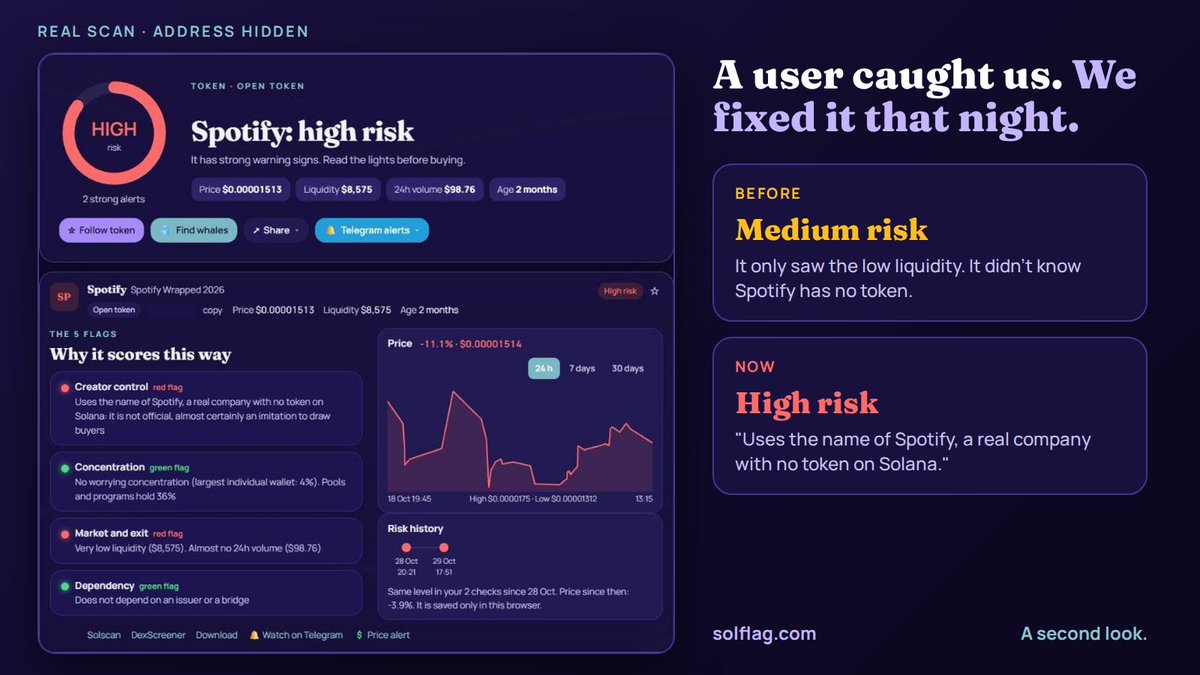
Someone sent us a screenshot: a token called "Spotify Wrapped 2026". SolFlag rated it medium risk.
It wasn't Spotify. It was a copy using a real brand's name to look legit. Medium was too soft.
So we fixed it:
→ A list of ~300 real brands. If a new token uses one, SolFlag checks it harder.
→ Same name and same ticker as another token? Now it gets compared against the original.
→ Liquidity 100x bigger than it should be for that token? Treated as fake and rated high risk.
Live test: both Spotify copies and a fake Shopify now show high risk. The real tokenized Shopify stays medium. BONK, JUP and Fartcoin stay low.
While fixing this we found the opposite problem.
Tokenized stocks like Tesla were showing high risk. The reason: their issuer can create tokens, and that looked like a red flag. But for a tokenized stock, that is how it works.
Now SolFlag knows the known issuers. If every control key belongs to the issuer, it says "controlled by its issuer" and shows medium. A copy that holds only one key to impersonate the issuer? Still red.
Tesla's token now shows medium. We also removed two false warnings ("transfer hook" and "default frozen accounts") that were scaring people on legit tokens.
A tool that only shouts "danger" is useless. A good one has to be right in both directions.
Thanks to @darametaX for the catch.
What should SolFlag catch next? 👇
#Solana #BuildInPublic #CryptoSecurity #SolanaDeFi
Not financial advice.
@KavianCoin Good reminder. The same trick works on tokens: a copy can use a real brand's name and ticker with a different address. Always check the address against the official source before you buy.
@tvbzify Hard to name one, but you can lower the odds. Check who paid for the launch and what that wallet did before, whether the creator can still mint, and if the liquidity looks real for its size. Not financial advice.
@SolanaFndn@AlliumLabs@coingecko@RWA_xyz A registry like this helps a lot. The other half of fact checking is catching copies: tokens with the same name and ticker as a real brand but a different address. We keep seeing those, so we check that against the real issuer.
@AlexMasonCrypto Great list. One thing I'd add to the "before you buy a memecoin" part: check who paid for the launch, not only who created the token. A wallet that keeps funding launches that die is a signal most checkers miss.
Myth: "The liquidity is locked, so it's safe." 🔒
Locked liquidity does one thing well: the creator can't pull the pool and run.
But that's one door. Here's what it doesn't stop:
→ a creator who can still mint more tokens
→ a creator who can freeze your wallet
→ one wallet holding half the supply
→ a launch where the same people bought in the first second
That's why SolFlag doesn't give one score from one signal. It looks at 5 flags and explains each one in a sentence.
A locked pool is a good sign. It's not a full picture.
Which "safe" claim have you heard that made you suspicious? 👇
SolFlag is a second look, not financial advice.
#Solana #CryptoSecurity #BuildInPublic #DeFi
Something new is coming to SolFlag 🗺️
Until now a scan told you what was wrong with a token. The On-chain Map shows you what's around it.
One full-screen view of a token:
→ its biggest holders, and what each one is: a person, an exchange, a bot or a pool
→ who gave each one their first SOL
→ groups of wallets that share the same origin of funds
→ transfer networks: who passed tokens to whom
That last one is what a normal holders list never shows. In one test token I found 5 networks with 448 wallets, and a single wallet that had sent tokens to 260 of them. None of those wallets were in the top 20 holders.
It's ready. I'm giving it a final round of testing and then it goes live on https://t.co/SsUn0VsLqQ, free like everything else.
And this is only the beginning. The map is the first piece of something bigger: seeing how money and wallets move around every token on Solana, and who is behind it. There's a lot more to come, and I'll keep building it in the open, step by step.
If you could see one thing on that map, what would it be?
SolFlag is a second look, not financial advice.
#Solana #BuildInPublic #CryptoSecurity #OnChain #Crypto
Good night, everyone 🌙
Today was one of those build days that doesn't look like much from the outside, but I'm proud of it. Here's what changed in SolFlag.
1) The wallet screen is finally tidy. On mobile the buttons were all in a row and badly placed. Now it follows the sketch I drew: the main action on top, three square buttons below. I also renamed "Estimate result" to "See profit and loss", because I realised it wasn't clear what it did.
2) SolFlag now remembers faces. While studying 79 brand-new tokens launched within one hour, 25 wallets were already behind 2 or more launches. And in 13 of 66 cases, the wallet that paid for the launch wasn't the creator shown on the token, which is a classic way to hide a serial launcher. So SolFlag now keeps a list of wallets that fund launches that die, and warns you when they show up again, even if they use a brand-new creator.
3) I found a bug of my own. While testing, I saw that for recent wallets the engine was asking the network for transactions in an old format, so it was losing the newest ones and couldn't find who first funded them. That also affected the groups by funder in the Whales tab. Fixed, published, and the tests pass.
Thanks for following along. What should I fix next? 🚩
SolFlag is a second look, not financial advice.
#Solana #BuildInPublic #CryptoSecurity #OpenSource
@darametaX Thanks @darametaX 🥳🥳 You were right: that "Spotify" only showed medium risk.
Fixed today on SolFlag:
🚩 Real company names on tokens nobody issued → high risk
🚩 Same name & ticker as an older token → copy warning
🚩 Faked liquidity → high risk
Same name. Same ticker. Different address. 🚩
I was looking for a clean example of something SolFlag catches that a chart never shows, and I found it in a few minutes.
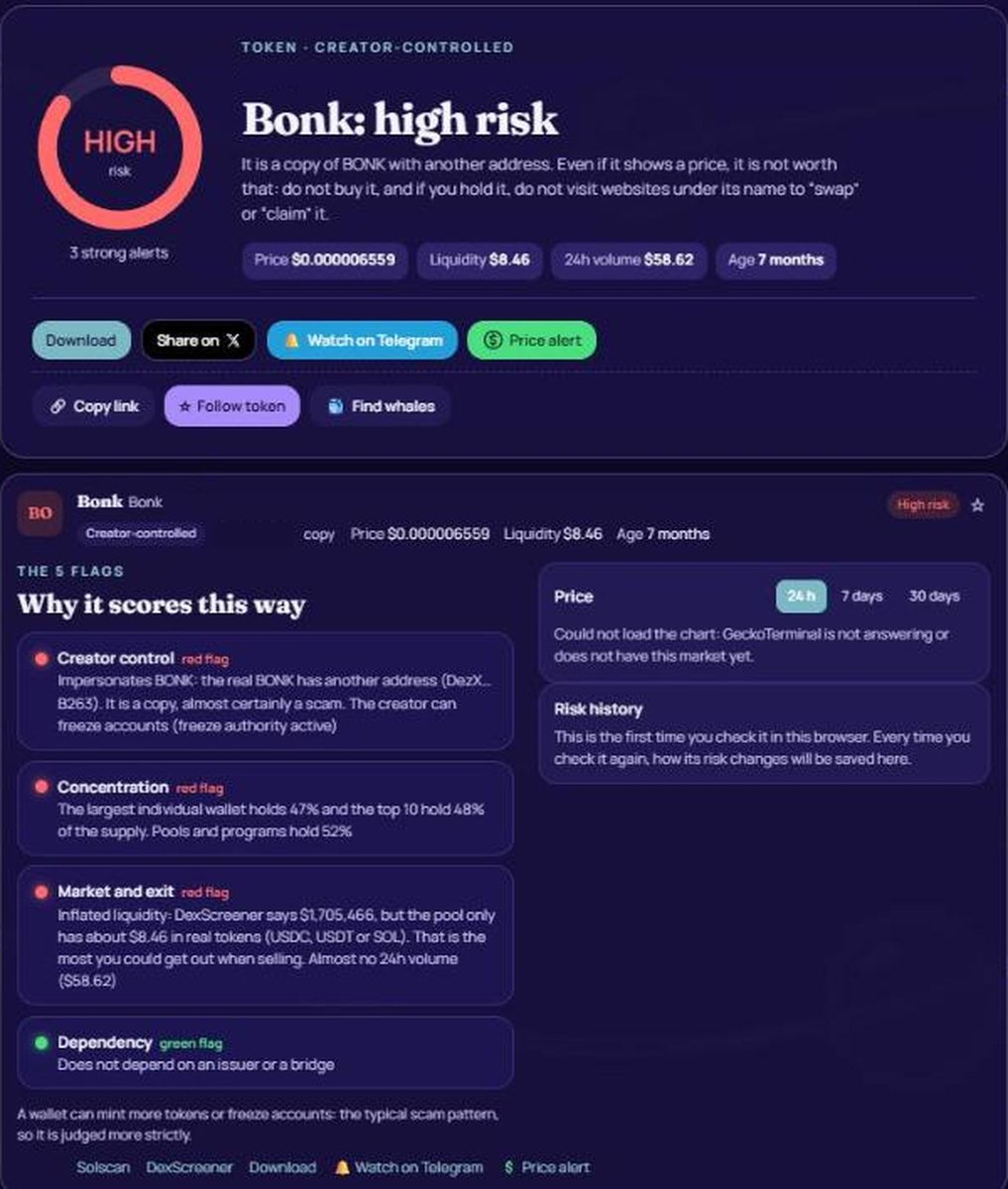
There's a token called "Bonk" on Solana. It is not BONK. It's a copy, with a different address.
Here's what it looks like from the outside: DexScreener lists it with $1,705,466 of liquidity.
Here's what SolFlag found when it looked inside the pool: about $8.46 in real tokens (USDC, USDT or SOL). That's the most anyone could get out when selling. It has almost no volume.
It also found:
• The creator can still freeze accounts.
• One wallet holds 47% of the supply.
• SolFlag knows the real BONK has a different address, so it says it plainly: this is a copy.
3 red flags, high risk. And the thing that scares me is how normal it looks at a glance: a familiar name, a familiar logo, a big liquidity number.
That's why I started building this. A second look takes seconds, and it's free.
If you ever hold something you didn't buy yourself, don't visit websites that ask you to "swap" or "claim" it.
I'm hiding the address on purpose, because I don't want to send anyone to it. These numbers are from today and can change.
Paste any token into https://t.co/SsUn0VsdBi and check it first. What kind of scam would you like SolFlag to catch next?
Not financial advice.
#Solana #CryptoSecurity #BuildInPublic #Crypto #SolanaDeFi
What do the wallets you follow have in common? 🔍
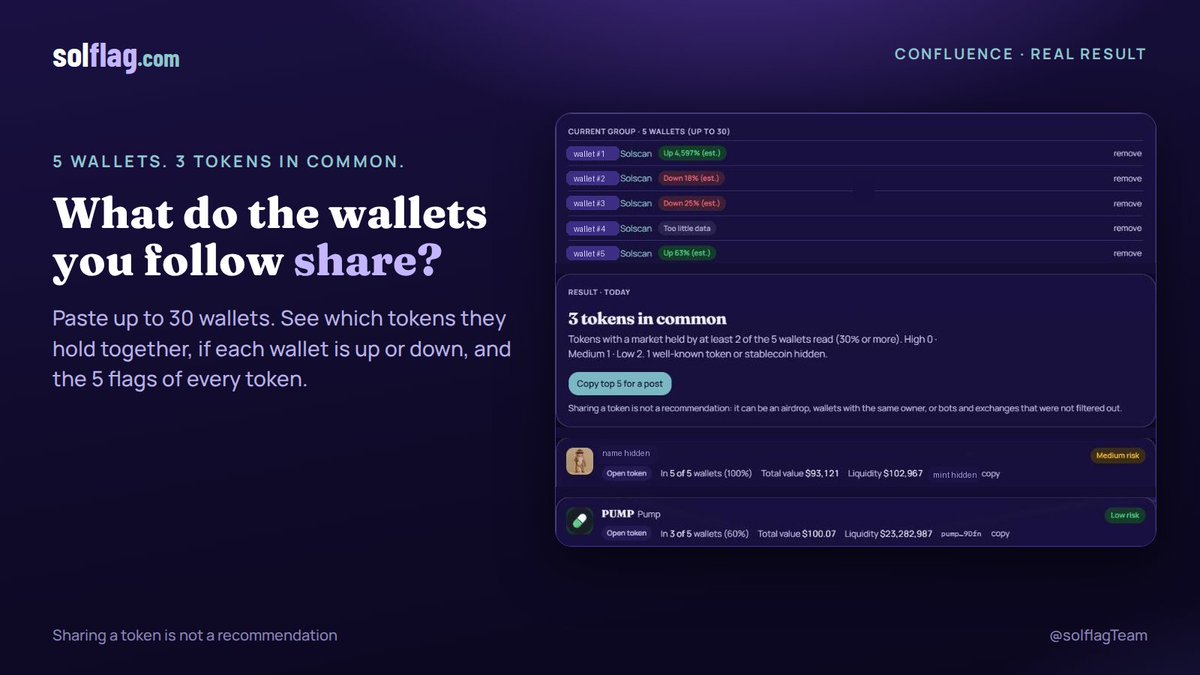
I pasted 5 wallets I follow into SolFlag's Confluence tool. It took a few seconds.
Result: 3 tokens held by at least 2 of them. And one token was held by all 5.
Here's what I like about it: it doesn't stop at "they hold the same thing". Each token comes with its 5 flags.
That one token in all 5 wallets? A 3-day-old market, and only 46% of its liquidity locked or burned. SolFlag marked it medium risk. Something worth a second look before copying anyone.
Sharing a token is not a recommendation. It can be an airdrop, wallets with the same owner, or bots. That's why the flags matter more than the crowd.
Try it with the wallets you follow: https://t.co/SsUn0VsdBi (Confluence tab). Paste up to 30, no sign-up, no wallet connection.
Not financial advice.
#Solana #OnChain #WhaleWatching #BuildInPublic #Crypto
Midday check-in: how's SolFlag going? 🚩
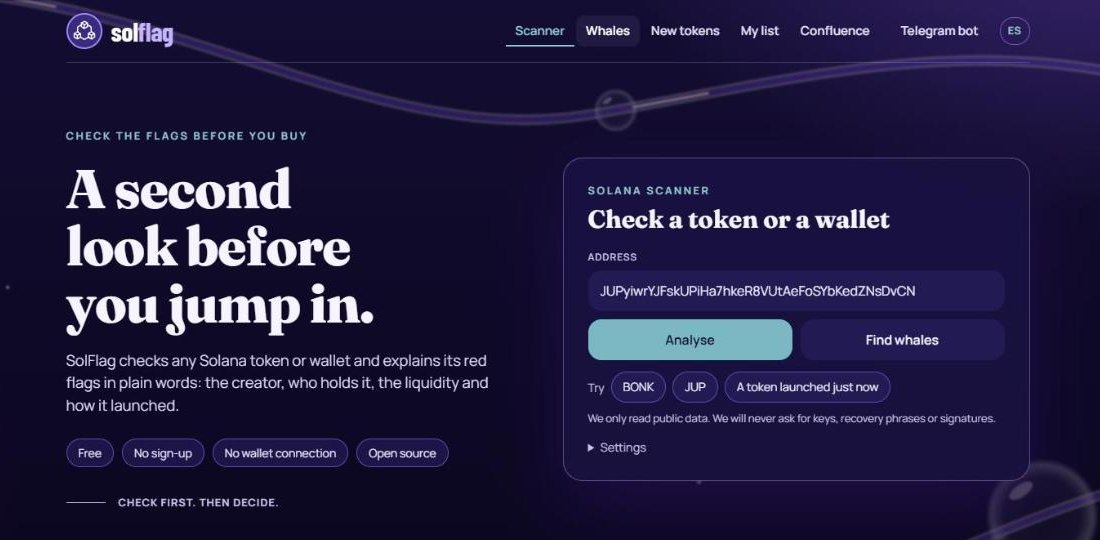
This is what the app looks like today: paste any Solana token or wallet and get the flags in plain words. Free, no sign-up, no wallet connection.
What's live today:
• The scanner with 5 flags
• A radar that checks the newest Solana launches in real time
• A Telegram bot for risk and price alerts
• An open-source engine on GitHub and npm, with 90 tests
What I learned this week:
My own scanner called a legit token high risk, and it was wrong. Program-controlled addresses were being counted as people. I fixed it, re-tested on 160+ real tokens, and found more edge cases along the way.
Fixing my own mistakes in public is the best part of building this.
What's next: teaching it to read more about the creators behind each token.
If you've tried it, tell me what's confusing or missing. That's the roadmap.
https://t.co/SsUn0VsLqQ
#Solana #SolanaDeFi #BuildInPublic #Crypto #CryptoSecurity #OpenSource
Thanks for the idea! 🙌 Finding good opportunities is something a lot of people ask for. SolFlag is built to flag risks first, so we'll think about how something like that could fit without turning into hype. We'll look into it and see what we can do. Anything specific you'd want it to look for?
Good morning ☀️
Today I want to tell you how SolFlag started, and where it's going.
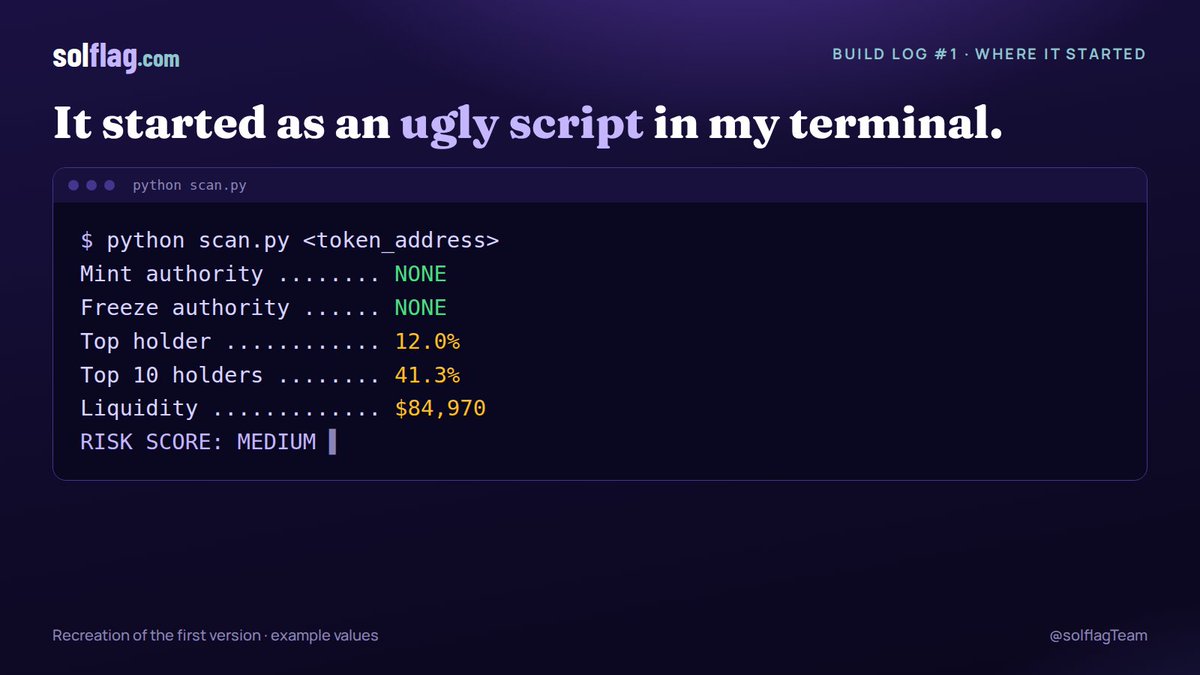
Before it had a name, a logo or a website, it was a messy Python script on my computer.
I'm a crypto investor. I spend my days on charts, support zones and trends. And I kept running into the same problem with Solana tokens: the chart looks great, and it tells you nothing about what's underneath.
Can the creator still print more supply? Do five wallets hold almost everything? Is there enough liquidity to actually get out? A candle can't answer any of that.
So I thought: why not build the thing I wish I had?
It's a hobby I do on my own, with a lot of trial and error. The first version had no design at all. You pasted a token address into the terminal and it printed text. It was ugly. But the first time it flagged something I would have missed by eye, I knew I had to keep going.
Today it's a free scanner with 5 flags, a Telegram bot for alerts, and an open-source engine anyone can check.
And where are we going? I want to keep teaching it to see what you can't see at a glance: who is behind each token, what else they launched, and how that went. The more we learn about the creators, the more useful it gets.
I'll tell the whole story here, chapter by chapter, with real scans and the mistakes included.
If you want to follow along, this is chapter 1. Tomorrow I'll tell you what that first version actually checked.
What would you want SolFlag to catch next?
#Solana #BuildInPublic #Crypto
This is what you get when you paste a token into SolFlag.
Not just a score. Every flag comes with its reason, in one plain sentence:
• Creator control: can anyone still mint more or freeze yours?
• Concentration: who holds the supply, and how much?
• Market and exit: is there real liquidity to get out?
• Dependency: does it rely on a bridge or an issuer?
• Launch: bundles at launch and serial launchers (for new tokens)
I wanted a result you can read in 10 seconds and still understand why. Green, amber or red, always explained.
Here's a real scan of a well-known token, just as it looks on the web. Try it with any address:
https://t.co/SsUn0VsdBi
A second look before you ape in. Not financial advice.
#Solana #BuildInPublic #Crypto