Well, let’s get this journey started 🥳
Power generation sits in one place. Compute doesn’t have to.
At Solnativo, we build compute where the energy already is - instead of trying to route energy to wherever the servers were planned first.
Energy → Compute
2/2
Watch how long users wait for the first token as traffic rises. An average can hide the slowest responses.
NVIDIA’s walkthrough shows how changing the traffic pattern changes the latency distribution:
https://t.co/WtRqySR3pg
1/2
The benchmark looked great. Then the users arrived.
Short prompts at a steady pace make a tidy test. Production brings longer requests and bursts of traffic.
NVIDIA’s AIPerf lets teams vary both. Worth trying before sizing the next cluster. @nvidia
2/2
Imagine a four-week delay with a team costing €20,000 a week. That is €80,000 of payroll during the wait, before any deferred revenue.
An illustrative case, but a useful question for a cheaper quote: how much room does your launch date have?🤔
Your GPUs are late. Your payroll keeps running.
A delayed deployment can leave engineers waiting to test, a customer pilot on hold and the sales team explaining a new launch date.
That cost belongs in the capacity decision
🔽🔽🔽
Gonka, Akash, Prime Intellect: different models of decentralised AI, all dependent on physical infrastructure.
At Solnativo, we see our future sites as potential nodes in these networks.
The key questions: which workloads fit, who pays, and can demand last?
Read more: https://t.co/3QB6ADEgdJ
@OpenAI ‘s GPT-6 Astra was trained on 100,000+ GPUs.
Behind every model milestone: power, cooling and compute infrastructure.
At Solnativo, we’re building solar-powered GPU capacity in Spain for training, fine-tuning and inference.
💪🏼
These developments reinforce the premise behind Solnativo:
The next phase of AI infrastructure starts with power.
Our Energy → Compute model brings modular compute directly to secured generation sites, turning available local energy into deployable AI capacity. 💪🏼🫶🏻
At Solnativo, we track the developments shaping the infrastructure behind AI—from power availability to investment and sovereignty.
Here’s what stood out across the industry in September 🧵
@cohere and Aleph Alpha signed an agreement to build what they describe as the first transatlantic sovereign AI provider.
Infrastructure is becoming part of the sovereignty conversation - not only models and data.
A Tier rating tells you how the facility is designed. It does not tell you whether all contracted GPUs will be available.
Before signing, check what the SLA actually measures, what counts as downtime and what happens when part of the cluster fails ☀️
Read more: https://t.co/iXvrztzwUe
Every megawatt matters.
The NVIDIA DSX AI Factory Platform helps AI factories maximize AI output, improve energy efficiency, and intelligently adapt to changing grid conditions. #AIInfraSummit
🔗 https://t.co/TVfKujlZr1
Five questions we would ask before signing for GPU capacity:
Is the power connected?
What is the energisation date?
What is the usable IT load?
How is intermittent supply firmed?
How many GPUs can operate under the proposed configuration?
The GPU model is not the first question.
Share your thoughts below 👇🏻💪🏼
What makes Spain interesting for AI infrastructure?
Its solar generation can connect directly with growing digital demand.
The key work lies between the solar plant and the GPU rack: grid access, storage, cooling, transmission and operations.
Which part of this chain will create the most value?☀️
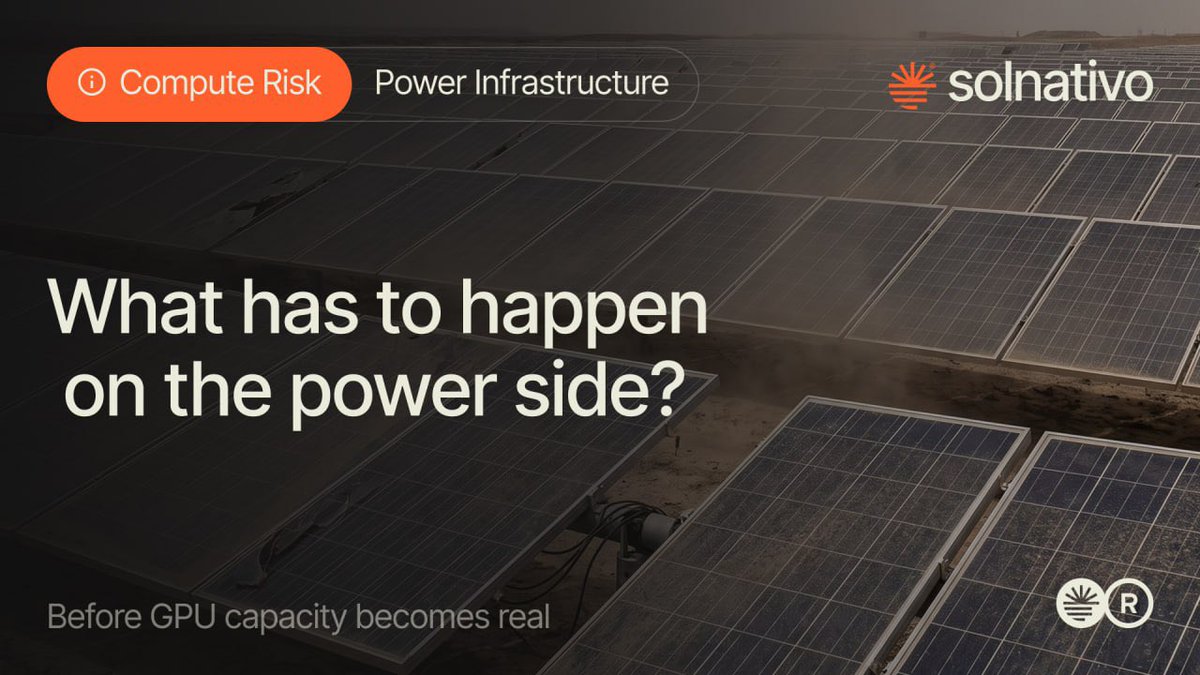
A compute provider offers capacity at an attractive price, available in six months.
Before discussing GPUs, ask one question:
What has to happen on the power side before that delivery date becomes real?
The answer will tell you whether you’re buying compute or taking on someone else’s development risk.
“Power available” is doing a lot of heavy lifting in data center proposals. 🫣🤔
Available now?
Contracted?
Grid application submitted?
Still sitting in a development plan?
Four very different answers. Four very different risk profiles.
At Solnativo, we ask one question: when can it actually power compute?
The €13B headline will get the attention. The 22-year power agreement is what matters.
@Google ‘s latest investment in Finland shows how AI infrastructure decisions are changing: secure the energy first, then build around it.
@GoogleCloud@Fortum