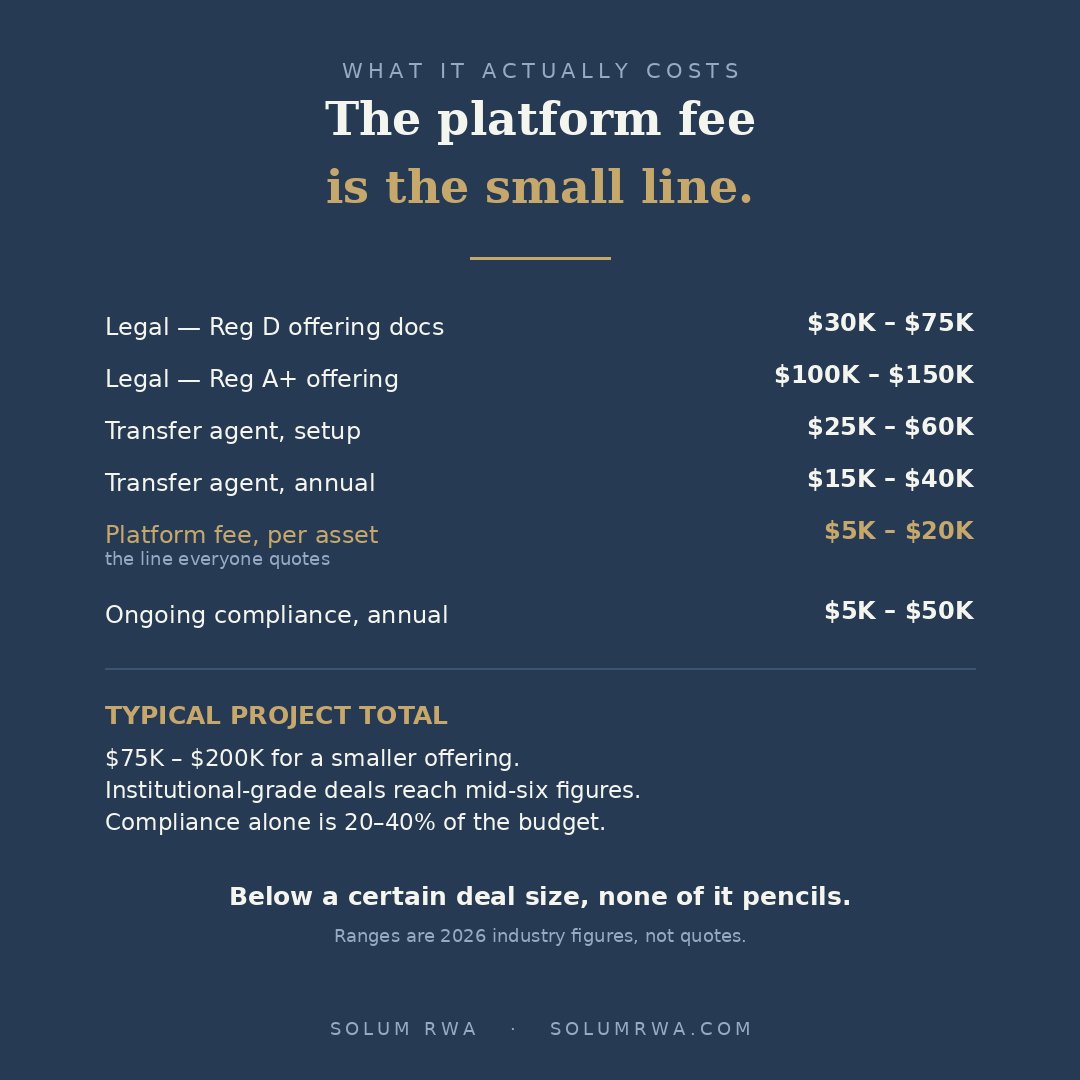
Nobody publishes what tokenization actually costs. So:
Legal for a Reg D offering, $30–75K. Transfer agent, $25–60K to set up and $15–40K a year. Compliance runs 20–40% of the total.
The platform fee is the small line. Below a certain deal size, none of it pencils.
https://t.co/PhGZw3aDY8
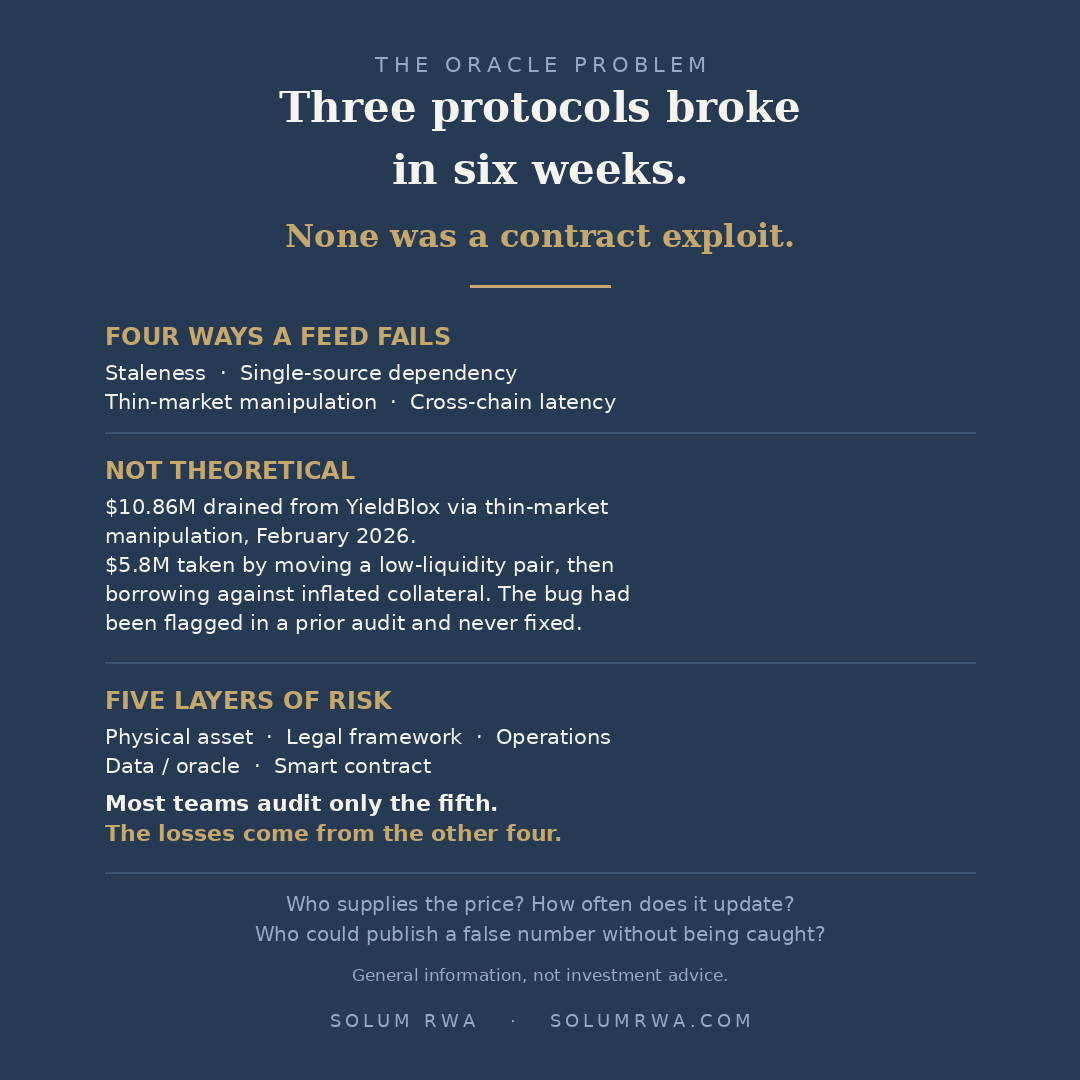
In early 2026, three lending protocols broke in six weeks. Moonwell, Aave, Morpho.
None was a smart contract exploit. All three were pricing failures.
The oracle is the layer most teams never audit — and where the losses come from.
https://t.co/pKDZvep72N
Two identical ore bodies. Different countries. Not the same asset.
Jurisdiction is treated as a footnote in most mining pitches. It belongs near the front.
The Fraser Institute surveys mining executives across 68 jurisdictions, weighting geologic potential at 60% against policy perception. Finland took the top spot in the most recent published survey, climbing from 17th, with Nevada close behind and Saskatchewan the strongest Canadian jurisdiction at 7th globally.
The permitting spread alone is stark. In Newfoundland and Labrador, 86% of respondents expected permits within two months. In the Northern Territory, only 9% did. In Victoria and Queensland, 60% and 50% waited beyond eleven months. Delay is not an inconvenience. It is capital sitting idle, and it moves the valuation directly.
Then the harder category. Resource nationalism is no longer an edge case; it is a mainstream planning variable. Across at least twelve African nations, mining legislation was materially revised between 2019 and 2026: royalty restructuring, mandatory state equity, community veto mechanisms, environmental recompliance. Most were deliberate legislative programmes, not opportunism.
The examples are not hypothetical. The DRC has restricted cobalt exports. Zimbabwe moved to ban exports of raw minerals and lithium concentrates. Barrick agreed to pay $430 million to settle its dispute with Mali in November 2025.
This is where jurisdiction meets the number. Gold projects are conventionally discounted around 5% real, while early-stage or higher-risk jurisdictions carry 12 to 15% or more. That spread is jurisdiction risk, priced.
For a tokenized asset it matters twice over. Your enforcement path runs through local courts or treaty arbitration. A token does not change which flag flies over the pit.
So before the geology, ask the boring questions. Which jurisdiction, at state level rather than national? What is the permitting record there? Has the mining code been revised recently, and in whose favour?
Source: Fraser Institute Annual Survey of Mining Companies
General information, not investment advice.
Solum RWA — institutional tokenization marketplace.
https://t.co/PhGZw3aDY8
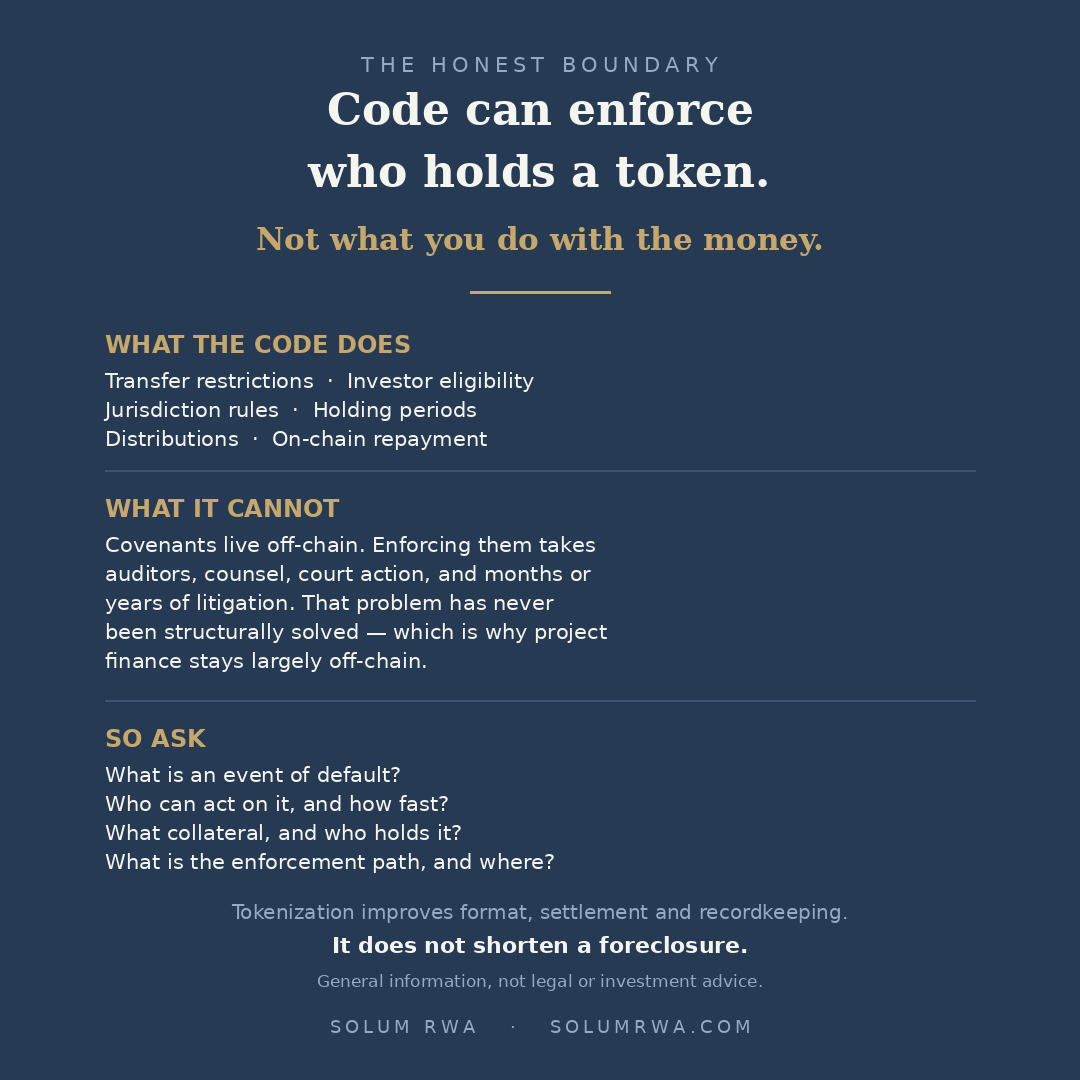
A smart contract can enforce who holds a token. It cannot enforce what a borrower does with the money.
That sentence is the honest boundary of this technology, and it deserves more attention than it gets.
Start with what code genuinely automates. Transfer restrictions, investor eligibility, jurisdiction rules, holding periods, distribution schedules, repayment mechanics where funds move on-chain. These are real improvements. They execute without a clerk, a reconciliation, or a settlement window.
Now the limit. Loan covenants, the restrictions governing how proceeds may actually be used, live in legal agreements off-chain. A submission to the SEC Crypto Task Force put the problem plainly: enforcing them requires auditors, legal counsel, court action, and months or years of litigation. The covenant enforcement problem has never been structurally solved.
That is precisely why construction lending, equipment financing and project finance remain largely off-chain.
Collateral can be locked. Repayment can be scheduled. But whether the operator actually spends the money on the mill, hits the development milestones, or maintains the equipment is a real-world question answered by site visits, independent engineers, audited reporting and, if it comes to it, a court.
So what protects an investor is not the code. It is the security package, the covenants, the reporting obligations, the independent verification, and the remedies written into the documents.
Four questions worth asking of any tokenized credit or development offering. What constitutes an event of default? Who has authority to act on it, and how quickly? What collateral secures the position, and who holds it? What is the enforcement path, and in which jurisdiction?
Tokenization improves the format, the settlement and the recordkeeping. It does not shorten a foreclosure.
General information, not legal or investment advice.
Solum RWA — institutional tokenization marketplace.
https://t.co/PhGZw3bbNG
Gold is near record levels, so every producing mine must be printing money. Not quite. The number that decides it is AISC.
All-in sustaining cost was standardised by the World Gold Council in 2013 and is now used by more than 90% of gold producers. It replaced cash cost, which flattered everyone. AISC is the fuller picture: cash costs, plus the sustaining capital a mine needs to keep running, plus corporate overhead, royalties and sustaining exploration, less by-product credits, divided by ounces produced.
It is a cost, not a margin. The margin is what remains after you subtract it from the gold price.
The current numbers are worth sitting with. The World Gold Council reported global average AISC of $1,785 per ounce in Q1 2026, up 5% on the quarter and 16% year over year. That marked the twenty-eighth consecutive year-on-year increase. Royalties were the largest single contributor.
The spread is wide. First-quartile producers report AISC under roughly $1,413 per ounce. The production-weighted median sat near $1,709. Same metal, very different economics, and that gap separates a mine that survives a downturn from one that does not.
Now the part AISC does not tell you, which matters most for anyone financing a project.
AISC measures the cost of sustaining current production. It deliberately excludes growth capital: new construction, expansions, major development. A company can report an excellent AISC and still be unable to fund the programme that would raise output, because that spending sits outside the metric entirely.
This is why a strong AISC and a capital shortfall coexist so often. The operating asset is healthy. The development pipeline is starved. Traditional finance answers that gap with dilution, expensive debt, or a stream against future production.
So when reading a mining disclosure, separate the two questions. What does it cost to keep this running, and what does it cost to build what comes next? AISC answers only the first.
Source: World Gold Council
General information, not investment advice.
Solum RWA — institutional tokenization marketplace.
https://t.co/PhGZw3aDY8
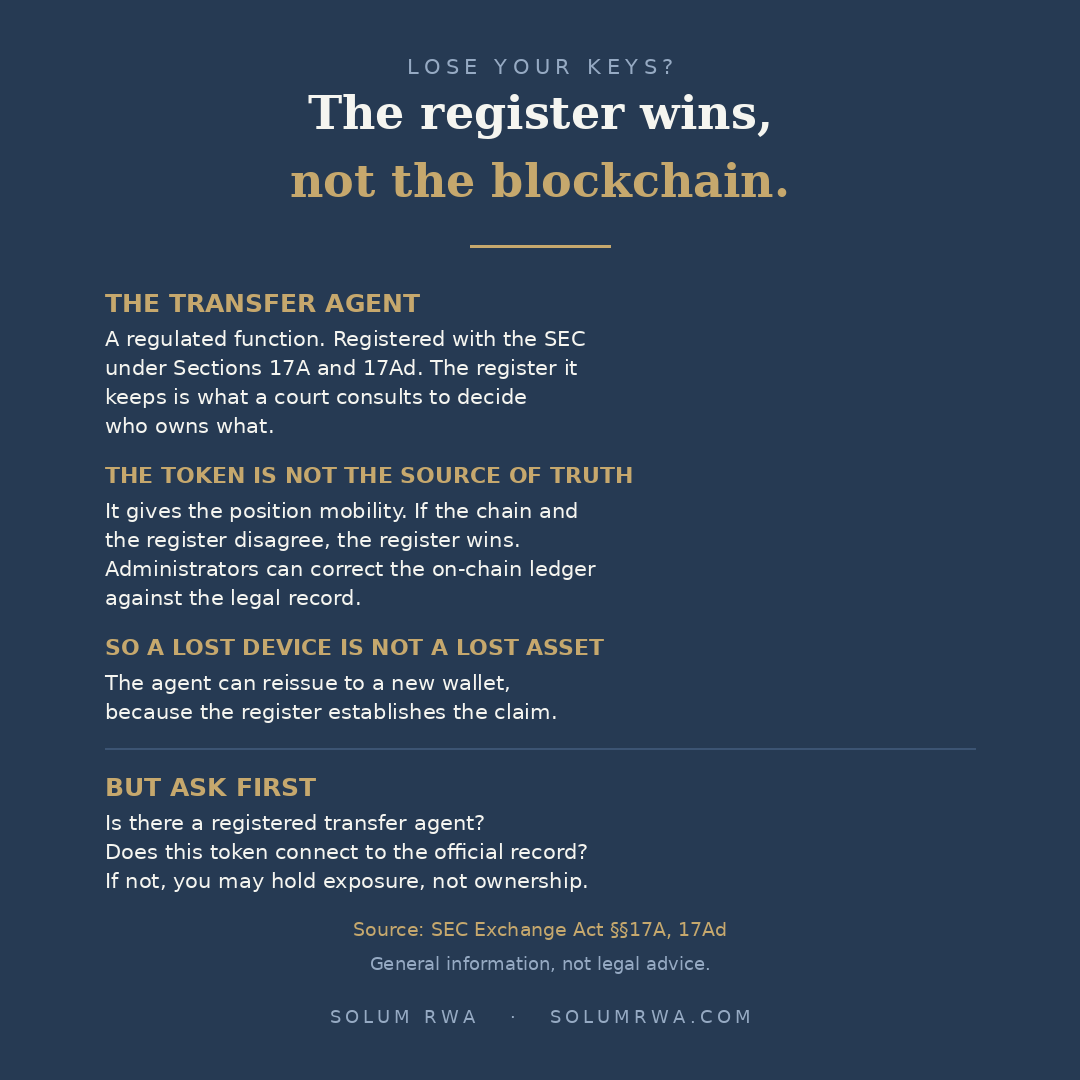
Lose your private key in crypto and the asset is gone. In a properly structured tokenized security, that is not what happens.
The reason is the transfer agent.
In US securities markets, a transfer agent maintains the official register of ownership. It is a regulated function. Transfer agents register with the SEC under Sections 17A and 17Ad of the Exchange Act, and the register they keep is what a court consults to determine who owns what.
In tokenized securities, that register remains the authoritative legal record. The token is a digital representation that gives the position mobility. It is not the source of truth. If the blockchain and the register disagree, the register wins, and administrators retain authority to correct the on-chain ledger against the legal record.
This inverts crypto's founding assumption that possession of the key is ownership. Whether that is a betrayal of the idea or the precise reason institutions will tokenize anything at all is the argument worth having.
The practical consequence: your ownership does not evaporate because a device failed. The agent can reissue to a new wallet, because the register establishes the claim, not the key.
The same mechanism runs the allow-list. Identity is screened, approved wallets are added on-chain, and the contract blocks transfers to any address not on it.
This is live regulation, not theory. The SEC proposed a transfer agent overhaul this month covering cybersecurity, disaster recovery, and recovery controls for records that are lost or altered. Injective secured transfer-agent registration in August. Superstate registered a blockchain-based transfer agent in March 2025.
One diligence warning. Industry groups told the SEC that tokens created without an issuer's direct approval may not carry the same rights as issuer-backed shares. Some products track a price without conferring registered ownership.
So ask two questions. Is there a registered transfer agent, and does this token connect to the official record? If not, you may hold exposure rather than ownership.
General information, not legal advice.
Solum RWA — institutional tokenization marketplace.
https://t.co/PhGZw3aDY8
Every tokenized mining asset has a number attached to it. Where does that number come from?
Not from the ground. It comes from a discounted cash flow model, and the model rests on three inputs most people never ask about.
The foundation is an independent technical report: NI 43-101 in Canada, SK-1300 in the US, JORC elsewhere. That report sets out the reserves, a year-by-year production schedule, operating costs usually expressed as all-in sustaining cost, capital spending, and the tax and royalty regime. An analyst projects after-tax free cash flow for each year, then discounts it back to today. The result is net present value.
Three things drive that result more than the geology does.
The price assumption. A study built on $2,300 gold produces a very different NPV than the same mine modelled at spot. Studies age. Check which metal price the report used, and when.
The discount rate. Convention for gold projects is roughly 5% real. Precious metals generally run 6 to 8%, base metals around 10%, and early-stage or higher-risk jurisdictions 12 to 15% or more. Moving the rate a few points moves the valuation substantially. There is no single correct number, which is exactly why it deserves scrutiny.
The study stage. A preliminary economic assessment is not a pre-feasibility study, and neither is a full feasibility study. Each step narrows the error bars and raises the evidentiary bar. A PEA-stage NPV and an FS-stage NPV are not comparable figures.
Worth knowing too: most producing miners trade below one times net asset value. The market routinely prices assets below the models, because financing, permitting, construction and concentration risk are real.
An NPV is not a fact about an asset. It is the output of a model with assumptions attached, prepared by a named professional who signed it. Ask which report, which stage, which metal price, and which discount rate. All four are disclosed.
General information, not investment advice.
Solum RWA — institutional tokenization marketplace. Active vertical: gold and mining output.
https://t.co/PhGZw3bbNG
When you hold a tokenized asset, what do you actually own?
Not the asset. In almost every structure, you own an interest in a legal entity that owns the asset. That entity is a special purpose vehicle, and understanding it matters more than understanding which chain the token settles on.
The chain of ownership runs like this. An SPV, usually a Delaware LLC or a trust, is formed for one purpose: to hold a specific asset. The asset is transferred into it through a true sale, meaning it legally leaves the sponsor balance sheet. The SPV issues interests, membership units or shares or notes, and those interests are what the token represents. Your rights are defined by the SPV governing documents, not by the token.
Without this structure, a token is a number on a blockchain with no legal claim behind it.
The reason for the vehicle is bankruptcy remoteness. If the sponsor other business fails, its creditors cannot reach assets inside the SPV, because those assets belong to a separate entity. No institutional allocator participates in an offering where the underlying asset could be seized to satisfy unrelated debts.
That protection is engineered, not automatic, and it can be done badly. What makes it real: a true sale opinion from counsel, a non-consolidation opinion stating a court would not pool the SPV with an insolvent sponsor, independent directors whose consent is required for any bankruptcy filing, limited-purpose restrictions preventing unrelated debt, and non-petition clauses from every material party.
The disclosure that belongs in every offering: token holders own vehicle interests, not asset title. In an SPV insolvency they rank behind secured creditors. Switzerland is the notable exception, where the DLT Act allows the token to be the share itself.
The SEC stated in January 2026 that a security issued as a token remains the same security under the same laws. The wrapper changed. The law did not.
Ask any issuer for these opinions. They exist or they do not.
General information, not legal advice.
Solum RWA — institutional tokenization marketplace.
https://t.co/PhGZw3aDY8
Who is actually allowed to invest in a private offering? The answer is narrower than most people expect, and it explains the liquidity problem better than any technology argument does.
In the US, most private offerings rely on Regulation D, which limits participation to accredited investors: broadly, individuals with income above $200,000, or $300,000 with a spouse, or net worth above $1 million excluding the primary residence. Certain institutions and credentialed professionals also qualify.
The two common paths under Reg D differ in a way that matters.
Rule 506(b) permits no general solicitation. You cannot advertise the offering. In exchange, the issuer may rely on a reasonable belief that investors are accredited, and may include up to 35 non-accredited but sophisticated investors.
Rule 506(c) permits general solicitation. You can market publicly. In exchange, every investor must be accredited and the issuer must take reasonable steps to verify it, typically reviewing tax returns, W-2s, or recent bank and brokerage statements.
There is a third detail that rarely gets mentioned and directly affects exit. Securities sold under Rule 506 are restricted securities. They generally cannot be resold for six to twelve months without registration. That is a legal constraint, not a platform limitation, and no amount of tokenization removes it.
Regulation S covers offerings made outside the US to non-US persons, which is why many issuers run parallel structures.
The SEC estimates roughly 18.6 million US households qualify as accredited. Legislation directing the SEC to broaden that definition passed the House in December 2025, but it remains in the Senate and is not law.
If you are evaluating a tokenized offering, the first question is not which chain it settles on. It is which exemption it relies on, whether you qualify, and how long you are locked.
General information, not legal advice.
Source: https://t.co/vQueephiij
Solum RWA — institutional tokenization marketplace.
https://t.co/PhGZw3aDY8
#RWA #Tokenization #RegulationD #AccreditedInvestor #PrivateMarkets #RealWorldAssets #SEC
Tokenization creates the possibility of liquidity. It does not create liquidity.
That distinction gets lost in most of the marketing in this sector, and it is the most important thing to understand before committing capital.
A study published this year examined tokenized real-world assets across US Treasuries, gold-backed commodities, and private credit, using token-level data from https://t.co/2dKJOt0t8w and contract-level data from Etherscan. It measured turnover, active addresses, and whether tokens traded at all in a given month. The finding was direct: on-chain representation and secondary-market liquidity are distinct outcomes. Issuing an asset on-chain does not automatically produce active trading in it.
The study also found that size is not a reliable proxy. A token can hold a large outstanding asset value and still show weak turnover and limited recurring activity. Scale of issuance and depth of market are separate variables.
There is an uncomfortable corollary this industry rarely states plainly. The tokenized assets with the deepest secondary markets tend to be the permissionless ones. Gold-backed tokens trade actively in part because anyone can buy them on a major exchange. Permissioned securities, the compliant and whitelisted accredited-investor instruments, are structurally harder to trade because the eligible buyer pool is smaller by design.
That is not an argument against compliance. It is the cost of it, and it should be priced honestly rather than papered over. An investor entering a compliant tokenized offering should assume the exit is negotiated, not instant, unless a specific secondary venue exists and can be named.
What tokenization does deliver is real: fractional ownership, faster settlement, programmable transfer rules, and a verifiable ownership record. Those are meaningful improvements over a subscription agreement and a spreadsheet.
But an asset that trades rarely off-chain will usually trade rarely on-chain. The token is a better wrapper. It is not a buyer.
Ask any platform, including this one, where the secondary market is, who makes it, and what actually traded last quarter. If the answer is vague, price the illiquidity in.
Sources:
Tokenized but Illiquid? Evidence from Real-World Asset Markets — https://t.co/jQUaP1wLJZ
Chainalysis on tokenized asset valuation — https://t.co/rDlVgCi6KL...
Solum RWA — institutional tokenization marketplace. Active vertical: gold and mining output.
https://t.co/PhGZw3aDY8
"Compliance built in" isn't marketing. It's a function signature.
An ERC-20 transfer executes. An ERC-3643 transfer asks permission first — identity, jurisdiction, investor type — and reverts if the answer is no.
The rule lives in the token.
https://t.co/IIw0IVuUzf
"Gold in the ground" is not financeable.
Inferred — too speculative for economics.
Indicated — medium confidence.
Measured — high confidence. Still not a reserve.
A reserve is the economically mineable part, signed by a qualified person.
https://t.co/WFBGitCRNw
Three ways to hold gold. Three different bills.
ETF — instant liquidity, 0.09-0.40% a year, no claim on metal.
Bar — you own it outright. 1-3% premium, then storage.
Token — 24/7 settlement, divisible. Redemption is the friction.
None is best. They solve different problems.
"Backed by gold" is a claim, not a control.
The questions that matter: Who custodies it? Is it segregated? Attested monthly or quarterly — and by whom? Can you look up the bar serial?
An attestation is a snapshot, not continuous monitoring.
Ask before you allocate.
Gold near $4,630 — highest since mid-May, on renewed US fiscal concerns.
Less covered: tokenized gold added $362M in 30 days, and Q1 on-chain volume ($90.7B) already topped all of 2025 ($84.6B).
The metal moves on macro. The format is compounding on its own.
Financing a mine, three doors:
Equity — dilutes your shareholders.
Debt — servicing costs have roughly doubled since the early 2020s.
Streaming — no dilution, but often 20-25% of free cash flow for the life of the mine.
Every door costs something. Tokenization is a fourth.
The CLARITY Act would put most tokens under the CFTC as digital commodities — and draw the line on what stays a security.
For real-world asset tokenization, that line is the whole game.
Market structure isn't a crypto story. It's an access story.
https://t.co/7QWNd3BE0e
Central banks bought 289 tonnes of gold last quarter — up 62% YoY. Gold near $4,472/oz.
Tokenized gold spot volume hit $90.7B in Q1 alone.
The demand is institutional. The rails are going on-chain.
Source: https://t.co/6pTIy0Gkj6