Watch/listen to @BenSasse's recent interviews and ask yourself if you've ever witnessed a freer man.
Despite a death sentence and tremendous pain, he living with an unmistakable joy, peace, and levity. Deep wisdom rolls out of him.
It begs the question, "Why?"
I want that.
"Why does it take a diagnosis, a crisis, a detonation, before we let God do the work He’s been wanting to do all along? What if we started handing them over now, while we’re healthy, while there’s still time to live in the freedom that’s on the other side?"
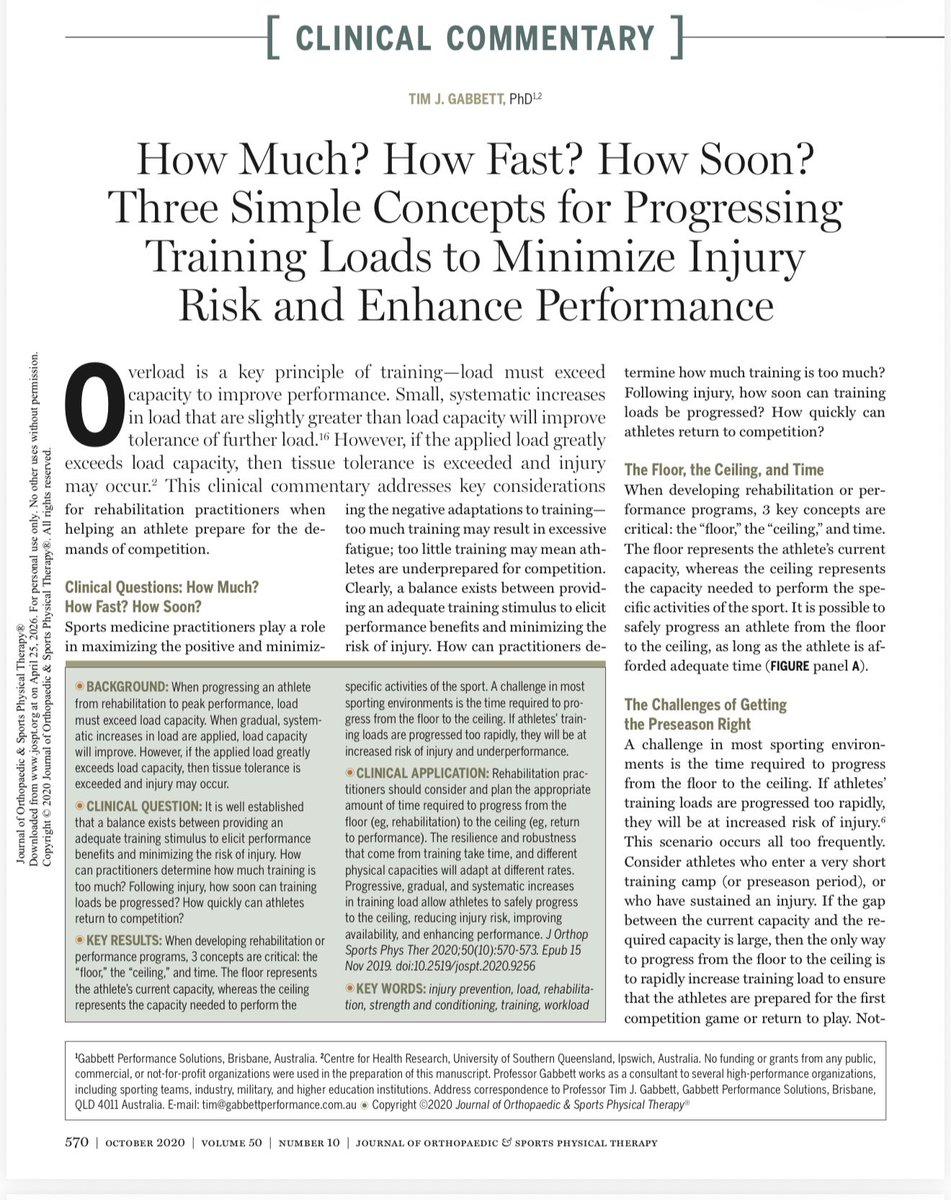
This is a good read and it gives a very clean framework for a conversation we often overcomplicate.
Gabbett frames rehabilitation and performance programming around three concepts: the floor, the ceiling, and time. The floor is the athlete’s current capacity. The ceiling is the capacity required to perform the specific demands of the sport. The problem is that we cannot pretend someone is ready just because symptoms are down or because they look good in a controlled setting. The real question is whether their current capacity has been progressively built toward the demand they are about to face.
That is why injury mitigation cannot become the primary operating system.
When injury mitigation leads the process, it can easily become exposure reduction. Less load. Less speed. Less complexity. Less chaos. That may look safer on paper, but Gabbett makes the opposite concern very clear: if the training stimulus is inadequate, the athlete may be underprepared, underperform, and be at risk for reinjury. The paper also states that reducing the ceiling is not realistic because the demands of performance continue to evolve, and the physicality and complexity of sport are generally increasing.
The right structure is performance first, with injury mitigation as a byproduct of intelligent preparation.
The goal is not to avoid demand. The goal is to build the capacity to tolerate demand. That means maintaining an adequate floor, identifying the ceiling, understanding the most demanding passages of play, and progressing training loads in a gradual, systematic way. Gabbett’s summary is the line that matters: appropriately prescribed training can create resilient and robust athletes capable of withstanding the high loads of competition.
That is the distinction.
Therapy can restore function.
Performance has to build capability.
Those are connected, but they are not the same thing. The end point cannot simply be “less pain” or “less exposure.” The end point has to be readiness for the real environment.
Watch Sabastian Sawe 🇰🇪 run 1:59:30 to destroy the Marathon World Record in London!!🤯🔥
First man ever to break 2 hours in a marathon.
2. Yomif Kejelcha 🇪🇹 1:59:41
3. Jacob Kiplimo 🇺🇬 2:00:28
All under the previous World Record.
Every person over 30 blames aging for their stiff, painful back.
Turns out it's not your chair or your age...
It's 3 forgotten muscles that have shut down after years of neglect.
Here are 5 simple exercises to reactivate them and feel 20 again: 🧵
Thought I'd share a🧵with couple of additional thoughts about this profile of Dusty May by @rustindodd, focusing on some of the work Dusty & I did together.
https://t.co/P9zazpKzAg
A legendary season is complete ✨
Team USA's Mikaela Shiffrin has added another World Cup overall title to her collection on the back of her slalom Olympic gold at #MilanoCortina2026 🥇🔮
#AlpineSki#FISAlpine
(1/4) Thank you @craigwelch & @nytimes for illuminating the burdensome plight of ACL injuries endured by young athletes around the world. I have spent my entire career alongside @drbertmandelbaum trying to define ACL mechanisms & develop programs to mitigate ACL injury risk
Anyone interested in Development should let this sink in from the Scottish Football Association’s 1yr Research Study which traveled the World looking at the best Programs and released their 133 Page document. The biggest take-away recommendation was, Football Starts at Home. Below are some highlights after studying 22 or the Worlds Best Players.
It seems to be unavoidable that, in order to become the best player in the world, 2-4yrs old seems to
be the ‘golden window’ for early engagement with the ball.
The world’s best players commented that the ‘ball was their favourite toy’ as a toddler – not that football was their favourite game (initially). Making the ball the favourite toy from the earliest age is the key trend in elite development.
Later, when these players started to play organised football, their early exposure meant they were seen as ‘more talented’ and thus excelled and fell in love with the game.
In Scotland, there is a grassroots assumption that by making children fall in love with the game, this will inspire them to practice further. However, this puts the process in the wrong order. A key takeaway from this research is that this fundamental phase in elite development happened within the house, and was inspired by a family member, usually a parent, and always before the child was involved in any kind of organised activity. This shows that waiting for the child to enter organised programmes is not enough, and the Scottish FA must stimulate a culture shift that encourages children to master the ball at an earlier age and stage. before the child was involved in any kind of organised activity. This shows that waiting for the
child to enter organised programmes is not enough, and the Scottish FA must stimulate a
culture shift that encourages children to master the ball at an earlier age and stage.e
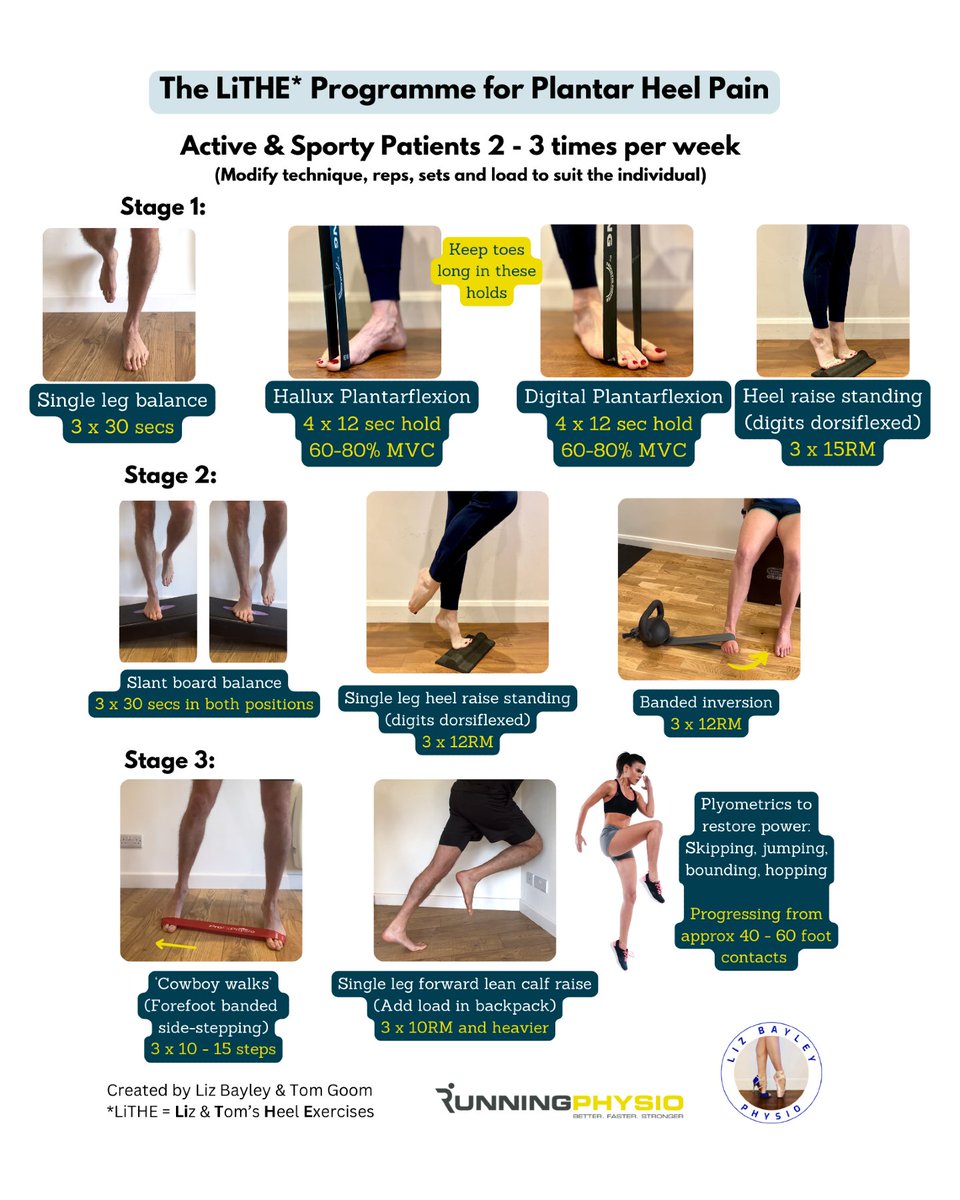
I teamed up with @Liz_Bayley_Physio to create this progressive rehab programme for Plantar Heel Pain.
We've called it 'LiTHE' (Liz and Tom's Heel Exercises) and it's aimed at active and sporty patients. It's not a recipe though so it's best to adapt it to suit individual needs.
Two years of vigorous exercise reversed the age-related structural changes in the hearts of sedentary 50-year-olds by about 20 years
The protocol used by Dr. Ben Levine's team:
• Norwegian 4x4 intervals (initially once per week, later increased to twice per week, eventually returning to once/week)
• Strength training (twice weekly)
• Recovery aerobics (20-30 minutes of light exercise)
• Endurance sessions (weekly 1+ hour endurance training, plus a separate 30-min base-pace session)
A few notes:
• Exercise intensity and frequency gradually increased from the start
• By 6 months, participants were exercising 5–6 hours/week