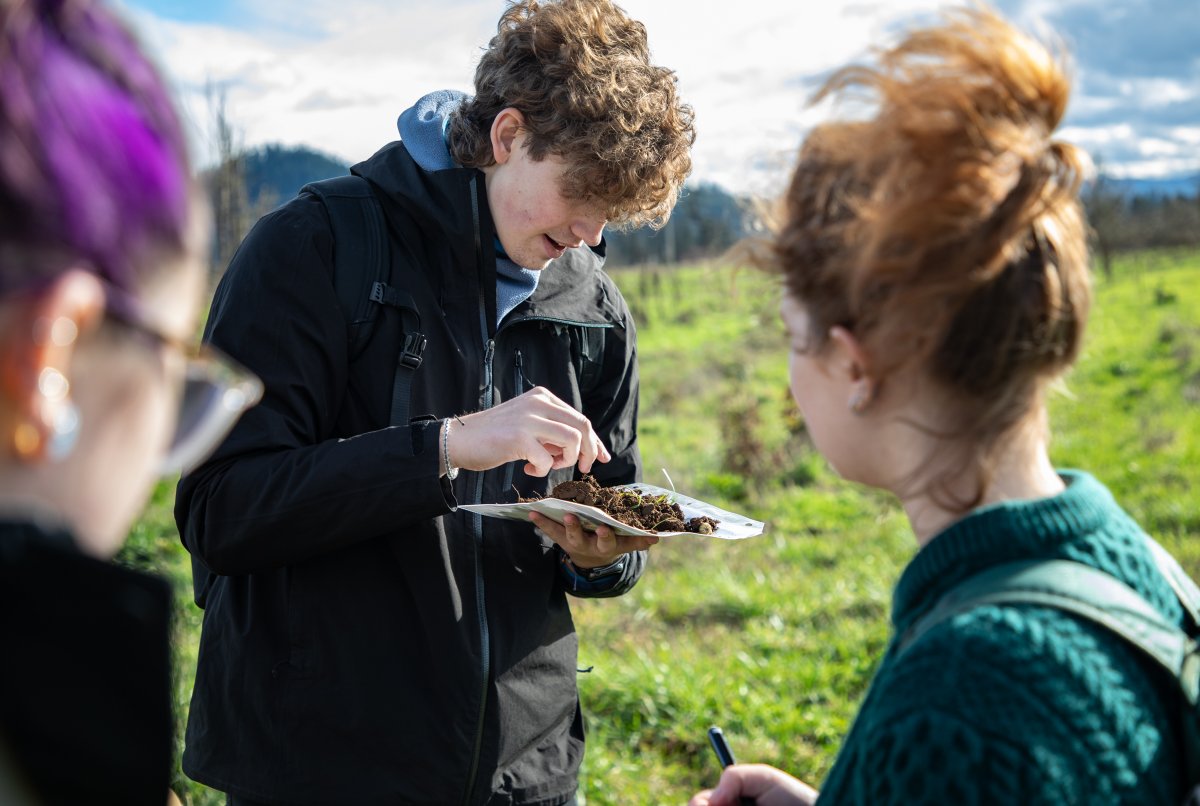
Thrilled to kick off this (literally) groundbreaking project! We are partnering with 20 farms to boost carbon capture. Led by @lmhallett & Marissa Lane-Massee @uoregon we will test how native species enhance weathering and CO2 sequestration 🌍 Read more: https://t.co/WrohAMHS46
The University of Oregon is working with Oregon’s Indigenous and rural communities to tackle climate change. Led by a team of UO scientists, this National Science Foundation (@NSF) backed effort aims to help the Coquille Indian Tribe develop land stewardship practices that increase carbon storage.
@UO_Research
@silva_lcr “Optimizing Carbon-Water Tradeoffs in Ecosystems: Strategies for Climate Change Mitigation & Biodiversity Conservation” a synthesis of efforts @uoregon@NSF@USDA@USLTER to advance #conservation & #climate change mitigation
https://t.co/dzPkRXBqIh
@k_podkovyroff “From Degradation to Restoration: Examining Nutrient Cycling & Ecosystem Dynamics” A @uoregon@NSF collab with the Coquille Indian Tribe: #soil records of #carbon & #nitrogen linked to changes in #salmon population stable #isotopes & #eDNA
https://t.co/5nhcRSONhr
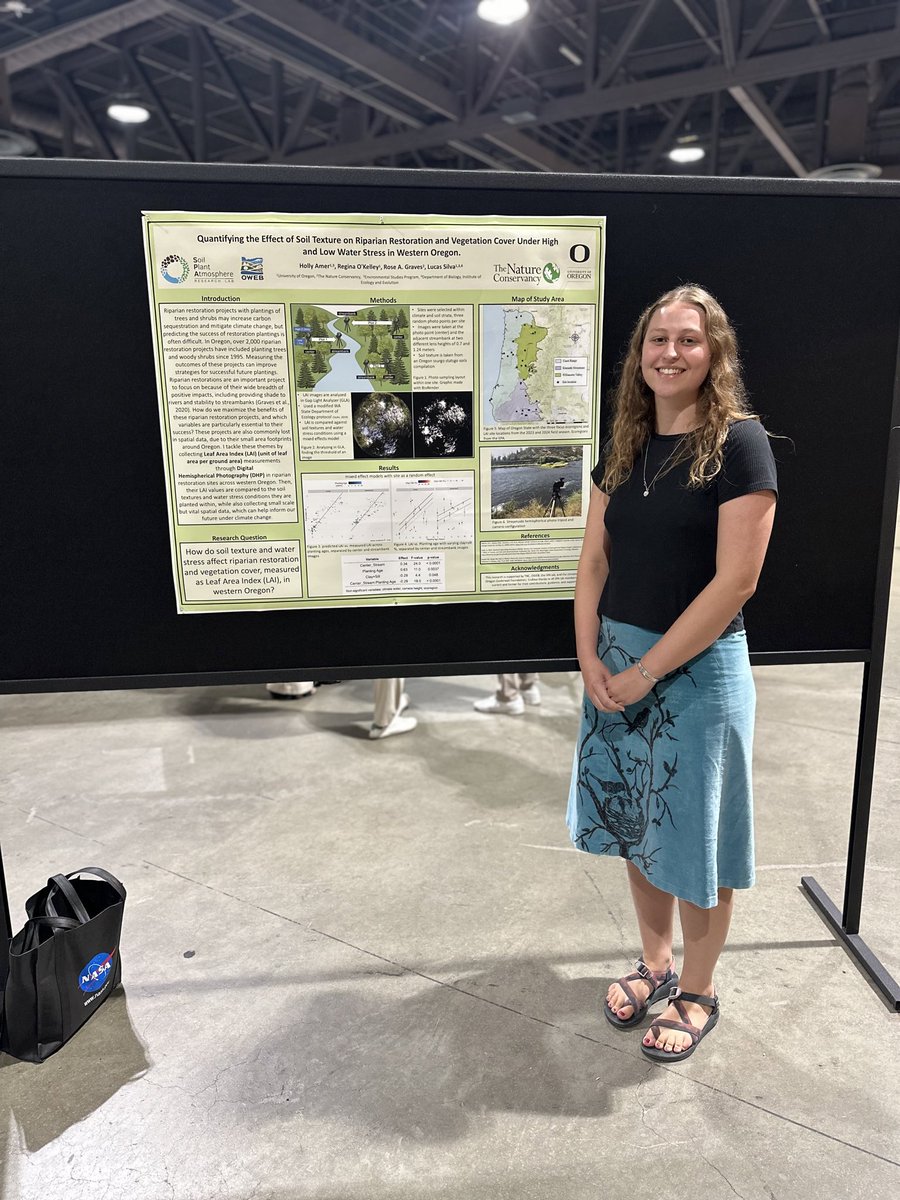
Holly Amer “Quantifying the effect of soil texture on riparian restoration and vegetation cover under high and low water stress” a collaboration between @uoregon & @nature_org and land owners focusing on multiple benefits of #ecosystem#restoration
https://t.co/QeMoGtXWUX
A thread about some unexpected but broadly applicable results arising from @NSF funded Convergence to Accelerate Research on Biological Sequestration #CARBS focusing on #PNW forests #carbon-#water relations
Some results from @NSF funded research @uoregon@HJA_Live@OregonState "Carbon-Water Tradeoffs in Old-Growth and Young Forests" @AguAdvances: Old-growth forests of the #PNW not only store more carbon but are more drought-resistant than younger forests https://t.co/rJaQxCKQOa
Proud to see @AlisonDeak’s thesis published @ESAEcosphere#OpenAccess “Prescribed fire placement matters more than frequency and extent in a simulated Pacific Northwest landscape” an interdisciplinary collaboration with @MelissaLucash @Anthro_Coughlan @ShelbyAWeiss @SPA_research
Proud of our ELP students at @uoregon and grateful to have such amazing staff @SPA_research running this long term experiment in collaboration with @EWEButility thanks everyone!
Excited to see a classroom project @uoregon@SPA_research become a peer-reviewed publication on 'The Spatial & Temporal Domains of Climate Solutions' Students explored land use optimization for CO2 drawdown using #PNW climate soil & ecosystem flux data https://t.co/cQoSrM5oK9
These plants solve nasty problems.
Students in the @uoregon Environmental Leadership Program (ELP) visit our carbon sequestration forest in their climate solutions class. The outdoor lab is a partnership between EWEB and the Soil, Plant and Atmosphere (@SPA_research) Lab.
Excited to share “Incorporating Small-Scale Disturbances in Models of Forest Structure & Aboveground Biomass" @adriana_uscanga et al show how field data+remote sensing enhance biomass mapping. A big step for predictive #ConservationScience#ClimateAction https://t.co/CozlTj9SoP
Article: Erosion rate is a first-order control of soil organic carbon abundance and persistence in hilly and mountainous regions
@Geomorph_Brooke @silva_lcr@morel851@UOgeomorph @BathSpaResearch
https://t.co/PAqlAbf8NH
Congratulations Dr Broz+team @SPA_research@NASA@uoregon diving into the past to predict Earth's future. "Eocene greenhouse climate recorded in nonmarine rocks" a tale of sea level variation and CO2 spikes. A possible window into future
https://t.co/3lGCWdbyO4
Exciting news! @Geomorph_Brooke leads "Geomorphic controls on the abundance & persistence of soil carbon pools" @NatureGeosci@SPA_research@UOgeomorph@uoregon https://t.co/DNEzBsJnKT A brilliant use if field data+lidar to predict C stocks in #PacificNorthwest forest landscapes