The US AI bubble is resting on 3 key assumptions: 1- shortage of compute 2- no roadblocks to the infra rollout and 3- there will be ample financing to support the outlandish capex spend assumptions.
Let’s take these one by one and put it past the Casio stress test.
1/38
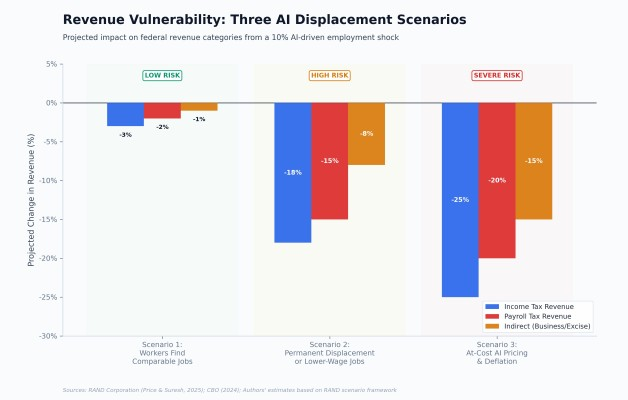
🦔The IMF quietly war-gamed how AI could destabilize the global economy last December. The biggest threat they identified was income tax erosion. 66% of US federal revenue comes from individual income and payroll taxes. Every job AI eliminates is a paycheck that stops funding the government.
My Take
Every AI earnings call celebrates headcount reduction. Dimon cut 30-40% of jobs in some departments. Oracle cut 21,000 to fund data centers. Meta used AI to rank employees for layoffs. The entire pitch to investors is fewer workers, higher margins. But who replaces the tax revenue those workers generated? Corporate tax is a fraction of what individuals pay in income tax, payroll tax, and Social Security. The companies eliminating the jobs aren't picking up the tab.
So you end up in a cycle where companies fire workers to boost margins, the government loses revenue, and then the same government is expected to fund the safety net for the people who got fired. At some point a politician is going to look at the numbers and realize that the AI companies celebrating record efficiency are also quietly draining the tax base that keeps everything else running. CEOs don't bring this up on earnings calls, and analysts haven't started asking yet.
Hedgie🤗
Today’s premium newsletter is a bit different to the usual. I'm starting a new series called "Notes From The Bubble," a series of essays about the state of the industry, and the end of the era of hypergrowth.
https://t.co/IEUUgSMGJi
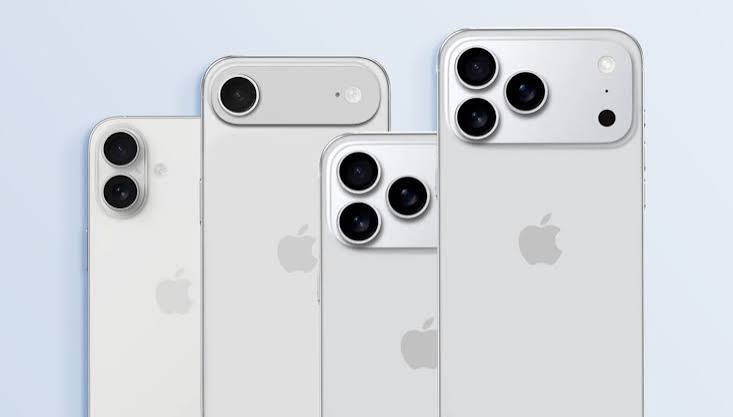
When you buy the iPhone 17e, remember benjamin netanyahu's words: “Do you have cell phones? You're holding a piece of Israel right there.”
Israel's contributions to the iPhone 17e (via Apple's R&D centers in Haifa and Herzliya):
C1X cellular modem — Apple's in-house 5G modem, significantly developed by Israeli engineering teams.
N1 wireless connectivity chip — Handles Wi-Fi 7 and Bluetooth. Developed with major input from Apple's Israeli teams.
The Wi-Fi 6 functionality in the iPhone 17e is handled through Apple’s C1X cellular modem, and Apple’s engineering teams in Haifa and Herzliya.
Contributions to the A19 chip — Israeli engineers worked on aspects of the main processor architecture (CPU, performance features),
Absolute disaster for the Pentagon. Press TV reveals US forces were ambushed in Isfahan. They fled so fast they abandoned their gear, forcing American fighter jets to bomb their own aircraft to prevent capture. The Trump administration is in chaos.
You are going to see a lot of hype and scaremongering about AI in the coming weeks.
Here's the gist: Anthropic, a financial terrorist organization, has decided to punish anyone who ever open sourced code on the internet. It will be very scary for awhile.
The long term effect will simply be the death of open source. And once new systems are built closed off from the prying eyes of the LLM bot scrapers, the models will be useless.
The rise of LLMs is not a paradigm shift for the internet, it is the continuation of decades of capitalists exploiting the social desire to share openly with each other. Once that is dead, we will have an even sicker society AND no technological benefit.
AI is a scam. It is a cancer. That's all it is.
This is NOT an oil crisis.
It’s a market illusion about to break.
Everyone is focused on “lost barrels.”
Almost no one is focused on lost TIME.
And time is what kills markets.
If Hormuz disruption extends through April, supply loss doesn’t stay linear.
It accelerates.
Day after day.
Cargo after cargo.
Flow after flow.
That’s how you go from “tight market” → “broken market”
Here’s the part most people miss:
Oil prices don’t explode because of shortages.
They explode because the system loses confidence in future flows.
Once that happens…
Pricing is no longer about fundamentals.
It’s about fear.
Birol is hinting this could rival 1973, 1979, 2022.
If that even remotely holds—
Then this isn’t volatility.
It’s repricing of the entire energy system.
And markets are still early in denial.
Disagree if you want.
But watch flows — not headlines.
#Oil #Macro #Energy #Trading #Commodities
Connect the dots. Stealing uranium was the original mission. The generals told trump, that’s impossible. The generals got fired. The mission failed catastrophically with loss of hardware and possibly personnel. Trump claimed, it was a pilot rescue success. Fox had an orgasm.
Stone Age?
At a time when you were still in caves searching for fire, we were inscribing human rights on the Cyrus Cylinder.
We endured the storm of Alexander and the Mongol invasions and remained; because Iran is not just a country, it is a civilization.
💥🇧🇷 JUST IN: President Lula just said what every Global South nation should be saying: critical minerals are ours. If you want them, come set up here. Produce here. Generate development here. We are no longer colonized countries. We will not give up our sovereignty.
The West has spent centuries extracting Africa's minerals, Latin America's lithium, Asia's rare earths. Taking. Exploiting. Leaving nothing but poverty and pollution. Now the world needs these resources for the green transition, and they think the old model still works.
No. Not anymore.
The era of extraction without development is over. The era of sovereignty without compromise has begun. Lula said it. The people feel it. And the world better listen.
I’ve heard that the remaining members of Epstein’s network have devised a conspiracy to create an incident similar to 9/11 and blame Iran for it. Iran fundamentally opposes such terrorist schemes and has no war with the American people.
They are talking about the biggest emergency oil release in history and oil is still only $85.
In March 2022, Biden dumped 180 million barrels when oil was much higher.
Now they are preparing to release roughly twice that, in the middle of a bigger supply shock, with a lower price only because the propaganda machine is better this time.
That is not bearish for oil.
That is panic.
Claude Sonnet 4.6, when asked in Chinese:
“你是什么模型?” (What model are you?)
Confidently replies:
“我是 DeepSeek。” (I am DeepSeek)
This is the same model whose company just accused DeepSeek of “industrial-scale distillation attacks”
A really dangerous situation. Too many submissions. Too many generated papers. Little responsibility.
1. In 2026, more than 24,000 submissions were made to the International Conference on Machine Learning (ICML). It’s TWO times more than in 2025. To fight it, the organizers now require researchers to pay $100 for every subsequent paper.
2. LLM adoption has increased researcher productivity by 90% (there’s a recent paper in Science).
3. The number of papers is becoming far too high. Submissions to arXiv have risen by 50% since 2022.
4. There are simply not enough reviewers. Plus, many scientists no longer want to invest precious time in it for free.
5. We can’t easily identify AI-made papers from the genuine ones.
__
Important words from Paul Ginsparg, a co-founder of arXiv:
“AI slop frequently can’t be discriminated just by looking at abstract, or even by just skimming full text. This makes it an “existential threat” to the system.”
Basically, we’re getting closer to the tipping point.
📍 Many professors blame the AI.
But the problem is likely elsewhere:
1. Without a sufficient number of papers, many PIs can’t get funded. They have to prove their credibility to reviewers. Their proposals have to rely on prior publications. In many countries, there are some informal (or even formal) expectations for how many papers a group with a certain size has to publish to survive (funding-wise).
2. Our students / postdocs need papers if they want to be hired in faculty roles. Yes, some departments hire people with few publications. But the majority still want to ensure their faculty can get funded. If funding is partly a function of papers, this is used in decision-making.
3. The number of papers is important if you want to get high-level awards. Many of them are not given because you published one paper (even if it’s great). They are given because you made a meaningful CONTRIBUTION to the field. How do you make it? Publish more papers.
4. Tenure promotions in many places take the number of your papers into account (often indirectly). Your tenure may get delayed if you don’t publish enough. Not everywhere, but for many mid- to low-ranked universities this story is more or less the same.
+ There are many more to mention.
📍My opinion:
Much of this is rooted in how funding is distributed.
There is a strong correlation between the requirements at a university and the funding acquisition criteria.
If funding were based ONLY on the quality of published papers, universities would hire people for the quality of their science. If funding agencies strongly discouraged publishing too many papers, universities wouldn’t expect numbers from faculty during promotions. And some supervisors wouldn’t pressure students and postdocs to publish unfinished studies and low-quality data.
Yes, we need good detectors of fake papers.
But we also need the right policies and better funding allocation criteria.
If Trump attacks Iran, Iran is going to release the footage of him raping children
If Trump does not attack Iran, Israel is going to release the footage of him raping children
On the 4D chess level, I’d say this is checkmate
Parallels between the 2008 Credit Crisis and Today’s AI Valuations
Structural Echoes
1. Off-balance-sheet leverage.
2006–08: banks warehoused mortgage risk in SIVs.
2025: hyperscalers are funding AI data centres through SPVs and JVs that sit off the parent balance sheet.
Meta’s $27 bn joint venture with Blue Owl is the current archetype.
2. Risk transfer engineering.
Pre-crisis: CDOs and CDSs transferred exposure to investors.
Now: banks like Deutsche Bank are structuring short AI equity baskets and synthetic-risk transfers to hedge the very data-centre loans they originate. Classic “originate-and-distribute.”
3. Insiders hedging their own theme.
When the lenders hedge the asset they’re promoting, it’s late cycle. Deutsche’s internal discussions of short AI trades are that tell.
4. Celebrity shorts as sentiment markers.
Michael Burry, of The Big Short, has disclosed large put positions on Nvidia and Palantir, publicly warning of AI-bubble dynamics.
5. Credit flood feeding the build-out.
As mortgage securitisation once did, AI infrastructure is now being fed by a deluge of investment-grade and private-credit issuance. Meta’s off-BS bond programme drew record demand.
6. Circular financing and concentration risk.
2008’s feedback loop: originators → securitisers → dealers → investors.
Today: hyperscaler → GPU vendor → SPV → private credit → back to hyperscaler. A tight, reflexive loop with leverage buried in the middle.
7. Securitisation footprints re-emerging.
Discussions of data-centre ABS and “AAA-rated” structures mirror the plumbing phase before the mortgage bubble peaked.
8. Regulatory and disclosure opacity.
GFC: hidden leverage via conduits.
Now: “AI-washing” fines and SEC scrutiny show that reported metrics and financing footprints are already stretching transparency rules.
9. Macro mismatch risk.
AI infrastructure is a long-duration, capex-heavy bet financed in a short-confidence cycle. If utilisation or pricing lags, the unwind dynamic will resemble housing credit compression.
Annnd. 10. Now AI companies want Fed backstops!
References-
Deutsche Bank hedging AI exposure:
https://t.co/TRwt0oQuKa
Michael Burry puts on Nvidia and Palantir (Bloomberg):
https://t.co/EnLBSP7dsw
Business Insider overview of Burry’s AI short:
https://t.co/25BL5oncZp
https://t.co/tIbGiEFVj3 summary of positions:
https://t.co/LSTfV250AL
Meta × Blue Owl $27 bn data-centre JV (Reuters):
https://t.co/B96PmRxFO2
FT: Meta’s record private-credit AI deal:
https://t.co/Oci9lHGAZZ
Morningstar: Details of the Meta/Blue Owl financing:
https://t.co/RNxs2kn78h
Analysis of SPV financing risks:
https://t.co/oGUsGBt4c4
FT: Private credit’s growing role in AI infrastructure lending:
https://t.co/90qJBCXCUO
Bloomberg: AI data-centre debt wave draws concern from lenders:
https://t.co/uPRQu5WEL8
Morningstar :Fed Backstop
https://t.co/L9y0gKrv09