We’re excited to announce our first mission into orbit!
The work began last year, with the development of our space internet architecture design, Space Fabric. Now, we’re taking the hardware into orbit in Q1 next year.
Its job will be to prove Space Fabric’s security and multi-tenancy computing capabilities in GEO.
If you want to build with confidential computing and security services in orbit, you have to solve the connectivity challenges between the different components of the space infrastructure orbit and Earth.
This mission is how we begin addressing that challenge.
Big credits to our amazing engineers for getting Space Fabric built and ready for orbit. Stay tuned for updates!
Read the article:
https://t.co/hhKCgeVso0
We're very excited to share that @SpaceComputerIO has joined the @creativedlab space stream as one of the 40 startups in their first session!
During the session in Milan we connected with more than 30 mentors from across the space industry, and got valuable feedback on our product and go-to-market. This is really important for our current growth stage, bridging our unique R&D to integration partners.
Looking forward to collecting valuable feedback and sharpening our message with James Slifierz, CEO of SkyWatch Space, as our mentor.
On Friday we toured @D_Orbit's manufacturing facility, which was so cool to see in person - from clean rooms to R&D plans, showcasing great connection between product & engineering. I loved the video of Mandalorian helmet in space!
We’re excited to be part of this #NewSpace cohort, and look forward to sharing more about what’s coming next.
Until then, we keep building 🚀
@SteffenKux of https://t.co/qZFWCjv3dl kicking off @EDCON_Official 2026 in Kuala Lumpur
Introduces pragmatic adaptive privacy
Because it should be a dynamic and proactive consideration rather than reactive
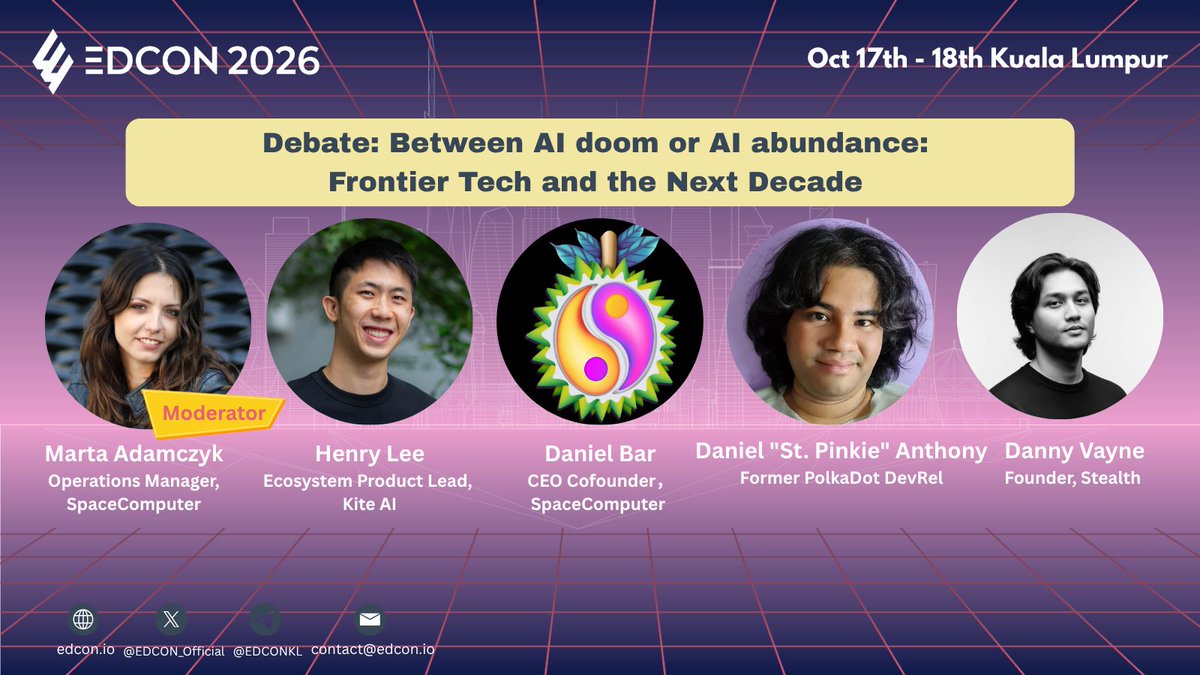
EDCON2026 is bringing an Oxford Debate about AI to the stage:
Between AI doom or AI abundance: Frontier Tech and the Next Decade
Panelists:
🔹 @Henryleemr , Ecosystem Product Lead @GoKiteAI
🔹 @semicondurian , CEO Cofounder @SpaceComputerIO
🔹 @StPinkie , Former PolkaDot DevRel
🔹 @dannyvayne , Founder Stealth
🎙️Moderator:
@madamczyk0 , Operations Manager @SpaceComputerIO
EDCON2026
📅 Oct 17–18, 2026
📍Menara KEN TTDI, Kuala Lumpur, Malaysia🇲🇾
Event free tickets :https://t.co/mNK5DPk7IR
More info: https://t.co/T4VQf5PWNK
Event group: https://t.co/zxL5W0xpRS
See you in KL!
SpaceComputer key management service (KMS) is live in beta to start testing in your security flow today.
Current capabilities include:
✓ Secret key generation and storage
✓ AWS KMS style API
✓ Custom policies
✓ Multi-tenancy
✓ AI workflow support
Test out KMS, available by SDK and CLI → https://t.co/TtHl1WtMN7
Follow for upcoming features releases related to AI and post quantum capabilities!
Secure infrastructure in space starts with getting the foundations right on Earth.
We’re excited to launch @SpaceComputerIO’s Key Management Service (KMS), now live in beta.
KMS gives teams a secure foundation for managing keys, identities, and cryptographic operations across their applications and infrastructure today, while giving us the base to build more advanced security capabilities over time.
Our engineering team has been working around the clock to bring this product to life this year, with the architecture and thinking outlined in our latest engineering blog.
Huge shoutout to @zkpedrongmi@danidelta8@utocif@am_ylm, and @easonchaiii for all their hard work bringing our on-Earth KMS to life.
We’re shipping more capabilities very soon.
Let’s keep building 🚀🙌
For SpaceComputer, a Key Management Service (KMS) is a natural first application to build.
It’s authority-dense, and needs modest compute and communication.
A KMS controls the cryptographic authority behind high-stakes actions, and authorization of critical downstream systems.
By securing the control plane for security keys, we’re enabling customers to protect action-driven decisions by AI agents and mission-critical information, while preparing for evolving space cybersecurity landscape.
Learn more from our engineering team about our KMS service: https://t.co/6qEmeSPzr9
During #WorldSpaceWeek, we’re celebrating a year of progress and momentum at SpaceComputer 🛰️
From launching our key management service this week, to preparing for our upcoming launches in 2027, our team at SpaceComputer is working hard to build compute and security capabilities for the next generation of space internet applications.
Behind every milestone we reach is an incredible team pushing SpaceComputer forward! 🚀
KMS was one of the most complex things we’ve built this year
And we will keep shipping new features on our way to SpaceKMS
In the meantime, here’s an absolute unit of a blog post where the architecture is explained in great detail
Build in public. For space 🚀
I’ll be joining @desilvaneil and Rob Meyerson in @cornell_tech New York City campus for a session on Space Economy’s Next Chapter
Join and HMU If you’re around !
We’re excited to announce SpaceComputer Key Management Service is live in public beta.
KMS acts as a verifiable control plane for cloud services, financial systems, and agentic applications rely on cryptographic keys to authorize high-value actions like signing, decrypting, and provisioning.
Our priority is to build a KMS domain strongly isolated, attestable, policy-controlled, cryptographically-agile and auditable.
Starting today, our KMS capabilities are available by SDK and CLI:
✓ Secret key generation and storage
✓ AWS KMS style API
✓ Custom policies
✓ Multi-tenancy
✓ AI workflow support
More updates are rolling out in the coming weeks, including TEE enablement, attestable execution, threshold cryptography, and PQC capabilities.
Create your account and start with 500 free credits: https://t.co/76zTg6mEor