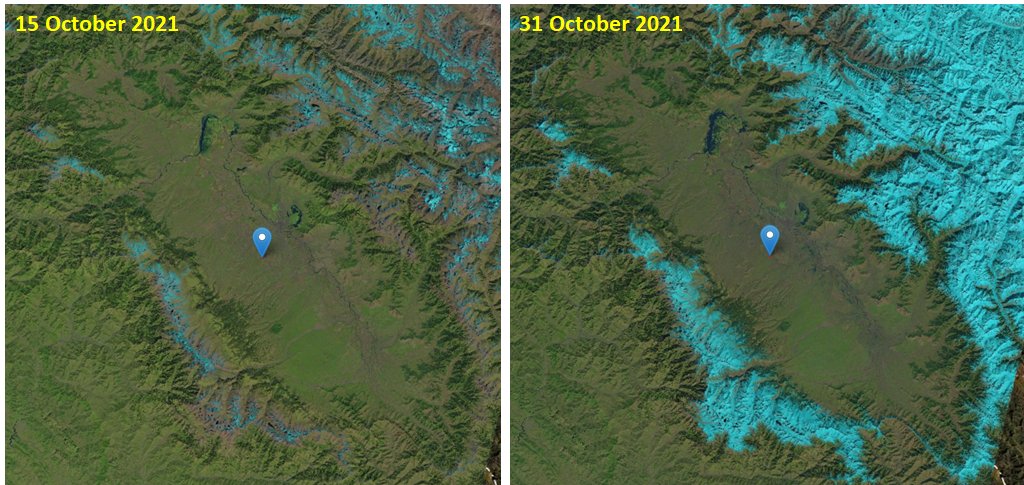
#Haze over #KashmirValley
The prevalent inversion conditions over bowl-shaped vale prevent the smog from getting dispersed especially in late autumn and winter severely degrading the air quality
Image Credits: European Union, Copernicus Sentinel-3 imagery
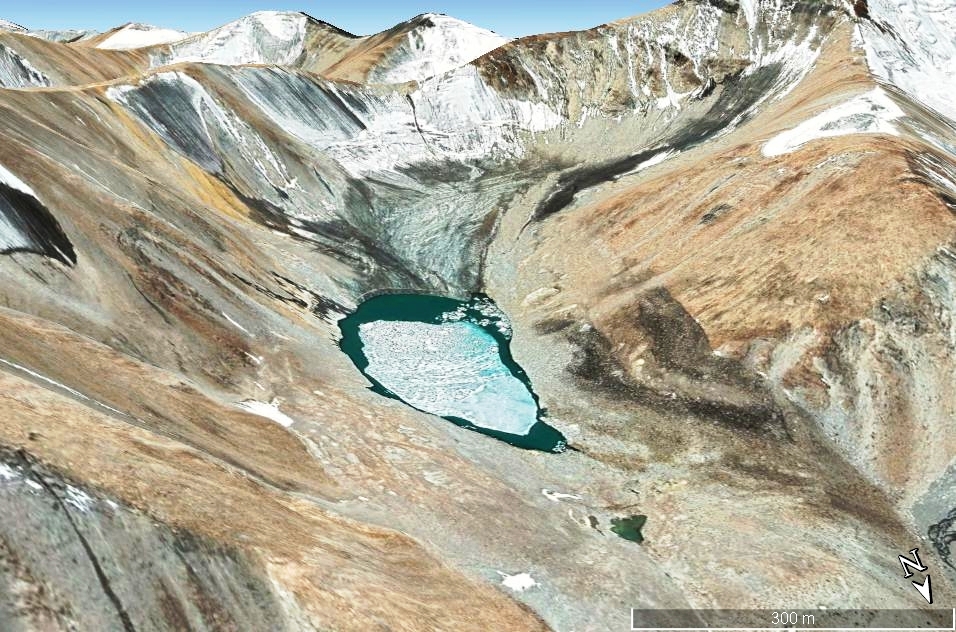
#DrangDrung, the largest glacier in the #Zanskar basin also happens to be a fast-melting glacier. This Google Earth image of September 2017 vividly captures the #ProglacialLake that is causing the accelerated frontal retreat of the glacier.
Frozen surface and waterways of #DalLake, #Kashmir captured from satellite on 13 Jan 2021. #KashmirValley is experiencing one of the record-shattering cold #winter this year.
Why can't #JKLAWDA hire technical manpower and take advantage of using freely available Google Earth images to identify the illegally raised houses that have come up in the lake during the past two decades? [2/2]
The otherwise vegetable gardens in #DalLake continue to be illegally encroached upon. Is it that #JKLAWDA [J&K Lakes and Waterways Development Authority] is deliberately playing blind or it doesn't have an idea of how technology can be used to check illegal constructions!! [1/2]
A #ProglacialLake associated with a lesser-known #GyaGlacier, located some 80 km from #Leh on Leh-Manali national highway. Pertinent to mention that the piping-failure of the dammed moraine resulted into a moderate #GlacialLakeOutburstFlood (#GLOF) in August 2014.
The repercussions of 4-laning the #SrinagarJammu#NationalHighway has led to the decapitation of the vegetated landscapes and exposed topographically and geologically unstable/weathered slopes. Will these slopes ever attain stability!
https://t.co/knnsQxJRg0
The three #HighAltitude#OligotrophicLakes, located in the upper reaches of #Tosamaidan, #PirPanjal mountain range, lying between 3900-4000 m asl could be apt ecosystems for reconstructing paleoclimatic signals. The lakes are associated with permafrost landscape.
While #Kolahoi happens to be the largest glacier in #KashmirValley, it also happens to be one of the fastest melting land terminating glaciers in #NWHimalaya. The glacier snout receeded by 454 m from 2006-14 at a rate of 56.75 m/year.
The #GreenCover in the #SrinagarCity has drastically reduced raising the concentration of pollutants (particulates and other auto-emissions). This might not only inflate the per capita spending on healthcare but also make living in the City unsustainable [2/2]
The transformation of the highway from 2-lane to 4-lane might have eased out traffic mess but road stretch from #Athwajan to #BeminaByepass, #Srinagar lost #GreenTunnel (Poplar trees) that not only diminished the aesthetics but also enhanced the dispersion of pollutants [1/2]