I believe that advice about behaviour management should be:
Concrete (i.e., specific things to do)
Actionable (i.e., possible to do for most teachers in most contexts without a massive workload increase)
Observation-informed (i.e., I've seen it work many times)
Experience-informed (i.e., I've done - and do - it myself)
Compassionate (i.e., does not blame the teacher)
Expectations-led (i.e., does not lower the bar for students)
Humane (i.e., respectful of students and their fundamental dignity as autonomous beings)
Example at the link and extensively on the blog at the "behaviour" tab, and if you want CPD or training you can sign up for updates here https://t.co/1KIWuItNhc
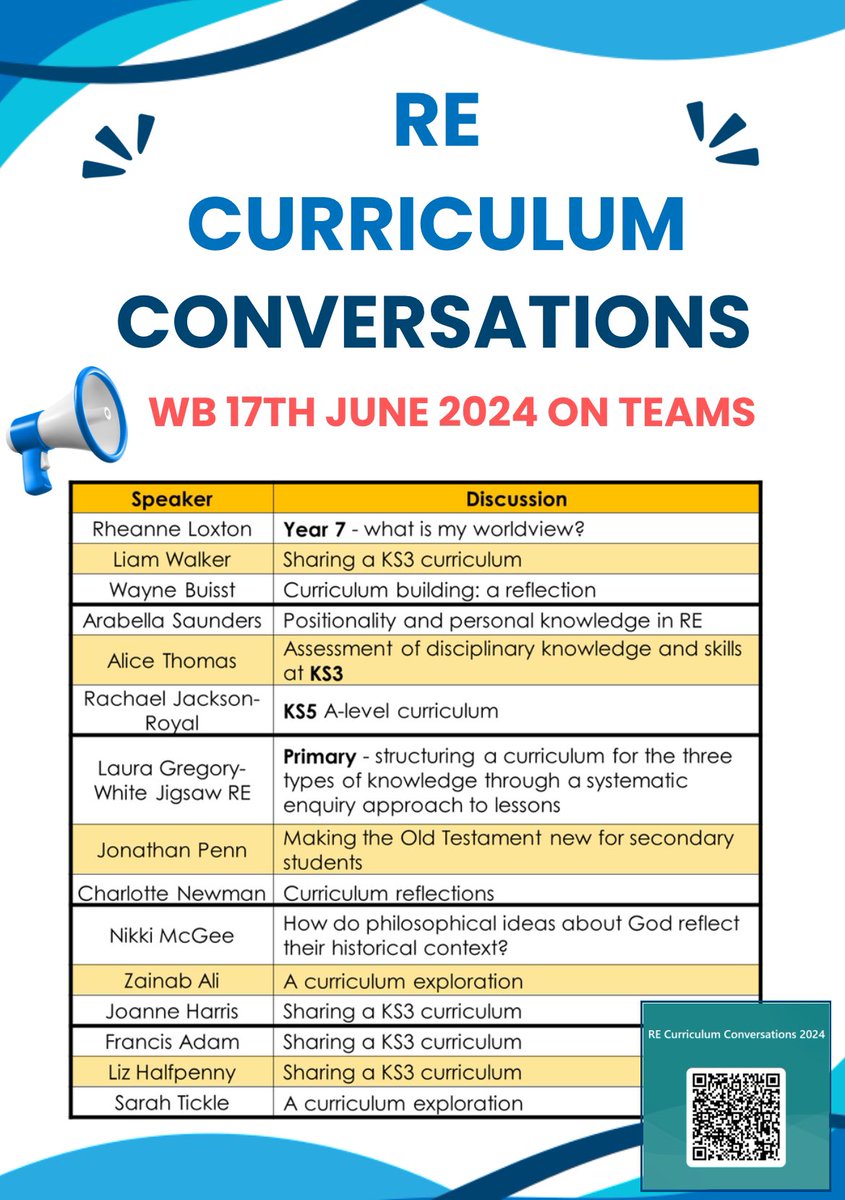
The schedule is ready! 📢
You cannot miss this week! A fanatic line up of brilliant RE leaders from across the country.
Please share. Use the QR code to sign up to receive the Teams links for each evening.
A busy week for RE coming up. Over 220 people are signed up to join the conversations next week. Check out the schedule below 👇🏻
Emails with Teams links have been sent out to those who have signed up.
Big thank you to @MrNorcrossRE for helping behind the scenes.
I’m at a secondary school during exam time. Some of the classrooms have been taken over for those exams. There are signs on the door. NO ENTRY in red. EXAMS IN PROGRESS.
Three teenage girls come to the door. They are about fourteen. They see that they can’t go to their usual class later that day, and they don’t know where to go instead. They find a teacher who looks it up. They have been re-roomed to G6. She writes on the door in red pen.
‘Well done girls’ she says, ‘For noticing that in advance’.
One of the girls is quick. ‘Can I have an achievement point?’ she asks.
The teacher thinks. ‘Okay’, she says. ‘Tell your teacher that Mrs. Terry says you can have an achievement point’.
The girls go off. I’m left wondering what strange world has been created where teenagers ask for achievement points – and teachers give them – for behaviour which is entirely unremarkable and in their own interests.
We immerse our children in this culture young. These young people have been trained methodically since they were four. It started with Star of the Week certificates and stickers for ‘Being Helpful’. They’ve been incentivised and sanctioned and invited to reward teas and doughnuts with the headteacher for being 'students who impress'. They've seen what happens to those who don't make the grade, when they're left out of Celebration Pizza Lunch or not allowed to join in non-uniform day.
They have been trained to be so focused on rewards that their first thought when a teacher says ‘Well done’ is ‘Will you give me an achievement point?’? If they don’t get the point, was it even worth pointing out the issue?
The research shows that when people behave themselves in order to get rewards (or avoid sanctions), that behaviour doesn’t continue once the rewards stop. It looks like they are learning to behave, but in fact they are just learning to do whatever is necessary to get the rewards. The behaviour has become a means to an end, rather than something they do for its own sake.
I wonder if anyone has looked at the long term impact of that on young people and their relationship with themselves. I wonder if anyone is tracking the impact on these young people’s sense of intrinsic motivation, and the way that they see themselves.
I wonder, but I think I know the answer.
NATRE notes that there is much for school leaders to consider in the RE subject report and would encourage leaders of RE to share key aspects with the school senior leadership team and governors.
A link to the full report can be found here https://t.co/WgEOp2EQYm
Really looking forward to attending this with @SaimaSaleh_RE and @Karenza_RRC . I lead the County Durham @NATREupdate local group, so would be great to connect with more people. @RE_Hubs
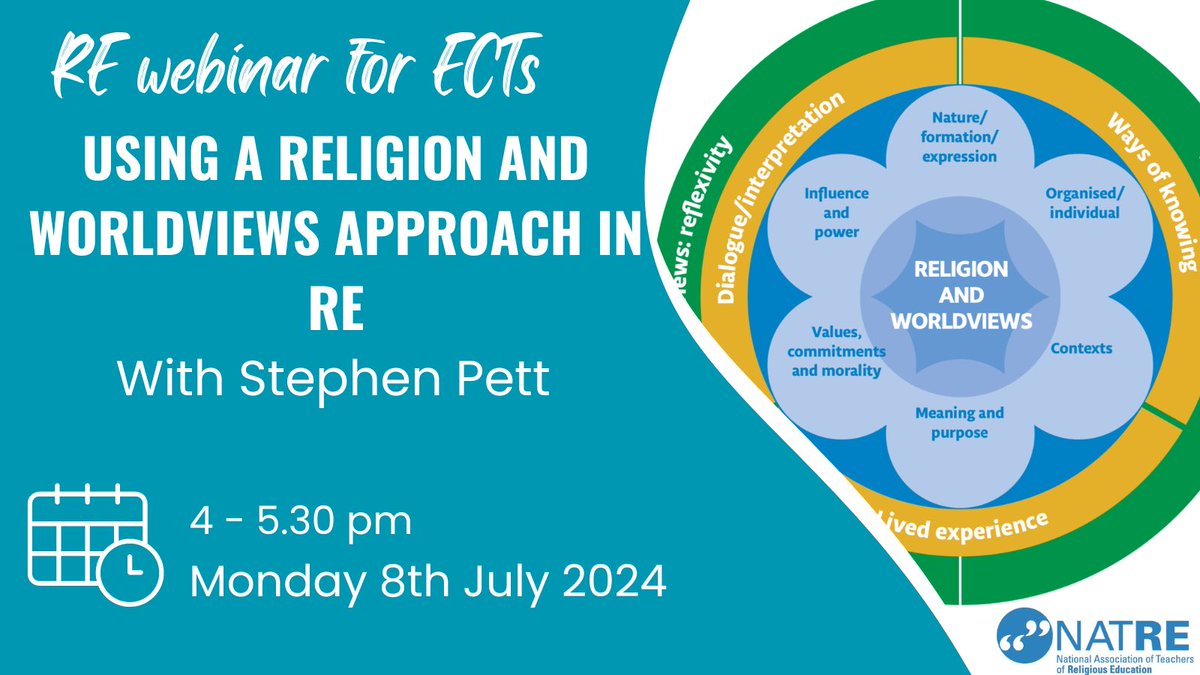
The OFSTED: ‘Deep and meaningful? The religious education subject report’ April 2024 has been released see comments on the report from NATRE and a link to the report below. https://t.co/WgEOp2EQYm
Looking to complete a Masters that links to religion and worldviews?
Our scholarship programme can help you with costs and support you in your studies!
Find out more: https://t.co/fU3Q9YwhQS
#TeamRE#ProfessionalDevelopment
@buckbyfamily One of the most powerful experiences I've ever had in school was when we had a Holocaust survivor to speak to year 8. Tears and silence. It was amazing. #REChatUK
On our campaign page you can download a report (and watch an in conversation session) which includes a list of possible learning outcomes that are specifically about FoRB https://t.co/3safhUtMjM #REChatUK
@RE_McGEE@kathrynfenlodge Partly just by using the phrase ‘freedom of religion or belief’, explaining what it means - and by linking it more clearly to human rights
#REchatUK
@kathrynfenlodge I think good RE will naturally have a great relationship with FoRB. Thinking of others, fairness, respect and celebrating diversity is at the core of RE. That said, I'm sure there will be people of faith and without who do not feel adequately represented or supported. #REChatUK
KS1 RE often starts with “beginnings” and festivals. It makes sense to combine these two by linking the natural world and festivals—something I did with the @InspirationEast KS1 curriculum.
@NATREupdate have a unit that links festivals and the environment. A 🧵below 1/10
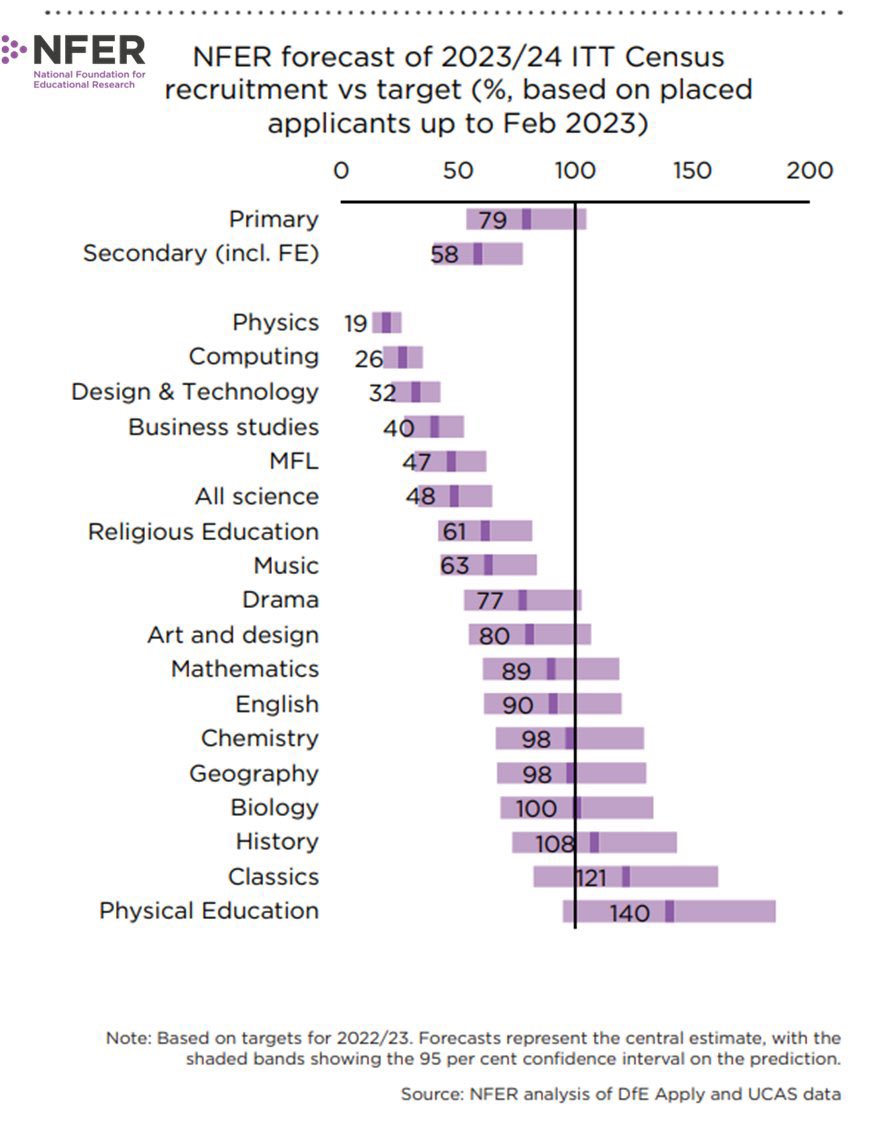
Who is going to teach RE if we don’t improve the recruitment of specialist RE teachers?
RE involves discussing complex and sometimes sensitive topics. We need teachers who have the skill and knowledge to manage these conversations
Sunak is installing 74 Special Economic Zones (SEZs) all over the UK.
48 in England
18 in Scotland
8 in Wales
The zones are publicly funded with State Aid under WTO rules, (Brexit allows the UK Govt to give public money to corporations of their choosing, this is illegal in the EU because it distorts markets and give corporations a competitive advantage chosen by the Govt.
Brexit means SEZs can be ‘free of Big Govt interference because the zones are ring-fenced enclaves separate from the host country.
UK SEZs set their own deregulated laws that allow corporations to make 100% profits without contributing anything back to local communities. They are tax exempt for 10 years.