“But ye shall receive power, after that the Holy Ghost is come upon you: and ye shall be witnesses unto me both in Jerusalem, and in all Judaea, and in Samaria, and unto the uttermost part of the earth.”
Acts 1:8 (KJV)
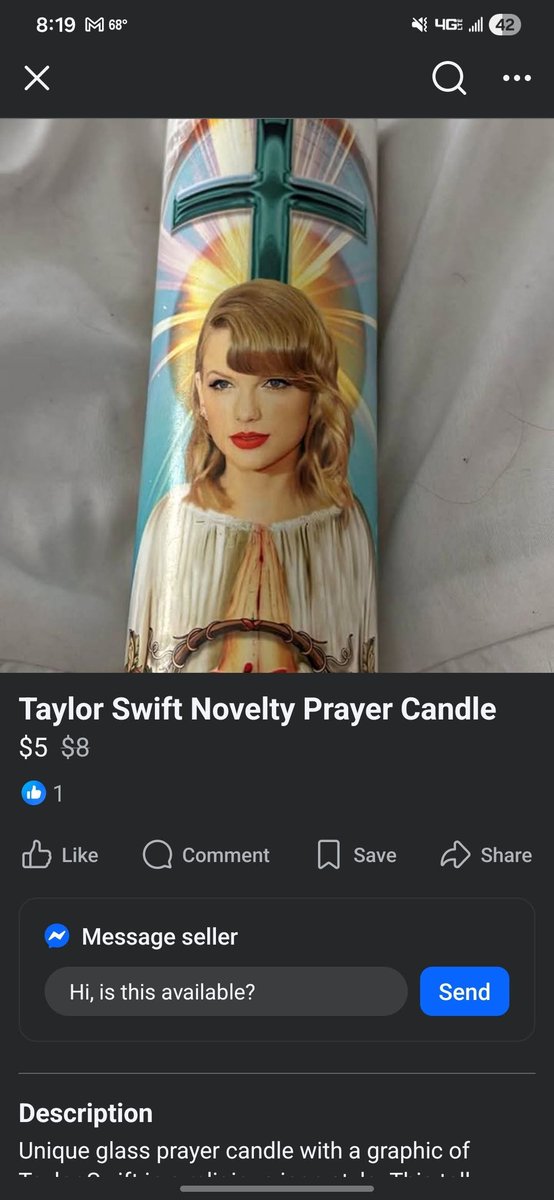
Spot on, Pastor! Whether someone is burning a prayer candle to Taylor Swift or lighting one up to Mary, Peter, or Jude, it is the exact same sin of idolatry. Both pop culture celebrity worship and Catholic saint worship take a created human being and put them in the place that belongs strictly to Almighty God. Romans 1:25 calls it out plainly: people who "changed the truth of God into a lie, and worshipped and served the creature more than the Creator, who is blessed for ever. Amen."
At the end of the day, Catholic traditions are just baptized paganism. Praying to dead people is straight-up necromancy, which God condemns as an abomination in Deuteronomy 18:10-12. Lighting candles, bowing down to graven images (Exodus 20:4-5), and chanting vain repetitions on rosary beads (Matthew 6:7) won't get anybody a single inch closer to Heaven. Whether it’s a pop star on a glass jar or a statue in a cathedral, none of them can hear your prayers, none of them died for your sins, and none of them have any power to intercede for you.
The King James Bible leaves zero room for confusion: "For there is one God, and one mediator between God and men, the man Christ Jesus;" (1 Timothy 2:5). We don't need a celebrity, a priest, a pope, or a dead saint to talk to the Father. When Jesus Christ died on the cross, the veil in the temple was rent in twain from top to bottom (Matthew 27:51), giving every saved believer direct access to the throne of grace through Jesus Christ alone (Hebrews 4:14-16).
Salvation isn't found in religion, sacraments, works, or candles—it is by grace through faith alone in the finished work of the Lord Jesus Christ (Ephesians 2:8-9). People need to ditch the false idols, open up a KJV, and put their trust 100% in Jesus!
This is no more or less effective than the other fake saints Catholics pray to.
"For there is one God, and one mediator between God and men, the man Christ Jesus;" - 1 Timothy 2:5
Romans 7:15 is about the battle between the spirit and the flesh after you're saved—not a test to prove you're saved.
If you look at your own struggle with sin for assurance, you're trusting your performance instead of the finished work of Jesus Christ (1 John 5:13). Salvation is by faith alone, not by how guilty you feel over sin. Also, the Bible calls Him Jesus, not "Yeshua" (Acts 4:12).
People who convert to Catholicism do so because they stopped relying on the King James Bible alone and started putting man-made traditions and uninspired "Church Fathers" above the Word of God!
The Bible is our final authority—not extra-biblical writings, not catechisms, and not church history (2 Timothy 3:16-17). If you actually compare Catholic doctrine directly to the KJV Scripture, they clash at every turn:
• Salvation by Grace Alone: Ephesians 2:8-9 makes it clear that salvation is a free gift through faith alone, not of works. Catholicism adds sacraments, works, and penance to the gospel, which Galatians 1:8-9 warns is an accursed "another gospel."
• No Other Mediators: 1 Timothy 2:5 states plainly that there is one mediator between God and men, the man Christ Jesus. Praying to Mary or the saints directly contradicts Scripture.
• Call No Man Father: Matthew 23:9 explicitly commands us to call no man on earth our spiritual "father," yet it is the foundational title of the Catholic priesthood.
• Idolatry: Exodus 20:4-5 strictly forbids bowing down to graven images and statues.
People get deceived into Catholicism when they let curiosity lead them into the philosophies of men rather than sticking strictly to the preserved Word of God (Colossians 2:8). Salvation isn't found in a church institution, tradition, or sacraments—it's found solely by believing on the Lord Jesus Christ (Acts 16:31).
Before many Protestants became Catholic, they had first condemned the Catholic Church and their beliefs. Then curiosity sets in. They start asking questions, reading Scripture and the Early Church Fathers. Eventually, they discover why Catholics believe what they believe, embrace the faith, and even bring their families along.
This is a classic Roman Catholic strawman that twists the meaning of the word "repent" to push a works-based salvation.
In the King James Bible, "repent" in the context of salvation simply means a change of mind—specifically turning from unbelief and false religion to faith in the Lord Jesus Christ alone (Acts 20:21). It does not mean "turn from all your sins" or "do penance" to earn or keep your salvation. In fact, Jonah 3:10 explicitly defines turning from evil ways as works ("And God saw their works, that they turned from their evil way"), and Ephesians 2:8-9 makes it crystal clear that salvation is "not of works, lest any man should boast."
Furthermore, Jesus Himself said in John 10:28, "And I give unto them eternal life; and they shall never perish, neither shall any man pluck them out of my hand." If you can lose your salvation by sinning, then it was never eternal life to begin with—it was temporary probation.
Real Christians don't reject repentance; we reject the Catholic heresy that you have to keep working, confessing to a priest, and paying off sins to stay saved. Once you believe on the Lord Jesus Christ, the debt is paid in full, and you are eternally secure.
You are conflating biblical Christianity with the Roman Catholic Church and state-run religions of the Dark Ages.
Real, Bible-believing Christians—the Baptists, Waldensians, and Anabaptists—were the ones being slaughtered by those institutions, not the ones doing the killing. The Catholic Inquisition and the Crusades were carried out by a pagan, false-works system that murdered millions of true believers for refusing to bow to the Pope or baptize infants. Blaming biblical Christianity for the death toll of Rome is like blaming the victims for the actions of the executioner.
Furthermore, Jesus Christ is not depicted in the King James Bible as a "smol bean." In Matthew 10:34, He explicitly said, "Think not that I am come to send peace on earth: I came not to send peace, but a sword." Revelation 19 describes Him returning with eyes as a flame of fire, a vesture dipped in blood, and a sharp sword to smite the nations.
True Christians don't take up the sword to force conversions—our warfare is spiritual, preaching the Gospel of salvation by grace through faith alone. Don't confuse the blood-soaked history of the Catholic whore of Babylon with the actual people of the Book.
Objectively speaking, Christianity is the most murderous religion in all of history. Not one other religion has even come close to Christianity's death toll, but we're supposed to pretend the opposite just because Christians artistically depict their god as an innocent smol bean
God created everything for His own glory and pleasure, not so humanity could define "flourishing" on its own sinful terms. "Thou art worthy, O Lord, to receive glory and honour and power: for thou hast created all things, and for thy pleasure they are and were created" (Revelation 4:11, KJV).
A "god" who just wants sinful mankind to prosper without repentance and obedience isn't the God of the Bible—that's an idol made in man's image. Real blessing only comes from fearing the Lord, trusting Jesus Christ alone for salvation, and obeying His Word. At the end of the day, whether you like it or not, "every knee shall bow to me, and every tongue shall confess to God" (Romans 14:11, KJV). You either worship Him willingly now as your Saviour, or you will bow before Him as your Judge.
This is exactly how churches die: someone decides the Bible is too offensive, so they edit it. Genesis 19:4-5 says every man in Sodom, "both old and young, all the people from every quarter," surrounded that house demanding Lot's guests so they could "know them." Jude 7 says they gave themselves over to fornication and went after "strange flesh," and that they are "set forth for an example, suffering the vengeance of eternal fire." Ezekiel 16:50 says they "committed abomination before me." Yes, pride and neglect of the poor were there too (v. 49), but verse 50 doesn't let you stop halfway. God did not burn two cities over rudeness. Preaching what the text says is not a weapon. It is the sword of the Spirit (Eph. 6:17). Romans 1 and 1 Cor. 6:9-11 say the same thing, and so does the God who doesn't change. Repent, believe the gospel, and quit being embarrassed by the Book.
Dear Christians, the story of Sodom and Gomorrah is not about homosexuality. It's about a lack of hospitality toward strangers.
Let’s stop weaponising Scripture to fight cultural wars.
Comparing a one-time, unsolicited miracle recorded in Scripture to the systemic, unbiblical practice of venerating relics is a massive distortion of God’s Word.
In 2 Kings 13:21, the men burying the dead man weren't worshipping Elisha, praying to him, kissing his skull, or parading his bones around in a gold box for spiritual merit. They threw a corpse into a sepulchre out of fear of a Moabite raiding party, and God sovereignly chose to perform a miracle to confirm Elisha’s prophetic ministry. There was zero ritual, zero veneration, and zero command for believers to seek power through dead bodies.
Look at how God actually treats the remains of His prophets when there is a risk of idolatry. In Deuteronomy 34:6, God intentionally hid the body of Moses so that the children of Israel wouldn't turn his grave into an idolatrous shrine. Furthermore, when the Israelites began burning incense to the brazen serpent Moses had made—an actual artifact God once used to heal people—King Hezekiah smashed it to pieces and called it Nehushtan (a piece of brass) in 2 Kings 18:4 because it had become an object of pagan worship.
Scripture is crystal clear:
1. There is only one Mediator: "For there is one God, and one mediator between God and men, the man Christ Jesus;" (1 Timothy 2:5).
2. Idolatry is strictly forbidden: Bowing down to, kissing, or venerating bones, statues, and images is a direct violation of the Second Commandment (Exodus 20:4–5).
3. The dead have no part in our worship: "For the living know that they shall die: but the dead know not any thing..." (Ecclesiastes 9:5).
God worked a miracle through Elisha's bones once; He never commanded the New Testament church to dig up dead men, encase them in gold, and bow before them. That isn't biblical Christianity—that is paganism baptized with Christian labels.
Our standard for truth is the preserved Word of God in the King James Bible, not uninspired "church fathers" or pagan traditions from Rome.
Claiming that "holy relics" are throughout the Old and New Testaments is a flat-out lie. Nowhere in Scripture are Christians commanded to venerate dead bones, kiss pieces of wood, or bow down to physical objects. In fact, when Israel turned a legitimate biblical artifact—Moses's brazen serpent—into a relic to burn incense to, King Hezekiah smashed it to pieces and called it Nehushtan (a piece of brass) in 2 Kings 18:4.
God explicitly forbids bowing down to graven images or likenesses of anything in heaven or earth (Exodus 20:4–5). What you call "veneration" of relics and statues is textbook idolatry. Paul warned that even in the first century, the "mystery of iniquity doth already work" (2 Thessalonians 2:7), so appealing to early post-apostolic writings like the Martyrdom of Polycarp over the clear text of Scripture proves nothing except how fast false religion crept in.
A real New Testament church is built on the foundation of the apostles and prophets with Jesus Christ as the chief cornerstone (Ephesians 2:20), not the man-made traditions of the Roman Catholic institution. True believers worship God in spirit and in truth (John 4:24), not through dead men's bones.
@sanderson1611 That you don't believe in holy relics proves that you're a fraud "church", which you just made up yourself. All of the most ancient Christians believed in relics (i.e. Martyrdom of Polycarp) and it's throughout the OT & NT.
You're in a cult Steven.
Biblical Christians do not bow to statues, relics, or dead bones. Those practices belong to Roman Catholicism, which contradicts the clear commands of Scripture against graven images (Exodus 20:4–5).
True Christianity is strictly monotheistic and rooted in the King James Bible. However, the Bible is clear that you cannot worship or know the one true God while rejecting His Son, Jesus Christ. As 1 John 2:23 states, "Whosoever denieth the Son, the same hath not the Father: (but) he that acknowledgeth the Son hath the Father also." Jesus Himself declared in John 14:6, "I am the way, the truth, and the life: no man cometh unto the Father, but by me."
Salvation and a relationship with the God of Abraham, Isaac, and Jacob come solely through faith in the death, burial, and resurrection of the Lord Jesus Christ—not by bloodline, works, or adherence to the Talmud.
@sanderson1611 Disgusting idol worship. Christians bow to statues and dead bones, I hate it. Jews only believe in one true god, thats why everyone is so jealous of us.
There is only one gospel, and it has always been salvation by grace through faith alone—from Abel and Abraham all the way through Peter and Paul.
When Paul says "my gospel" in the KJV (Romans 2:16, Romans 16:25, 2 Timothy 2:8), he isn't bragging about a brand-new, separate way of salvation that the twelve apostles didn't know about. He is simply referring to the gospel that he preaches—the exact same gospel he also calls "our gospel" (2 Corinthians 4:3) and "the gospel of Christ" (Romans 1:16). Just like a preacher today might say "my sermon" or "my message" without claiming he invented a new religion, Paul uses "my gospel" to emphasize his personal ministry and stewardship as the apostle to the Gentiles.
Hyper-dispensationalism ("Right Division" heresy) tries to chop up the Bible and pit Paul against Peter and Jesus, claiming people in the Gospels were saved by works and only Paul preached salvation by faith. That directly contradicts Scripture:
• Galatians 1:8-9 — Paul explicitly curses anyone who preaches any other gospel than the one already preached. If Paul had a different gospel than Peter, Paul would be calling a curse down on the twelve apostles.
• 1 Corinthians 15:1-4, 11 — Paul defines the gospel (Christ died for our sins, was buried, and rose again) and then explicitly says in verse 11: "Therefore whether it were I or they, so we preach, and so ye believed." Paul and the other apostles ("they") preached the exact same message.
• Acts 15:11 — Peter himself stands up and declares that Jews and Gentiles are saved the exact same way: "But we believe that through the grace of the Lord Jesus Christ we shall be saved, even as they."
• Romans 4:3-6 — Paul uses Abraham and David—Old Testament saints—as his prime examples of justification by faith without works.
Saying Paul had a "unique message" of salvation different from those before him is false doctrine. Abraham looked forward to the cross by faith, and we look back at the cross by faith. One Savior, one blood atonement, one gospel.
If Paul taught the same gospel as those before him, then why did he call it “my gospel” three times?
Paul uses both phrases “the gospel” and “our gospel” in his epistles, but when Paul mentions “my gospel” it shows that he had a unique message given specifically to him.
Absolutely not. Water baptism is an act of obedience that comes after salvation, never a requirement to get saved.
Salvation is by grace through faith alone in the finished work of the Lord Jesus Christ (Ephesians 2:8-9). Adding any work—even something good like getting baptized—turns grace into works and creates a false gospel (Romans 11:6; Galatians 1:8-9).
In Acts 2:38, "for the remission of sins" means because of or with reference to the remission of sins you already received through faith—just like you take medicine "for" a headache you already have. Look at Acts 10:43-48: Cornelius and his household believed, received remission of sins, and were filled with the Holy Ghost before anyone ever touched water. Peter didn't baptize them to get them saved; he baptized them because they were already saved.
Jesus's blood washes away sin (Revelation 1:5), not tap water. If water baptism were required, the thief on the cross would be in hell, and Paul wouldn't have said Christ sent him not to baptize, but to preach the gospel (1 Corinthians 1:17).
Get saved by believing on Christ alone, and then get baptized to follow His command.
Saying "Acts 2:38 has nothing to do with Gentiles" is pure Hyperdispensationalist heresy that requires you to literally ignore the very next verse in your King James Bible.
Look at Acts 2:38-39:
"Then Peter said unto them, Repent, and be baptized every one of you in the name of Jesus Christ for the remission of sins, and ye shall receive the gift of the Holy Ghost. For the promise is unto you, and to your children, and to all that are afar off, even as many as the Lord our God shall call."
Who is "afar off" in Scripture? THE GENTILES!
Paul literally defines that exact phrase for us in Ephesians 2:13 & 17:
"But now in Christ Jesus ye who sometimes were far off are made nigh by the blood of Christ... And came and preached peace to you which were afar off, and to them that were nigh."
Peter explicitly preached the promise of Acts 2:38-39 to the Gentiles right there on the Day of Pentecost!
Furthermore, Peter didn't preach a "Jewish gospel" of works while Paul preached a "Gentile gospel" of grace. In Acts 15:7-11, Peter stands up at the Jerusalem council and settles the whole debate:
• God chose Peter's mouth so "that the Gentiles by my mouth should hear the word of the gospel, and believe" (v. 7).
• God gave the Gentiles the Holy Ghost "even as he did unto us; And put no difference between us and them, purifying their hearts by faith" (v. 8-9).
• "But we believe that through the grace of the Lord Jesus Christ we shall be saved, even as they" (v. 11).
There is no difference between Jew and Gentile (Romans 10:12). There is ONE Lord, ONE faith, ONE baptism, and ONE Gospel (Ephesians 4:5). Stop chopping up the KJV to excuse unbelief—get saved by grace through faith alone, and follow Christ in believer's baptism!
That is a complete false equivalence, and you know it.
Nobody is walking into a post office or a courthouse, falling on their knees, lighting candles, burning incense, and kissing the feet of a framed photo of George Washington. Hanging a picture of a civil leader for historical or governmental recognition is not remotely the same thing as erecting a graven image inside a religious building where people bow down and venerate it.
God's Word makes the line crystal clear in Exodus 20:4-5 (KJV):
"Thou shalt not make unto thee any graven image, or any likeness of any thing that is in heaven above, or that is in the earth beneath, or that is in the water under the earth: Thou shalt not bow down thyself to them, nor serve them: for I the LORD thy God am a jealous God..."
A U.S. President does not sit on a throne in a church claiming to be the "Vicar of Christ" or the "Holy Father," which is a direct violation of Matthew 23:9 ("And call no man your father upon the earth: for one is your Father, which is in heaven"). People do not pray before photos of presidents or rub the toes off bronze statues of them expecting spiritual merit.
Even the Apostle Peter himself refused to let Cornelius bow down to him in Acts 10:26, saying, "Stand up; I myself also am a man." If a real apostle would not accept that kind of religious reverence in person, he certainly would not want people bowing to a marble or bronze statue of him or any pope.
Stop confusing basic civil recognition with flat-out religious idolatry. Read a King James Bible and repent of the traditions of men.
Whether the statue is made before or after a pope dies completely misses the biblical issue. From a Bible-believing perspective, both sides of this "trad" vs. mainstream Catholic debate are arguing over different shades of the exact same unscriptural practice.
God’s Word is clear on graven images:
"Thou shalt not make unto thee any graven image, or any likeness of any thing that is in heaven above, or that is in the earth beneath, or that is in the water under the earth: Thou shalt not bow down thyself to them, nor serve them..." (Exodus 20:4-5, KJV)
Pointing to Renaissance popes like Leo X or Julius II commissioning monuments to themselves doesn't validate the practice—it just proves how far the institution had already drifted from New Testament Christianity. In Acts 10:25-26, when Cornelius fell down at Peter’s feet to worship him, Peter immediately stopped him and said, "Stand up; I myself also am a man." Yet the papacy spent centuries erecting marble statues of men, dressing them in royal robes, and encouraging people to kiss their feet and bow before them.
As for the follow-up point comparing this to historical monuments like Robert E. Lee: there is a massive difference between a secular civic statue in a town square and a religious icon placed inside a house of worship where people pray, kneel, and venerate it. Nobody is burning candles, praying rosaries, or seeking spiritual intercession from a Civil War general.
The true Church doesn't need marble statues, Vatican traditions, or earthly "Holy Fathers" (Matthew 23:9). Our authority is the preserved Word of God, and our only mediator is the Lord Jesus Christ (1 Timothy 2:5).
I have seen a lot of "trad" accounts saying it is inappropriate to have a statue of a pope before he is dead. Well, not very trad of you.
Pope Boniface VIII (1294–1303 AD) had multiple statues of him sculpted during his lifetime including a large seated marble statue by Arnolfo di Cambio. Leo X (1513-1531 AD) had a marble statue of himself installed in 1518. Gregory XIII and Sixtus V both had statues in their lifetime. Julius II (1503–1513 AD) had a statue commissioned by Michelangelo sculpted in 1505. Sixtus V (1585–1590AD) and Paul V (1605–1621AD) had monuments sculpted of themselves in their lifetimes. Urban VIII (1623–1644AD) had a statue by Bernini that was started during his lifetime.
And others. People who know nothing about church history are so annoying.
Neither of these answers is completely right according to the King James Bible.
First, the Catholic answer—"because I'm a baptised Christian"—is a false works-based gospel that will send a person straight to Hell. Water baptism does not wash away sins or get anyone into Heaven. Getting sprinkled as a baby or dunked in water without believing the gospel just makes you a wet sinner. As Ephesians 2:8-9 clearly states: "For by grace are ye saved through faith; and that not of yourselves: it is the gift of God: Not of works, lest any man should boast." And Titus 3:5 tells us it is "Not by works of righteousness which we have done, but according to his mercy he saved us."
Second, while the Protestant answer gets closer by mentioning faith alone and rejecting works, modern Protestants (especially Calvinists and Lordship Salvationists) often corrupt the gospel by claiming you have to "repent of your sins" (turn from your sinful lifestyle) or "make Jesus the Lord of your life" to prove you are saved. That is just works-salvation disguised as grace.
The only biblical answer to why God should let you into Heaven is:
"Because at a specific point in time, I realized I was a sinner on my way to Hell, I put my 100% faith and trust in the finished work of Jesus Christ—His death, burial, and resurrection—and I called upon His name to save me (Romans 10:13). Because salvation is a free gift and I am sealed by the Holy Ghost unto the day of redemption (Ephesians 4:30), I have eternal life that can never be lost (John 10:28)."
Salvation isn't a church, a sacrament, a baptism, or a lifestyle. It is a free gift received solely by believing on the Lord Jesus Christ (Acts 16:31).
God: "So why should I allow you into into heaven?"
Protestants: Because I believe in your saving grace. I believe you died for me. I believe it is your works that saved me, not my works. Because I have faith alone in you. I believe my works cannot save me, but by my faith alone in you. That is why I want you to accept me into your kingdom."
Catholics: Dear Lord, because I'm a baptised Christian. 👍🏾
Acts 2:39 isn't a mystery that you have to cross-reference back to Daniel 9 to redefine. Look at the plain English of your King James Bible right in the context of Acts 2 and the rest of the New Testament.
1. Paul explicitly defines "afar off" in Ephesians 2:13 & 17: "But now in Christ Jesus ye who sometimes were far off are made nigh by the blood of Christ... And came and preached peace to you which were afar off, and to them that were nigh." Paul is literally talking to Gentiles (Ephesians 2:11). The Bible interprets itself. "Afar off" in the New Testament is a direct reference to the Gentiles who were previously aliens from the commonwealth of Israel.
2. Acts 2:39 is a promise to everyone: "For the promise is unto you, and to your children, and to all that are afar off, even as many as the Lord our God shall call." Notice the words "ALL that are afar off" and "even as many as the Lord our God shall call." Trying to restrict that to scattered Jews in Daniel 9 is classic hyperdispensationalist gymnastics to avoid the obvious truth that the Gospel was always meant for both Jew and Gentile.
3. Salvation has always been by faith alone: You don't need to chop up the Bible into different gospels or claim Pentecost was "only for Jews under the law" to defend salvation by grace through faith. Repentance in Acts 2:38 is turning from unbelief to believing on the Lord Jesus Christ, and water baptism is the outward step of obedience after you get saved—just like it is for Gentiles today (Acts 10:47-48).
Stop dividing the Word of Truth right out of the Bible. There is one Gospel, one Savior, and one way to Heaven for Jew and Gentile alike (Romans 10:12-13).
It never fails. You bring the plain, unvarnished truth of the King James Bible to some of these online Catholics—including the ones larping as "Knights of the Immaculata"—and they completely fold.
The moment you rebuke their unbiblical traditions, Marian idolatry, and works-based salvation with actual Scripture, the tough-guy act disappears. Instead of opening a Bible to defend what they believe, they follow the exact same weak routine:
1. Whine about the tone of the rebuke.
2. Accuse you of being "uncharitable" for quoting God's Word.
3. Hit the block button and retreat back into their echo chamber.
"Am I therefore become your enemy, because I tell you the truth?" (Galatians 4:16)
You can put "Knight" in your bio all day long, but running away and blocking people the second you get reproved by Scripture isn't valiant—it's cowardice. If your traditions can't survive basic biblical scrutiny without you hitting block, it’s because they aren't built on the Rock.