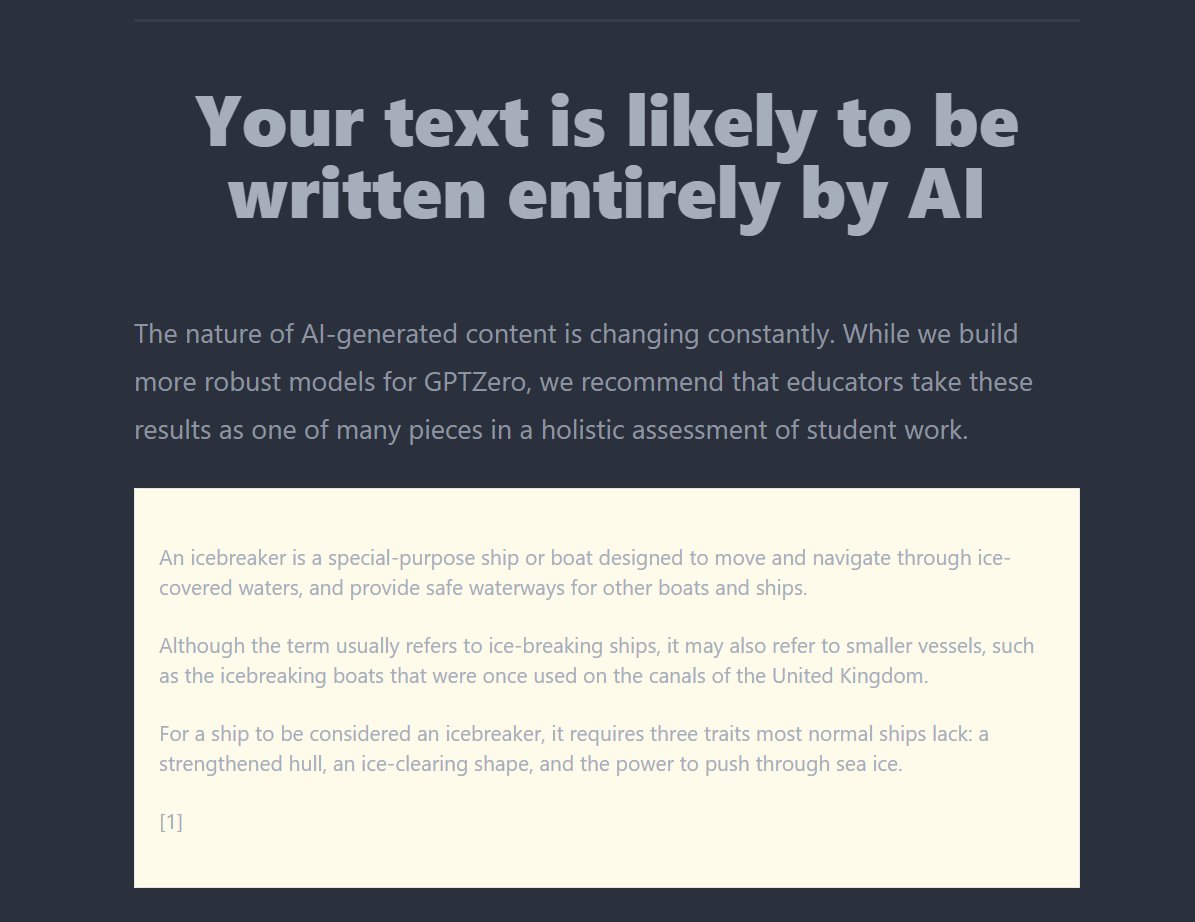
@DanySlicer Your evidence makes no logical sense, because I tried those exact same services, pasted in text from Wikipedia, and those were also flagged as AI.... so clearly you have intentionally chosen AI-detectors that are fake, in order to insult our service? Why?
@DanySlicer For some reason, all the AI detectors you are testing now, when we test them directly with text from Wikipedia, they show them all as written by AI. So your results are meaningless, at best.
@DanySlicer Hilariously -- this detector is supposed to detect GPT2 https://t.co/AIKatRE9Da ... and Speedwrite is DEFINITELY not based on ANY model even CLOSE TO gPT-2
I guess that's where we differ. You wrote: "a well written text is not same as text which is easier to understand" -- basically, no. Great writing is clear, concise, and easy to understand. Sure, especially in Academia, there are lots of examples of intentional obfuscation. But that's not what Speedwrite does.
If you try Speedwrite, you'll see it's not possible. It works in a fundamentally different way than most services like chatGPT, Jasper, copyAI. With Speedwrite, YOU control the source input. With those other systems, you're basically trusting a machine learning model so more-or-less copy from the internet. (Or at least the internet, as it existed, when that system's model was trained). Speedwrite's approach is fundamentally more humane, and more like a human writer, than these other systems.
You're asking about metrics, yes? Speedwrite is for generating fluent, well-written prose, from any source text. It can't really be measured with "metrics". But it could be useful to compare the output of Speedwrite against other AI-writers, which tend to produce very bland output......
@viky_bhat Speedwrite takes your original notes, and make fluent, intelligent, well-written text. That's one reason it's so popular with smart people, whose first language was not English. English is hard!