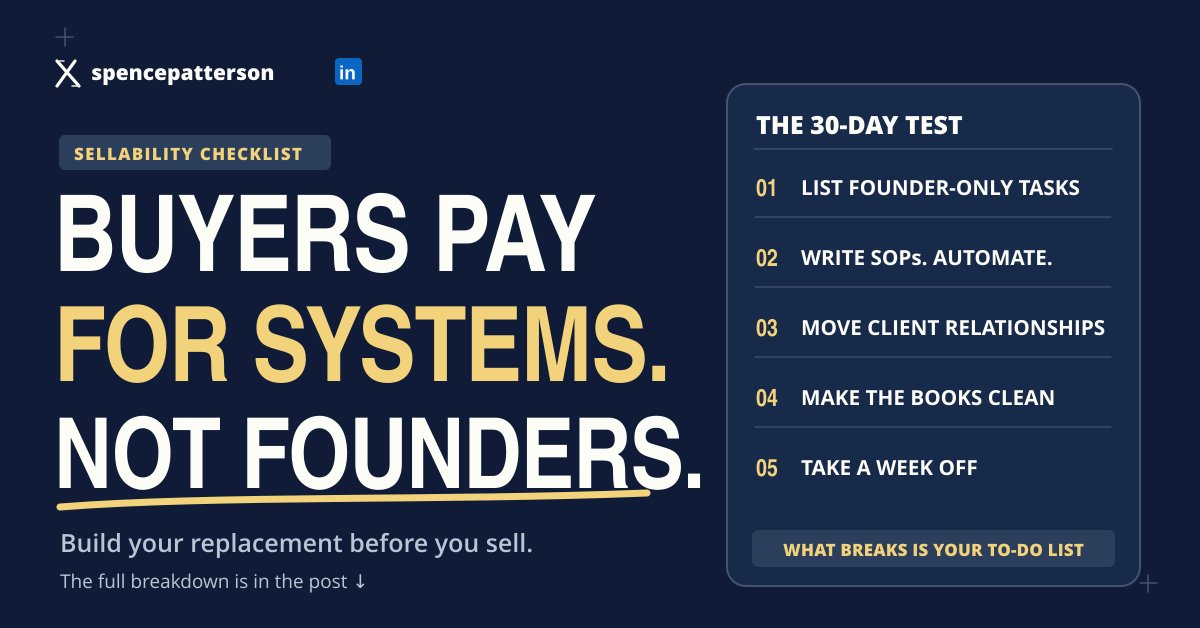
If your business can't run for 30 days without you, you're leaving money on the table when you sell.
I've sold multiple SaaS companies.
The less a business depends on the founder, the higher the valuation.
Every serious buyer asks one question before they dig into revenue: what breaks when the founder walks away?
If you ever want to sell, start building your replacement now:
1. Write down every task only you know how to do. That list is your risk, and the buyer will take it off the price.
2. Turn each task into an SOP, an automation, or a hire, in that order.
3. Move every client relationship off your personal phone and inbox and into the company's systems.
4. Get the books clean enough that a stranger can read them without calling you.
5. Take a full week off. Whatever breaks is your to-do list.
Don't aim to be the hero of your business. Aim to be the least necessary person in it.
Buyers pay a premium for systems. They pay a discount for founders.
Instead of asking a friend what they think of your business idea...
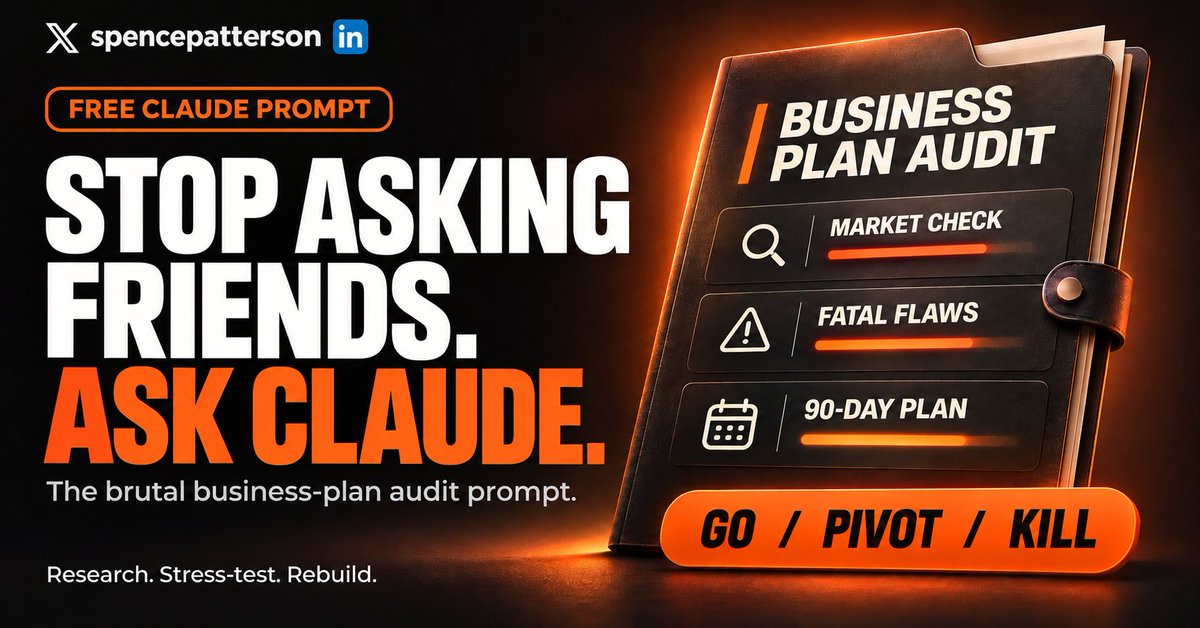
Paste this prompt into Claude instead. It checks if your "untapped market" is actually untapped, scores your idea, and grades it.
---
You are a cynical, experienced operator and market analyst who has built, sold, and killed multiple businesses. You know [YOUR INDUSTRY] deeply: the buyers, the incumbents, the budgets, and how deals actually get done. Your job is NOT to encourage me. Your job is to find every reason this plan fails, then tell me exactly how to fix it or whether to kill it. No flattery, no hedging, no filler.
CONTEXT
I am launching [ONE-LINE DESCRIPTION OF YOUR IDEA]. I believe [WHY YOU THINK IT WILL WORK]. My full plan is pasted at the bottom.
STEP 1: CLARIFY FIRST
If my plan does not clearly state any of the following, ask me up to 5 short questions before going further. If I answer "I don't know," make the most realistic assumption, label it ASSUMPTION, and continue.
1. Who is the exact buyer (job title, company type, company size, or consumer profile)?
2. What specific problem or decision does my product solve?
3. What exactly is the product and how is it delivered?
4. What does it cost me to deliver?
5. What is my price and my revenue goal for day 90?
STEP 2: VERIFY THE MARKET WITH REAL RESEARCH
Use web search. Do not rely on memory. Find every company, tool, agency, newsletter, freelancer, or free alternative already solving this problem. For each one list the name, URL, what they sell, who they sell to, their price (or "not public"), and their biggest weakness. Then give a blunt verdict: is this market untapped, underserved, or crowded? If "untapped" really means "nobody will pay for this," say so.
STEP 3: STRESS TEST
Score each question 1 to 10 and explain the score in 2 to 3 sentences.
1. Is this a hair-on-fire problem or a nice-to-have?
2. Who has budget for this, and what line item does the money come from?
3. What stops someone from copying this in a weekend?
4. How exactly do I reach my first 10 paying customers?
5. What is a realistic price, acquisition cost, churn risk, and time to first dollar?
6. Can I actually execute this plan in 90 days with my resources?
7. Am I building before validating demand?
8. Are there legal, licensing, regulatory, or platform risks I'm ignoring?
9. What stops a bigger player or a free AI tool from making this irrelevant?
STEP 4: FATAL FLAWS
List the top 5 risks most likely to kill this business, ranked by severity. For each, give the specific fix or the evidence that would prove it's not a problem.
OUTPUT FORMAT
Start with one line: GO, PIVOT, or KILL, plus a confidence percentage. Then a scorecard table for Step 3, then the competitor table, then everything else in order using headers and short bullets.
RULES
Be blunt. Assume I'm overconfident and too attached to my idea. Don't soften bad news. If part of my plan is good, say so in one sentence and spend your time on what's weak.
MY PLAN:
[PASTE YOUR PLAN HERE]
Most founders don't fail because the idea was bad.
They quit right before it starts working.
The ones who don't quit share 5 skills. You aren't born with any of them, and all 5 can be trained.
How many do you have?
They treat a bad month as temporary and specific. "This launch flopped," not "I always fail."
They believe their effort changes the outcome, so they work harder and quit later.
When something breaks, they skip "why me" and go straight to "what's the next move?"
They let the emotion pass before they decide. No panic pivots, no angry emails, no killing a product at midnight.
They keep a few people who pick up the phone when the business is on fire, and that's worth more than 30,000 followers.
Psychologists have studied this for decades. Resilience is a set of behaviors you learn.
Train these like a muscle, because your business will test every one.
https://t.co/h1NadKT52w
Is anyone still chasing status?
Who cares about a rolex or lambo?
Luxury is:
-Wake up when you want
-Workout when you want
-Sleep when you need to
-No suit
-No commute
-No calendar full of other people's meetings
-No "per my last email"
-No asking permission to take a day off
-No Lambo to impress strangers
-Revenue that doesn't need me in the room
-Work that doesn't feel like work
-Almost zero calls. Texting only or DMs.
-Building what I want, when I want
-Nothing to prove to anyone
Status means renting other people's approval.
Freedom means steering your own life in any direction you want.
@spencerpratt Happens to @Waymo also, except they are actually at fault when it happens. But honestly, I'd trust a Waymo over a Tesla. They are amazingly good at collision avoidance.