It is imperative for non-Jews to express our support for the Jewish Community, and to do so publicly. We must make it clear to our Jewish friends and neighbours that they are not alone, and we must make it clear to anti-Semites that if they want to get to the Jewish Community they will have to go through all of us.
Multiple things that can be simultaneously true.
1) Canada and other middle power states have not pulled our weight on military spending for a generation. This has largely been the result of the peace dividend brought about by the unqualified generational success of NATO. Nonetheless, we deserve to be called out and even penalized for it.
2) This has been widely and nearly universally acknowledged. All of these states are now actively rectifying this collective failure. Rebuilding our military capacity will not happen overnight, but it is happening.
3) Hegseth et al. know this. This dude is engaging in a bad faith deflection by taking potshots at allies to distract from the most embarrassing strategic military failure by the United States in recent history.
4) Strong players don't pick on the weak.
Here's how Canada can become a respectable military power:
1) Invest into Ukraine's drone industry. Help them manufacture as many drones as possible, and have them do this on Canadian soil, where facilities are protected from Russian bombing.
2) Use this partnership to learn from the Ukrainians. Years of war have made them into global experts on (low cost) drone warfare. Encourage as much contact as possible between Canadian and Ukrainian military experts, and take lots and lots of notes. Don't just focus on technology, though: study how Ukraine handles procurement and product development, too.
3) Implement Ukrainian drone technology and fighting tactics throughout the Canadian Armed Forces as widely as possible. Be cognizant of where low-cost drones can substitute for expensive weapons we currently struggle to afford and maintain.
Voila. Instead of spending a fortune updating our military for yesterday's wars, we can absorb Ukrainian expertise and technology, cost-effectively leapfrogging into modernity.
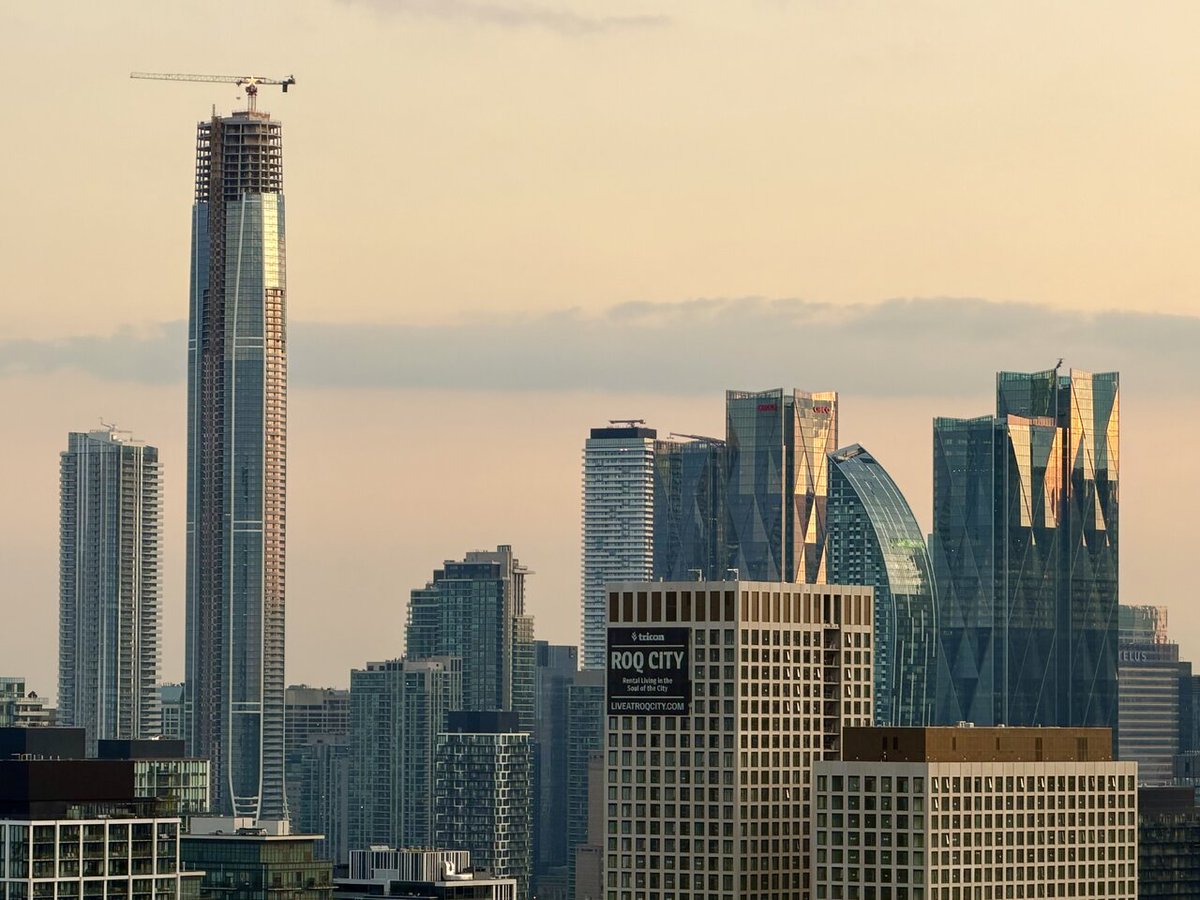
Toronto's record-breaking Sky Tower at Pinnacle One Yonge now stands nearly fully cladded, towering above the city's waterfront. https://t.co/xJnsWjAYtv
“Rather than basing Canadian identity on one slice of the population, the idea of Canada as a haven nation is broad, and speaks to both lived reality and aspirational values.
For example, a significant number of Canadians either came here as immigrants or refugees themselves, or are the children or grandchildren of those who were welcomed to Canada as immigrants and refugees. And, especially early on in Canada's history, those who did the welcoming were largely British, French, and Indigenous, building Canada's haven status through the act of welcoming and including others.
This is not to dismiss the cycle of insider and outsider discussed earlier, nor to deny the fact that immigration and refugee settlement often cause challenges, but to note that Canada has repeatedly overcome those challenges and retained our status as a welcoming nation.”
.@Cohere's @jpineau1 says the interest is coming from business customers looking to diversify their tech stack, as well as from governments outside the US and China that are concerned about maintaining access.
https://t.co/3Isrsll3nw
"We favour multiculturalism. And what Canadians need to understand, what we understand about multiculturalism, is that people who make the hard decision to leave countries where they've been established for centuries and come here, they first and foremost want to belong to this country. That's why they come. That's why they're here. They also, at the same time, will change our country, and we show through multiculturalism our willingness to accommodate their differences, so they're more comfortable. That's why we're so successful integrating people as a country. I think we're probably the most successful country in the world in that regard."
- The Rt Hon. Stephen Harper, 2011 English-language federal leaders debate.
-
Canada strongly condemns Russia’s latest attack on Kyiv, including the strike on the Kyiv Pechersk Lavra, a sacred site in Ukraine and Eastern Christianity.
Canada stands with Ukraine. Their cause — freedom, democracy, sovereignty — is our cause.
It is important that the world does not remain silent in response to this latest act of Russian barbarism. This strike on the Lavra is an attack on the Christian community and on the cultural heritage of humanity. There can be no justification for this or for any other similar Russian attacks. What is needed is more cooperation to stop Russia’s war and stronger protection to save lives from Russia.
A new group of immigrants or refugees are welcomed to Canada, only for a portion of the population to see those newcomers as 'not Canadian' and treat them as outsiders. Over time, many of those attitudes fade, and the newcomers become widely recognized as Canadian. Then, some of the descendants of those newcomers join in on treating subsequent waves of immigrants as 'not Canadian' and as 'outsiders.' On and on the cycle goes.
People of Ukrainian, German, Italian, and Caribbean descent (among many others) were once seen as outsiders to the Anglo-French idea of what it meant to be 'Canadian'. Now, people from those backgrounds are widely seen as Canadian. To varying degrees, people of African, Chinese, Indian (India), Filipino, and Middle Eastern descent have their 'Canadianness' questioned, and in some cases by those who were previously seen as outside the idea of what it meant to be 'Canadian'. The cycle continues.
Moving beyond that cycle requires building Canadian identity on higher ground.