[Pinning this post on both of my accounts for a reason. It is maybe the most important piece I have ever written.]
To President Trump:
I would so much enjoy seeing you make a decision that serves your peace efforts more than anything else.
This is how it could work:
Get together with the most trustworthy Rabbis and discuss Jewish scripture with them.
Specifically discuss the old prophet Isaiah, who spoke at a time when prophets still were scrutinized for the accuracy of their predictions.
In chapter 2:4 he says: "And he shall judge among the nations, and shall rebuke many people: and they shall beat their swords into plowshares, and their spears into pruninghooks: nation shall not lift up sword against nation, neither shall they learn war any more."
Halt for a moment and repeat: He shall judge among the nations.
Remember that prophets had to be right - the Torah put a prophet’s life on the line if he spoke in God’s name what God had not spoken. So let's assume Isaiah was right and this is going to happen.
Now the question is: on which side will the USA end up under your leadership? The condemned, or the righteous?
Try to imagine this:
You get the arms industry to a conference table and convince them to start the process of converting their production to civil products gradually, say 5% or 10% per year.
Now where you have added @elonmusk to your new military planning team, there is a realistic chance that this can be done in an efficient way.
He has not only the competence to lead a major transformation, most importantly he also has visionary power and can precisely tell you which steps to do in which sequence.
Then you announce that the USA has made a U-turn. Then you denuclearize in tandem with Russia and the other nuclear countries.
The Bible promises it. Somebody at some point in the future will do it. Will it be you, President Trump?
Africa remembers: Thomas Sankara was killed on 15 October 1987 in Ouagadougou.
Blaise Compaoré, his former ally, led the coup that ended Sankara’s four-year presidency.
Sankara and twelve others died at a meeting of the National Council of the Revolution.
In April 2022 a military tribunal sentenced Compaoré (in absentia), Gilbert Diendéré and Hyacinthe Kafando to life.
If you set the single afternoon in Ouagadougou beside the long list of other African leaders who were removed, a pattern of merciless domination becomes visible.
--- Historical Context ---
Thomas Sankara took power in Upper Volta in August 1983. He renamed the country Burkina Faso, cut official privileges, raised school attendance, planted trees against the desert, and argued that the country should control its own cotton and minerals instead of remaining dependent on French loans and markets.
On 15 October 1987 armed men arrived at the Conseil de l’Entente in Ouagadougou. Sankara stepped outside and was shot with twelve others.
Compaoré took the presidency the same day. The 2022 tribunal treated the killing as a planned act by the circle around Compaoré.
On the day of the anniversary a list of other leaders was published by the account "New Direction AFRICA". It named the foreign entities who cut their lives short in order to suffocate their visions for African independence:
Patrice Lumumba (Congo, 1961, Belgian and CIA);
Amílcar Cabral (Guinea-Bissau, 1973, Portuguese secret police);
Sylvanus Olympio (Togo, 1963, French-backed coup);
Eduardo Mondlane (Mozambique, 1969, Portuguese parcel bomb);
Félix-Roland Moumié (Cameroon, 1960, French secret service);
Prince Louis Rwagasore (Burundi, 1961, Belgian involvement);
Muammar Gaddafi (Libya, 2011, NATO);
Marien Ngouabi (Congo, 1977);
Herbert Chitepo (Zimbabwe, 1975, Rhodesian and British intelligence);
Ruben Um Nyobè (Cameroon, 1958, French colonial army);
Pio Gama Pinto and Tom Mboya (Kenya, 1965 and 1969);
Steve Biko (South Africa, 1977, apartheid);
Chris Hani (South Africa, 1993);
Laurent-Désiré Kabila (Congo, 2001);
Mário Pinto de Andrade (Angola, 1990);
Josiah Tongogara (Zimbabwe, 1979);
Samora Machel (Mozambique, 1986);
Mehdi Ben Barka (Morocco, 1965, French and CIA).
Each argued for control of land, minerals or political direction - just like Captain Ibrahim Traoré, again of Burkina Faso, is doing today. Each was removed by force.
You can place the individual choice and the national choice in the same light.
--- Spiritual Perspective ---
The seven spiritual laws treat free will as absolute: no being can coerce the will of another individualised spark of consciousness.
The same law applies to countries, on a larger scale. Sovereignty is free will exercised by a people over their own territory, resources and future.
When that choice is taken by force, the Law of Cause and Effect records the act and the Law of Compensation later requires balance.
The "Law of One" channelings distinguish "service to others" versus two kinds of "service to self".
One is service to self at the expense of others – overriding another country’s free will so that one’s own position grows stronger.
The other is benign service to self: education, skill, health, the private and social work that strengthens a person or a nation without stripping the same from anyone else.
Sankara’s short presidency tried the second path. The coup that stopped it, and the institutions responsible for the longer list of leaders removed by similar means, chose the first.
You do not have to treat every name on that list as a pure hero. You can simply notice which kind of free will was protected and which was taken.
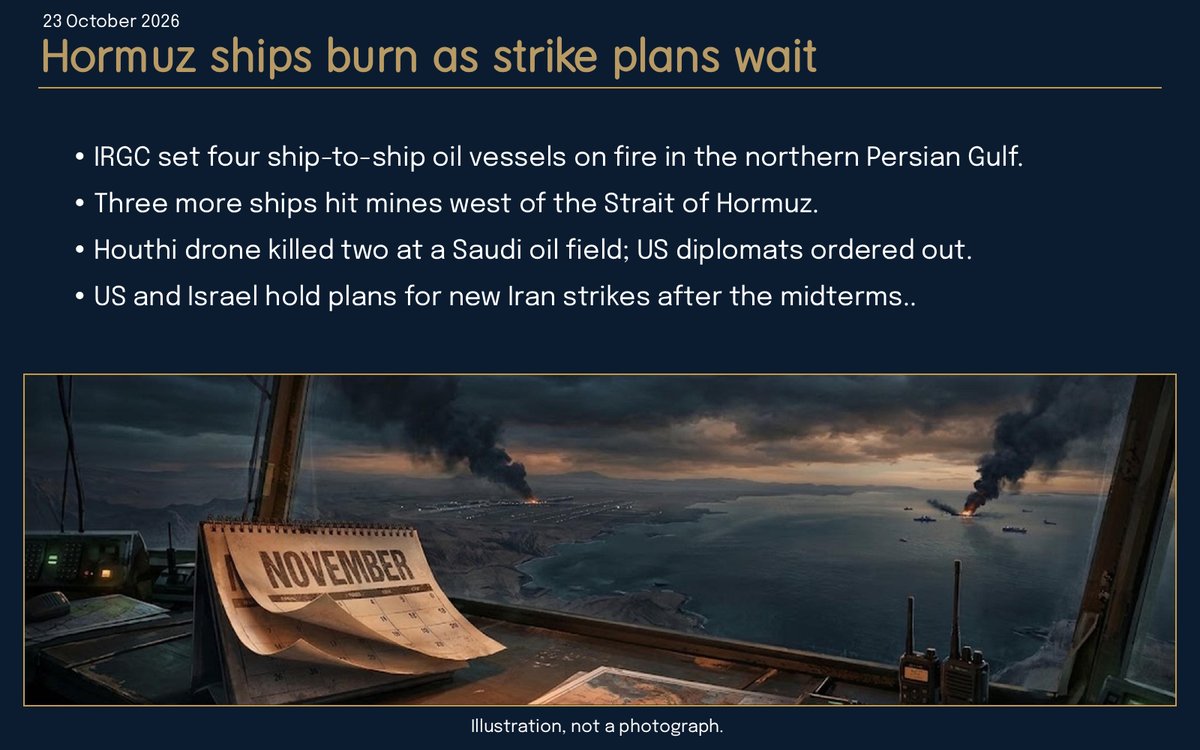
The same week that plans for new strikes on Iran sit ready for after the midterms, ships burn in the Strait of Hormuz and a Saudi airport is hit.
Iran's Islamic Revolutionary Guard Corps said its forces struck four vessels transferring oil ship-to-ship in the northern Persian Gulf and set them on fire.
Three more ships hit mines west of the Strait of Hormuz. Israeli jets flew war games along Iran's western border. Explosions were reported in the port of Sirik. A Houthi drone attack on a Saudi oil field killed two people.
The US State Department ordered non-emergency diplomats and their families to leave Saudi Arabia. Trump said Iran is trying to raise oil prices before the midterm elections. US and Israeli officials have drawn up plans for renewed strikes on Iran after 3 November.
The tanker that caught fire and the diplomat who left the embassy sit on opposite sides of the same strait.
Whether both stay inside the life you count as yours does not wait for the next election night.
--- Historical Context ---
Place the burning ships next to the tankers that flew American flags in 1987, and the older argument returns.
In the Iran-Iraq war that began in 1980, both sides attacked neutral oil tankers. Iraq under Saddam Hussein hit Iranian shipping. Iran under Ayatollah Khomeini hit ships bound for Arab ports that supported Iraq.
By 1986 Kuwait asked the United States for protection. President Ronald Reagan's administration agreed in March 1987 to reflag eleven Kuwaiti tankers under the American flag and escort them.
The operation was called Earnest Will. The first convoy sailed in July 1987 under Rear Admiral Harold Bernsen. Iraq later hit the USS Stark by mistake, killing 37 sailors; Saddam Hussein apologised.
Iran continued mining and attacks. In April 1988 the US sank an Iranian frigate during Operation Praying Mantis. In July 1988 the USS Vincennes shot down Iran Air Flight 655, killing 290 civilians.
Iran accepted a UN ceasefire the same month. The war ended. The men who ordered the escorts and the men who ordered the mines were still in office when the last tanker reached Kuwait.
The present IRGC is arguing that the ship-to-ship transfers are illegal and that continued US escorting will bring a wider response.
The US and Israel are arguing that the plans after the midterms will deter further attacks. The next tanker that passes the strait will test which argument holds the water.
--- Spiritual Perspective ---
Set the burned tanker next to the airport that reopened after the Houthi strike.
A Course in Miracles says the real world is the one you see when you choose not to attack.
It names no strait. It names the choice that keeps the sailor on the burning ship and the planner who schedules the next strike inside the same frame.
Conscience here is that choice. The fire can be real. The plan can be real. Which persons stay inside the life you count as yours when the next ship is hit?
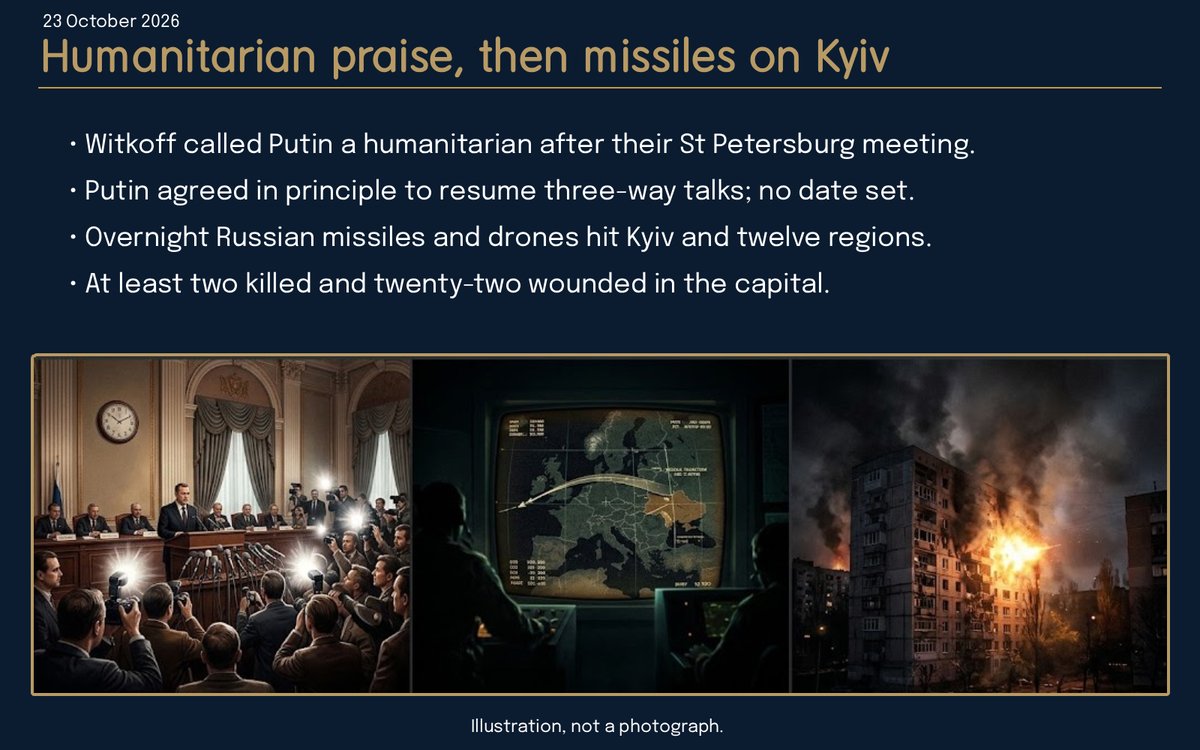
Hours after an American envoy called the Russian president a humanitarian in St Petersburg, missiles hit Kyiv.
Steve Witkoff met Vladimir Putin in St Petersburg.
Witkoff described Putin as a humanitarian. Putin said he agrees in principle to resume three-way talks with Ukraine and the United States. No date was set.
Overnight Russian drones and ballistic missiles struck twelve Ukrainian regions, including Kyiv. At least two people were killed and twenty-two wounded in the capital. Ukrainian forces launched hundreds of drones toward Moscow and other Russian cities.
Zelensky said the strikes covered twelve regions. Russia said it intercepted more than eight hundred drones.
The man who praised the humanitarian and the person who woke to the missile sit in the same night.
Whether both stay inside the life you count as yours does not depend on which side claims the next interception.
--- Historical Context ---
Lay the St Petersburg words next to the long night in Minsk in 2015, and the older pattern returns.
On 11-12 February 2015 Ukrainian President Petro Poroshenko, Russian President Vladimir Putin, German Chancellor Angela Merkel and French President Francois Hollande met for sixteen hours in Minsk.
They agreed on a package of measures that included a ceasefire starting 15 February, withdrawal of heavy weapons, and a security zone. The contact group signed it. Poroshenko called the talks very difficult.
Putin welcomed the deal. The ceasefire was broken within days. Fighting continued around Debaltseve.
Earlier, in September 2014, a first Minsk protocol had been signed after heavy Ukrainian losses. It too was broken. The leaders who signed the papers and the soldiers who kept firing were still alive when the next round of shelling began.
Witkoff is arguing that the praise and the agreement in principle open a path. Zelensky is reporting the dead and wounded from the same night. The next talk will test which sentence the guns follow.
--- Spiritual Perspective ---
Place the humanitarian label next to the apartment that lost its roof in Kyiv.
The Law of One material says service to others and service to self are the two polarities.
It names no envoy. It names the choice that decides whether the person under the missile remains inside the same count as the person who accepted the praise.
Soul here is that choice. The meeting can be real. The strike can be real. Which names stay inside the life you count as yours when the next round is launched?
[This post first appeared on 13 October 2026 on my personal account. Moved here to complete the collection.]
North Korea fires missiles after South Korea's hypersonic test.
On Monday 12 October South Korea's Joint Chiefs detected several ballistic missiles launched from the Pyongyang area toward the East Sea at about 9:20 a.m.
At least one flew more than 900 km. Japan reported at least two, landing outside its exclusive economic zone.
Seoul called the launches a show of force after President Lee Jae Myung watched South Korea's first test of a domestically built hypersonic glide vehicle four days earlier.
North Korea's last test was on 3 October, which it described as a hypersonic intermediate-range missile overseen by Kim Jong Un.
This is the fourth launch event in a month.
--- Historical Context ---
Step back to the same peninsula and the same two capitals.
On 3 October Kim Jong Un supervised what North Korean state media called a firing drill of an intermediate-range strategic missile belonging to its hypersonic system.
His sister Kim Yo Jong later said the weapon could change its flight path at low altitude. South Korea and Japan tracked a shorter distance than Pyongyang claimed. Four days after Seoul's public hypersonic test, the 12 October launches followed.
The pattern is not new. North Korea has used missile tests for years as a visible answer whenever the South or the United States displays a new capability.
The argument on one side is that a credible nuclear-capable arsenal is the only way a small state stays un-invaded.
The argument on the other side is that each test raises the chance of miscalculation along a border that already saw three South Korean soldiers injured by mines last month.
--- Spiritual Perspective ---
Notice how the launch itself is only the outer motion of two group minds that have been locked in the same argument for decades.
Ra described karma as inertia: actions once set in motion continue until a higher principle, such as forgiveness or a change of choice, brings them to a stop.
The peninsula carries the collective inertia of the 1950-53 war, the armistice that never became a peace, and every later decision to answer strength with more strength.
Each side can name real fears. Neither side has yet chosen the brake.
You do not have to decide which capital is right. You can simply watch the size of the attention horizon that treats a short-range or intermediate-range test as the whole of the story, and ask what larger field of consciousness would have to open before either side could stop answering the last launch with the next one.
A book presentation related to today's posts:
The Impersonal Life
Joseph S. Benner (first published anonymously in 1914; later editions by DeVorss, Penguin and others; freely available as PDF)
** Summary **
The book is a direct transmission written in the first person as the voice of the impersonal consciousness (the I AM) speaking from within.
It presents free will as the choice to align with or resist that presence.
Care, justice, and the inclusion of others are treated as expressions of the impersonal life rather than as personal preferences. Physical events are the result of focused inner choices.
The text was published under the pen name “Anonymous” and has remained in circulation for more than a century.
** Evaluation **
The origin is unusual: a 1914 anonymous transmission that treats the reader as already containing the impersonal consciousness rather than as someone who must acquire it.
It is short, available at no cost as a PDF, and easy to sample. The ideas stay concrete enough to set beside named events without requiring the reader to accept a full metaphysical system first.
** Selected passages **
“I AM the Tree of Life within you. My Life will and must push forth, but It will do it by gradual and steady growth.”
“You who have begun to realize I AM within, but have not yet learned to commune with Me, listen and learn now.”
“The impersonal life is a life aware of the idea that one’s identity is inseparable from the light of God and that through this acknowledgment one can experience the peace that emanates from all that is God’s creation.”
** Connection to today **
The three posts today show free will operating inside the count of who is included.
In Abuja a Ugandan woman who flew in on 5 October tested positive for Bundibugyo virus on 19 October; 44 contacts, mostly healthcare workers, have been identified while Congo has already recorded about 9,500 cases and more than 4,600 deaths.
In France curfews are in force from Paris to Marseille and troops will join police for Saturday’s protests; the marches that began over school buildings have become the worst unrest in years, with more than 2,300 arrests.
In India more than 130 million names have been removed from the voter rolls under the Special Intensive Revision; protests in Delhi demand that the election chief step down while the Supreme Court has issued notices.
The Impersonal Life’s statement that free will is the choice to align with or resist the impersonal presence, and that care and justice are expressions of that presence, names the same mechanism.
The patient in Abuja, the student under the curfew, and the migrant whose name vanished are the points where the count is still open.
Link: https://t.co/wp729lOIIz
@SamaHoole I have no gallbladder, and I eat so much fat that my partner cannot watch it 🤪
I still can reach a point where I get a queasy feeling, but only when I really overdo it.
@ShanonLee_AF That was a perfectly timed banger!
He is such a sincere, open and brillant person. A real human being, zero facade.
Too good to be burned to ashes in the president's red hot chair.
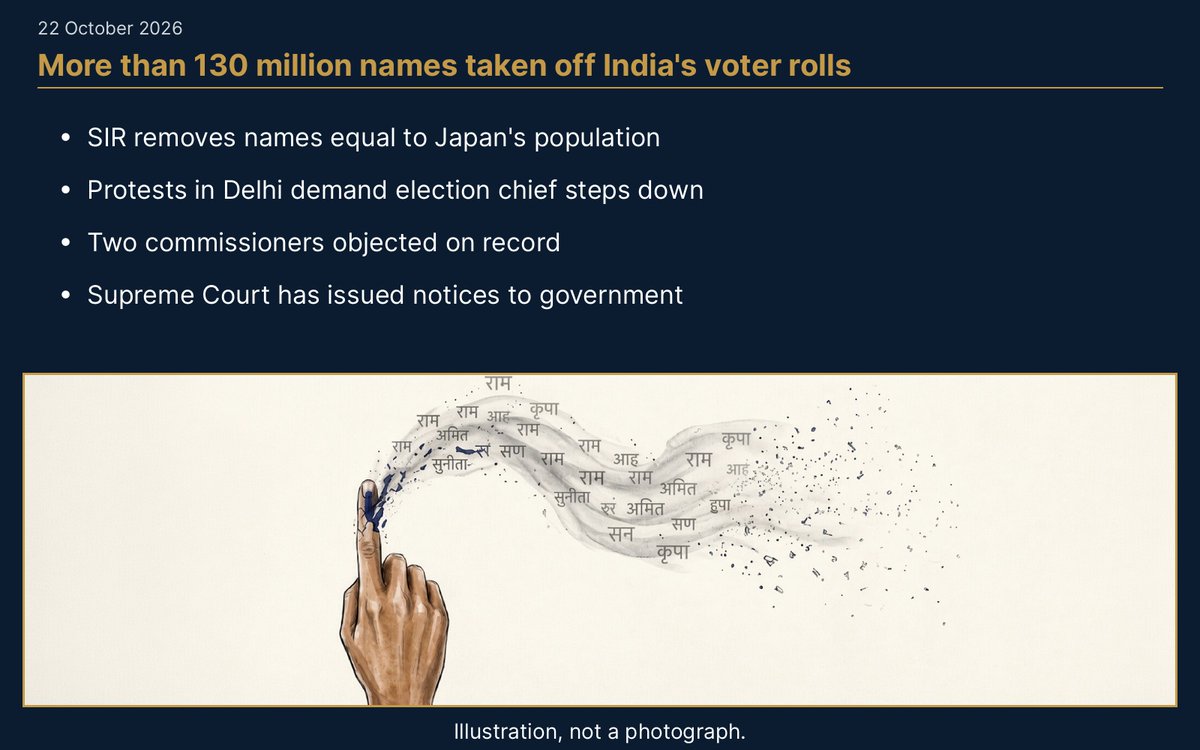
More than 130 million names have been taken off India's voter rolls. Protests in Delhi demand the election chief step down. The revision that was meant to clean the list has become a fight over who gets to vote.
The Special Intensive Revision, or SIR, has removed more than 130 million names from India's electoral rolls since it began. That is more than the population of Japan.
Opposition parties and the youth-led Cockroach Janta Party say the process has disenfranchised legitimate voters, especially migrants and minorities.
Chief Election Commissioner Gyanesh Kumar has overseen the exercise. Two other election commissioners objected on record to some of the decisions.
Protests in Delhi and other cities have drawn thousands. Police have detained organisers and closed metro stations. The Supreme Court has issued notices to the government and the Election Commission.
Kumar's office says the revision is removing duplicates, the deceased and fraudulent entries. Critics call it a tool that shrinks the list before the next election.
An EU citizen living in India notes that birth certificate, citizenship proof and residence registration have long been mandatory in the EU; India is now making the same rules nationwide and digital.
The migrant worker whose name vanished and the official who signed the revision sit in the same country. Whether both are inside the life you count as yours does not depend on which list is final.
--- Historical Context ---
Hold the missing names next to the Emergency of 1975, and the older argument returns.
On 25 June 1975 Prime Minister Indira Gandhi declared a state of emergency after a court found her 1971 election invalid. Opposition leaders were arrested. Press censorship was imposed. Elections were postponed.
Gandhi argued that the state needed order to protect itself from chaos. The opposition argued that the emergency was a way to keep power after a court defeat.
When elections were finally held in 1977, Gandhi's Congress party lost. The emergency ended. The persons who signed the proclamation and the persons who sat in jail were still alive when the votes were counted.
Neither sentence closed the gap between the list that existed and the list that was used.
Today, Kumar is arguing that the revision protects the integrity of the vote. The protesters are arguing that the missing names are real voters. The next election will test which argument the count accepts.
--- Spiritual Perspective ---
Set the deleted names next to the persons still marching in Delhi.
The Bhagavad Gita tells Arjuna that he has the right to the action, not to the fruit of the action.
It names no voter roll. It names the duty that stays even when the result is uncertain.
The soul in that teaching is the part that decides whether the person whose name is missing is still inside the same count.
Karma here is the later return of a list that left persons outside it.
The revision can be real. The march can be real. Which names stay inside the life you count as yours when the next ballot is printed?
@Henryf1w Yes. If Elon sees the platform crumble, he will fix it quickly.
I do expect a drop in quality, but he has seen worse.
If you survive the shock of seeing your rocket explode, a social media network's stumbling won't rob your sleep.
@clashreport No, Sir.
They have different layers of people, just like Israel (and every other country in the world).
I am just wondering about the percentages 🙄