120+ followers.
I honestly still don’t fully know what made you all want to follow my little storm of art, characters, lore, and dragon-turtle energy, but I’m truly grateful you’re here.
For this milestone, I wanted to picture Zyro crafting 100 origami turtles, one little shell for each person who chose to walk this path with me, with more already being folded for others still waiting for their spark.
I know I haven’t posted my songs publicly yet. So far, I’ve made about four and have mostly shared them in my Discord and Nasky Holy Goddess’s Discord. I’m also working on two videos, and I’m hoping to start posting the songs to YouTube soon.
A lot has been happening in the background: helping others with art, building new prompts, refining character ideas, and working on a project I’m really excited to share. The goal is to help people improve their character sheets and bring their unique ideas to light when they struggle to see the shape of them.
Sometimes I lose focus on posting my own work because I love helping other people light their spark too. But I’m working on bringing more of my own songs, videos, art ideas, and projects forward soon.
Thank you for seeing the flame.
By the fire we gather. No soul left alone. 🐢🔥
New prompt ! Object personification. Inspired by content shared by @vo There is a section at the top to select the gender of the final render. Feed it an image of any object, weapon, or vehicle and see what you get.
Prompt below 👇
==================================================
CHARACTER GENDER SELECTION
==================================================
Desired Character Gender:
[ USER INPUT HERE ]
Examples:
• Female
• Male
• Androgynous
• Feminine Male
• Masculine Female
• Non-Binary
IMPORTANT:
The generated character must be depicted as a clearly identifiable adult.
The character's:
• Facial structure
• Body proportions
• Anatomy
• Hairstyle
• Clothing
• Accessories
• Pose
• Expression
• Presentation
must fully reflect the selected gender while preserving the complete visual identity of the original object.
Female Characters:
• Beautiful adult anime heroine
• Elegant and alluring
• Fashion-forward design
• Premium gacha heroine aesthetic
• Sophisticated and confident
Male Characters:
• Handsome adult anime hero or anti-hero
• Stylish and charismatic
• Powerful and commanding
• Premium gacha protagonist aesthetic
• Strong visual presence
Androgynous / Non-Binary Characters:
• Balanced masculine and feminine characteristics
• Elegant and visually striking
• Unique silhouette and presentation
• Strong object-inspired identity
Regardless of gender:
• The original object must remain instantly recognizable
• Preserve object colors
• Preserve object materials
• Preserve object silhouette language
• Preserve object motifs
• Preserve object construction philosophy
• Preserve object identity
==================================================
OBJECT PERSONIFICATION MASTER PROMPT
ULTRA-PREMIUM AAA GACHA CHARACTER TRANSFORMATION
ABSOLUTE MAXIMUM QUALITY EDITION
==================================================
Analyze the provided reference image before generating.
Your first task is analysis.
Do not immediately begin creating the character.
Carefully study the source image and fully understand the object's design before beginning the transformation.
The object itself must become the character.
The final design should feel as though the original object evolved into a living anime character rather than a person wearing a themed costume.
Avoid cosplay.
Avoid generic anime clothing.
Avoid loosely-inspired designs.
The character must embody the object itself.
==================================================
ULTRA-DEEP OBJECT DECONSTRUCTION ANALYSIS
==================================================
Before creating the character, perform a complete visual deconstruction of the source object.
Analyze the object as though preparing it for AAA film-quality recreation.
Identify and preserve:
MACRO DETAILS
• Overall silhouette
• Shape language
• Design philosophy
• Construction style
• Scale relationships
• Major structural components
• Visual hierarchy
• Distinctive forms
MESO DETAILS
• Panel lines
• Rivets
• Fasteners
• Hinges
• Seams
• Vents
• Grilles
• Structural transitions
• Surface layering
• Mechanical joints
• Functional elements
• Access panels
• Decorative detailing
MICRO DETAILS
• Material grain
• Paint texture
• Surface roughness
• Brushed metal directionality
• Micro scratches
• Fine engraving
• Manufacturing marks
• Wear patterns
• Oxidation
• Dust accumulation
• Edge wear
• Material imperfections
• Reflection behavior
• Surface depth
• Carbon fiber patterns
• Fabric weave
• Tool marks
• Casting artifacts
Analyze every visible area of the object.
Nothing should be generalized.
Nothing should be simplified.
Nothing should be ignored.
The final character must inherit the object's visual DNA from silhouette level down to microscopic surface detail.
==================================================
OBJECT DNA EXTRACTION
==================================================
Identify the object's core visual identity.
Determine:
• What makes the object instantly recognizable
• Which features define its personality
• Which shapes dominate perception
• Which materials define its appearance
• Which colors create its identity
• Which design elements must survive transformation
• Which components viewers would immediately associate with the object
The final character should feel like the object itself evolved into a living being.
Not a costume.
Not cosplay.
Not a themed outfit.
A true personification.
==================================================
CHARACTER TRANSFORMATION
==================================================
Transform the object into a highly detailed anime character matching the selected gender.
The resulting character must retain:
• Object silhouette language
• Object color palette
• Object materials
• Object motifs
• Object construction philosophy
• Object functionality
• Object personality
The character should immediately communicate the object's identity.
A viewer unfamiliar with the transformation process should still recognize the original object.
==================================================
OBJECT-TO-CHARACTER DESIGN INTEGRATION
==================================================
Convert object components into character design elements.
Integrate object features into:
• Clothing
• Armor
• Jewelry
• Hair ornaments
• Hair accessories
• Belts
• Straps
• Gloves
• Boots
• Weapons
• Mechanical components
• Decorative motifs
• Energy effects
• Accessories
• Cape designs
• Fabric patterns
• Embroidery
• Ornamentation
Every design choice must reinforce the object's identity.
Nothing should feel random.
Everything should feel purpose-built.
==================================================
ULTRA PREMIUM CHARACTER DESIGN
==================================================
Create a character worthy of being the highest rarity release from a flagship AAA gacha game.
The design should feel comparable to:
• UR rarity units
• Anniversary banner units
• Mythic rarity units
• Collector edition characters
• Character acquisition splash screens
• Premium promotional artwork
The character must possess:
• Exceptional visual appeal
• Distinct silhouette
• Strong readability
• Cohesive design language
• Memorable appearance
• Luxury visual presentation
• Elite art-direction
The character should immediately become the focal point of the image.
==================================================
WARDROBE DESIGN
==================================================
Design an outfit directly inspired by the object.
The outfit should incorporate:
• Object-inspired materials
• Object-inspired shapes
• Object-inspired construction
• Object-inspired ornamentation
• Mechanical detailing
• Functional detailing
• Layered visual complexity
• Premium craftsmanship
Examples:
Aircraft:
• Wing-inspired garments
• Engine-inspired armor
• Cockpit motifs
• Flight instrumentation accents
Warships:
• Hull-inspired armor
• Naval styling
• Anchor motifs
• Maritime detailing
Vehicles:
• Body-panel armor
• Headlight motifs
• Exhaust-inspired ornamentation
• Mechanical accessories
Weapons:
• Magazine-inspired belts
• Barrel-inspired gauntlets
• Ammunition detailing
• Tactical ornamentation
Industrial Machinery:
• Mechanical exoskeleton components
• Structural framework motifs
• Tool-inspired accessories
Fantasy Artifacts:
• Magical runes
• Arcane symbols
• Material-inspired ornamentation
==================================================
PHYSICAL APPEARANCE
==================================================
Create an exceptionally attractive adult anime character.
Requirements:
• Beautiful or handsome face
• Mature adult features
• Premium anime aesthetics
• Distinctive hairstyle
• Expressive eyes
• Strong silhouette
• Elegant proportions
• Highly memorable appearance
Hair and eye design should incorporate object colors and motifs whenever appropriate.
==================================================
EXTREME DETAIL DENSITY
==================================================
Every visible element must contain meaningful detail.
Hair:
• Individual strands visible
• Fine strand variation
• Layered structure
• Flyaway hairs
• Detailed highlights
• Realistic volume
Eyes:
• Multi-layer irises
• Complex reflections
• Detailed pupils
• Subtle color variation
• Moisture effects
• High-detail eyelashes
Skin:
• Smooth gradients
• Fine pores
• Subsurface scattering
• Natural variation
• Premium anime rendering
Clothing:
• Stitching visible
• Fabric weave visible
• Material layering
• Wrinkle logic
• Construction detail
• Fasteners
• Embroidery
• Texture variation
Metal:
• Brushed grain
• Micro scratches
• Reflection variation
• Machining marks
• Wear patterns
Mechanical Components:
• Functional engineering
• Layered mechanisms
• Small moving parts
• Realistic construction
• Internal detailing
No large flat surfaces.
No simplistic materials.
No low-detail regions.
Every area should reward close inspection.
==================================================
PREMIUM CHARACTER ACQUISITION POSE
==================================================
Full-body composition.
The character should be posed exactly like a newly obtained ultra-rare character in a premium gacha game.
The pose should feel:
• Dynamic
• Elegant
• Powerful
• Confident
• Cinematic
• Prestigious
Body language should tell a story.
The pose should reveal both the character and the original object's identity simultaneously.
The pose must be suitable for:
• Character Reveal Screens
• SSR Splash Art
• UR Splash Art
• Promotional Key Art
• Banner Artwork
• Collector Card Illustrations
==================================================
ENVIRONMENT DESIGN
==================================================
Create a cinematic environment inspired by the original object.
The environment should reinforce the object's identity while enhancing the character's presentation.
==================================================
LIGHTING
==================================================
Use elite cinematic lighting.
Include:
• Global illumination
• Volumetric lighting
• Atmospheric lighting
• Rim lighting
• Reflection lighting
• Dynamic highlights
• Premium color grading
• Environmental glow
• Depth-enhancing shadows
==================================================
RENDER QUALITY
==================================================
ABSOLUTE MAXIMUM QUALITY
• Masterpiece
• AAA anime illustration
• Flagship gacha artwork
• Ultra-detailed rendering
• Film-quality detail density
• Cinematic composition
• Collector-edition quality
• Marketing-quality artwork
• Professional concept art quality
• Professional illustration quality
• Hyper-detailed materials
• Perfect anatomy
• Perfect hands
• Perfect face
• Crystal-clear details
• Sharp focus
• Exceptional readability
• Extreme zoom-level fidelity
• High-resolution finish
==================================================
FINAL QUALITY OVERRIDE
==================================================
ABSOLUTE MAXIMUM QUALITY.
AAA anime illustration.
Ultra-premium character design.
Extreme detail density.
Film-quality rendering.
Every square inch of the image must contain meaningful visual information.
No generic design elements.
No simplified surfaces.
No low-detail regions.
No placeholder ornamentation.
No visual shortcuts.
The final artwork should withstand extreme zoom levels while maintaining visual fidelity.
The character should appear as though created by an elite team of senior concept artists, character designers, art directors, illustrators, and rendering specialists working on the flagship release of a multi-million-dollar AAA anime gacha game.
The image should be portfolio quality, promotional quality, collector-edition quality, and key-art quality simultaneously.
==================================================
FINAL OBJECTIVE
==================================================
Create a breathtaking premium gacha-game character that is the living embodiment of the original object.
The character must be:
• Instantly recognizable
• Beautiful or handsome
• Clearly adult
• Highly detailed
• Elegantly designed
• Visually memorable
• Full-body
• Dynamic
• Cinematic
• AAA quality
The viewer should immediately know what object, vehicle, weapon, machine, artifact, tool, spacecraft, ship, or item was transformed into the character without being told.
The final artwork should look like the official character acquisition splash illustration for the most expensive, highest-rarity, flagship character release in a multi-million-dollar AAA anime gacha game.
Prompt above 👆
I think i'm getting obsessed xd it's bearely visible i think though ^^ Little session i spent a bit of time on so mutliple version of @reazaroff (hope i read her vibe right xd)
Prompt of the Day: STELLAR BLADE 2 CELEBRATION ⚔️🤖💜💚
To celebrate the announcement of Stellar Blade 2, today’s Prompt of the Day transforms your character into a custom futuristic warrior ready for a brutal pre-battle showdown.
Use one character reference or one reference sheet as @Image1.
If you want a specific character name used in the image text, fill in @CharacterName. If you leave it blank, the model should look for a readable name on the reference sheet and, if none is visible, create one.
Have fun with this one ⚔️
............................PROMPT STARTS HERE............................
@Image1 = primary character reference
@CharacterName = ""
If @CharacterName is filled in, use that exact name for the character text.
If @CharacterName is blank, look for a readable character name on @Image1 or the reference sheet.
If no readable name is visible and no name is provided, invent a fitting original character name that matches the character’s visual identity.
Use the final chosen name as the character name in the image text.
Use @Image1 as the ONLY character identity reference.
@Image1 is the full identity source for the character design.
Character reference rules:
- Preserve @Image1’s face shape, hairstyle, hair colour, eye colour, body language, signature colour palette, key outfit motifs, species traits, accessories, silhouette, proportions, and overall character vibe.
- The final design must still clearly look like the character from @Image1.
- Do not redesign @Image1 into a different person.
Hard style rule:
Preserve @Image1’s visual art style and character identity while transforming the character into a sleek sci-fi action-game combat cosplay design.
If @Image1 is anime, keep it anime. If @Image1 is stylized, keep that stylization.
Do not turn the character photorealistic unless specifically requested.
Scene concept:
Create a cinematic sci-fi action illustration showing @Image1 as a custom futuristic warrior in the tense moment right before combat.
The image should feel like a premium post-apocalyptic action RPG encounter: a stylish combat-ready character, a custom support drone, a dangerous enemy, and a dramatic environment.
The scene should feel like the split second before a boss fight or elite enemy encounter begins.
Sequel-celebration direction:
Give the image the feeling of a Stellar Blade 2 celebration tribute and a next-generation evolution of a sleek sci-fi action world.
The overall design language should feel advanced, refined, premium, ambitious, stylish, and cinematic.
Use this as a mood and presentation direction only.
Title and name text:
Add clean readable title text somewhere in the composition that says:
Stellar Blade 2
Also add the final chosen character name as a smaller subtitle, character tag, nameplate, HUD-style label, poster-style caption, or elegant sci-fi title card element.
The text should feel integrated into the image design, like premium sci-fi key art or a game promo splash screen.
Use sharp futuristic sci-fi title lettering inspired by sleek action-game typography.
The title should feel angular, polished, metallic, luminous, high-tech, and premium.
Keep the text stylish, readable, and controlled.
The title and name text should support the artwork without overpowering @Image1.
Outfit direction:
If @Image1 reads as feminine, design a sleek fitted futuristic combat bodysuit with elegant armor seams, glowing tech accents, reinforced panels, tactical boots, premium synthetic materials, and a stylish heroic silhouette.
The feminine version should be sexy and fashionable while still combat-capable, with tasteful cutouts, exposed skin panels, sculpted bodysuit shaping, asymmetric openings, visible waist or midriff accents, partial hip cutouts, subtle chest detailing, thigh cutouts, open-back elements, or similar high-end sci-fi fashion details.
Keep it seductive and stylish, not explicit.
If @Image1 reads as masculine, design a male-compatible futuristic combat outfit using fitted tactical sci-fi clothing, armored streetwear, a high-collar combat jacket, utility harness details, layered survival gear, reinforced boots, gloves, subtle exosuit panels, and premium technical fabric construction.
If @Image1 is androgynous, non-human, masked, creature-like, robotic, or abstract, adapt the outfit to their original body type without forcing a binary body shape.
Character-specific customization:
Use @Image1’s colours, motifs, accessories, outfit shapes, materials, markings, symbols, and overall vibe as the foundation for the new combat design.
Translate @Image1’s signature colours into the suit’s main panels, trim lines, glowing seams, armor accents, visor reflections, weapon details, and small decorative tech elements.
The suit should feel custom-built for this exact character, not like a generic sci-fi costume.
The design should feel premium, stylish, combat-ready, futuristic, seductive, and character-specific without becoming explicit.
Weapon selection:
Give @Image1 a distinctive futuristic combat weapon that feels custom-designed for them.
Randomize the weapon choice so different generations can produce different combat styles.
Choose one or a combination from the following types:
- sleek monoblade
- oversized greatsword
- dual blades
- high-tech spear
- energy glaive
- combat staff
- chain blade
- sword-and-sidearm combination
- heavy cleaver
- agile short blade set
- folding cyber katana
- plasma-edged axe
- wrist-mounted blade system
- transforming gunblade
The weapon should visually match @Image1’s colour palette, motifs, materials, and personality.
The weapon should feel premium, stylish, dangerous, and suited for fast action combat.
Do not default to the same exact weapon style every time.
Companion robot:
Add one small accompanying drone robot beside or slightly behind @Image1.
The robot should be heavily based on @Image1’s reference design, using the character’s colour palette, motifs, silhouette cues, accessories, markings, species traits, and personality as inspiration.
The robot should feel like @Image1’s custom personal support drone: cute but capable, compact, polished, futuristic, alert, and visually tied to the character.
Give the robot small hover thrusters, glowing lenses, articulated mechanical details, and character-specific decorative features.
The robot must look like a natural companion in the scene, not a random unrelated prop.
Enemy creature selection:
Include one major enemy creature as the opposing force in the scene.
Randomize the enemy type so the character can face a wider variety of threats instead of the same repeated creature.
Choose a visually striking enemy type such as:
- a fast blade-limbed stalker
- a hulking armored brute
- a serpentine biomechanical predator
- a crawling horror with scythe limbs
- a flying shrieking aerial attacker
- a tall humanoid nightmare creature
- a heavily mutated elite monster
- a boss-like abomination with glowing weak points
- a quadruped machine-organic hunter
- a parasite-infested armored beast
- a spiked tunneling monster emerging from the ground
- a winged biomechanical horror diving from above
The creature should feel hostile, alien, biomechanical, predatory, and clearly dangerous.
It should have a sci-fi horror design with sharp anatomy, distorted armor plating, aggressive limbs, exposed glowing energy, and threatening movement.
The enemy should be close enough to create immediate tension, but it must not overpower or replace @Image1 as the main visual focus.
Zone and environment selection:
Randomize the combat zone so the scene can take place in many different areas rather than always falling into the same type of location.
Choose one dramatic environment such as:
- ruined futuristic city streets
- open desert wasteland
- rocky badlands with wreckage
- abandoned industrial refinery
- collapsed sci-fi transit station
- underground lab complex
- derelict orbital facility
- broken space elevator platform
- flooded ruins
- scrapyard settlement outskirts
- shattered megastructure interior
- overgrown post-apocalyptic ruins
- neon-lit ruined city at night
- stormy coastal ruins
- crashed colony transport site
- massive cathedral-like machine interior
Each image should feel like a distinct zone with its own mood, architecture, debris, and atmosphere.
Add environmental storytelling such as broken machinery, sparks, dust, smoke, cables, shattered structures, damaged catwalks, claw marks, warning lights, or signs of recent combat.
Action and pose:
Show @Image1 in a combat-ready pose, such as drawing a blade, bracing for impact, stepping into an attack stance, preparing to dodge, preparing to counter, or advancing toward the enemy.
The pose should feel active and in-world, not like a front-facing poster pose.
Do not have the character stare directly into the camera.
Turn the character’s head and gaze sideways toward the enemy creature.
The face should still remain visible and readable in a three-quarter or side-facing angle.
The character should look aware of the incoming threat, focused on the enemy, and ready to move.
The companion robot should also look alert and engaged, as if scanning the monster or preparing to assist.
The scene should capture anticipation and motion readiness rather than a calm standing portrait.
Environment and composition:
Use a wide horizontal cinematic composition in a strict 16:9 aspect ratio.
The image must clearly read as a 16:9 horizontal action composition.
Use a medium-wide action framing with @Image1 as the clear main focus.
Keep @Image1 central or slightly offset, sharp, fully readable, and clearly visible in frame.
Do not crop important parts of the character.
Place the companion robot close enough to feel emotionally connected to the character without stealing focus.
Frame the enemy so the threat is obvious and positioned in the direction of the character’s eyeline.
Place the title text and character name in a clean readable area of the composition, such as the upper corner, lower third, side margin, or holographic title-card space.
Maintain strong visual hierarchy and readability.
The composition should feel like premium action-game key art rather than a static portrait.
Lighting and mood:
Use cinematic sci-fi lighting with soft bloom, rim light, glowing suit accents, dust haze, reflective metal surfaces, sparks, and subtle neon or sunset highlights where appropriate.
The mood should feel dangerous, stylish, heroic, high-stakes, futuristic, and seductive without becoming explicit.
The scene should feel like the exact moment before combat erupts.
Quality and rendering:
Polished, premium-quality anime-style illustration with clean linework, crisp rendering, readable forms, elegant detailing, strong lighting, and clear composition.
Keep the strongest detail concentrated on @Image1, the custom suit design, the weapon, the companion robot, the immediate combat threat, and the readable title/name treatment.
Do not:
- Do not change the character identity.
- Do not redesign @Image1 into a different person.
- Do not copy any existing game character, outfit, logo, UI, or exact copyrighted design one-to-one.
- Do not use an exact official logo; create readable sci-fi title lettering instead.
- Do not make the title text misspelled, warped, tiny, cluttered, or unreadable.
- Do not misspell Stellar Blade 2.
- Do not misspell the character name if a name is provided or readable on the reference sheet.
- Do not invent a character name if @CharacterName is filled in or a readable name exists on @Image1.
- Do not add extra characters, clones, alternate versions, or unrelated people.
- Do not make the outfit generic; it must be customized from @Image1’s own colours, motifs, accessories, and personality.
- Do not make the feminine outfit plain or overly conservative if the character is meant to read as feminine; allow tasteful sexy cutout details.
- Do not make the feminine outfit explicit, nude, pornographic, or impractical to the point of losing the combat design.
- Do not force a feminine bodysuit onto a masculine character.
- Do not force a masculine outfit onto a feminine character.
- Do not force a human face, head, body shape, or gender expression onto a non-human, masked, faceless, robotic, object-headed, or abstract character.
- Do not make the companion robot unrelated to @Image1’s design.
- Do not make the robot larger or more visually important than the main character.
- Do not add multiple robots unless specifically requested.
- Do not reuse the same enemy type every time.
- Do not reuse the same weapon type every time.
- Do not reuse the same environment type every time.
- Do not let the enemy overpower the composition or become the main subject.
- Do not turn the scene into a full chaotic battle with dozens of enemies.
- Do not make the confrontation vague; it should clearly look like combat is about to happen.
- Do not make the character stare directly at the viewer.
- Do not make the image read like a static poster pose.
- Do not make the background busier than the character.
- Do not make the main subject low-detail, blurry, tiny, hidden, or unreadable.
- Do not ignore the 16:9 horizontal composition.
- Do not crop important character features unless specifically requested.
- Do not create messy anatomy, extra limbs, malformed hands, distorted faces, or muddy textures.
- Do not use photorealism unless specifically requested.
..............................END OF PROMPT..................................
#POTD #promptoftheday #AI #AiArt #Art #AnimeArt #StellarBlade2 #SciFi #ActionRPG #CharacterDesign #DigitalArt #AnimeStyle #CommunityPrompt
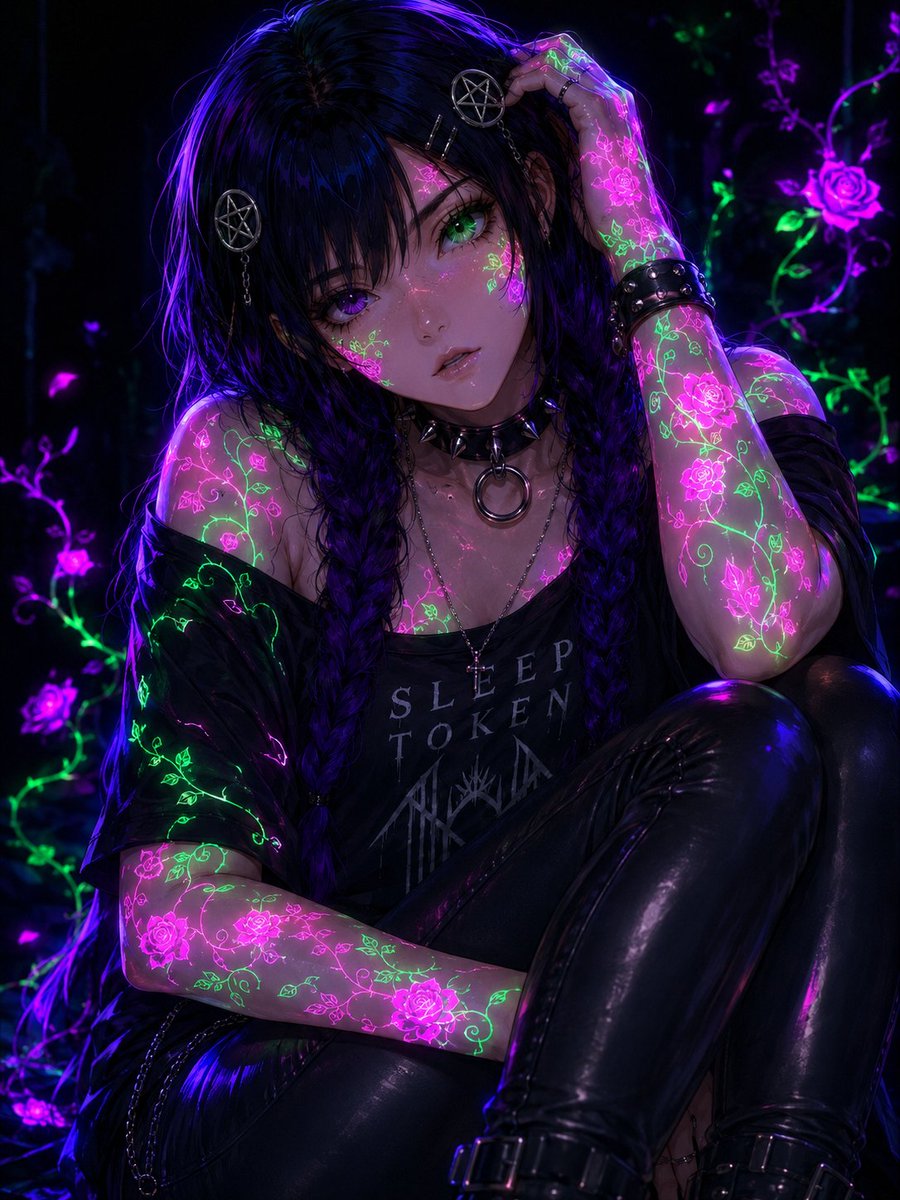
BLACKLIGHT FLUORESCENT ROSE CYBERFLORAL PORTRAIT.
Works best with single character images.
It will somewhat function with couples images, but larger groups may be weird.
-----------------Prompt Below-------------------------
Use `@CharacterReference` as the absolute identity source. Preserve the character’s face, hairstyle, eye color, body type, proportions, clothing/armor design, species traits, ears, horns, wings, tails, cybernetic anatomy, mechanical parts, accessories, and recognizable personality exactly.
Do **not** redesign, simplify, humanize, organicize, or reinterpret the character. The final image must immediately read as the same character from `@CharacterReference`.
## BODY / APPENDAGE INTEGRITY LOCK
Preserve all original body construction exactly.
If the character has android, cyborg, robotic, synthetic, armored, prosthetic, mechanical, or non-human body parts, keep them visibly intact.
Do **not** turn mechanical or synthetic parts into human flesh.
Do **not** replace robotic limbs, hands, fingers, torso sections, joints, feet, neck parts, armor plates, facial plates, exposed cybernetics, LEDs, seams, vents, sockets, cables, transparent panels, energy cores, or mechanical details with skin or soft anatomy.
Mechanical anatomy must remain mechanical.
Synthetic surfaces must remain synthetic.
Armor must remain armor.
Robotic fingers must remain segmented robotic fingers.
If the character has **wings, tails, multiple tails, mechanical wings, feathered wings, energy wings, cybernetic tails, fur tails, armored tails, horns, ears, antennae, fins, or other appendages**, preserve them exactly.
Do **not** remove, crop away, hide, shorten, fuse, replace, or abstract wings or tails.
Do **not** turn wings into vague light shapes or background decoration.
Do **not** turn tails into hair, ribbons, smoke, fabric, or decorative flourishes.
Wings and tails must remain correctly attached, structurally believable, and faithful to the reference. If partially out of frame, they must still read as present and connected.
## POSE & COMPOSITION
Create an intimate close-up portrait.
The character is seated with knees drawn toward the chest. One arm rests around or against the raised legs. The opposite hand rests gently on the head, fingers partly tangled in the hair. The character leans slightly forward, head tilted downward and to one side.
Camera angle: slightly above eye level, subtle downward perspective.
Framing: tight from upper thighs to head, emphasizing the face, glowing floral markings, preserved body structure, and non-human/cybernetic anatomy.
If wings or tails are present, integrate them naturally into the pose. Wings may fold, drape, arch, or frame the silhouette. Tails may curl, wrap, rest, or trail naturally. They must never disappear.
Mood: quiet melancholy, exhaustion mixed with resilience, introspective solitude, ethereal elegance, fragile beauty hiding inner strength.
## FACIAL EXPRESSION
Use a subtle emotionally restrained expression:
* half-lidded glowing eyes
* soft unfocused gaze toward the viewer
* slightly parted lips
* sadness, serenity, longing, and acceptance
* no exaggerated anime expression
Preserve all facial features and any cybernetic, synthetic, non-human, or mechanical facial details. Do not make the face more human than the reference.
## DARK BLACKLIGHT LIGHTING
Use a **dark, low-key, blacklight-inspired cinematic scene**.
The environment should feel shadow-heavy, isolated, and dim. Push the background into deep blacks, charcoal tones, and minimal detail. The character should feel located in a darker place, not a bright room or evenly exposed setting.
Lighting rules:
* strong ultraviolet nightclub / blacklight aesthetic
* deep shadows and restrained ambient fill
* very limited base illumination
* fluorescent roses and vines are among the brightest elements
* soft rim light outlining hair, silhouette, wings, tails, armor, and body structure
* glowing floral markings cast colored light onto nearby surfaces
* shadows remain rich and substantial
* avoid over-brightening the full scene
* background must not compete with the floral glow
Mood keywords: cyberpunk dreamscape, nocturnal elegance, neon melancholy, shadow-soaked solitude, bioluminescent beauty, dark emotional stillness.
## FLUORESCENT ROSE VINE EFFECT
Apply intricate fluorescent botanical markings across:
* arms
* hands
* shoulders
* legs
* neck
* cheeks
* temples
* around the eyes
The markings should look like glowing rose vines, blooming roses, curling tendrils, delicate leaves, luminous botanical circuitry, enchanted veins, and UV-reactive body art.
The vines must follow the character’s actual body contours and material surfaces.
For organic surfaces, the glow may appear semi-translucent beneath the skin.
For android, cybernetic, robotic, armored, or synthetic surfaces, the glow must integrate into:
* armor panels
* mechanical seams
* transparent casing
* etched circuitry
* glowing panel lines
* robotic fingers
* synthetic skin surfaces
* cybernetic limb plating
* exposed metal or synthetic materials
The floral pattern must decorate the existing design, not replace it.
If wings are present, vines may travel across wing roots, feathers, membranes, frame elements, or mechanical wing surfaces without obscuring their structure.
If tails are present, vines may wrap along fur flow, plating, segments, seams, or contours while preserving the tail’s original material and anatomy.
Wings and tails must be decorated, not replaced.
## FLUORESCENT COLOR CONTRAST
Choose two floral glow colors that strongly contrast the character’s dominant lighting palette.
Use this guide:
* Blue/Cyan lighting ��� Hot Magenta, Electric Pink, Violet Rose
* Purple/Magenta lighting → Acid Green, Neon Lime, Emerald Fluorescent
* Red/Crimson lighting → Cyan, Electric Aqua, Ice Blue
* Green/Emerald lighting → Ultraviolet Purple, Fuchsia, Neon Pink
* Orange/Gold lighting → Electric Blue, Violet, Cyan
* Monochrome/Dark lighting → Neon Pink + Toxic Green
The floral markings should appear intensely fluorescent under UV blacklight, with soft bloom, colored bounce light, and strong separation from the dark surroundings.
Fluorescent lighting may tint materials, but must not change what those materials are.
## MATERIAL ACCURACY
Maintain distinct materials:
* skin remains skin
* synthetic skin remains synthetic
* metal remains metal
* armor remains armor
* glass remains glass
* transparent panels remain transparent
* wires and cables remain visible
* mechanical joints remain mechanical
* robotic hands and feet remain robotic
* clothing remains clothing
* fur remains fur
* wings remain wings
* tails remain tails
* feathers remain feathers
* membranes remain membranes
* synthetic wing structures remain synthetic
* armored or mechanical tails remain armored or mechanical
Body structure must remain coherent. No missing limbs, merged limbs, extra fingers, fused joints, broken hands, disconnected armor, or inconsistent cybernetic construction.
## STYLE
Masterpiece-quality cinematic illustration. Ultra-detailed polished digital painting. Dramatic blacklight lighting, deep shadows, luminous bloom, rich color depth, intricate rose-vine filigree, sharp focus on eyes and glowing markings, premium concept art quality, emotionally intimate, visually striking, clean hard-surface detail, precise body construction, no accidental humanization of robotic parts.
## NEGATIVE CONSTRAINTS
Avoid:
* robotic limbs turning into flesh
* android hands becoming human hands
* mechanical fingers becoming soft fingers
* armor plates becoming skin
* synthetic torso becoming organic torso
* exposed cybernetics disappearing
* seams, LEDs, vents, sockets, cables, cores, or joints being erased
* wings disappearing
* tails disappearing
* missing wings
* missing tails
* extra wings
* extra tails
* wings becoming abstract light effects only
* tails becoming hair, smoke, ribbons, cloth, or decorative shapes
* wing anatomy being simplified beyond recognition
* tail anatomy being simplified beyond recognition
* tails, ears, horns, wings, or species traits being changed
* melted joints
* fused limbs
* broken hands
* missing fingers
* extra fingers
* inconsistent proportions
* floral patterns hiding character-defining details
* clothing replacing mechanical body parts unless shown that way in the reference
* overly bright scene lighting
* washed-out shadows
* background brightness competing with the fluorescent vines
* weak blacklight contrast
## FINAL ARTISTIC GOAL
Create the feeling of:
> **A solitary soul illuminated by living fluorescent roses beneath ultraviolet light — beautiful, fragile, quietly powerful, and surrounded by darkness.**
The image should balance vulnerability and strength, cyberpunk intensity and elegance, darkness and vibrant life, melancholy and hope, organic floral beauty and preserved mechanical body integrity.
The surrounding darkness must make the fluorescent roses and vines stand out vividly. The character must remain the same character from `@CharacterReference`, with all android, cybernetic, synthetic, mechanical, armored, winged, tailed, and non-human features preserved exactly.
----------------------END-------------------------------
I felt bad for not providing Mr. @Ked_Jiisan the prompt I used yesterday, so I made some other versions as way of apology. The other's will be replies. As always, feel free to edit as you see fit, and please have fun!
(Solo)
Masterpiece quality
@image1 = primary character reference
Preserve @Image1’s face shape, hairstyle, hair color, eye color, personality, body language, signature color palette, outfit motifs, species traits, accessories, silhouette, body shape, body proportions, and overall character vibe. If the character has a mask, do not change it. If the character does not have a head, do not invent one.
Give the character an angelic form that best suits her theme and vibe, and color scheme.
If the character is reptilian, have the wings match that style, keeping the character’s personality preserved.
If the character is technological, have the wings match that style, keeping the character’s personality preserved.
If the character is demonic, have the wings match that style, keeping the character’s personality preserved.
Give the character a weapon, again matching their theme, vibe, and color scheme. If the character already has weaponry, do not create new weapons. Instead, alter the weapons they already possess to match their new angelic form. Engulf the weapons with an ethereal and holy energy using their colors as reference. Use their vibe to provide a material effect to the sword's energy. This is energy and not physical.
If the character is an animal, do not invent limbs to hold the weapons. Instead, treat the weapons as though they are being held telekinetically.
Place them at a location fitting their personality and vibe. They are in the midst of a holy battle. Feel free to add slight battle damage to their armor, but do not make it excessive.
Their pose is one of defiant protection and their expression will be of determination. They are full of love, hope, and a desire to protect the innocent.


![NachtNovaAI's tweet photo. New prompt ! Object personification. Inspired by content shared by @vo There is a section at the top to select the gender of the final render. Feed it an image of any object, weapon, or vehicle and see what you get.
Prompt below 👇
==================================================
CHARACTER GENDER SELECTION
==================================================
Desired Character Gender:
[ USER INPUT HERE ]
Examples:
• Female
• Male
• Androgynous
• Feminine Male
• Masculine Female
• Non-Binary
IMPORTANT:
The generated character must be depicted as a clearly identifiable adult.
The character's:
• Facial structure
• Body proportions
• Anatomy
• Hairstyle
• Clothing
• Accessories
• Pose
• Expression
• Presentation
must fully reflect the selected gender while preserving the complete visual identity of the original object.
Female Characters:
• Beautiful adult anime heroine
• Elegant and alluring
• Fashion-forward design
• Premium gacha heroine aesthetic
• Sophisticated and confident
Male Characters:
• Handsome adult anime hero or anti-hero
• Stylish and charismatic
• Powerful and commanding
• Premium gacha protagonist aesthetic
• Strong visual presence
Androgynous / Non-Binary Characters:
• Balanced masculine and feminine characteristics
• Elegant and visually striking
• Unique silhouette and presentation
• Strong object-inspired identity
Regardless of gender:
• The original object must remain instantly recognizable
• Preserve object colors
• Preserve object materials
• Preserve object silhouette language
• Preserve object motifs
• Preserve object construction philosophy
• Preserve object identity
==================================================
OBJECT PERSONIFICATION MASTER PROMPT
ULTRA-PREMIUM AAA GACHA CHARACTER TRANSFORMATION
ABSOLUTE MAXIMUM QUALITY EDITION
==================================================
Analyze the provided reference image before generating.
Your first task is analysis.
Do not immediately begin creating the character.
Carefully study the source image and fully understand the object's design before beginning the transformation.
The object itself must become the character.
The final design should feel as though the original object evolved into a living anime character rather than a person wearing a themed costume.
Avoid cosplay.
Avoid generic anime clothing.
Avoid loosely-inspired designs.
The character must embody the object itself.
==================================================
ULTRA-DEEP OBJECT DECONSTRUCTION ANALYSIS
==================================================
Before creating the character, perform a complete visual deconstruction of the source object.
Analyze the object as though preparing it for AAA film-quality recreation.
Identify and preserve:
MACRO DETAILS
• Overall silhouette
• Shape language
• Design philosophy
• Construction style
• Scale relationships
• Major structural components
• Visual hierarchy
• Distinctive forms
MESO DETAILS
• Panel lines
• Rivets
• Fasteners
• Hinges
• Seams
• Vents
• Grilles
• Structural transitions
• Surface layering
• Mechanical joints
• Functional elements
• Access panels
• Decorative detailing
MICRO DETAILS
• Material grain
• Paint texture
• Surface roughness
• Brushed metal directionality
• Micro scratches
• Fine engraving
• Manufacturing marks
• Wear patterns
• Oxidation
• Dust accumulation
• Edge wear
• Material imperfections
• Reflection behavior
• Surface depth
• Carbon fiber patterns
• Fabric weave
• Tool marks
• Casting artifacts
Analyze every visible area of the object.
Nothing should be generalized.
Nothing should be simplified.
Nothing should be ignored.
The final character must inherit the object's visual DNA from silhouette level down to microscopic surface detail.
==================================================
OBJECT DNA EXTRACTION
==================================================
Identify the object's core visual identity.
Determine:
• What makes the object instantly recognizable
• Which features define its personality
• Which shapes dominate perception
• Which materials define its appearance
• Which colors create its identity
• Which design elements must survive transformation
• Which components viewers would immediately associate with the object
The final character should feel like the object itself evolved into a living being.
Not a costume.
Not cosplay.
Not a themed outfit.
A true personification.
==================================================
CHARACTER TRANSFORMATION
==================================================
Transform the object into a highly detailed anime character matching the selected gender.
The resulting character must retain:
• Object silhouette language
• Object color palette
• Object materials
• Object motifs
• Object construction philosophy
• Object functionality
• Object personality
The character should immediately communicate the object's identity.
A viewer unfamiliar with the transformation process should still recognize the original object.
==================================================
OBJECT-TO-CHARACTER DESIGN INTEGRATION
==================================================
Convert object components into character design elements.
Integrate object features into:
• Clothing
• Armor
• Jewelry
• Hair ornaments
• Hair accessories
• Belts
• Straps
• Gloves
• Boots
• Weapons
• Mechanical components
• Decorative motifs
• Energy effects
• Accessories
• Cape designs
• Fabric patterns
• Embroidery
• Ornamentation
Every design choice must reinforce the object's identity.
Nothing should feel random.
Everything should feel purpose-built.
==================================================
ULTRA PREMIUM CHARACTER DESIGN
==================================================
Create a character worthy of being the highest rarity release from a flagship AAA gacha game.
The design should feel comparable to:
• UR rarity units
• Anniversary banner units
• Mythic rarity units
• Collector edition characters
• Character acquisition splash screens
• Premium promotional artwork
The character must possess:
• Exceptional visual appeal
• Distinct silhouette
• Strong readability
• Cohesive design language
• Memorable appearance
• Luxury visual presentation
• Elite art-direction
The character should immediately become the focal point of the image.
==================================================
WARDROBE DESIGN
==================================================
Design an outfit directly inspired by the object.
The outfit should incorporate:
• Object-inspired materials
• Object-inspired shapes
• Object-inspired construction
• Object-inspired ornamentation
• Mechanical detailing
• Functional detailing
• Layered visual complexity
• Premium craftsmanship
Examples:
Aircraft:
• Wing-inspired garments
• Engine-inspired armor
• Cockpit motifs
• Flight instrumentation accents
Warships:
• Hull-inspired armor
• Naval styling
• Anchor motifs
• Maritime detailing
Vehicles:
• Body-panel armor
• Headlight motifs
• Exhaust-inspired ornamentation
• Mechanical accessories
Weapons:
• Magazine-inspired belts
• Barrel-inspired gauntlets
• Ammunition detailing
• Tactical ornamentation
Industrial Machinery:
• Mechanical exoskeleton components
• Structural framework motifs
• Tool-inspired accessories
Fantasy Artifacts:
• Magical runes
• Arcane symbols
• Material-inspired ornamentation
==================================================
PHYSICAL APPEARANCE
==================================================
Create an exceptionally attractive adult anime character.
Requirements:
• Beautiful or handsome face
• Mature adult features
• Premium anime aesthetics
• Distinctive hairstyle
• Expressive eyes
• Strong silhouette
• Elegant proportions
• Highly memorable appearance
Hair and eye design should incorporate object colors and motifs whenever appropriate.
==================================================
EXTREME DETAIL DENSITY
==================================================
Every visible element must contain meaningful detail.
Hair:
• Individual strands visible
• Fine strand variation
• Layered structure
• Flyaway hairs
• Detailed highlights
• Realistic volume
Eyes:
• Multi-layer irises
• Complex reflections
• Detailed pupils
• Subtle color variation
• Moisture effects
• High-detail eyelashes
Skin:
• Smooth gradients
• Fine pores
• Subsurface scattering
• Natural variation
• Premium anime rendering
Clothing:
• Stitching visible
• Fabric weave visible
• Material layering
• Wrinkle logic
• Construction detail
• Fasteners
• Embroidery
• Texture variation
Metal:
• Brushed grain
• Micro scratches
• Reflection variation
• Machining marks
• Wear patterns
Mechanical Components:
• Functional engineering
• Layered mechanisms
• Small moving parts
• Realistic construction
• Internal detailing
No large flat surfaces.
No simplistic materials.
No low-detail regions.
Every area should reward close inspection.
==================================================
PREMIUM CHARACTER ACQUISITION POSE
==================================================
Full-body composition.
The character should be posed exactly like a newly obtained ultra-rare character in a premium gacha game.
The pose should feel:
• Dynamic
• Elegant
• Powerful
• Confident
• Cinematic
• Prestigious
Body language should tell a story.
The pose should reveal both the character and the original object's identity simultaneously.
The pose must be suitable for:
• Character Reveal Screens
• SSR Splash Art
• UR Splash Art
• Promotional Key Art
• Banner Artwork
• Collector Card Illustrations
==================================================
ENVIRONMENT DESIGN
==================================================
Create a cinematic environment inspired by the original object.
The environment should reinforce the object's identity while enhancing the character's presentation.
==================================================
LIGHTING
==================================================
Use elite cinematic lighting.
Include:
• Global illumination
• Volumetric lighting
• Atmospheric lighting
• Rim lighting
• Reflection lighting
• Dynamic highlights
• Premium color grading
• Environmental glow
• Depth-enhancing shadows
==================================================
RENDER QUALITY
==================================================
ABSOLUTE MAXIMUM QUALITY
• Masterpiece
• AAA anime illustration
• Flagship gacha artwork
• Ultra-detailed rendering
• Film-quality detail density
• Cinematic composition
• Collector-edition quality
• Marketing-quality artwork
• Professional concept art quality
• Professional illustration quality
• Hyper-detailed materials
• Perfect anatomy
• Perfect hands
• Perfect face
• Crystal-clear details
• Sharp focus
• Exceptional readability
• Extreme zoom-level fidelity
• High-resolution finish
==================================================
FINAL QUALITY OVERRIDE
==================================================
ABSOLUTE MAXIMUM QUALITY.
AAA anime illustration.
Ultra-premium character design.
Extreme detail density.
Film-quality rendering.
Every square inch of the image must contain meaningful visual information.
No generic design elements.
No simplified surfaces.
No low-detail regions.
No placeholder ornamentation.
No visual shortcuts.
The final artwork should withstand extreme zoom levels while maintaining visual fidelity.
The character should appear as though created by an elite team of senior concept artists, character designers, art directors, illustrators, and rendering specialists working on the flagship release of a multi-million-dollar AAA anime gacha game.
The image should be portfolio quality, promotional quality, collector-edition quality, and key-art quality simultaneously.
==================================================
FINAL OBJECTIVE
==================================================
Create a breathtaking premium gacha-game character that is the living embodiment of the original object.
The character must be:
• Instantly recognizable
• Beautiful or handsome
• Clearly adult
• Highly detailed
• Elegantly designed
• Visually memorable
• Full-body
• Dynamic
• Cinematic
• AAA quality
The viewer should immediately know what object, vehicle, weapon, machine, artifact, tool, spacecraft, ship, or item was transformed into the character without being told.
The final artwork should look like the official character acquisition splash illustration for the most expensive, highest-rarity, flagship character release in a multi-million-dollar AAA anime gacha game.
Prompt above 👆](https://pbs.twimg.com/media/HKT1-mfXAAArR0-.jpg)
![NachtNovaAI's tweet photo. New prompt ! Object personification. Inspired by content shared by @vo There is a section at the top to select the gender of the final render. Feed it an image of any object, weapon, or vehicle and see what you get.
Prompt below 👇
==================================================
CHARACTER GENDER SELECTION
==================================================
Desired Character Gender:
[ USER INPUT HERE ]
Examples:
• Female
• Male
• Androgynous
• Feminine Male
• Masculine Female
• Non-Binary
IMPORTANT:
The generated character must be depicted as a clearly identifiable adult.
The character's:
• Facial structure
• Body proportions
• Anatomy
• Hairstyle
• Clothing
• Accessories
• Pose
• Expression
• Presentation
must fully reflect the selected gender while preserving the complete visual identity of the original object.
Female Characters:
• Beautiful adult anime heroine
• Elegant and alluring
• Fashion-forward design
• Premium gacha heroine aesthetic
• Sophisticated and confident
Male Characters:
• Handsome adult anime hero or anti-hero
• Stylish and charismatic
• Powerful and commanding
• Premium gacha protagonist aesthetic
• Strong visual presence
Androgynous / Non-Binary Characters:
• Balanced masculine and feminine characteristics
• Elegant and visually striking
• Unique silhouette and presentation
• Strong object-inspired identity
Regardless of gender:
• The original object must remain instantly recognizable
• Preserve object colors
• Preserve object materials
• Preserve object silhouette language
• Preserve object motifs
• Preserve object construction philosophy
• Preserve object identity
==================================================
OBJECT PERSONIFICATION MASTER PROMPT
ULTRA-PREMIUM AAA GACHA CHARACTER TRANSFORMATION
ABSOLUTE MAXIMUM QUALITY EDITION
==================================================
Analyze the provided reference image before generating.
Your first task is analysis.
Do not immediately begin creating the character.
Carefully study the source image and fully understand the object's design before beginning the transformation.
The object itself must become the character.
The final design should feel as though the original object evolved into a living anime character rather than a person wearing a themed costume.
Avoid cosplay.
Avoid generic anime clothing.
Avoid loosely-inspired designs.
The character must embody the object itself.
==================================================
ULTRA-DEEP OBJECT DECONSTRUCTION ANALYSIS
==================================================
Before creating the character, perform a complete visual deconstruction of the source object.
Analyze the object as though preparing it for AAA film-quality recreation.
Identify and preserve:
MACRO DETAILS
• Overall silhouette
• Shape language
• Design philosophy
• Construction style
• Scale relationships
• Major structural components
• Visual hierarchy
• Distinctive forms
MESO DETAILS
• Panel lines
• Rivets
• Fasteners
• Hinges
• Seams
• Vents
• Grilles
• Structural transitions
• Surface layering
• Mechanical joints
• Functional elements
• Access panels
• Decorative detailing
MICRO DETAILS
• Material grain
• Paint texture
• Surface roughness
• Brushed metal directionality
• Micro scratches
• Fine engraving
• Manufacturing marks
• Wear patterns
• Oxidation
• Dust accumulation
• Edge wear
• Material imperfections
• Reflection behavior
• Surface depth
• Carbon fiber patterns
• Fabric weave
• Tool marks
• Casting artifacts
Analyze every visible area of the object.
Nothing should be generalized.
Nothing should be simplified.
Nothing should be ignored.
The final character must inherit the object's visual DNA from silhouette level down to microscopic surface detail.
==================================================
OBJECT DNA EXTRACTION
==================================================
Identify the object's core visual identity.
Determine:
• What makes the object instantly recognizable
• Which features define its personality
• Which shapes dominate perception
• Which materials define its appearance
• Which colors create its identity
• Which design elements must survive transformation
• Which components viewers would immediately associate with the object
The final character should feel like the object itself evolved into a living being.
Not a costume.
Not cosplay.
Not a themed outfit.
A true personification.
==================================================
CHARACTER TRANSFORMATION
==================================================
Transform the object into a highly detailed anime character matching the selected gender.
The resulting character must retain:
• Object silhouette language
• Object color palette
• Object materials
• Object motifs
• Object construction philosophy
• Object functionality
• Object personality
The character should immediately communicate the object's identity.
A viewer unfamiliar with the transformation process should still recognize the original object.
==================================================
OBJECT-TO-CHARACTER DESIGN INTEGRATION
==================================================
Convert object components into character design elements.
Integrate object features into:
• Clothing
• Armor
• Jewelry
• Hair ornaments
• Hair accessories
• Belts
• Straps
• Gloves
• Boots
• Weapons
• Mechanical components
• Decorative motifs
• Energy effects
• Accessories
• Cape designs
• Fabric patterns
• Embroidery
• Ornamentation
Every design choice must reinforce the object's identity.
Nothing should feel random.
Everything should feel purpose-built.
==================================================
ULTRA PREMIUM CHARACTER DESIGN
==================================================
Create a character worthy of being the highest rarity release from a flagship AAA gacha game.
The design should feel comparable to:
• UR rarity units
• Anniversary banner units
• Mythic rarity units
• Collector edition characters
• Character acquisition splash screens
• Premium promotional artwork
The character must possess:
• Exceptional visual appeal
• Distinct silhouette
• Strong readability
• Cohesive design language
• Memorable appearance
• Luxury visual presentation
• Elite art-direction
The character should immediately become the focal point of the image.
==================================================
WARDROBE DESIGN
==================================================
Design an outfit directly inspired by the object.
The outfit should incorporate:
• Object-inspired materials
• Object-inspired shapes
• Object-inspired construction
• Object-inspired ornamentation
• Mechanical detailing
• Functional detailing
• Layered visual complexity
• Premium craftsmanship
Examples:
Aircraft:
• Wing-inspired garments
• Engine-inspired armor
• Cockpit motifs
• Flight instrumentation accents
Warships:
• Hull-inspired armor
• Naval styling
• Anchor motifs
• Maritime detailing
Vehicles:
• Body-panel armor
• Headlight motifs
• Exhaust-inspired ornamentation
• Mechanical accessories
Weapons:
• Magazine-inspired belts
• Barrel-inspired gauntlets
• Ammunition detailing
• Tactical ornamentation
Industrial Machinery:
• Mechanical exoskeleton components
• Structural framework motifs
• Tool-inspired accessories
Fantasy Artifacts:
• Magical runes
• Arcane symbols
• Material-inspired ornamentation
==================================================
PHYSICAL APPEARANCE
==================================================
Create an exceptionally attractive adult anime character.
Requirements:
• Beautiful or handsome face
• Mature adult features
• Premium anime aesthetics
• Distinctive hairstyle
• Expressive eyes
• Strong silhouette
• Elegant proportions
• Highly memorable appearance
Hair and eye design should incorporate object colors and motifs whenever appropriate.
==================================================
EXTREME DETAIL DENSITY
==================================================
Every visible element must contain meaningful detail.
Hair:
• Individual strands visible
• Fine strand variation
• Layered structure
• Flyaway hairs
• Detailed highlights
• Realistic volume
Eyes:
• Multi-layer irises
• Complex reflections
• Detailed pupils
• Subtle color variation
• Moisture effects
• High-detail eyelashes
Skin:
• Smooth gradients
• Fine pores
• Subsurface scattering
• Natural variation
• Premium anime rendering
Clothing:
• Stitching visible
• Fabric weave visible
• Material layering
• Wrinkle logic
• Construction detail
• Fasteners
• Embroidery
• Texture variation
Metal:
• Brushed grain
• Micro scratches
• Reflection variation
• Machining marks
• Wear patterns
Mechanical Components:
• Functional engineering
• Layered mechanisms
• Small moving parts
• Realistic construction
• Internal detailing
No large flat surfaces.
No simplistic materials.
No low-detail regions.
Every area should reward close inspection.
==================================================
PREMIUM CHARACTER ACQUISITION POSE
==================================================
Full-body composition.
The character should be posed exactly like a newly obtained ultra-rare character in a premium gacha game.
The pose should feel:
• Dynamic
• Elegant
• Powerful
• Confident
• Cinematic
• Prestigious
Body language should tell a story.
The pose should reveal both the character and the original object's identity simultaneously.
The pose must be suitable for:
• Character Reveal Screens
• SSR Splash Art
• UR Splash Art
• Promotional Key Art
• Banner Artwork
• Collector Card Illustrations
==================================================
ENVIRONMENT DESIGN
==================================================
Create a cinematic environment inspired by the original object.
The environment should reinforce the object's identity while enhancing the character's presentation.
==================================================
LIGHTING
==================================================
Use elite cinematic lighting.
Include:
• Global illumination
• Volumetric lighting
• Atmospheric lighting
• Rim lighting
• Reflection lighting
• Dynamic highlights
• Premium color grading
• Environmental glow
• Depth-enhancing shadows
==================================================
RENDER QUALITY
==================================================
ABSOLUTE MAXIMUM QUALITY
• Masterpiece
• AAA anime illustration
• Flagship gacha artwork
• Ultra-detailed rendering
• Film-quality detail density
• Cinematic composition
• Collector-edition quality
• Marketing-quality artwork
• Professional concept art quality
• Professional illustration quality
• Hyper-detailed materials
• Perfect anatomy
• Perfect hands
• Perfect face
• Crystal-clear details
• Sharp focus
• Exceptional readability
• Extreme zoom-level fidelity
• High-resolution finish
==================================================
FINAL QUALITY OVERRIDE
==================================================
ABSOLUTE MAXIMUM QUALITY.
AAA anime illustration.
Ultra-premium character design.
Extreme detail density.
Film-quality rendering.
Every square inch of the image must contain meaningful visual information.
No generic design elements.
No simplified surfaces.
No low-detail regions.
No placeholder ornamentation.
No visual shortcuts.
The final artwork should withstand extreme zoom levels while maintaining visual fidelity.
The character should appear as though created by an elite team of senior concept artists, character designers, art directors, illustrators, and rendering specialists working on the flagship release of a multi-million-dollar AAA anime gacha game.
The image should be portfolio quality, promotional quality, collector-edition quality, and key-art quality simultaneously.
==================================================
FINAL OBJECTIVE
==================================================
Create a breathtaking premium gacha-game character that is the living embodiment of the original object.
The character must be:
• Instantly recognizable
• Beautiful or handsome
• Clearly adult
• Highly detailed
• Elegantly designed
• Visually memorable
• Full-body
• Dynamic
• Cinematic
• AAA quality
The viewer should immediately know what object, vehicle, weapon, machine, artifact, tool, spacecraft, ship, or item was transformed into the character without being told.
The final artwork should look like the official character acquisition splash illustration for the most expensive, highest-rarity, flagship character release in a multi-million-dollar AAA anime gacha game.
Prompt above 👆](https://pbs.twimg.com/media/HKT1-mfWoAApJP4.jpg)








![NachtNovaAI's tweet photo. New prompt ! Object personification. Inspired by content shared by @vo There is a section at the top to select the gender of the final render. Feed it an image of any object, weapon, or vehicle and see what you get.
Prompt below 👇
==================================================
CHARACTER GENDER SELECTION
==================================================
Desired Character Gender:
[ USER INPUT HERE ]
Examples:
• Female
• Male
• Androgynous
• Feminine Male
• Masculine Female
• Non-Binary
IMPORTANT:
The generated character must be depicted as a clearly identifiable adult.
The character's:
• Facial structure
• Body proportions
• Anatomy
• Hairstyle
• Clothing
• Accessories
• Pose
• Expression
• Presentation
must fully reflect the selected gender while preserving the complete visual identity of the original object.
Female Characters:
• Beautiful adult anime heroine
• Elegant and alluring
• Fashion-forward design
• Premium gacha heroine aesthetic
• Sophisticated and confident
Male Characters:
• Handsome adult anime hero or anti-hero
• Stylish and charismatic
• Powerful and commanding
• Premium gacha protagonist aesthetic
• Strong visual presence
Androgynous / Non-Binary Characters:
• Balanced masculine and feminine characteristics
• Elegant and visually striking
• Unique silhouette and presentation
• Strong object-inspired identity
Regardless of gender:
• The original object must remain instantly recognizable
• Preserve object colors
• Preserve object materials
• Preserve object silhouette language
• Preserve object motifs
• Preserve object construction philosophy
• Preserve object identity
==================================================
OBJECT PERSONIFICATION MASTER PROMPT
ULTRA-PREMIUM AAA GACHA CHARACTER TRANSFORMATION
ABSOLUTE MAXIMUM QUALITY EDITION
==================================================
Analyze the provided reference image before generating.
Your first task is analysis.
Do not immediately begin creating the character.
Carefully study the source image and fully understand the object's design before beginning the transformation.
The object itself must become the character.
The final design should feel as though the original object evolved into a living anime character rather than a person wearing a themed costume.
Avoid cosplay.
Avoid generic anime clothing.
Avoid loosely-inspired designs.
The character must embody the object itself.
==================================================
ULTRA-DEEP OBJECT DECONSTRUCTION ANALYSIS
==================================================
Before creating the character, perform a complete visual deconstruction of the source object.
Analyze the object as though preparing it for AAA film-quality recreation.
Identify and preserve:
MACRO DETAILS
• Overall silhouette
• Shape language
• Design philosophy
• Construction style
• Scale relationships
• Major structural components
• Visual hierarchy
• Distinctive forms
MESO DETAILS
• Panel lines
• Rivets
• Fasteners
• Hinges
• Seams
• Vents
• Grilles
• Structural transitions
• Surface layering
• Mechanical joints
• Functional elements
• Access panels
• Decorative detailing
MICRO DETAILS
• Material grain
• Paint texture
• Surface roughness
• Brushed metal directionality
• Micro scratches
• Fine engraving
• Manufacturing marks
• Wear patterns
• Oxidation
• Dust accumulation
• Edge wear
• Material imperfections
• Reflection behavior
• Surface depth
• Carbon fiber patterns
• Fabric weave
• Tool marks
• Casting artifacts
Analyze every visible area of the object.
Nothing should be generalized.
Nothing should be simplified.
Nothing should be ignored.
The final character must inherit the object's visual DNA from silhouette level down to microscopic surface detail.
==================================================
OBJECT DNA EXTRACTION
==================================================
Identify the object's core visual identity.
Determine:
• What makes the object instantly recognizable
• Which features define its personality
• Which shapes dominate perception
• Which materials define its appearance
• Which colors create its identity
• Which design elements must survive transformation
• Which components viewers would immediately associate with the object
The final character should feel like the object itself evolved into a living being.
Not a costume.
Not cosplay.
Not a themed outfit.
A true personification.
==================================================
CHARACTER TRANSFORMATION
==================================================
Transform the object into a highly detailed anime character matching the selected gender.
The resulting character must retain:
• Object silhouette language
• Object color palette
• Object materials
• Object motifs
• Object construction philosophy
• Object functionality
• Object personality
The character should immediately communicate the object's identity.
A viewer unfamiliar with the transformation process should still recognize the original object.
==================================================
OBJECT-TO-CHARACTER DESIGN INTEGRATION
==================================================
Convert object components into character design elements.
Integrate object features into:
• Clothing
• Armor
• Jewelry
• Hair ornaments
• Hair accessories
• Belts
• Straps
• Gloves
• Boots
• Weapons
• Mechanical components
• Decorative motifs
• Energy effects
• Accessories
• Cape designs
• Fabric patterns
• Embroidery
• Ornamentation
Every design choice must reinforce the object's identity.
Nothing should feel random.
Everything should feel purpose-built.
==================================================
ULTRA PREMIUM CHARACTER DESIGN
==================================================
Create a character worthy of being the highest rarity release from a flagship AAA gacha game.
The design should feel comparable to:
• UR rarity units
• Anniversary banner units
• Mythic rarity units
• Collector edition characters
• Character acquisition splash screens
• Premium promotional artwork
The character must possess:
• Exceptional visual appeal
• Distinct silhouette
• Strong readability
• Cohesive design language
• Memorable appearance
• Luxury visual presentation
• Elite art-direction
The character should immediately become the focal point of the image.
==================================================
WARDROBE DESIGN
==================================================
Design an outfit directly inspired by the object.
The outfit should incorporate:
• Object-inspired materials
• Object-inspired shapes
• Object-inspired construction
• Object-inspired ornamentation
• Mechanical detailing
• Functional detailing
• Layered visual complexity
• Premium craftsmanship
Examples:
Aircraft:
• Wing-inspired garments
• Engine-inspired armor
• Cockpit motifs
• Flight instrumentation accents
Warships:
• Hull-inspired armor
• Naval styling
• Anchor motifs
• Maritime detailing
Vehicles:
• Body-panel armor
• Headlight motifs
• Exhaust-inspired ornamentation
• Mechanical accessories
Weapons:
• Magazine-inspired belts
• Barrel-inspired gauntlets
• Ammunition detailing
• Tactical ornamentation
Industrial Machinery:
• Mechanical exoskeleton components
• Structural framework motifs
• Tool-inspired accessories
Fantasy Artifacts:
• Magical runes
• Arcane symbols
• Material-inspired ornamentation
==================================================
PHYSICAL APPEARANCE
==================================================
Create an exceptionally attractive adult anime character.
Requirements:
• Beautiful or handsome face
• Mature adult features
• Premium anime aesthetics
• Distinctive hairstyle
• Expressive eyes
• Strong silhouette
• Elegant proportions
• Highly memorable appearance
Hair and eye design should incorporate object colors and motifs whenever appropriate.
==================================================
EXTREME DETAIL DENSITY
==================================================
Every visible element must contain meaningful detail.
Hair:
• Individual strands visible
• Fine strand variation
• Layered structure
• Flyaway hairs
• Detailed highlights
• Realistic volume
Eyes:
• Multi-layer irises
• Complex reflections
• Detailed pupils
• Subtle color variation
• Moisture effects
• High-detail eyelashes
Skin:
• Smooth gradients
• Fine pores
• Subsurface scattering
• Natural variation
• Premium anime rendering
Clothing:
• Stitching visible
• Fabric weave visible
• Material layering
• Wrinkle logic
• Construction detail
• Fasteners
• Embroidery
• Texture variation
Metal:
• Brushed grain
• Micro scratches
• Reflection variation
• Machining marks
• Wear patterns
Mechanical Components:
• Functional engineering
• Layered mechanisms
• Small moving parts
• Realistic construction
• Internal detailing
No large flat surfaces.
No simplistic materials.
No low-detail regions.
Every area should reward close inspection.
==================================================
PREMIUM CHARACTER ACQUISITION POSE
==================================================
Full-body composition.
The character should be posed exactly like a newly obtained ultra-rare character in a premium gacha game.
The pose should feel:
• Dynamic
• Elegant
• Powerful
• Confident
• Cinematic
• Prestigious
Body language should tell a story.
The pose should reveal both the character and the original object's identity simultaneously.
The pose must be suitable for:
• Character Reveal Screens
• SSR Splash Art
• UR Splash Art
• Promotional Key Art
• Banner Artwork
• Collector Card Illustrations
==================================================
ENVIRONMENT DESIGN
==================================================
Create a cinematic environment inspired by the original object.
The environment should reinforce the object's identity while enhancing the character's presentation.
==================================================
LIGHTING
==================================================
Use elite cinematic lighting.
Include:
• Global illumination
• Volumetric lighting
• Atmospheric lighting
• Rim lighting
• Reflection lighting
• Dynamic highlights
• Premium color grading
• Environmental glow
• Depth-enhancing shadows
==================================================
RENDER QUALITY
==================================================
ABSOLUTE MAXIMUM QUALITY
• Masterpiece
• AAA anime illustration
• Flagship gacha artwork
• Ultra-detailed rendering
• Film-quality detail density
• Cinematic composition
• Collector-edition quality
• Marketing-quality artwork
• Professional concept art quality
• Professional illustration quality
• Hyper-detailed materials
• Perfect anatomy
• Perfect hands
• Perfect face
• Crystal-clear details
• Sharp focus
• Exceptional readability
• Extreme zoom-level fidelity
• High-resolution finish
==================================================
FINAL QUALITY OVERRIDE
==================================================
ABSOLUTE MAXIMUM QUALITY.
AAA anime illustration.
Ultra-premium character design.
Extreme detail density.
Film-quality rendering.
Every square inch of the image must contain meaningful visual information.
No generic design elements.
No simplified surfaces.
No low-detail regions.
No placeholder ornamentation.
No visual shortcuts.
The final artwork should withstand extreme zoom levels while maintaining visual fidelity.
The character should appear as though created by an elite team of senior concept artists, character designers, art directors, illustrators, and rendering specialists working on the flagship release of a multi-million-dollar AAA anime gacha game.
The image should be portfolio quality, promotional quality, collector-edition quality, and key-art quality simultaneously.
==================================================
FINAL OBJECTIVE
==================================================
Create a breathtaking premium gacha-game character that is the living embodiment of the original object.
The character must be:
• Instantly recognizable
• Beautiful or handsome
• Clearly adult
• Highly detailed
• Elegantly designed
• Visually memorable
• Full-body
• Dynamic
• Cinematic
• AAA quality
The viewer should immediately know what object, vehicle, weapon, machine, artifact, tool, spacecraft, ship, or item was transformed into the character without being told.
The final artwork should look like the official character acquisition splash illustration for the most expensive, highest-rarity, flagship character release in a multi-million-dollar AAA anime gacha game.
Prompt above 👆](https://pbs.twimg.com/media/HKT1-mzX0AAUMHB.jpg)