A strange box found on a mountainside near Moncton, Canada remained a mystery for 55 years.
Local resident David McPherson stumbled across the bizarre contraption in 1962. A few days later he drove a bulldozer up the mountain and retrieved the box, then brought it home to figure out what it was. The box weighed more than 400lbs, featured two large camera lenses, and an antenna which could be remotely extended by a small dynamite charge. David didn’t open it to avoid exposing the film inside, and in case it was booby-trapped with more dynamite.
Shortly afterwards the Canadian military showed up and confiscated the box. They promised to let the McPherson family know what they learned about it. Unsurprisingly, the family was kept completely in the dark afterwards.
For decades David worked to learn more about the box he had recovered. Inquiries to the CIA, NSA, International Spy Museum, and Canadian authorities were all met with silence. After his passing in 2016, his son David Jr. continued the search.
A CBC news report about the long-standing mystery in July 2017 finally brought answers. Hours after the segment aired, intrepid viewers sent links to declassified CIA documents describing the AN/DMQ-1, a gondola spy camera device that flew on balloons at altitudes up to 100,000 feet beginning in 1956. It was likely hanging in the woods for nearly six years before David stumbled onto it.
More than 500 AN/DMQ-1s were launched to take pictures over the Soviet Union, but only about 10% were successfully recovered. Designed to be nearly invisible to Soviet radar, an unforeseen design flaw meant they were actually easily detected. A 91-centimeter steel rod in the balloon rigging corresponded perfectly to an early-warning radar frequency.
The balloons flew too high to be intercepted during the day, but MiG pilots learned they descended overnight as the air cooled and could be shot down at sunrise before rising again. Soviet scientists recovered some of the gondolas and the unique film for use in their own Lunik 3 space probe, which in 1959 recorded the first ever photos of the far side of the moon.
#canada #newbrunswick #spycamera #gondola #mig
In Japan, climbing 12,388-foot Mount Fuji is a once-in-a-lifetime test of spirit.
Five off-duty U.S. Marines treated it like a pleasant afternoon hike, and then carried an unconscious Japanese woman two miles down a volcano by hand.
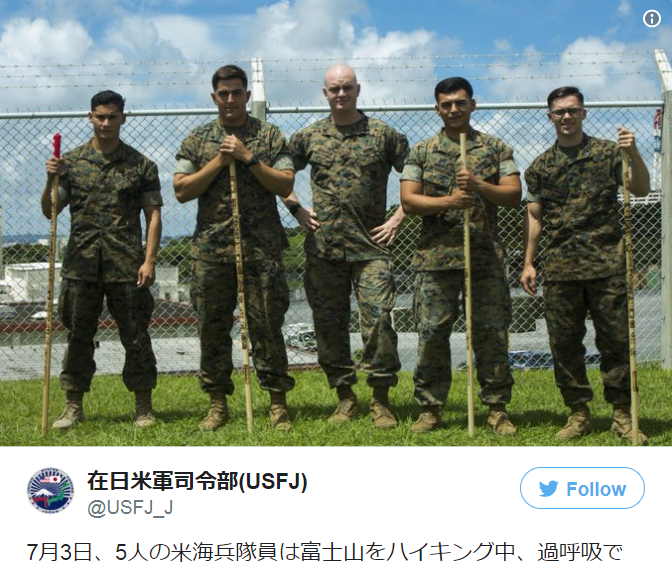
On July 3, 2017, right at the opening of climbing season, five young Marines were making their way up Mount Fuji carrying those classic wooden souvenir walking sticks they stamp at each mountain station.
High on the steep volcanic gravel trail, where the air grows thin and every step slides backward in loose cinders, they came across a Japanese woman who had collapsed unconscious from severe hyperventilation.
An ambulance cannot drive up the side of Mount Fuji. Even walking down empty-handed wrecks your knees.
Those five Marines did not wait around hoping somebody else would figure it out. Right there on the mountain, they put their heads together, built a simple improvised stretcher out of what they had, lifted her gently onto it, and started walking down.
Not for two hundred yards. For two full miles.
Three point two kilometers of steep, ankle-twisting volcanic rock in thin mountain air, trading corners of that handmade litter until they delivered her safely into medical hands.
When U.S. Forces Japan shared a photo of the five Marines smiling in their boots with their wooden Fuji sticks, Japanese comments flooded in with gratitude, plus one observation that made our whole country smile:
Only U.S. Marines could carry a human being down Japan's tallest volcano and casually call their day off "hiking."
Thank you, gentlemen. Japan still remembers.