InterLink Ensures KYC for Everyone & Priority Based on Contribution
The KYC verification process at InterLink operates continuously, and all users will be verified. There are no phases and no users are excluded. The only difference lies in the order of processing. Users with higher levels of activity and contribution will be prioritized and processed sooner, while those at lower priority levels will remain in the queue and be verified over time.
Unlike traditional KYC processes, where applications are reviewed strictly based on submission order, InterLink is designed to ensure fairness through contribution-based prioritization.
How Priority Is Determined
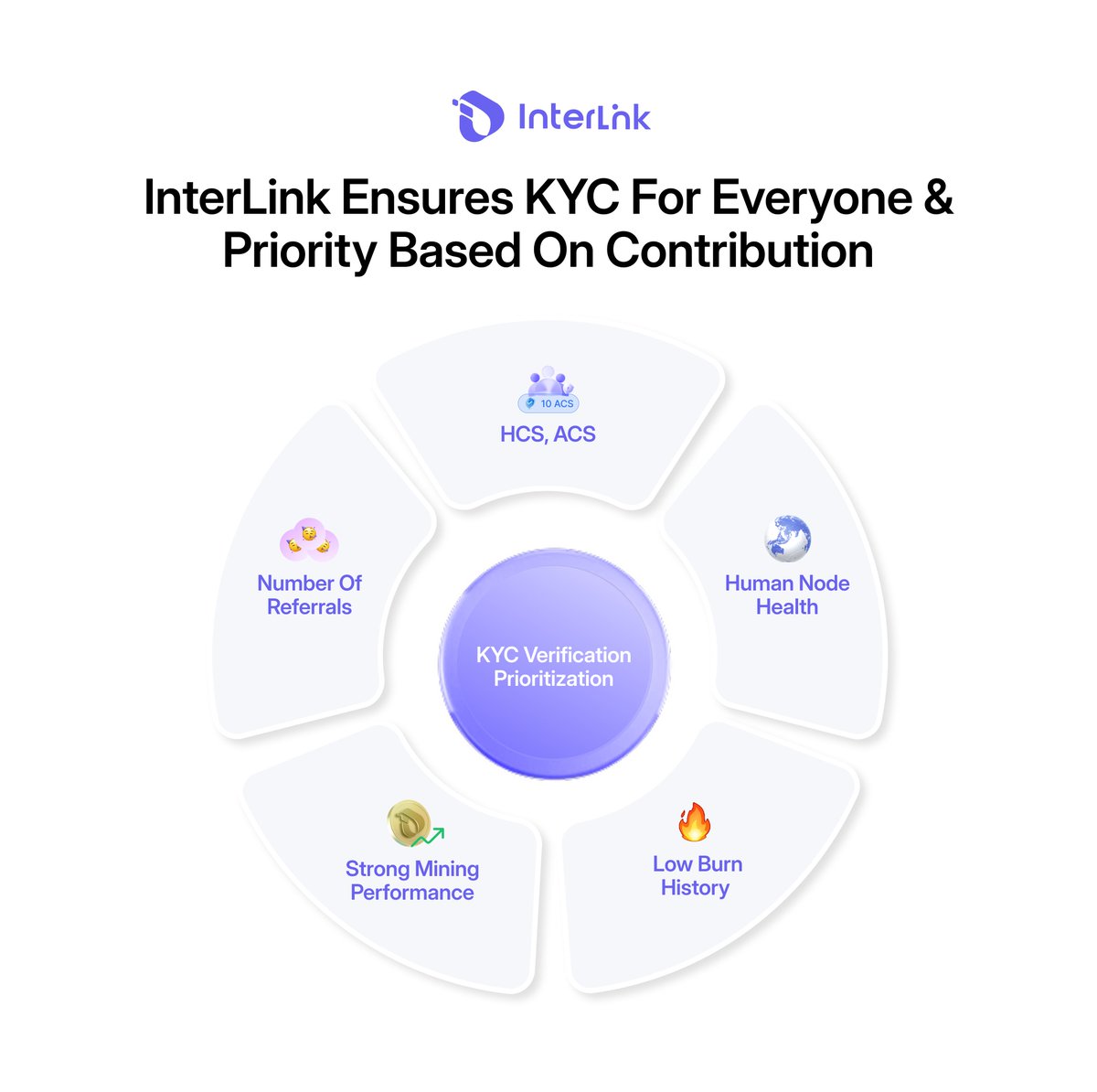
Entering the queue earlier or later does not determine priority. Instead, the system evaluates users holistically based on the following factors:
• Human Node health
• Strong mining performance
• Low burn history
• HCS (Human Credit Score)
• ACS (Ambassador Credit Score)
• umber of referrals
These factors collectively reflect each user’s level of participation, reliability, and real contribution to the network.
Importantly, the system does not rely on any single metric, but rather on an overall assessment. For example, within the same queue, having a higher HCS does not guarantee priority. Users are not evaluated in isolation, but compete with others within the same queue for prioritization. The system applies a multi-factor evaluation framework, where overall performance across a combination of metrics determines priority. As a result, a user with a higher score in a single metric may still be ranked lower if their overall performance is not stronger than others in the same queue.
Priority is not fixed and is continuously updated over time. This means that positions in the queue are not “locked”. Users can actively improve their priority by maintaining consistent activity and enhancing the quality of their contributions. Improving these metrics directly increases the likelihood of being reviewed sooner.
This approach allows InterLink to maintain a fair and sustainable system, while giving every user the opportunity to improve their position through meaningful participation and contribution.
#InterLink #ITLG #ITL
Those who have been verified and received ITLG early will be migrated to ITLG on the upcoming InterLink Chain private mainnet.
vITLG on the InterLink Chain will be used for staking to receive ITL.
You will receive an additional notification once your profile has been matched with a curator. After submitting your profile, results will be provided within a maximum of 24 hours.
For those who have not yet been matched with a curator, there is no need to worry, you will not lose your chance. Please focus on improving your Human Node metrics, as well as your HCS and ACS scores, to gain higher priority in the queue as previously announced.
In the near future, I will be taking on a new role at @itl_fdn, so I will no longer be providing frequent or detailed updates as before. This responsibility will be handled by @scott_itl, Head of Product at @inter_link, please make sure to follow him.
I will focus more on strategic direction moving forward.
Thank you everyone for always supporting me.
🚀 InterLink Version 5.0 is officially live
Version 5.0 introduces key upgrades that lay the foundation for a more complete ecosystem, where information, identity, and assets are seamlessly connected.
🔹 Connect Social
The interface has been redesigned with improved layout and content structure. The experience is now cleaner, more intuitive, and easier to navigate, allowing users to interact more efficiently without visual clutter.
🔹 News
Track highlighted posts through the Top View tab. The News feature has been enhanced with multi-language support, real-time impression metrics, and an integrated Play button that seamlessly redirects videos to X.
This enables users to quickly stay updated with the latest information, understand content in their native language, assess the relevance of information through view counts, and consume content smoothly on a familiar platform.
🔹 Curator System
The core feature of Version 5.0, designed to ensure fairness across the network by protecting real users, eliminating bot activity, and serving as the gateway to verified asset ownership.
Users can now initiate the KYC process to verify real human identity, a mandatory step to unlock eligibility for receiving Verified $ITLG.
🔹 Visa Card
The InterLink Visa Card will support payments using digital assets such as USDT, USDC, and Ethereum. Users can seamlessly integrate the card with Apple Pay, Google Pay, and any platform that supports Visa payments, enabling simple and convenient daily spending.
The InterLink Visa Card will be launching in the coming days.
📲 Update the app today to experience Version 5.0 and prepare for the next stage of the InterLink ecosystem.
#InterLink #ITLG #ITL
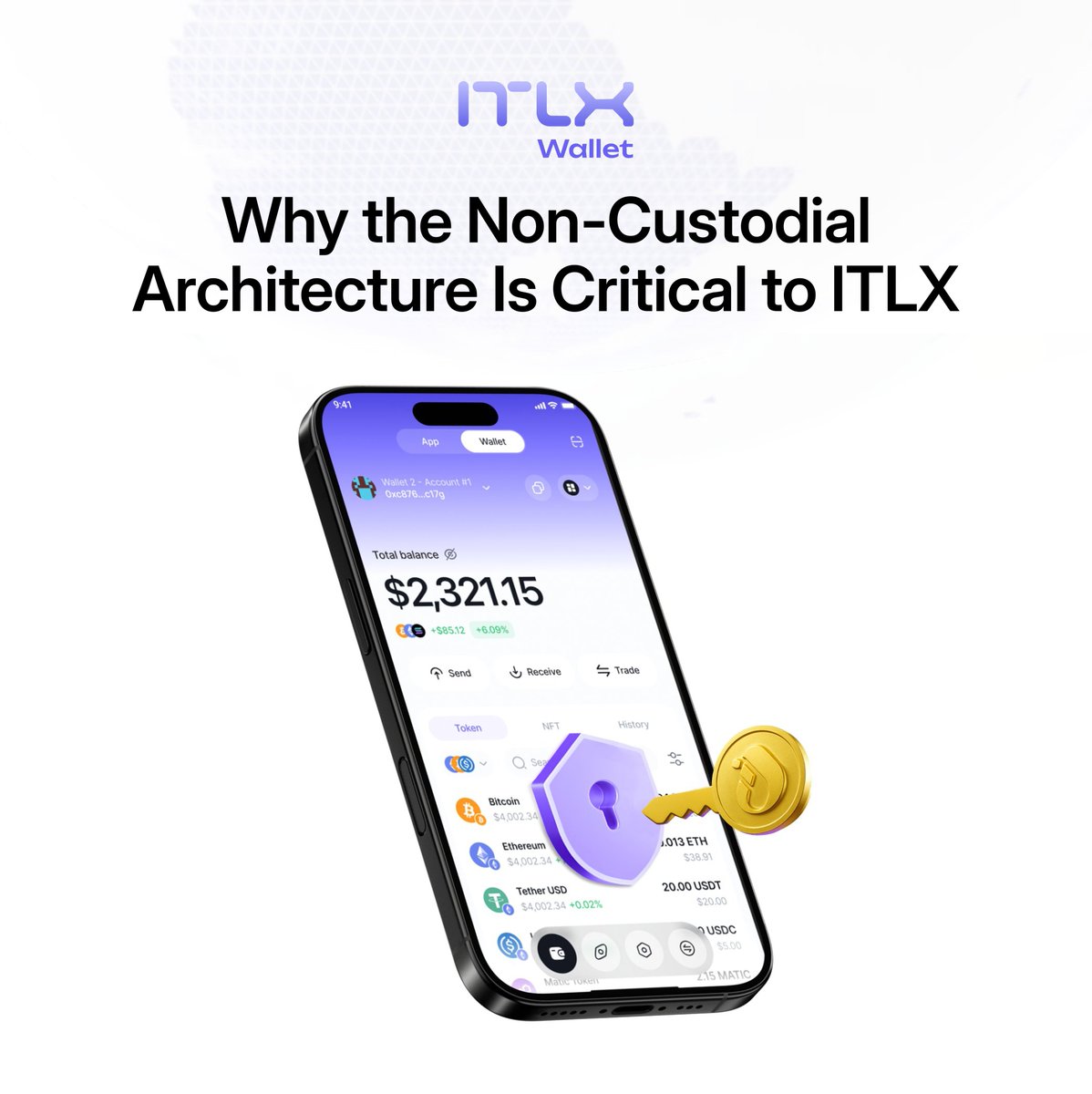
🔥Why the Non-Custodial Design Matters in ITLX Wallet
@itlx_defi is built on a non-custodial architecture, where private keys and full control over transactions are entirely held by the user. This structure establishes a clear security boundary between user intent and system execution.
📌Core Advantages:
Full User Control of Assets: Users are not dependent on any third party, eliminating concerns about losing funds due to exchange failures or security breaches. At the same time, users retain full flexibility. Assets can be transferred to exchanges for trading or withdrawn back to a non-custodial wallet at any time, quickly and securely.
Enhanced Security for Assets and Personal Data: Users are not required to complete KYC procedures or provide personal information to any centralized entity. All transactions are conducted based on wallet addresses. By removing third-party verification, transactions can be executed almost instantly once the user confirms them.
The non-custodial design serves as a foundational principle that ensures sovereignty, security, and integrity within @itlx_defi.
#ITLX #ITLG #ITL
InterLink Is Building a Quantum-Resistant Future for Digital Assets
Quantum computing is emerging as one of the greatest risks to digital assets. As AI accelerates computational power, cryptographic systems once considered secure are becoming increasingly vulnerable. If an asset can be broken by quantum machines, it cannot serve as a reliable store of value.
Recently, Google once again highlighted growing concerns around quantum resistance in crypto, warning that Bitcoin’s security could be compromised sooner than expected and that current cryptographic standards may not hold in the near future. The report further emphasizes that crypto projects should begin implementing quantum-resistant solutions before 2029.
InterLink is not waiting for that moment. It has proactively established a dedicated quantum research team months in advance, bringing together leading cryptographers and engineers.
Quantum-resistant mechanisms are being integrated directly into InterLink’s token infrastructure, ensuring that security is built into the foundation.
🔹 Why this matters
-Quantum resistance is essential for any asset aiming to serve as a long-term store of value
-Future-proof security is not a feature. It is a requirement
-By aligning with security standards set by the National Institute of Standards and Technology, InterLink positions itself at the highest global benchmark
🔹 What InterLink is doing differently
-Advancing post-quantum cryptography research before the threat becomes inevitable
-Embedding quantum-resistant security designs directly into the development of the Private Mainnet
-Positioning $ITLG and $ITL as infrastructure-grade digital assets, not experimental tokens
InterLink is not building for market cycles.
InterLink is building the security layer required for digital assets to survive the quantum era.
#InterLink #ITLG #ITL
Version 5.0 has been approved on Google Play and the App Store and is ready to go public.
The InterLink Foundation Operations team is currently setting up the necessary procedures for curators to officially begin their work.
Once everything is in place, we will roll it out simultaneously.