A login is part of two AD groups. One group has read access and other has sysadmin. When the user logged in, only the read access is applied. Sysadmin role is not applied. Is there a reason for this? But when the login was added directly as sysadmin, it got sysadmin role #sqlhelp
Sql server & Agent service account don’t have access to backup share. Running Ola’s T-sql backup job from sql agent. Job owner is sysadmin and has access to share.Backups are failing due to no access on share for service account. Any ideas on how to run as job owner? #sqlhelp
@DBAduck Thank you!! Any ideas on what could have made the DB get into “initializing/ in recovery” state. The dbs were in sync and redo queue was zero before failover. Post failover, the error log said “DB recovery completed” but it was still stuck in this state for over 5 hours #sqlhelp
SQL 2019 AG DB stuck in “initializing/in recovery” state after failover. The DB is in secondary role. The error log said - “recovery completed for database <db name> in 30 seconds” an hour ago but DB still stuck in initializing/recovery state. Any help to recover the DB #sqlhelp
Getting this error - Database ��abcde” already exists. Choose a different database name. But the db does not show up when queried sys.databases or in SSMS object explorer Any ideas how to fix the issue #sqlhelp
@AngryPets Thanks @AngryPets for the input. Yes, it could be plan cache issue but we did not notice difference in the query plan before and after the stats were updated that resolved the issue.
We also tried evicting plans and it worked only when the query was not executing at that time
On sql 2019 cu19, parameterized adhoc app query execution takes ~30 secs randomly. Updating stats fixes the issue.
Hourly job updates stats for the table but even then noticing issues btw those runs. Manually updating statistics fixes.
Table size range - 50 to 250GB. #sqlhelp
Have two log backup jobs set up using Ola’s scripts databases in parallel mode. Sometimes, one of the log backup job can take a while backing up one database and overlap with its next schedule. Does the second log backup job on its next run backup all the remaining dbs? #sqlhelp
Noticing constant spike in “MEMOBJ_SOSNODE” clerk in SQL 2016 sp3. It is growing at 60 MB for every 15 mins. Any ideas what could be leading to this? #sqlhelp
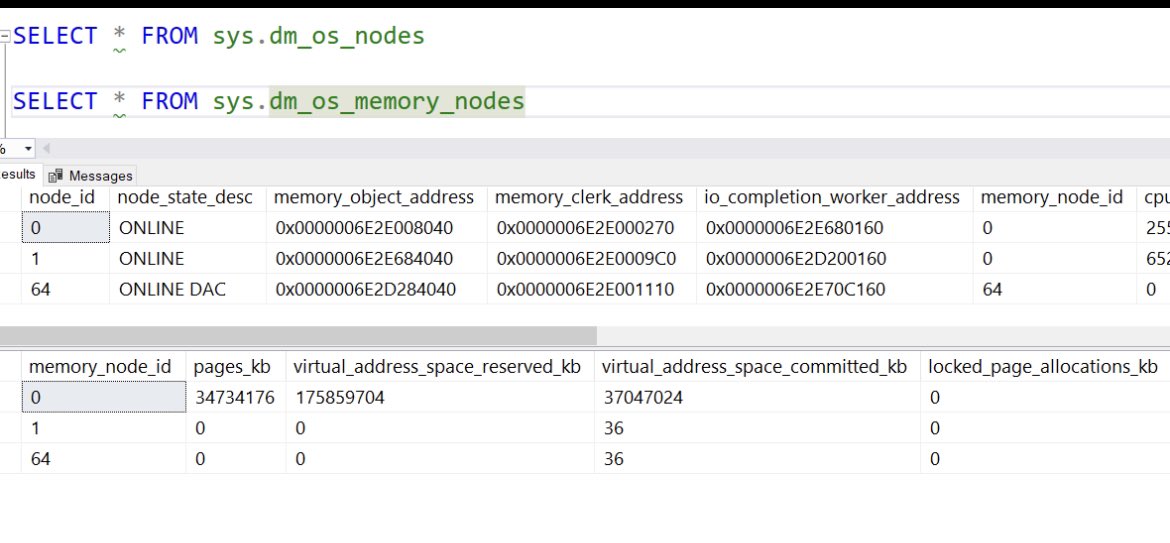
@sqL_handLe@arvisam The Schedulers count is stable and has 16 cores. There is only one NUMA node and two memory nodes. Dm_Os_memory_node where memory_node<64 comes back with two rows but memory node id = 1 does not have pages allocated. Memory_node 0 is doing all the work. No,that dbcc did not help.
@arvisam fyi: This instance hosts SSIS, SSRS databases (not SSRS web server) and other user DB’s. We have lot of jobs that run SSRS subscriptions and SSIS packages. Could they be related? Thanks again for looking. Will open support ticket with MS. 2/2
@arvisam Thank you for looking into this. Do not have any profiler\trace\XEvents session enabled that’s collecting XML plan output. I disabled the default the trace and the system Xevent session. Still noticing constant growth in “SOSNODE” memory clerk. 1/2
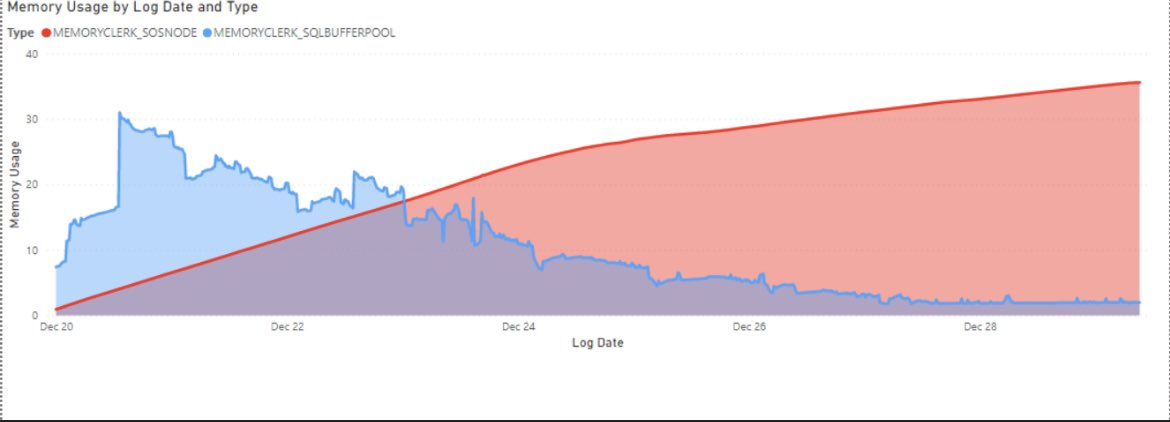
@arvisam Yes. It has been growing and eventually taking entire buffer pool. Restarting the instance is the only way to release that memory. Below is the graph that shows ever increasing “SOSNODE” memory clerk. https://t.co/VnnHNsVV79_os_memory_objects show ever increasing “MEMOBJ_SOSNODE”
What’s causing the high memory usage for “MemoryClerk_SOSNode”. Server is SQL 2016 sp3 and hosts SSIS packages and executes them very frequently. “SOSNODE” memory usage keeps on increasing. Server has 40GB. Below pic shows how memory usage by clerks since restart #sqlhelp
sys.syscerts table in SSISDB database is over 90 GB. What does it contain? Cannot query it because it’s internal table. Is it possible to clean it up? #sqlhelp