This college student says he's voting for Kamala. I ask him a very basic question: "What has she done as Vice President of the United States that would give you confidence that she'll do a good job as President?"
No one can answer this very simple question. WATCH
The Senate continues to reject request after request for Trump’s border wall. This vanity project would be a misuse of taxpayer money and the President needs to give it up. #SOTU
PGVECTOR IS NOW FASTER THAN PINECONE. And 75% cheaper thanks to a new open-source extension – introducing pgvectorscale.
🐘 What is pgvectorscale?
Pgvectorscale is an open-source PostgreSQL extension that builds on pgvector, enabling greater performance and scalability (keep reading for the actual numbers).
By using pgvector and pgvectorscale, developers can build more scalable AI applications, benefiting from higher-performance embedding search and cost-efficient storage.
📈 How does it perform?
On our benchmark of 50 million Cohere embeddings (768 dimensions each), PostgreSQL with pgvector and pgvectorscale achieves 28x lower p95 latency and 16x higher query throughput compared to Pinecone for approximate nearest neighbor queries at 99 % recall, all at 75 % less cost when self-hosted on AWS EC2.
We also tested it against Pinecone’s p2 high performance index, see the blog post at the end of this post for full results (spoiler: It’s just as impressive).
🤔 Why did we build pgvectorscale?
Our team at @timescaledb built pgvectorscale to make PostgreSQL a better database for AI and to challenge the notion that PostgreSQL and pgvector are not performant for vector workloads.
⚙️How does it achieve such good performance?
Pgvectorscale brings specialized data-structures and algorithms for large-scale vector search and storage to PostgreSQL as an extension, including: (1) StreamingDiskANN – a high-performance, cost-efficient vector search index for pgvector data inspired by research at Microsoft, and (2) Statistical Binary Quantization (SBQ), developed by Timescale’s own researchers to improve upon standard binary quantization techniques.
These innovations help PostgreSQL deliver comparable and often superior performance than specialized vector databases like Pinecone. 👏 Big shoutout to @cevianNY and @sql_johnpruitt, two senior staff engineers at Timescale, who worked on these technical breakthroughs.
🧑💻 Sounds exciting! How can I get started?
Pgvectorscale is open-source under the PostgreSQL license, and free to use on any PostgreSQL database. You can find installation instructions on the pgvectorscale GitHub repository (see end of post). It’s also available on any database service in Timescale’s PostgreSQL cloud platform.
📚Learn more
[1] Pgvectorscale explainer blog: https://t.co/kG7Y48hxjy
[2] Pgvectorscale github repo: https://t.co/xcpA65dWOQ
Share this post with your followers to let them know about pgvectorscale and comment your reactions and questions.
Who's the CHEAPEST bridge: an analysis, with data! Read on for more.
Conclusion:
For the average L2 to L2 transfer, @AcrossProtocol is clearly the fastest and cheapest bridge.
For the average ETH to L2 transfer, Across is far faster and cheaper than Stargate’s fast bridge, and Across is effectively tied in cost with Stargate’s slow bridge (however Across is literally 20x faster).
For the average L2 to ETH transfer, Across is far faster and cheaper than Stargate’s fast option, and marginally more expensive than Stargate’s slow option (but Across is literally 100x faster).
Analysis:
Over the last few days, my brother-in-bridging @PrimoridalAA has accused me of cherry picking data when comparing our bridges. I think the best response to this is to develop a methodology for what “cheaper” means, and then see who wins.
My methodology: for the average bridge transaction, which bridge is cheapest? Since transaction sizes and costs are quite different for L2 to L2, ETH to L2, and L2 to ETH, I look at each of these separately. For “which L2s” I propose we look at the three largest: Arb, Base, OP.
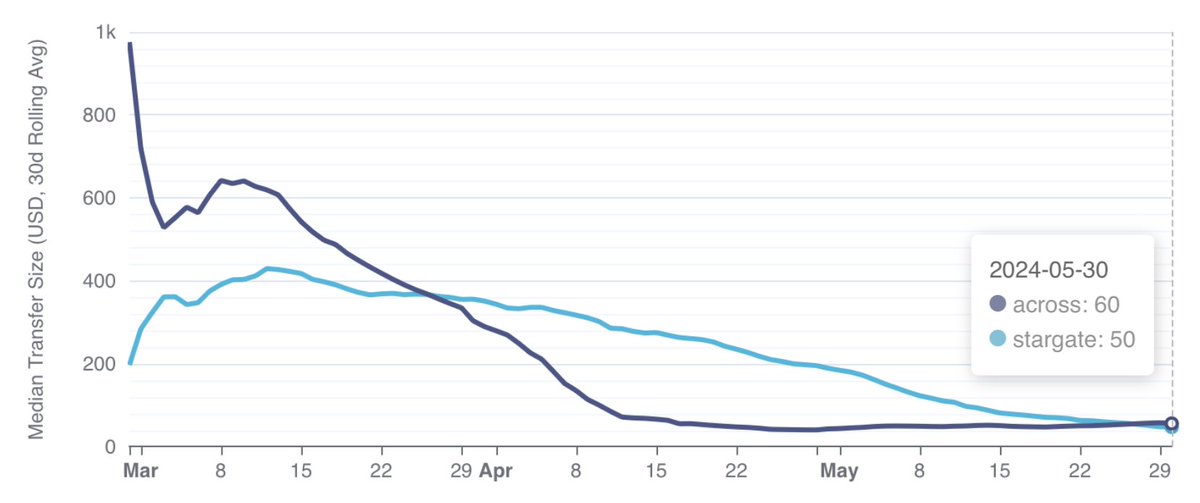
Here’s the 30d rolling average L2 to L2 bridge transaction size on the three large L2s, measured using both Across and Stargate data:
The average L2 to L2 transaction size for both bridges is ~$55, or approx 0.015 ETH. (Also notice how the average size is trending down; more on this later).
Ok great, so which bridge is cheaper for moving 0.015 ETH between L2s? This should answer the question “which bridge is cheaper for the average bridge transaction between L2s”.
Answer: no matter which permutation you look at for bridging 0.015 ETH between Arb, Base, and OP, Across is cheaper and faster than Stargate, full stop.
I just bridged 0.015 ETH from Base to OP. Results:
Across took 4 secs and cost 1.1 cents.
Stargate “fast” took 50 secs and cost 5.6 cents.
Stargate “cheap” took 1m2s and cost 3.0 cents.
I’m sure I’ll be accused of cherry picking Base to OP, but honestly go check any route of 0.015 ETH and see if yourself. Across is substantially cheaper, and it is certainly faster on any L2 to L2 permutation! This one isn’t even close.
Conclusion: Across is clearly the fastest and cheapest bridge for the average L2 to L2 transaction. Period.
Just bridged 0.1 ETH from Arb to OP.
Across took 2 seconds and cost $0.097
Stargate v2 "fast" took 49 seconds and cost $0.174
Stargate v2 "cheap" took 83 seconds and cost $0.119
Across is WAY faster and cheaper than Stargate v2.
Let's drop the false marketing, ok?
The Farcaster DAU printer:
- Bots pay 5$ to FC to sign up.
- Bots circle-jerk to amass DEGEN tips.
- Degen tokens cover the signup fees.
Rinse and repeat.
FC adds feature to hide bots. "Win-win". Users live in a bubble, FC can "demo" insane DAU. Completely healthy ecosystem /s
Whistleblowers at Boeing just keep dying right after they start alerting authorities about what is going on at Boeing.
Boeing has an amazing hit squad. Extremely efficient and talented.
It's too bad that Boeing didn't put as much effort into the 737 Max and the 787.
Coming soon - you will be able to download and manage 1000s of open source models and adapters using the BitTorrent protocol directly from within the node.
Let’s keep it simple.
cc @far__el



![avthar's tweet photo. PGVECTOR IS NOW FASTER THAN PINECONE. And 75% cheaper thanks to a new open-source extension – introducing pgvectorscale.
🐘 What is pgvectorscale?
Pgvectorscale is an open-source PostgreSQL extension that builds on pgvector, enabling greater performance and scalability (keep reading for the actual numbers).
By using pgvector and pgvectorscale, developers can build more scalable AI applications, benefiting from higher-performance embedding search and cost-efficient storage.
📈 How does it perform?
On our benchmark of 50 million Cohere embeddings (768 dimensions each), PostgreSQL with pgvector and pgvectorscale achieves 28x lower p95 latency and 16x higher query throughput compared to Pinecone for approximate nearest neighbor queries at 99 % recall, all at 75 % less cost when self-hosted on AWS EC2.
We also tested it against Pinecone’s p2 high performance index, see the blog post at the end of this post for full results (spoiler: It’s just as impressive).
🤔 Why did we build pgvectorscale?
Our team at @timescaledb built pgvectorscale to make PostgreSQL a better database for AI and to challenge the notion that PostgreSQL and pgvector are not performant for vector workloads.
⚙️How does it achieve such good performance?
Pgvectorscale brings specialized data-structures and algorithms for large-scale vector search and storage to PostgreSQL as an extension, including: (1) StreamingDiskANN – a high-performance, cost-efficient vector search index for pgvector data inspired by research at Microsoft, and (2) Statistical Binary Quantization (SBQ), developed by Timescale’s own researchers to improve upon standard binary quantization techniques.
These innovations help PostgreSQL deliver comparable and often superior performance than specialized vector databases like Pinecone. 👏 Big shoutout to @cevianNY and @sql_johnpruitt, two senior staff engineers at Timescale, who worked on these technical breakthroughs.
🧑💻 Sounds exciting! How can I get started?
Pgvectorscale is open-source under the PostgreSQL license, and free to use on any PostgreSQL database. You can find installation instructions on the pgvectorscale GitHub repository (see end of post). It’s also available on any database service in Timescale’s PostgreSQL cloud platform.
📚Learn more
[1] Pgvectorscale explainer blog: https://t.co/kG7Y48hxjy
[2] Pgvectorscale github repo: https://t.co/xcpA65dWOQ
Share this post with your followers to let them know about pgvectorscale and comment your reactions and questions.](https://pbs.twimg.com/media/GPy5FEaXoAE8gzi.jpg)