BREAKING: Microsoft $MSFT falls 3% in just 30 minutes after Anthropic launches Claude Sheets, Claude Whiteboards and Claude Data.
Excel has owned the spreadsheet market for over 40 years. Now an AI company is coming straight for it.
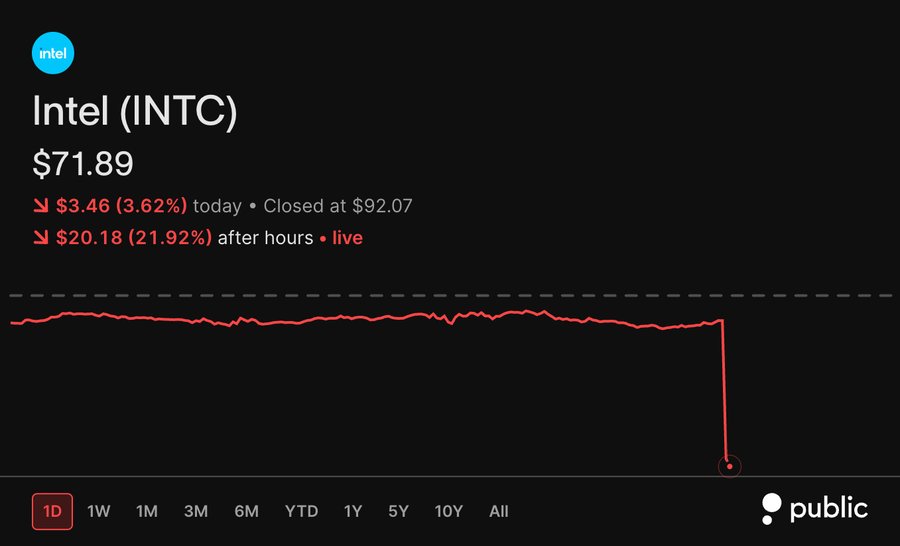
I'm dumping the majority of my Intel shares. This was genuinely one of the saddest earnings calls.
I had SO much hope for this company. I genuinely believed Intel was finally turning things around under Lip-Bu Tan and to be fair, they've made some real progress. But after listening to the entire earnings call, I honestly think Intel messed up BAD. And what makes this even more frustrating is that Intel has one of the biggest opportunities in the semiconductor industry sitting right in front of it, yet it cannot fully take advantage of it.
First, the guidance was absolutely terrible. Intel reported $16.5 billion in Q3 revenue and adjusted EPS of $0.52, which were actually pretty solid results. But then management guided for just $15 billion to $16 billion in Q4 revenue, compared to Wall Street's expectations of around $17.1 billion. They also expect adjusted EPS to fall to $0.25, compared to expectations of roughly $0.43. Even worse, gross margins are expected to fall from 44.1% to just 38% in a single quarter. That's a massive decline, especially for a company that's supposed to be improving its profitability.
But the biggest problem is what management said about 2027. Intel's PC business is getting destroyed by the ongoing memory shortage. Companies like Samsung, SK Hynix, and Micron are benefiting from enormous AI demand, but that same demand is making memory more expensive and harder to find for traditional computers.
And when memory becomes more expensive, the entire computer becomes more expensive. That means fewer people and businesses are willing to upgrade their PCs, which directly hurts Intel. Management now expects the overall PC market to shrink by around 12% in 2026 and another 10% in 2027. Intel also expects its own client revenue to fall more than 20% in Q4 alone. What really caught my attention was when management basically admitted that they don't expect the memory situation to improve in 2027. So this isn't just a temporary problem that disappears next quarter. It could continue hurting Intel for another year or longer.
Now, here's what frustrates me the MOST. Intel's data center business is absolutely booming, but they cannot manufacture enough chips to meet demand. Data Center and AI revenue grew nearly 80% year over year to $7.3 billion. Management expects industry server CPU shipments to grow more than 30% in both 2026 and 2027, and Lip-Bu Tan even believes the server CPU market could grow from around $40 billion today to more than $200 billion over the next five years because of AI agents. That's an unbelievable opportunity. But Intel is dealing with manufacturing capacity limitations, production bottlenecks, and shortages of the materials needed to package its chips. In other words, customers WANT to buy more Intel server CPUs, but Intel cannot produce enough of them.
And management made it pretty clear that these supply problems will continue into the first half of 2027, with meaningful improvements not expected until the second half. This is what bothers me more than anything. We're experiencing one of the strongest periods of CPU demand in years, and Intel is leaving billions of dollars in potential sales on the table while competitors fight for market share. Then there's the tragic accident at Intel's factory in Israel, which forced production to shut down for approximately two weeks. Management expects this to reduce Q4 revenue by around $300 million, with a similar impact potentially extending into Q1. It also accounts for about two percentage points of the expected Q4 gross margin decline. Obviously, this was an unfortunate situation, but it creates even more problems for a company that was already struggling to produce enough chips.
And don't even get me started on the foundry business. This was supposed to be one of the biggest reasons to invest in Intel. The idea was that Intel could become a serious competitor to TSMC by manufacturing chips for other companies. And yes, Intel is making progress. Its 18A manufacturing process is improving, production costs are coming down, and management sounds more confident about 14A but here's the reality. Intel's foundry business still lost $1.9 BILLION in Q3. External foundry revenue was only $411 million, and part of that came from a one time customer program. Management keeps talking about potential customers, improving yields, and future opportunities. But where are the major external customer commitments that will actually make this business profitable? I'm not saying they won't come. I'm saying investors have already been waiting years for this turnaround, and we're still talking about what MIGHT happen in 2027 and 2028.
And then came another comment that really disappointed me. Intel doesn't expect to generate positive free cash flow in 2027. The company already expects to spend around $20 billion on capital expenditures in 2026, and management said spending will increase significantly next year. So we're looking at another year of massive investments, continued foundry losses, a declining PC market, and potentially negative free cash flow. And remember, Intel raised $23 billion by issuing additional shares in August, meaning existing shareholders also have to deal with dilution. At some point, investors need to ask when all this spending is actually going to translate into sustainable profits.
Now, I want to be fair because there ARE positives here. Intel's server CPU demand is incredibly strong. Its manufacturing technology is improving. Granite Rapids is becoming more profitable, its custom silicon business is growing rapidly, and its upcoming products like Diamond Rapids and Nova Lake could help it regain market share. I also think the long term opportunity in AI infrastructure, advanced packaging, and foundry services is enormous. But here's the issue. Almost every major positive Intel talks about is something that could happen in the FUTURE. More manufacturing capacity in the second half of 2027. Potential foundry customers. A stronger product roadmap. Better profitability. Eventually positive free cash flow.
Meanwhile, all the problems are happening RIGHT NOW. The PC business is declining right now. Manufacturing constraints are hurting sales right now. Foundry is losing billions right now. And margins are expected to fall significantly next quarter. The worst part is that Intel doesn't even have a demand problem in its server business. It has an execution problem. And that's arguably even more frustrating because the opportunity is already there.
I understand that rebuilding a company like Intel takes years, and I still respect what Lip-Bu Tan is trying to accomplish. But after the massive rally in this stock, investors were expecting Intel to finally start delivering meaningful results, not another year of excuses and promises. I was willing to be patient with Intel because I believed the turnaround was gaining momentum. But this earnings call genuinely changed my perspective.
I'm not selling because I suddenly believe Intel is a terrible company or that its technology has no future. I'm selling because I no longer think the risk and reward are nearly as attractive as they were before. I'm dumping the majority of my position, but I'll likely keep a smaller stake because I still believe there's long-term potential here. I really wanted Intel to succeed. I still do. But wanting a company to succeed and believing its stock is a good investment at the current valuation are two completely different things.
And after listening to management today, I just cannot justify maintaining the same level of exposure. Intel had the opportunity to prove that its turnaround was finally working. Instead, management gave investors even more reasons to question it. This was genuinely disappointing.
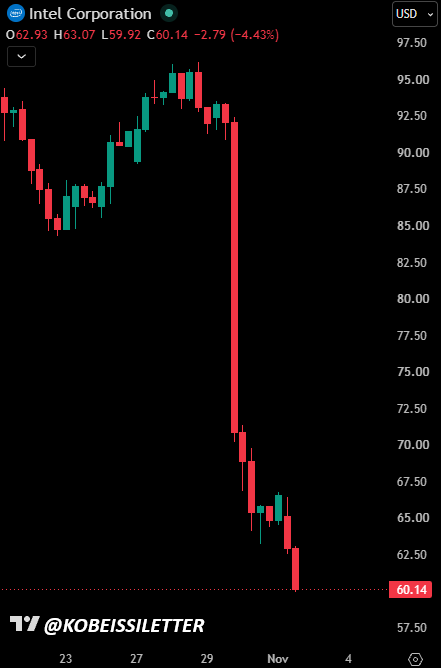
BREAKING: Intel, $INTC, extends losses to nearly -10% on the day, now down -37% over the last 3 trading sessions.
The stock has now erased -$450 billion in market cap from its peak.
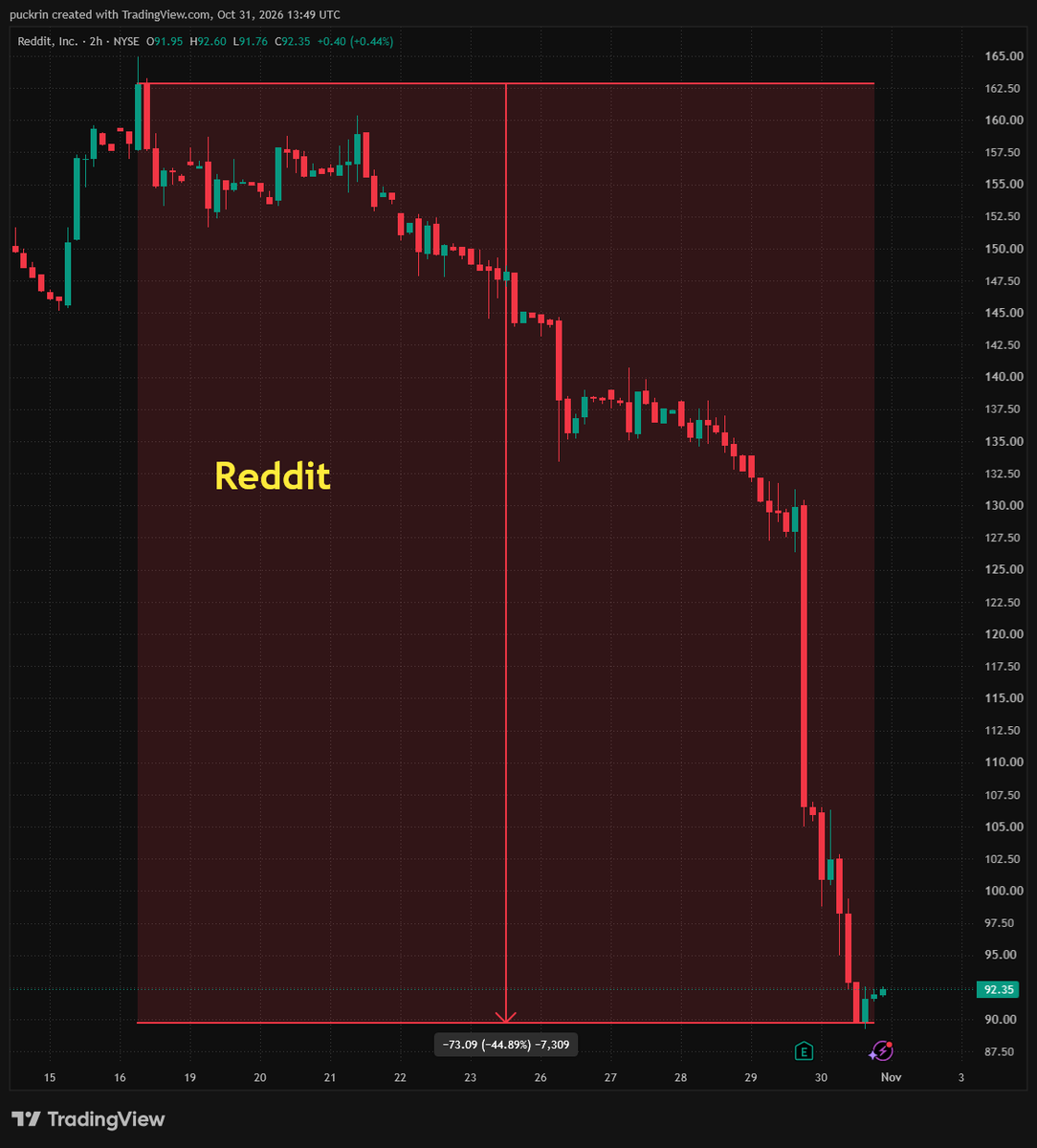
The collapse of Reddit will be studied.
After reporting earnings, its stock collapsed 30% in a single day.
It's down 44% in 2 weeks.
But the most important detail is what was revealed in that earnings call.
The CEO said AI is killing Google search.
People no longer get sent to Reddit from Google. They merely get their answers from the AI Mode itself.
Even Google confirmed this themselves with their disastrous results - AI mode is cannibalising their search business.
Pretty soon, no one will visit Reddit voluntarily. Its traffic will continue to crater.
The worst part?
Reddit isn't alone. There are millions of companies and publishers that rely on search traffic.
That's what happens when you rely on a single funnel for discovery.
BREAKING: Intel, $INTC, extends losses to -30% on the day, now on track for its biggest decline on record.
Not even the Dot-Com bubble or 1970s saw a decline in $INTC like this.
BREAKING: ServiceNow, $NOW, plunges -23.9% after disappointing Q3 earnings and a weak Q4 outlook raised concerns over slowing organic growth and shrinking margins.
The clinical data reading out of AVA6000 & 6103 is a product of Chris & her team’s execution.
These findings not only strengthen our platform, they validate our strategy of retaining IP until we believe it represents maximum value for #AVCT shareholders.
A busy Q4 ahead of us.
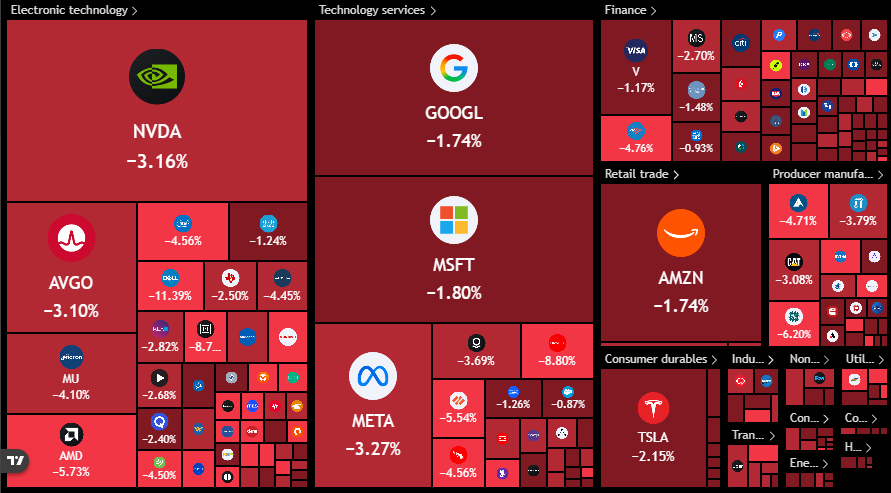
🚨 $700 billion has been wiped out from $NVDA market cap as it crashes 12% in the last 10 days.
That is equal to the market cap of Intel and Disney combined.
BREAKING: The S&P 500 officially posts its worst day since July 29th, erasing -$800 billion of market cap.
Inflation is rising again in the US, now nearly double the Fed's long-term target.
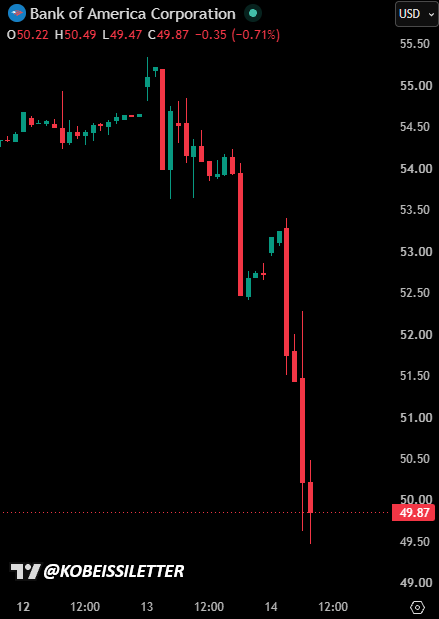
BREAKING: Bank of America stock, $BAC, falls over -8% after the bank was fined $1.2 billion over money laundering violations and US CPI inflation pushes rate hike expectations higher.
The stock has now erased -$30 billion of market cap today.
🚨 Insider Buy Alert
Former CEO of Quest Diagnostics just picked up $3.5M worth of $ORCL shares as the stock trades nearly 60% below all-time highs
He currently sits on the Board of Directors at Oracle.