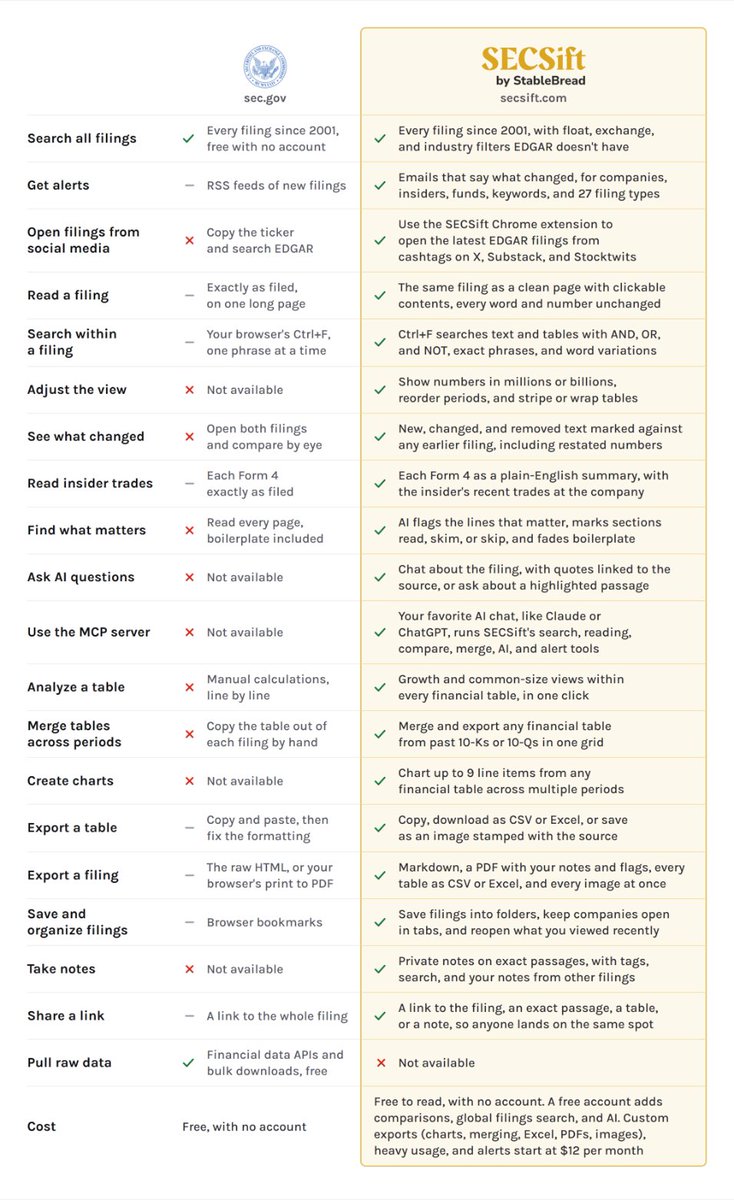
If you're still using EDGAR to read SEC filings, you're wasting your time!
Just use SECSift: https://t.co/HSfdmpulMJ
It's the obvious solution if you want to cut down the time spent reading filings by more than half and better understand any business.
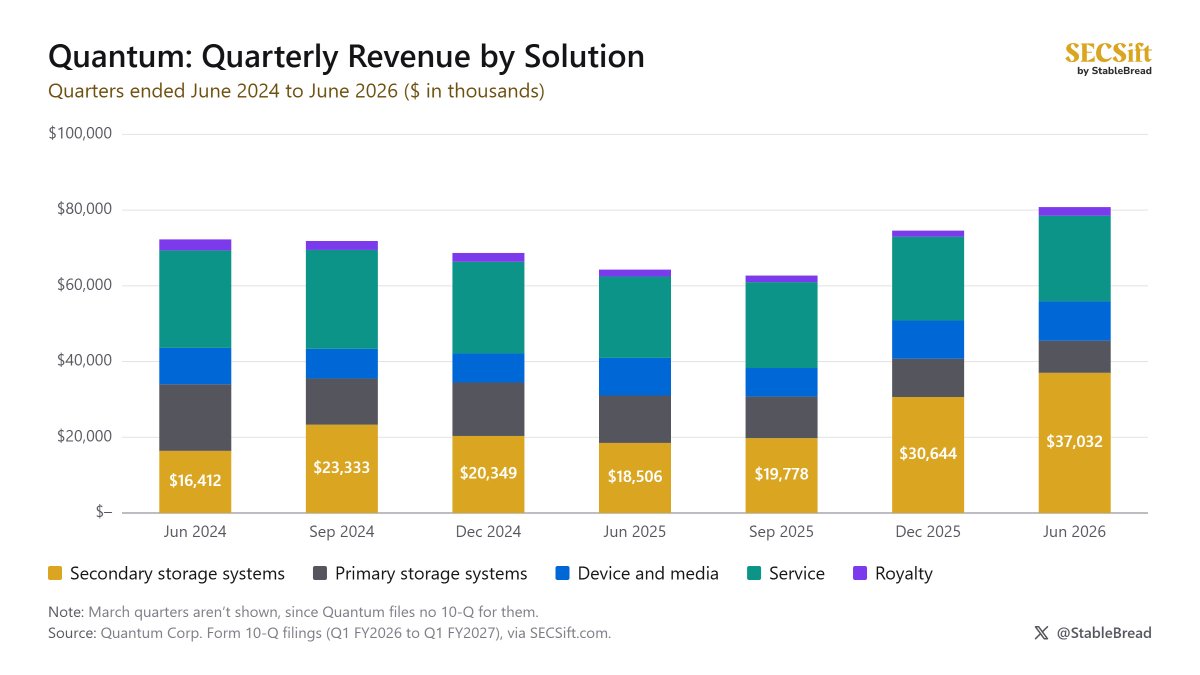
See $QMCO’s revenue by solution in its 10-Qs here: https://t.co/f4p8x4t2Cy
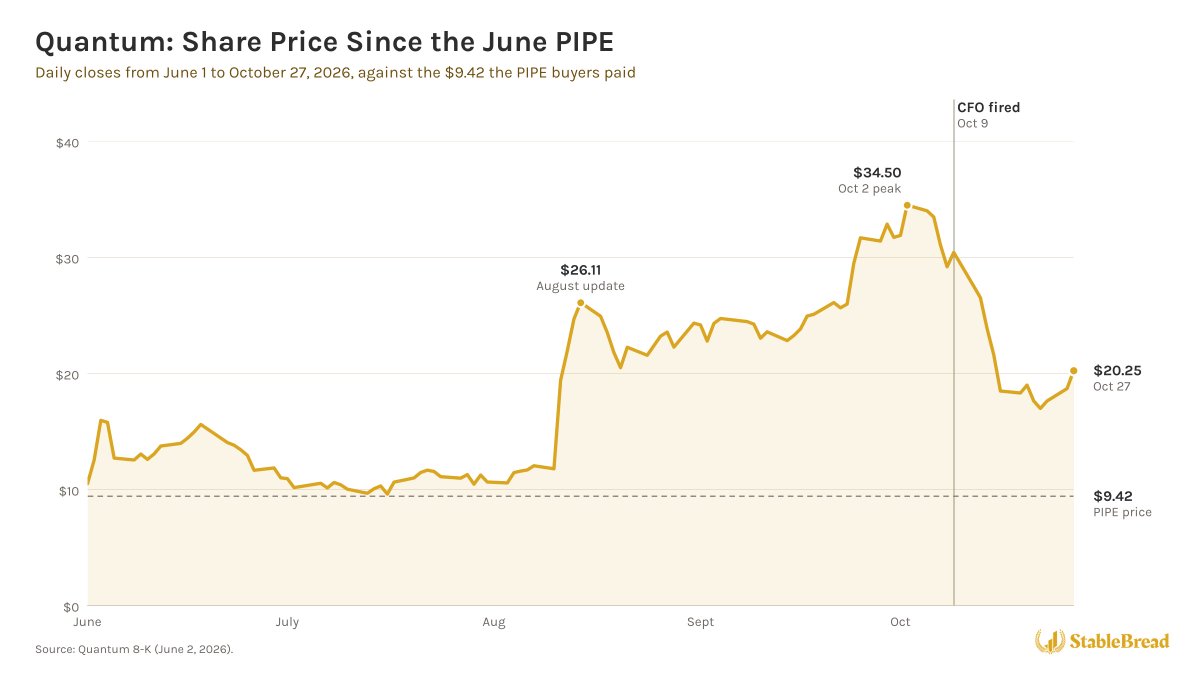
Continue reading here for whether $QMCO insiders sold into the run to $34.50: https://t.co/GXzV3AQBgs
The first thing I said I’d watch on Quantum $QMCO in my August 16 update was $IBM’s tape drive supply, since CEO Hugues Meyrath said on the June-quarter call that “customers’ demand remains stronger than our ability to fulfill it.”
The LTO Program, the group of $HPE, $IBM, and $QMCO that sets the LTO tape standard, reported on September 1, 2026 that tape capacity shipped in Q1 2026 rose 57% from Q1 2025.
The 57% measures data capacity, and each new LTO generation holds more data per cartridge, so capacity shipped can grow faster than the number of cartridges sold.
Meyrath said on the June-quarter call that $QMCO’s $82.0M ±$2M revenue guidance for the September quarter is only “mildly up” because tape drive supply had stayed “flat for the past handful of months.”
$IBM, which supplies the drives, had told $QMCO it would increase production toward the back half of the year, but Meyrath said the increase still hadn’t shown up as of August.
So by Meyrath’s account, $IBM’s drive supply, not demand, limits how much $QMCO can sell for now.
$QMCO’s quarterly revenue has risen from $62.7M in the September 2025 quarter to $80.8M in the June quarter.
Secondary storage, which $QMCO’s 10-K describes as “primarily tape storage systems,” drove the growth.
It doubled from a year earlier to $37.0M in the June quarter, 46% of total revenue, up from 29%.
That $18.5M increase was more than the $16.5M rise in total revenue, since primary storage, $QMCO’s file and object storage systems, fell to $8.5M from $12.5M.
@MicrocapDr Yep, and the next one comes fast. Commerce's preliminary ruling on the Ethiopia inquiry is due ~December 14, and $TOYO is a mandatory respondent. Its no-Chinese-wafers defense has to hold up next to the $94.9M it bought from VSun China in 2025.
https://t.co/6LtcbOeYKs
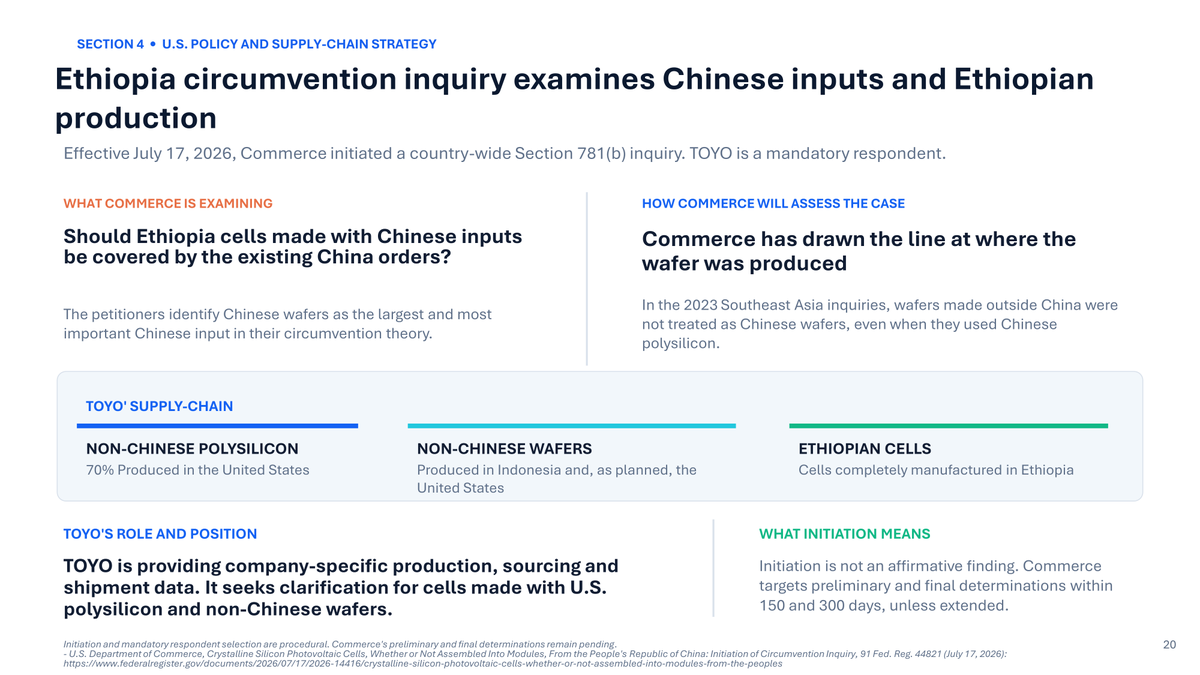
Commerce’s first ruling on whether TOYO Co., Ltd’s $TOYO Ethiopian cells should pay the duties on Chinese cells is due ~December 14.
$TOYO says those cells use no Chinese wafers, but in 2025, it bought $94.9M of goods from VSun China, which its 20-F calls “a crucial supplier of monocrystalline silicon wafer.”
Circumvention is when a producer finishes its products in another country to avoid duties on goods from its home country.
On May 12, 2026, First Solar $FSLR and seven other U.S. manufacturers asked Commerce to extend the 2012 duties on Chinese solar cells to cells and modules completed in Ethiopia with Chinese parts.
Commerce opened the inquiry on July 17, and $TOYO’s deck says it’s a mandatory respondent, meaning Commerce chose $TOYO as one of the companies whose production, sourcing, and shipment records it examines directly.
Commerce targets a preliminary determination within 150 days (~December 14, 2026) and a final one within 300 days (~May 13, 2027), unless it extends the deadlines.
$TOYO’s defense rests on the line Commerce drew in 2023.
In its Southeast Asia rulings that August, Commerce applied the China duties to cells made there from wafers produced in China, plus modules that paired those cells with more than two Chinese components.
However, it didn’t count wafers made outside China as Chinese, even when they used Chinese polysilicon.
Products outside those terms could avoid the China duties through a certification process, but Commerce barred the companies it found uncooperative in those inquiries from using the certification.
Neither $TOYO nor VSUN (the Vietnamese panel maker $TOYO was carved out of) was on that list.
$TOYO’s deck says the inquiry also covers past shipments.
$TOYO bought no raw materials from VSun China in H1 2026, just $2.6M of machinery, but it did buy $7.4M of unspecified raw materials from VSUN’s Vietnamese subsidiary in Q2.
I found no filing, release, or Commerce notice that says where VSun China’s wafers were made or which $TOYO plant used them.
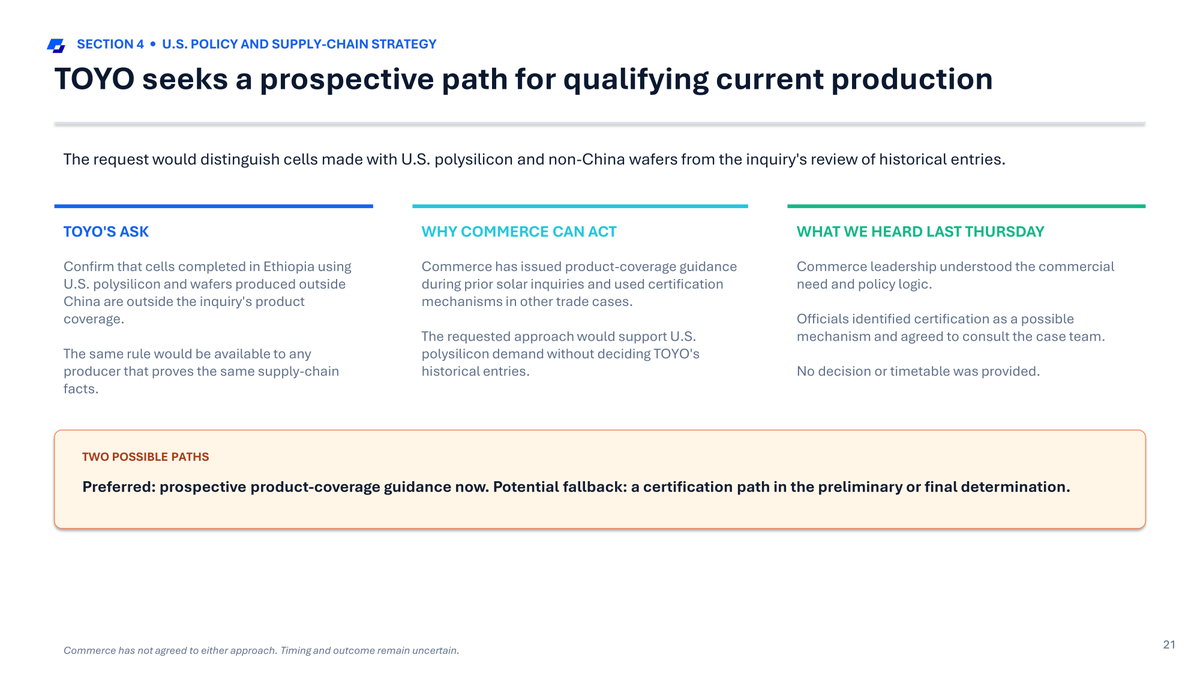
$TOYO has asked Commerce for a prospective path, which would judge its current production separately from past shipments.
$TOYO’s slide on that request reads, “Commerce has not agreed to either approach. Timing and outcome remain uncertain.”
I’m fairly comfortable with $TOYO’s current cells, since $TOYO says they use non-Chinese wafers, which Commerce left out of the China duties in its 2023 rulings.
I’m less comfortable with its 2025 shipments, since $TOYO bought $94.9M of goods from VSun China that year, and Commerce hasn’t agreed to judge them separately from current production.
Owning more than 20 stocks barely lowers your risk because every stock carries two kinds of risk. Systematic risk, the risk of the entire market falling, can't be reduced by the number of stocks you own. Unsystematic risk, which comes from the company itself, can. With all 466 S&P 500 stocks in my test, the roughly 16% that's left is almost all systematic risk.
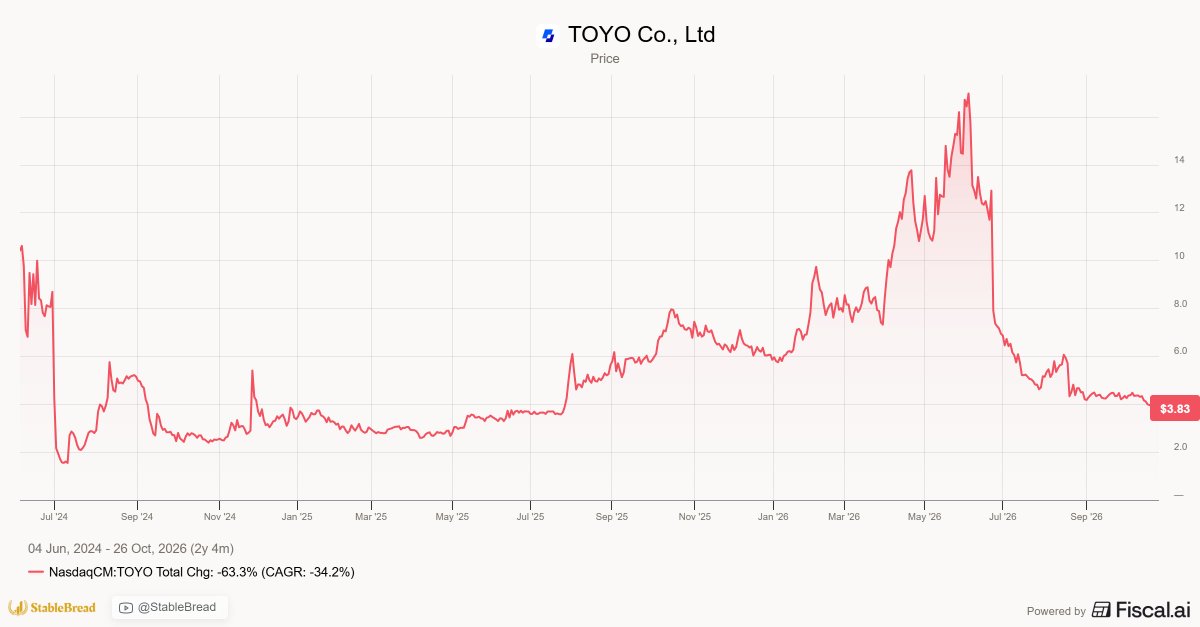
First Solar $FSLR trades at 6.7x TTM EBITDA and 10.4x TTM net income, while TOYO Co., Ltd $TOYO trades at just 0.9x and 2.0x.
At $3.83/share, $TOYO has a market cap of $163.6M and an EV of $137.2M ($163.6M + $25.7M of bank loans + $51.4M owed to VSUN, an affiliate - $103.5M of cash).
It trades at 0.9x TTM EBITDA of $156.4M, 2.0x TTM net income of $80.5M, and 0.78x its $209.8M of book value.
Since 80.7% of its H1 revenue came from U.S. end customers, $TOYO’s closest comps are four other listed solar manufacturers selling into the U.S. (TTM multiples as of the October 26 close):
→ First Solar $FSLR (U.S. thin-film panel maker): 6.7x EV/EBITDA, 10.4x P/E, 1.75x P/B, and down 47.2% from its 2026 high.
→ Canadian Solar $CSIQ (panel and battery storage maker): 18.8x EV/EBITDA, a net loss, 0.22x P/B, and down 65.2%.
→ JinkoSolar $JKS (China-based panel maker): A net loss, 0.19x P/B, and down 72.7%.
→ T1 Energy $TE (Texas panel assembler building a U.S. cell plant): Negative EBITDA, a net loss, 2.95x P/B, and down 82.4%.
So the market prices $TOYO’s earnings at 0.9x EBITDA, less than a seventh of First Solar’s 6.7x, a multiple that only makes sense if the four U.S. trade actions on its Ethiopian cells wipe out most of those earnings.
Only $TE has fallen further from its 2026 high.
I was originally going to write up T1 Energy until I found $TOYO, which offers a more attractive setup mainly because (1) it’s profitable, with $80.5M of TTM net income vs. T1’s $367.8M net loss, (2) it trades at 0.78x book vs. T1’s 2.95x, and (3) it has $26.4M of net cash vs. T1’s $629.2M of net debt.
Read the 20-F’s line on VSun China’s wafers here: https://t.co/VORm0Lw2wt
Continue reading here for what each possible Commerce ruling does to my valuation of $TOYO: https://t.co/76t1GCSzlU
Commerce’s first ruling on whether TOYO Co., Ltd’s $TOYO Ethiopian cells should pay the duties on Chinese cells is due ~December 14.
$TOYO says those cells use no Chinese wafers, but in 2025, it bought $94.9M of goods from VSun China, which its 20-F calls “a crucial supplier of monocrystalline silicon wafer.”
Circumvention is when a producer finishes its products in another country to avoid duties on goods from its home country.
On May 12, 2026, First Solar $FSLR and seven other U.S. manufacturers asked Commerce to extend the 2012 duties on Chinese solar cells to cells and modules completed in Ethiopia with Chinese parts.
Commerce opened the inquiry on July 17, and $TOYO’s deck says it’s a mandatory respondent, meaning Commerce chose $TOYO as one of the companies whose production, sourcing, and shipment records it examines directly.
Commerce targets a preliminary determination within 150 days (~December 14, 2026) and a final one within 300 days (~May 13, 2027), unless it extends the deadlines.
$TOYO’s defense rests on the line Commerce drew in 2023.
In its Southeast Asia rulings that August, Commerce applied the China duties to cells made there from wafers produced in China, plus modules that paired those cells with more than two Chinese components.
However, it didn’t count wafers made outside China as Chinese, even when they used Chinese polysilicon.
Products outside those terms could avoid the China duties through a certification process, but Commerce barred the companies it found uncooperative in those inquiries from using the certification.
Neither $TOYO nor VSUN (the Vietnamese panel maker $TOYO was carved out of) was on that list.
$TOYO’s deck says the inquiry also covers past shipments.
$TOYO bought no raw materials from VSun China in H1 2026, just $2.6M of machinery, but it did buy $7.4M of unspecified raw materials from VSUN’s Vietnamese subsidiary in Q2.
I found no filing, release, or Commerce notice that says where VSun China’s wafers were made or which $TOYO plant used them.
$TOYO has asked Commerce for a prospective path, which would judge its current production separately from past shipments.
$TOYO’s slide on that request reads, “Commerce has not agreed to either approach. Timing and outcome remain uncertain.”
I’m fairly comfortable with $TOYO’s current cells, since $TOYO says they use non-Chinese wafers, which Commerce left out of the China duties in its 2023 rulings.
I’m less comfortable with its 2025 shipments, since $TOYO bought $94.9M of goods from VSun China that year, and Commerce hasn’t agreed to judge them separately from current production.
New on SECSift: Superinvestor Stocks, the stocks 72 well-known investors report in their latest 13Fs, ranked by how many of them hold each one.
→ Top: At a 5% portfolio weight, Alphabet leads with 27 of the 72, then Amazon (18) and Visa (13).
→ Weight: Count a stock at 1%, 2%, 3%, 5% or 10% of a portfolio.
→ Change: See how many investors each stock gained or lost since the prior 13F.
→ Holders: Open a stock to see each investor's weight, share change and 13F.
→ Free here, no account needed: https://t.co/6gSvXX3I5V
From 1977 to 1990, Peter Lynch ran Fidelity's Magellan fund, and $1,000 invested in it grew to $28,000, roughly 29% per year. By 1989 it owned about 1,400 stocks, with half its money in 100 of them. For individual investors, he wrote that he'd be comfortable owning 3 to 10 stocks, and that a part-time stock picker probably only has time to follow 8 to 12 companies.
→ Full video: https://t.co/eh2Ze5lRDF
Read the 6-K’s own words on the June orders here: https://t.co/3IeIu4Wbge
Continue reading here for what Commerce’s Ethiopia inquiry could add on top of the detentions: https://t.co/76t1GCSzlU
U.S. Customs and Border Protection (CBP) detained just $13,770 of TOYO Co., Ltd’s $TOYO solar cells in May, yet by $TOYO’s own account, the review affected its Q3 and Q4 2026 earnings.
CBP enforces the Uyghur Forced Labor Prevention Act (UFLPA), which presumes that any product made even partly in China’s Xinjiang region involves forced labor, so the agency can hold solar shipments until the importer documents where its polysilicon came from.
The cells were worth little, but U.S. customers pulled back.
$TOYO’s largest customer (35% of H1 2026 revenue) placed no orders in June, Ethiopian production lines sat idle that month, and moving their costs into G&A drove most of a ~$3.4M rise in other G&A costs in Q2.
Rhone Resch, $TOYO’s Chief Strategy Officer, said on the Q2 call on August 19 that the total amount detained was “not all that significant,” and he was optimistic the detentions would be released in Q3, which ended September 30.
By October 6, 2026, when $TOYO held its Analyst Day, CBP had detained four of $TOYO’s cell shipments, though $TOYO didn’t say how many cells or dollars they carried.
Resch called the detentions “almost a normal part of the process,” and on the Q2 call, he had said CBP moves a company to an expedited path “after about four reviews or so.”
He also introduced Ana Hinojosa as part of the $TOYO team, noting she was CBP’s former Executive Director of Trade Remedy Law Enforcement.
She told analysts the company was “very optimistic that the resolution of the detentions is a day to a week away.”
I found no announcement of a release in $TOYO’s press releases or filings through October 26.
VSUN, the Vietnamese panel maker $TOYO was carved out of, has had the same problem.
Abalance, the Japanese group that controls both companies, disclosed that CBP refused entry to part of VSUN’s panels from Vietnam in January 2026, costing it ¥2,082M (~$13.3M at today’s exchange rate), and that solar products from two major overseas subsidiaries, which it didn’t name, were detained under the UFLPA.
I’m not comfortable with the detentions yet, since CBP doesn’t appear to have a deadline to decide, and June already proved that customers stop placing orders while $TOYO’s cells are under review.
On the no-equity point, $BRUN said Oct 26 it's closed more than $600M of non-dilutive project financing so far in 2026. Tho H2 alone needs ~$527-686M, so the mid-November Q3 report is the first check on whether it covers the build. And the July order plus Cohere add $160.7M/year starting 2027.
Read the 8-K on White’s firing here: https://t.co/gmoUnXnVzc
Continue reading here for how much of $QMCO’s growth now comes from tape: https://t.co/GXzV3AQBgs
I compared the 8-K on Quantum’s $QMCO CFO firing to the one on its chief accounting officer’s exit in August.
$QMCO terminated William White as CFO on October 9, 2026, effective immediately, eight months after appointing him on February 2, 2026.
When I first wrote up $QMCO on May 6, White was its newly appointed CFO, after the seat had been empty since August 2025.
The 8-K gives no reason, and I found no press release about the firing on $QMCO’s investor relations site.
Instead, the 8-K says $QMCO expects to file its September-quarter 10-Q on time.
The filing also says $QMCO expects to meet or exceed its guidance for the quarter, even though it was still “early in its financial closing process.”
Chief accounting officer Hiral Patel took over as principal financial officer, so she now signs off on $QMCO’s financial statements with the CEO.
Patel only joined $QMCO on September 1, after the company decided on August 11 to replace Laura Nash as chief accounting officer.
The 8-K on Nash says there are “no disagreements” between her and the company, but the one on White doesn’t say either way.
So within two months, $QMCO replaced both of its top finance officers.
$QMCO’s June-quarter 10-Q still reports material weaknesses (the most serious kind of gap in a company’s financial reporting controls) in revenue recognition, inventory, and income taxes.
It also says $QMCO “lacked sufficiently qualified staff or resources to perform control activities.”
None of the weaknesses has led to a material misstatement, but $QMCO has restated its financial statements before, in May 2024 and again in August 2025.
In my May 6 write-up, I listed restatements as a risk that could break the story, and wrote that a third “would be a serious credibility hit.”
$QMCO expected to fix one of its three revenue weaknesses, the schedules that set when service revenue is recognized, by the end of the September quarter.
Its June-quarter 10-Q was also officially filed on August 11, a day after its 40-day deadline, and its FY2026 10-K needed a notice of late filing in June.
So with open material weaknesses, a history of restatements, and a 10-Q filed a day late in August, I’d rather see the September-quarter 10-Q, due November 9, before taking $QMCO at its word.
35% of TOYO Co., Ltd’s $TOYO H1 2026 revenue came from one customer it doesn’t name, and 22% came from companies under its own controlling shareholder.
$TOYO manufactures solar cells, the processed silicon wafers that turn sunlight into electricity, and assembles some of them into panels (modules).
Its cells use TOPCon (tunnel oxide passivated contact), a common high-efficiency silicon cell design.
$TOYO runs three factories:
1) Ethiopia (4 GW of cells): Started production in April 2025, six months after $TOYO announced the plant, added a second 2 GW line in August, and reached its 4 GW nameplate in October 2025.
2) Vietnam (2 GW of cells): Running since H2 2023, but its cells now go to non-U.S. markets like India and Taiwan, since the U.S. Commerce Department set anti-dumping and countervailing duties (taxes on imports sold below cost or subsidized) on Vietnamese cells in April 2025.
3) Texas (2 GW of modules): A leased 567,140-square-foot plant near Houston that started its first 1 GW line in October 2025 and had completed its second by early October 2026. It assembles panels from $TOYO’s Ethiopian cells.
VSUN (Vietnam Sunergy JSC) is the Vietnamese panel maker $TOYO was carved out of, and both companies sit under the same majority shareholder, Abalance, a Japanese solar group.
VSUN is still $TOYO’s lender, owed $51.4M including interest, and a past wafer supplier through its Chinese subsidiary.
$TOYO’s $261.0M of H1 2026 revenue came from four lines:
→ Third-party cells (56.5%): $147.6M of cells sold to outside module makers.
→ Related-party sales (22.0%): $57.5M of cells and modules sold to VSUN and its affiliates.
→ OEM services (14.2%): $37.2M of fees for cells made under one customer’s name, which $TOYO books net, counting only its fee as revenue.
→ Third-party modules (7.2%): $18.7M of Texas-made panels.
Upstream, 70% of the polysilicon (the refined silicon that wafers are cut from) in $TOYO’s Ethiopian cells comes from a U.S. producer and the rest from OCI’s plant in Malaysia, Rhone Resch, $TOYO’s Chief Strategy Officer, said on the Q2 call.
Resch also said its 2026 wafers come from non-China production, “including a designated facility in Indonesia.”
$TOYO markets its supply chain as “non-FEOC,” free of any foreign entity of concern.
U.S. buyers care, since the One Big Beautiful Bill Act (OBBBA) denies the main clean-power tax credit to projects with too much equipment from Prohibited Foreign Entities, a label aimed at Chinese suppliers.