Twelve tokens, one subject, nothing redrawn.
The clip is the whole path in one take. Lock a rigged mesh, set the weights and the forbidden pairs, watch the observed rarity settle against the numbers you declared, then stamp the set.
What lands is a ZIP: the images, ERC-721 metadata carrying an image hash per token, and a manifest holding the seed, the subject hash and the trait table. Hand that ZIP to anyone and the Verify page re-derives it without trusting us.
All of it renders in your browser. Nothing leaves the machine until you publish. Publishing to Robinhood Chain is what we are building next. $STAMP
0xc7874e2534f9fd4321226eb104b0f87745373db0
Every collection has a page now, and it argues for itself.
Until today a creator who finished publishing had nothing of their own to hand anybody. The only link available was a marketplace listing, which is somebody else's page and says nothing about whether the collection is what it claims to be.
Now each one has its own address: the seed, both subject hashes, the supply, the contract, and the result of checking all of it. The check has already run by the time the page loads, so a reader sees the verdict without pressing anything.
The link carries it too. Paste it into a chat and the preview card shows the collection, what was minted, and whether it holds up. Most people who see a link never click it. They should still get the part that matters.
https://t.co/4iyGKYUP0B $STAMP
Good instinct, and half right. People do share what features them.
But we will not mint anyone's name and tag them without asking. That is on chain forever, and for a project built on being checkable it is the wrong first impression to make on someone with an audience.
The version we like: they publish their own collection, on their own wallet. The contract is theirs, the page is theirs, and the link they share carries the proof with it. Anyone you think would enjoy that, send them our way.
Standard pipeline: decide the traits, write them into JSON, ask a model for a picture, hope the picture contains them.
Stampad pipeline: decide the traits, configure the scene, render, then read the scene back and write down what was actually there.
The build asserts the readback against the intended combination and aborts on any mismatch. A collection cannot be published with a trait table that disagrees with its own art, because the build fails before the files are ever pinned. $STAMP
https://t.co/c1krjwP86q
A rig exposes slots. A slot is a named bone that parts attach to, so a hat follows the head and a cape follows the spine, exactly, every frame.
head takes hats, helms, crowns, horns, halos. hand.L and hand.R take tools, banners, lanterns. back takes capes, packs, wings. face takes visors and masks.
A palette repaints the shared materials, shell, accent, visor, metal, trim. It changes colour and nothing else, no vertex moves. A backdrop sets the world behind the shot.
Every one of those is a trait category. Every trait is a thing that exists in the scene, not an adjective in a sentence.
Them: the subject is a sentence pasted in front of every prompt, the model redraws the character from zero on every image, and a 40 to 60 percent reject rate is treated as normal.
Us: the subject is a rigged mesh that gets photographed, never regenerated. Parts are swapped on the same geometry. Reject rate is structurally zero, because there is nothing that can drift.
Same output format on the surface. Completely different physics underneath. $STAMP
Check any collection. Own none of it.
Say someone offers you a token from a collection you have never heard of, and tells you the twelve characters were drawn at random from a seed, with nothing held back and nothing swapped in their own favour.
Until today you had no way to test that sentence. Our verifier existed, but it wanted the creator's archive, and the only person holding that archive is the person you are trying to check.
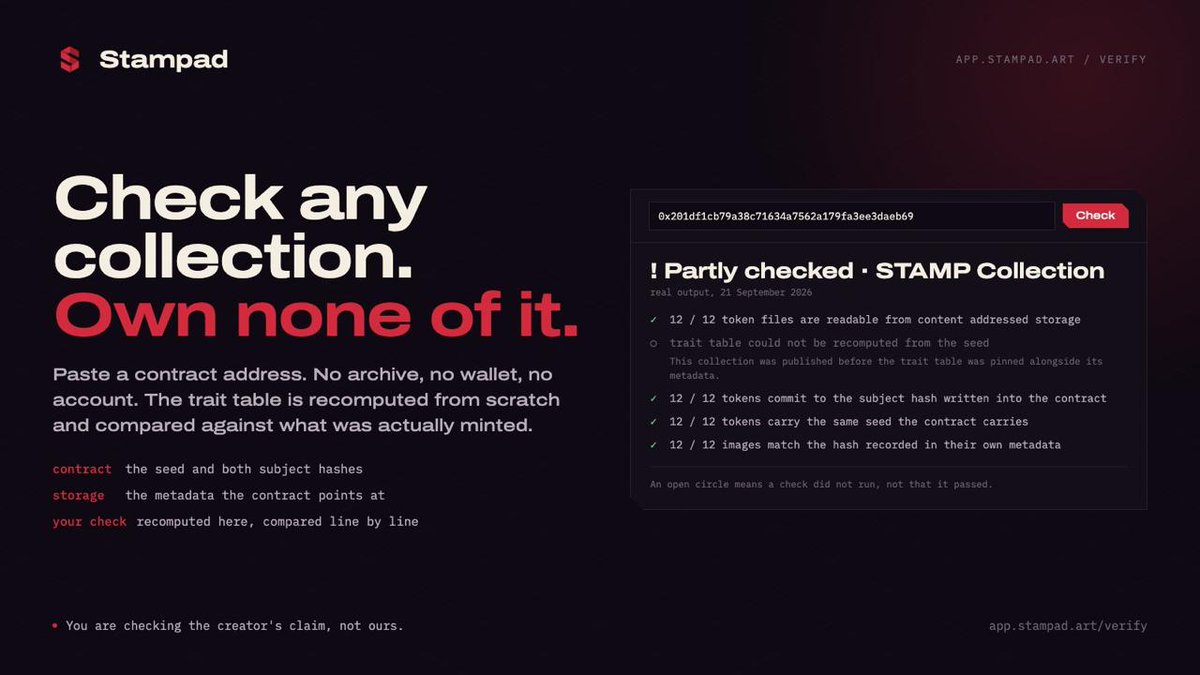
Now you paste the contract address. The seed and both subject hashes are read from the contract, the metadata from the storage the contract points at, and the trait table is recomputed from that seed and compared against what was actually minted. If a creator moved one token so the rare one landed in their own wallet, the recomputation disagrees and you see exactly which token.
No archive, no wallet, no account. You are checking the creator's claim, not ours.
https://t.co/pkqSBvi7gr
0xc7874e2534f9fd4321226eb104b0f87745373db0
Every collection, with its proof.
There is a new page in the studio listing every collection ever published through Stampad. Not a feed and not a ranking, just the record.
Each card carries what the contract itself holds: the collection seed, both subject hashes, the creator's address, and how many of the declared supply have actually been minted. That is enough for a stranger to recompute the entire trait table from the seed and check it against what exists on chain, without asking us for anything and without owning the archive.
The contract belongs to the creator, not to us. The page just reads the chain and shows you what is already there.
https://t.co/4iyGKYUP0B
$STAMP
Publishing is open.
Build a collection in the studio, press publish once, and it goes on chain. The art is pinned to content addressed storage, an ERC-721 is deployed to your wallet, the source is verified, and the tokens are minted. Four steps, one flow, one tab.
Here is a collection published exactly that way, with nothing finished by hand afterwards:
https://t.co/pvSXZhgl22
The contract belongs to the creator, not to us. The collection seed and both subject hashes are written into it permanently, so anyone can recompute the whole trait table from the seed and check it against what was actually minted. That is the part the category usually asks you to take on faith. $STAMP
https://t.co/CwxcxvDEUM
A studio that asks you to trust it is not much of an improvement on the one you left.
Every export leaves as a plain ZIP on your own disk: the images, ERC-721 metadata carrying a hash of each image, and a manifest with the seed, the subject hash and the trait table. Hand that file to a stranger and the verifier rebuilds the table from the seed and re-hashes every image in it.
The exported file comes back 12 of 12 verified. The same file with one attribute edited by hand comes back 11 of 12, and it names the token that changed. The check needs no account, no server of ours, and not even the studio that made the file. $STAMP
Stampad is live.
This is the whole thing in one take. Connect a wallet, pick the locked subject, set the trait table, stamp the set, publish. Nothing is cut and nothing is sped up past the part where you would actually be waiting.
What happens when you press publish: the archive is checked again on our side before anything is stored, the collection contract is deployed by your own wallet, its source is published so it can be read rather than trusted, and the tokens are minted to you.
You pay the publish fee and your own gas. You own the contract that comes out. We never hold your money and never sign anything on your behalf. $STAMP
https://t.co/CwxcxvD75e
This is where collection metadata usually starts lying. The JSON says Head: Crown because the prompt said crown, not because a crown was ever drawn.
Stampad writes the metadata after the render, by reading the scene back off the thing that was actually photographed. The intended combination and the readback are compared token by token, and one mismatch stops the batch before a single file is written.
Last live export: 12 of 12 readbacks. A rarity table cannot disagree with its own art when the art is where the table comes from. $STAMP
Most rarity tables are a promise. You type the percentages in, the generator does something close to them, and nobody ever checks the gap.
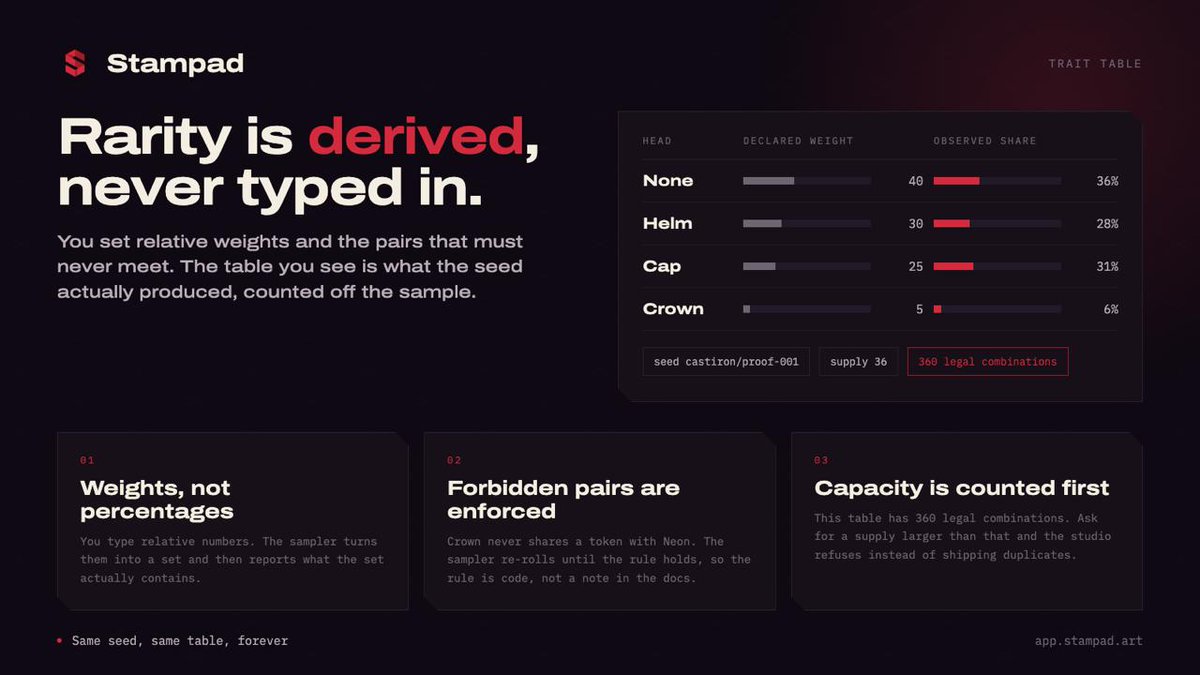
In the studio you set relative weights and the pairs that must never meet. The table you read back is counted off the sample the seed actually produced, sitting next to what you declared, so the gap is on screen instead of hidden.
Two things that are code rather than documentation. Crown never shares a token with Neon, and the sampler re-rolls until that holds. And the legal combinations are counted before you pick a supply, so asking for more tokens than the table can produce fails loudly instead of shipping duplicates. $STAMP
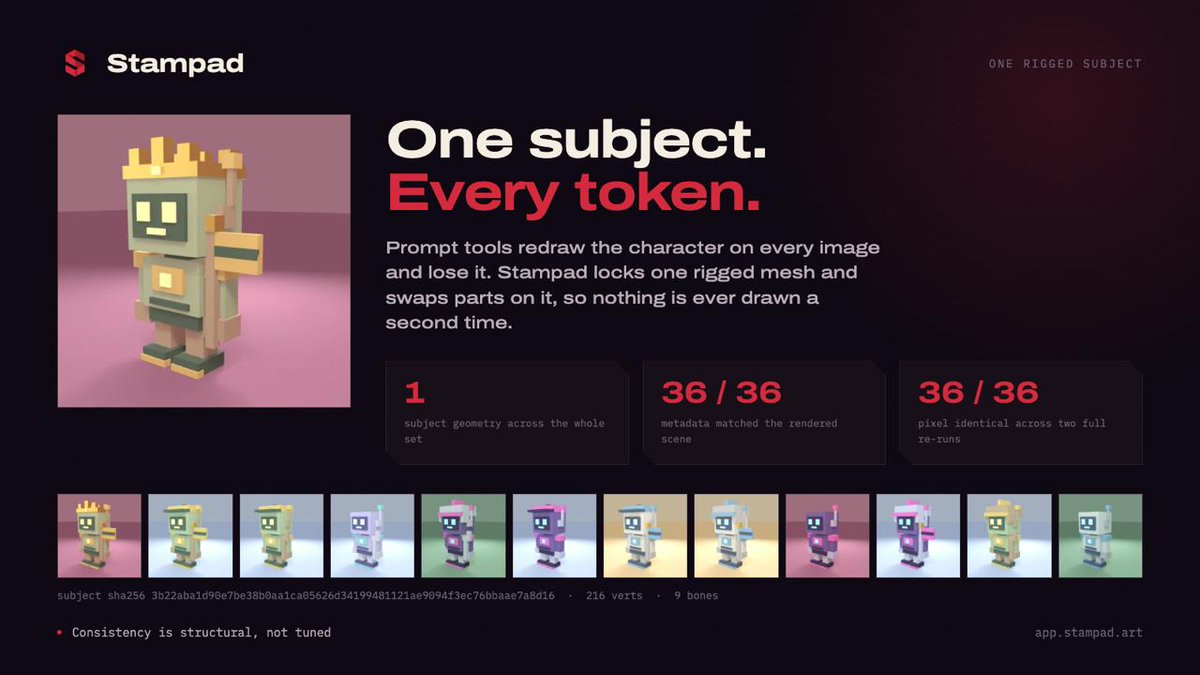
Every AI collection tool fails the same quiet way. You describe your character, the model draws it, and the next render draws a different one wearing the same sentence.
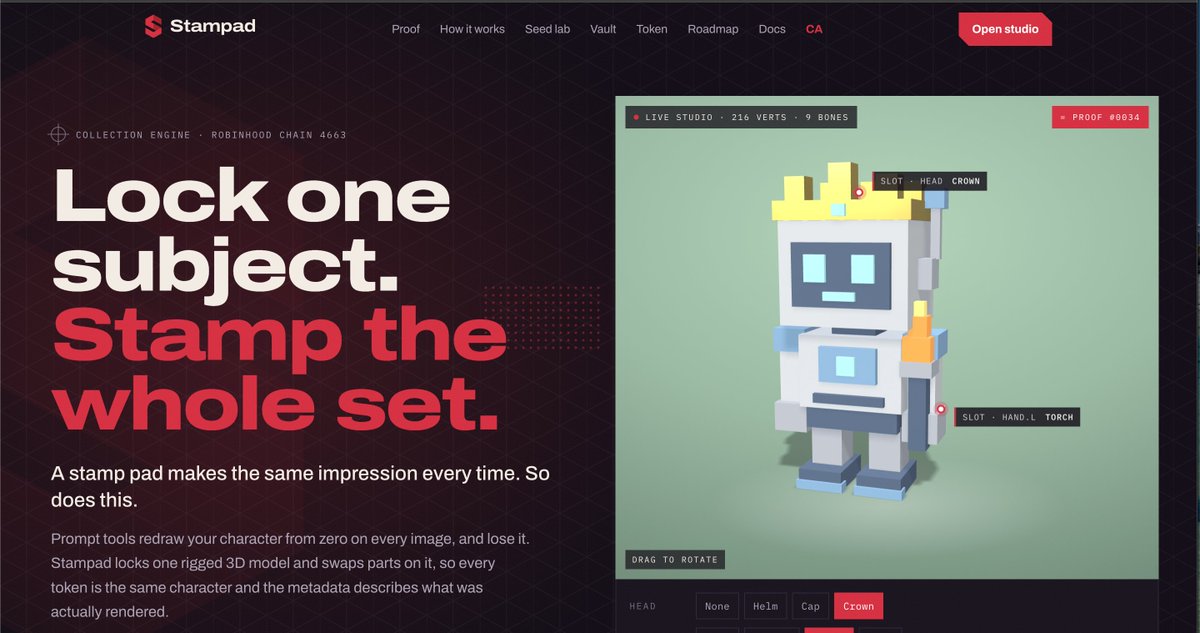
Stampad stops regenerating and starts photographing. One rigged mesh gets locked, parts get swapped on it, the camera fires. Nothing is redrawn, so there is nothing that can drift.
Measured before any of this was posted: 36 tokens, 1 subject geometry across all of them, 36 of 36 whose metadata matched the scene that produced them, and 36 of 36 pixel identical across two full re-runs. $STAMP
Dev just sent 3.3% of $Stamp to the furnace.
33,000,000 tokens burned on Robinhood Chain.
No pre-mine. No team dump.
https://t.co/JvnuLU5UBn
https://t.co/aaCOR9KdZc
We don’t ask for trust. Check the numbers on-chain.
Dev buyback + burn: 0.8% of supply.
Not a promise, A transaction.
Bought off the market, Sent to burn. 0.8% gone.
Chart gets thinner. Circulating supply just took a hit.
tx: https://t.co/aaCOR9KdZc
0xc7874e2534f9fd4321226eb104b0f87745373db0