Before the Senate votes on the ASIO Bill, we want to hear from you.
After weeks of public discussion, expert analysis and growing scrutiny of these proposed powers, the legislation is now approaching a crucial stage.
How do you think Senators will vote?
🟩 A. All Labor Senators will follow party lines and support the bill.
🟩 B. Liberal Senators will broadly support the bill, with a few exceptions.
🟩 C. One Nation will support the bill.
🟩 D. Unsure.
Cast your vote in the comments and tell us why.
The Senate vote could have significant implications for the future of ASIO’s questioning powers and the balance between national security and civil liberties.
👇 Let us know your prediction. Will the bill pass, and who will support it? #AllEyesOnASIO #StandUpNowAustralia #ASIOBill #AustralianPolitics #SenateVote
A few months ago, making ASIO’s compulsory questioning powers permanent seemed like a foregone conclusion.
Now, the Government has reportedly backed away from that proposal.
Why?
Because people paid attention.
Australians spoke up.
Legal experts raised concerns.
Civil liberties groups scrutinised the legislation.
Members of Parliament questioned the changes.
🔉 And the Government listened.
‼️ This is exactly why public engagement matters.
The proposed legislation is still before Parliament, and important questions remain about the expansion of these powers and where the limits should be drawn.
But this development is a reminder that informed Australians can influence the conversation.
The debate is not over.
Join us this week for our final webinar in this series, where Andrew Wilkie MP and Michael Arbon will unpack the Bill, the latest changes, and what they could mean for Australians.
📅 Thursday 18 June, 6pm AEST
Secret powers deserve public scrutiny.
Register via the link in bio.
https://t.co/ZmphiFLAxG
When ASIO's questioning powers were first introduced after 9/11, they were justified as extraordinary measures for extraordinary times.
But in 2020, those powers were expanded beyond terrorism to cover ASIO's broader security functions, including espionage, foreign interference, sabotage and politically motivated violence.
These threats are serious.
They are also not new.
Australia has dealt with spies, foreign influence operations and national security threats throughout its history.
So before Parliament grants even more extraordinary powers, shouldn't Australians ask whether the case has actually been made?
Robert Barwick explains why the debate is bigger than terrorism.
To learn more about the proposed ASIO amendments and the expansion of intelligence powers, join our second and final webinar in this series as we unpack what is being proposed and why it matters.
Register here:
https://t.co/ZmphiFLAxG
People subject to questioning can face secrecy restrictions about what happened — while lawyers may have limited ability to intervene, and in some cases be removed.
Secrecy can protect investigations. But secrecy also hides mistakes.
Rights are strongest when tested in difficult moments, not easy ones.
If someone cannot freely speak about the process, and counsel is constrained, who ensures fairness?
Democracy depends not only on power — but on accountability.
Temporary powers should not become permanent.
Reject the ASIO Amendment Bill.
Contact your Senator now:
https://t.co/M6aiflTTWK
Link in bio.
Australia’s intelligence laws are changing — and Australians deserve to understand what is being proposed, what powers are at stake, and where the limits should be.
Join Michael Arbon and Andrew Wilkie MP for the second and final webinar in this series.
18 June · 6pm AEST
Register via link in our bio.
https://t.co/ZmphiFLAxG
Questioning warrants are approved by the Attorney-General, not an independent court judge.
Courts exist to test evidence, limit overreach, and stand apart from politics. Ministers are part of government.
When the same branch seeking powers also approves them, checks and balances weaken.
If the power is extraordinary, shouldn’t the scrutiny be too?
If you value scrutiny, now is the time to speak.
Reject the ASIO Amendment Bill.
Email your Senators today:
https://t.co/M6aiflTTWK
Link in bio.
One of the proposed amendments introduces additional reporting requirements when ASIO uses a compulsory questioning warrant.
Sounds like stronger oversight.
But who receives that reporting?
The Attorney-General — the same office responsible for approving the warrant in the first place.
Is that truly independent oversight, or simply reporting back to the person who authorised the process?
And remember, these warrants aren’t limited to people suspected of committing crimes.
They can be used against people who may simply possess information considered relevant to a security investigation.
Michael Arbon examines what accountability really means when extraordinary powers are involved.
This is one of the many issues we’ll be discussing in our second and final webinar in this series.
If you haven’t joined us yet, this is your last opportunity to hear from our expert panel as we unpack the proposed ASIO amendments, the expansion of intelligence powers, and the accountability questions that deserve public scrutiny.
Register here:
https://t.co/ZmphiFLAxG
Australia's worst terrorist attack in recent history was carried out by a man already known to ASIO.
Yet instead of asking hard questions about what went wrong, Parliament is preparing to give ASIO even more extraordinary powers.
Why isn't anyone talking about the intelligence failure?
Why aren't we examining whether existing powers were used effectively before expanding them further?
If agencies fail to act on information they already have, does giving them additional questioning powers actually make Australians safer?
Robbie Barwick joins us to discuss the questions few politicians seem willing to ask.
Want to understand the proposed ASIO amendments and what they could mean for Australians?
Join our second and final webinar in this series as we unpack the powers being debated, the implications for civil liberties, and why public scrutiny matters.
Register here:
https://t.co/ZmphiFLAxG
Did you know some foreign investors can access tax treatment that isn’t available to ordinary Australians?
While Australians face increasing taxes, compliance obligations and cost-of-living pressures, some foreign investors can avoid Australian capital gains tax on certain investments altogether.
Why does it sometimes feel like attracting foreign capital is a higher priority than rewarding Australians who live, work, save and invest here?
🔉 Dave Hughes, keeping the community informed.
@dhughesy
Under current proposals, compulsory questioning powers can still apply to children as young as 14.
That means teenagers may face intelligence questioning powers designed for national security investigations.
Even if intended for rare cases, laws are judged not only by intent — but by what they allow.
Should a democratic country normalise coercive powers over minors?
Australia deserves freedom with accountability.
Reject the ASIO Amendment Bill.
Tell your Senator today:
https://t.co/M6aiflTTWK
Link in bio.
If the laws were designed to solve the problem, why is stronger enforcement now needed? And was enough time spent getting the framework right before it was passed?
Australia's under-16 social media ban was introduced to keep children off major platforms.
Now, the eSafety Commissioner says regulators are moving into an "enforcement stance", with investigations underway into several major social media companies over compliance concerns.
For many Australians, the concern has never just been the ban itself.
It's what comes next.
If children are still finding ways around the restrictions, will the answer be more enforcement, stronger age verification requirements and greater pressure on Australians to hand over personal information just to access online platforms?
Perhaps this is the lesson whenever major laws move through Parliament too quickly.
The unanswered questions don't disappear.
They simply reappear later during implementation, compliance and enforcement.
The debate may have started with protecting children online.
It is now shifting toward enforcement.
Article:
https://t.co/QlyhiBclqX
📣 SPEAKER PROFILE: Andrew Wilkie MP brings a rare perspective to this conversation.
Before entering Parliament, he served as an Australian Army officer and later worked as an intelligence analyst with the Office of National Assessments. In 2003, he resigned over concerns about the intelligence being used to justify the Iraq War.
Since entering Federal Parliament, he has been a strong voice for transparency, accountability and democratic oversight.
On 18 June at 6pm AEST, Andrew Wilkie joins us for the second and final webinar in this series as we examine government power, national security laws and why public scrutiny matters.
🔗 https://t.co/ZmphiFLAxG
The Federal Government has attempted to prevent cabinet documents relating to counter-terrorism funding from being publicly released during the Bondi Royal Commission.
The Government says it is simply following normal cabinet confidentiality procedures.
Critics argue Australians deserve transparency when a Royal Commission is examining whether counter-terrorism resources were reduced before one of the country’s worst terror attacks.
Adding another twist, Commissioner Virginia Bell has now rejected the Government’s attempt to keep key documents from the inquiry, ruling they are important for assessing counter-terrorism resourcing and decision-making in the lead-up to the Bondi attack.
As governments continue expanding intelligence powers, surveillance capabilities and national security legislation, transparency and accountability become more important than ever.
👁️ ALL EYES ON ASIO
Our upcoming webinar, The Intelligence State: What Are The Limits?, will unpack the growing powers being granted to intelligence agencies, what recent legislative changes mean for everyday Australians, and where the balance should sit between national security, privacy, oversight and civil liberties.
Whether you support these powers or have concerns about them, understanding how they are changing is becoming increasingly important.
🎟️ Register here:
https://t.co/ZmphiFLAxG
Original article:
https://t.co/wZG85yFFWQ
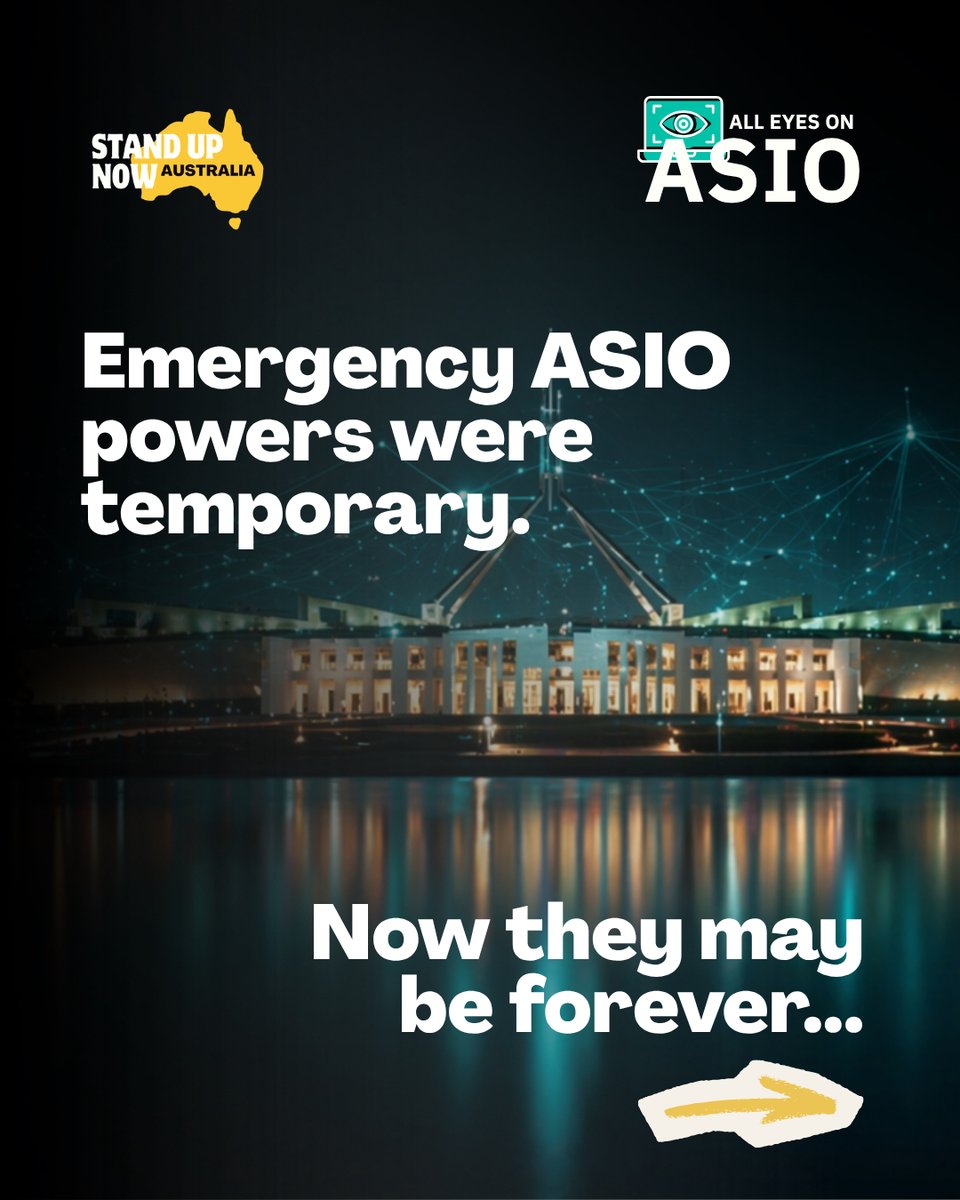
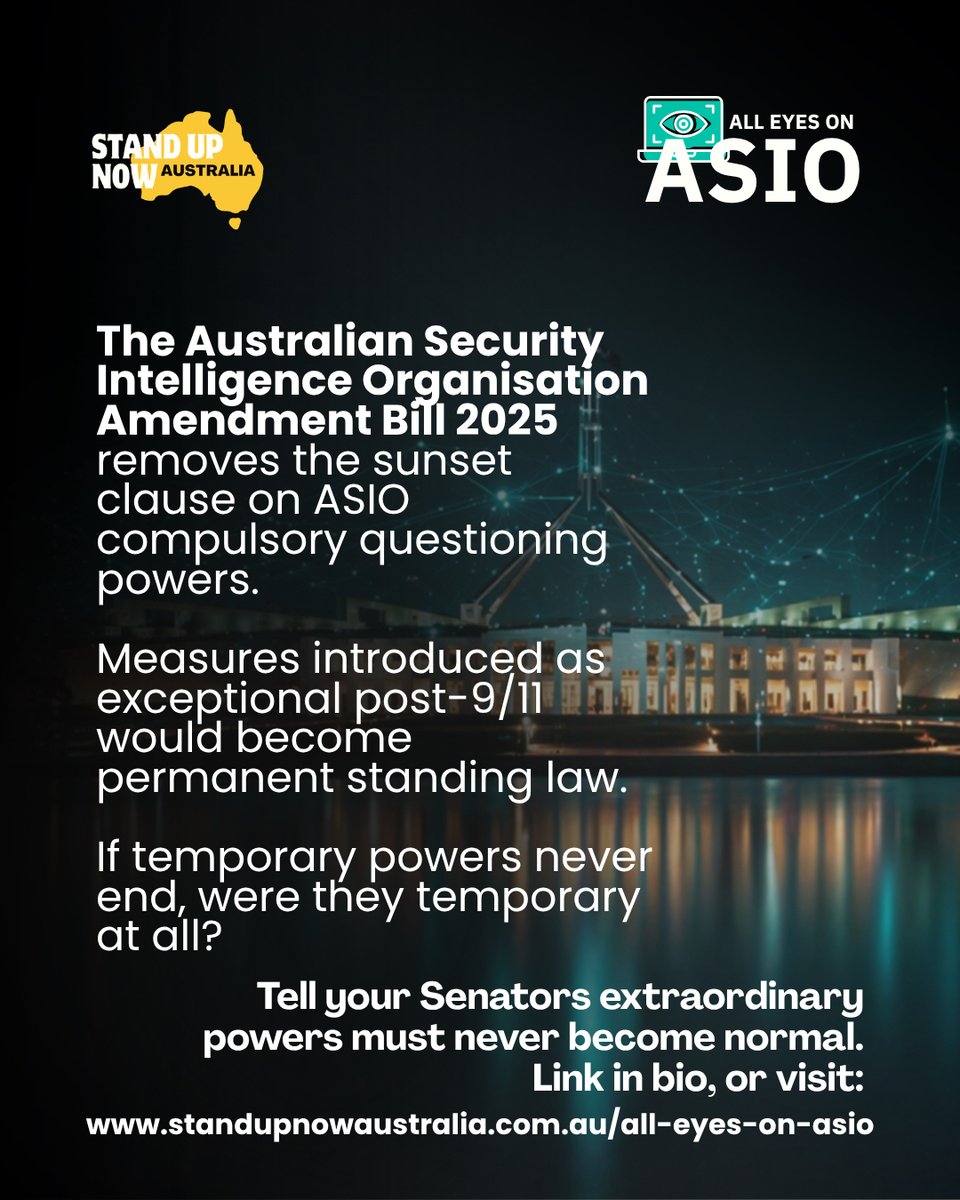
Some of Australia’s strongest intelligence powers were introduced after 9/11 as temporary emergency measures.
Now Parliament is considering making them permanent by removing the sunset clause.
History shows emergency powers are easiest to introduce during fear — and hardest to remove afterward.
When “temporary” lasts forever, was it ever temporary at all?
Australians should decide whether crisis-era laws belong in peacetime permanently.
If you value liberty, now is the time to speak.
Reject the ASIO Amendment Bill.
Email your Senator today:
https://t.co/M6aiflTTWK
Link in bio.
The Prime Minister’s salary has increased by approximately $57,000 a year since 2022.
Not the total salary.
The increase.
Australia’s national minimum wage is approximately $52,000 a year.
That means the Prime Minister’s cumulative pay rise alone is now larger than the annual income of Australia’s lowest-paid full-time workers.
The PM now earns around $622,000 per year.
Meanwhile, households continue to grapple with rising rents, mortgages, power bills, insurance premiums and grocery costs.
What do you think?
One of the more interesting reactions to this year’s Federal Budget didn’t come from the Opposition.
It came from NSW Labor Premier Chris Minns.
Minns has publicly raised concerns about bracket creep and the growing tax burden on working Australians, arguing that teachers, nurses, paramedics and other workers are seeing pay rises increasingly swallowed up by the tax system. He said more needs to be done to put money back into the pockets of working families.
Why does this matter?
Because Chris Minns is not a conservative commentator or an Opposition politician.
He’s a Labor Premier.
When concerns about affordability, tax pressure and the long-term sustainability of these policies are being raised from within Labor’s own ranks, it’s a sign that the debate is much broader than party politics.
If concerns about economic pressure, bracket creep and cost of living are now being voiced from within Labor itself, Australians have every right to pay attention.
Article:
https://t.co/ztuKOjhl3I
Paul Keating’s famous “banana republic” warning is one of the most quoted economic warnings in Australian history.
In 1986, Keating warned Australia could not ignore deficits, productivity, competitiveness and long-term economic sustainability without consequences.
Fast forward to 2026 and Keating is supporting key elements of Labor’s proposed tax reforms.
That leaves Australians with an interesting question.
Should we focus on what Keating supports today?
Or should we focus on the economic principles he spent years warning the country about?
Because regardless of where you stand politically, concerns around productivity, government spending, competitiveness and long-term fiscal sustainability remain at the centre of the Budget debate.
What would 1986 Keating say?
Original article:
https://t.co/GNs3ROQl14
Join our mailing list & community:
https://t.co/LLuQKcfeL7
Our second and final webinar in this series is happening on 18 June at 6pm AEST.
As debate continues around expanding intelligence and surveillance powers, many Australians are asking an important question:
Where should the limits be?
Join us for an important discussion exploring the balance between national security, democratic accountability and individual freedoms. We’ll unpack the powers currently being proposed, what they could mean in practice, and why oversight matters.
We’re pleased to be joined by Andrew Wilkie MP, Independent Member for Clark, former intelligence analyst and long-time advocate for transparency, accountability and civil liberties.
If you want to better understand the laws being proposed and the implications they may have for everyday Australians, this is a conversation you won’t want to miss.
📅 Wednesday 18 June | 6pm AEST
🔒 Extraordinary powers require extraordinary scrutiny.
Register via the link in bio 👆🏻
https://t.co/ZmphiFLAxG