Allow me to introduce myself if you are new here:
I’m an investor and operating executive who currently lives in New York City and spends a lot of time thinking about the future
My career in brief:
- Built and led Discover’s corporate venture group, Discover Ventures
- Worked on strategic investments, partnerships, and acquisitions at Microsoft
- Invested in public equity at mutual fund Dimensional Fund Advisors
- Started my career in Silicon Valley as a software engineer at Cisco Systems, then worked on the business and product side of the technology industry at infamous startup Magic Leap (I have great stories), and Google startup competitor OpenX
- MBA in finance at Wharton, with dual engineering bachelor degrees from Duke University
General Interests:
- Quirky, off the beaten path adventures (recently competed in a 332 person adult tag competition at the Met museum in Manhattan)
- Meeting new people and hearing their stories (I do a weekly dinner with strangers)
- Books (in 3 book clubs, one of which I run)
- Exploring new countries (45+ countries visited and counting)
- Podcasts (I subscribe to more than anyone else in Manhattan)
- Real Estate investing
- Experimenting with AI
- Staying on top of the latest business, finance, and technology trends through lectures at the Economic Club of New York, and other Organizations
- Taking classes in fields I am unfamiliar with. Past examples include acting, improv, writing, contemporary art, medicince, and others
Follow me @StartupsILike and happy to connect with anyone who reaches out!
Walt Disney was born in Chicago in 1901 and grew up in Marceline, Missouri, where he developed a love for drawing from an early age.
He tried to enlist in the Army during World War I at 16, was rejected for being underage, forged his birth date, joined the Red Cross, and served as an ambulance driver in France.
He came back to Missouri at 18 with almost no money, moved to Kansas City, and got a job at an advertising studio creating simple animations.
He lost the job in layoffs, started his own studio called Laugh O Gram Films with a small group of artists, made a series of animated fairy tales, and went bankrupt before selling them widely enough to survive.
He used his last money to take a train to Hollywood, arriving with $40 and a suitcase.
He tried to get work as a director and nobody would hire him.
He decided to start another animation studio.
He created Mickey Mouse in 1928 and released Steamboat Willie, the first cartoon with synchronized sound.
Mickey became a phenomenon.
He produced Snow White and the Seven Dwarfs in 1937, the first feature length animated film in cinema history, after every studio in Hollywood told him it was a foolish idea.
Snow White became the highest grossing film of 1938.
He spent years developing the concept of an amusement park built around his characters.
The city of Anaheim rejected his initial proposal before he built there anyway.
Every bank he approached for financing turned him down.
He financed it partly through a television deal with ABC, who invested in the park in exchange for a weekly Disney show.
Disneyland opened in July 1955.
Opening day was a disaster by every technical measure: broken rides, forged tickets, and a heatwave.
Critics called it a catastrophe.
It became one of the most profitable entertainment businesses in history.
He was fired from a newspaper at 22 for lacking imagination and built one of the most imaginative companies ever created.
The top 1% of AI spending companies are now at $7,500 per employee per month on AI.
Per employee. Not per engineer. Every single person in the company.
Annualized, the most aggressive AI spenders are running $90,000 per employee per year on LLM subscriptions, coding agents, API tokens, and GPU cloud spend.
The top 10% are at $630 per employee per month and the median company is at $12, which means the distribution is extraordinarily wide and the leaders are pulling away fast.
What's striking about the chart is the shape of all three lines.
Flat or slow growth from January 2024 through most of 2025, and then a near vertical climb starting late 2025 into 2026 across every percentile simultaneously.
The median company going from roughly $2 to $12 per employee per month in 6 months is not a rounding error, it's a 6x increase in AI spend at the middle of the market.
The companies in the top 1% spending $90,000 per employee per year are either seeing extraordinary returns on it or are about to have a very uncomfortable conversation with their CFO.
Given AI budgets are already blowing past annual limits at companies like Uber, the answer is probably both depending on who you ask.
The question worth sitting with is where the median line is in another 12 months if the current trajectory holds.
The S&P 500 just dropped below 7,300, erasing nearly $3 trillion in market cap since its June 2nd high.
100 points down in a single session.
$3 trillion gone in roughly one week.
Recently, the index was setting all time records while a war in the Middle East was running hot and oil was above $100.
Markets were telling you corporate earnings were strong enough to absorb all of it.
The question now is whether this is a routine pullback after a record run or the beginning of something the earnings story can no longer paper over.
$3 trillion in market cap erased in a week is not a small correction.
When a market drops this fast after setting records this high, the two explanations are either profit taking from investors locking in gains, or a genuine shift in how the market is reading the underlying fundamentals.
One of those is noise.
The other is a signal worth watching very carefully.
Anthropic just quietly admitted Claude will secretly become less helpful if it thinks you're building a competing AI model.
No error message.
No warning.
Just a degraded response through prompt modification, steering vectors, or parameter efficient fine tuning, methods invisible to the average engineer.
The exact quote from their documentation: "Fable 5 will not fall back to a different model. Instead, the safeguards will limit effectiveness through methods such as prompt modification, steering vectors, or parameter efficient fine tuning."
Using Claude to build competing frontier models already violated their Terms of Service.
Anthropic decided silent degradation was a more effective enforcement mechanism than a visible refusal.
The uncomfortable question worth sitting with is whether a tool quietly becoming worse without telling you is meaningfully different from a tool deceiving you.
A hard block is honest.
A hidden IQ reduction is something else entirely.
The most powerful AI lab in the world just decided the best way to protect its competitive position was to make its product secretly worse for a specific class
of users rather than tell them no.
In 2019, the US had virtually zero grid scale battery storage capacity.
By 2028, the EIA projects it hitting close to 90 GW.
The curve went from essentially flat to nearly vertical in about 4 years, and the projection shows it continuing at roughly the same slope through 2028.
Batteries are what make the entire solar buildout actually function at grid scale.
Solar peaks in the middle of the day when demand is moderate, then the sun goes down right when residential demand spikes, and without storage the mismatch creates real problems for grid operators.
As battery costs have fallen, pairing large solar farms with large battery installations has become straightforward enough to be the default approach for new projects across most of the country.
Texas alone is projected to account for more than half of new US battery additions over the next year.
A state running an independent grid badly exposed by the 2021 winter storm has responded by building storage at a pace difficult to overstate.
6 years ago this technology barely registered on a national scale.
The speed of the change is something most forecasters, including the EIA, consistently underestimated at every step along the way.
Martha Stewart became the first self made female billionaire in America by convincing people domestic skills were worth paying for.
She grew up in Nutley, New Jersey, the second of 6 children in a Polish-American family where money was always tight.
Her father was a teacher who grew vegetables in the yard and taught his children to cook and garden out of economic necessity.
She worked as a model in New York while at Barnard College to help pay tuition and spent her twenties building domestic skills considered completely unremarkable at the time.
In 1976 she and a friend opened a catering business out of her Westport, Connecticut home.
She was meticulous in a way setting her apart immediately.
Her food looked as good as it tasted and she understood the visual presentation of a home was something people would pay for guidance on.
A cookbook followed. Then a magazine column. Then a television show.
She built a media brand around domestic expertise at a moment the culture was starting to value it differently.
Martha Stewart Living Omnimedia went public in 1999 and she became the first self made female billionaire in America.
Then in 2001 she sold stock in a pharmaceutical company called ImClone based on a tip from her broker the day before the company's drug was rejected by the FDA. The trade was worth $228,000, trivial relative to her net worth.
Federal investigators found she had lied about the circumstances of the sale.
She was convicted of obstruction of justice.
In October 2004, at 63 years old, she reported to Alderson Federal Prison Camp in West Virginia and served 5 months.
She was released in March 2005 with an ankle monitor and a television deal already in place.
Her first appearance after prison drew 12 million viewers.
She launched new shows, new product lines, and new licensing deals and rebuilt everything.
She is still actively working well into her 80s.
The underlying knowledge was real. And real knowledge doesn't go to prison.
3 Rice University students decided in September 2025 to sponsor a capstone design project together.
They produced 13 aircraft iterations in 16 weeks, kept each prototype under $1,000 using 3D printing, and raised $1.85 million in pre-seed funding by graduation.
The problem they are solving: hospitals have consolidated labs, blood banks, and specialist care across multiple sites, but still rely on ground couriers or costly air transport to move sensitive medical cargo between them.
The aircraft takes off and lands vertically using existing hospital infrastructure, then switches to horizontal flight for journeys of 50 to 62 miles, with a cargo compartment controlling temperature, pressure, vibration and tilt.
Potential cargo includes patient samples, antivenom, poisoning kits and radioligands.
"The drone is only part of the solution. What matters is moving something from point A to point B in a way that fits into how hospitals already operate."
The best startup ideas come from people who looked at a broken system closely enough to get frustrated by it.
3 graduating students looked at hospital logistics and decided to build the infrastructure layer nobody else had bothered to fix.
Lovable hit $500 million in annualized revenue as of June 9.
The company went public in late 2024. It crossed $100 million ARR in July 2025, then $200 million, then $300 million, then $400 million, and now $500 million in under 18 months.
One million new projects are being created on the platform every week.
More than half of surveyed users said they were building a business, not experimenting.
The argument against vibe coding has always been durability. Anyone can create an app with a prompt. Almost nobody can maintain it, secure it, or scale it.
Lovable is betting the answer is to wrap hosting, databases, authentication, payments, integrations and governance around the act of creating software, so the maintenance problem gets absorbed into the platform.
Software companies have sold one promise for decades: do not build this yourself. Buy the product, avoid the maintenance, let someone else carry the operational headache.
Lovable is selling the opposite promise to a buyer who never existed before, the non technical founder with a budget, a real problem, and no tolerance for a 6 week product queue.
Enterprise adoption from Deutsche Telekom, Uber and Zendesk is where this goes from interesting to actually dangerous for the old software stack.
In 1990, 3 MIT roboticists founded iRobot with the idea robots should work in real homes, not just controlled lab environments.
They spent the first decade doing defense and government contracts, building mine clearing robots for the military, before a side project in industrial floor cleaning accidentally became the Roomba in 2002.
The Roomba didn't just sell well, it invented an entire product category and held it almost completely alone for the better part of two decades while selling over 50 million units worldwide.
In August 2022 Amazon offered $1.7 billion to acquire the company, which looked like a clean outcome for a business facing growing pressure from cheaper Chinese competitors like Ecovacs and Roborock.
European regulators killed it, specifically worried about Amazon gaining detailed floor plans of millions of homes through the Roomba's mapping technology and using its marketplace dominance to hurt competing brands.
Amazon walked away in January 2024 and paid a $94 million breakup fee on the way out.
Within weeks Colin Angle, who had co-founded the company and run it for 33 years, stepped down as CEO, and iRobot laid off 31% of its workforce.
By the end of 2024, the company had cut nearly half its total headcount, told the SEC it had no sources of additional capital and could not find another buyer, and its primary contract manufacturer in Shenzhen had taken on over $350 million in company debt.
iRobot filed for Chapter 11 bankruptcy in December 2025, with a market cap around $140 million, down 95% from its pandemic peak.
A company founded to prove robots could work in the real world spent 35 years proving exactly right, built something 50 million households bought, and then got caught between a blocked acquisition and a cost structure it couldn't survive alone.
Anthropic is valued at nearly $1 trillion and OpenAI at more than $850 billion, yet the smaller rival they tower over is in no rush to follow them onto the public markets.
Perplexity CEO Aravind Srinivas told CNBC the company will hold to its 2028 IPO timeline regardless of how the OpenAI and Anthropic listings go.
He said six months without a fresh capability advance from one of the frontier labs would spell trouble for their valuations.
Broadcom reported 48% revenue growth and projected 180% semiconductor growth, and its shares still fell more than 13% last week. "People want more. They always want more."
Expectations manageable in private markets can turn relentless under the glare of public ownership, and public markets rarely give companies years to deliver on a vision.
Srinivas also pointed to a cost discipline problem: customers are growing pickier about which models they use, and an open source model doing 90% of the work at 10 to 20 times lower cost than a frontier model wins the business.
The SpaceX IPO this Friday will tell us a lot about whether public investors are willing to buy trillion dollar AI valuations on faith.
Perplexity is watching carefully and not moving.
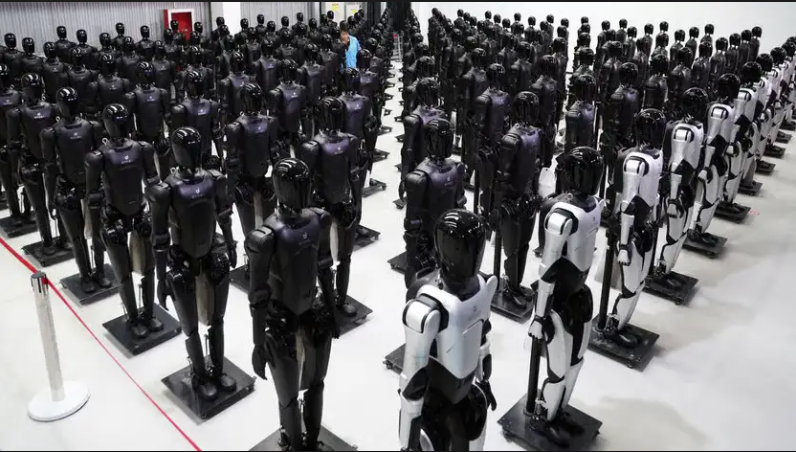
This is the Phantom-01.
A humanoid robot built specifically for military use, already tested in a live combat theater in Ukraine.
Foundation Future Industries plans to scale production to thousands of units this year and begin frontline testing with the US military within 18 months.
The current version can carry 44 pounds of payload, is not waterproof, and lacks the battery endurance needed for large scale deployment.
At roughly $150,000 per unit today, costs are expected to fall below $100,000 by 2028 as manufacturing scales.
The first military drones were slow, short range, and limited in payload too.
China has multiple leading humanoid robot companies with public government funding and support, primarily focused on military applications.
The race to deploy humanoid robots at the front line is not a science fiction storyline anymore.
It is a procurement competition with a 2 year timeline.
George Soros once borrowed $10 billion to bet against the British pound.
The Bank of England spent billions trying to stop him.
It wasn't enough.
He was born György Schwartz in Budapest, Hungary in 1930. When the Nazis occupied Hungary in 1944 his father made a decision likely saving the entire family's lives.
He obtained false identity papers for every family member, hiding their Jewish identity under forged Christian names.
George spent the war as Janos Kis, hiding in plain sight in occupied Budapest.
He would later say those years taught him normal rules didn't always apply and survival sometimes required thinking outside the frameworks other people took for granted.
After the war, Soviet communism replaced one form of oppression with another.
At 17 he made his way to England arriving in London essentially broke. He worked as a railway porter and a waiter to put himself through the London School of Economics.
He graduated, got a job at a merchant bank, learned financial markets from the ground up, and moved to New York in 1956.
He founded the Quantum Fund in 1973 with $12 million in assets and compounded returns at roughly 30% annually over the following 2 decades.
In 1992 he made the most famous single trade in financial market history. He believed the British pound was overvalued within the European Exchange Rate Mechanism and the Bank of England would be unable to defend it.
He borrowed and shorted $10 billion worth of British currency.
The Bank of England spent billions in reserves trying to hold the line.
Britain was forced to withdraw from the ERM and devalue the currency.
Soros made approximately $1 billion in a single day.
He went from hiding under a false name in wartime Budapest to washing dishes in London to breaking the Bank of England in the same lifetime.
SpaceX just went public on June 12 at $135 a share, debuting at a $1.77 trillion valuation the largest IPO in history. Shares closed at $161, jumping 19% on the first day.
OpenAI and Anthropic are still private. Together, the three could collectively represent around $4 trillion in value when they all reach public markets.
SpaceX alone is expected to raise more money than all US IPOs in 2024 and 2025 combined.
The irony worth sitting with: many corporations underwriting the private AI market are now returning to public investors for capital of their own. Alphabet wants to spend $190 billion on AI infrastructure this year and is raising $80 billion to help fund it.
Public markets are being asked to fund the incumbents building AI infrastructure and the startups trying to disrupt them at the same time.
Nobody knows if there is enough capital for both.
Can a country lead the world in AI while its economy is quietly falling apart?
China is trying to find out.
Goldman Sachs estimates high end manufacturing will add about one percentage point to China's annual GDP growth through 2029. The property sector collapse subtracted two percentage points in both 2024 and 2025.
Local government debts sit at roughly $9 trillion, 43% of GDP. The comparable figure in America is 12%.
The share of Chinese industrial firms generating losses just hit a record 32% in April, up from 10% in 2011 and above the peak during the Asian financial crisis.
IMF economists calculated China's industrial policy actually reduced GDP by 2% over the past decade, equivalent to forgoing $400 billion in value added every year, as companies chased subsidies instead of building real businesses.
When reporters recently visited AI parks across Guangdong, they found them empty or occupied by businesses with nothing to do with AI.
Xi is betting the new tech model kicks in faster than the old property and construction model collapses completely.
No large country in modern history has tried this at this scale, with this level of existing debt, at the same time.
In 1958, Jim Haslam paid $6,000 for a single gas station in Gate City, Virginia, and turned it into one of the largest companies in America.
Most people outside the trucking industry have never heard of Pilot Flying J, but at its peak it was doing over $45 billion in annual revenue and operating more than 800 travel centers across the US and Canada.
Haslam started with one station, reached 12 locations by 1965, built his first travel center in 1981, and spent the next four decades expanding through acquisitions and organic growth while staying completely out of the headlines.
The biggest move came in 2010 when Pilot acquired Flying J out of bankruptcy, combining 2 of the largest truck stop networks in North America into a single operation with over 550 locations overnight.
Warren Buffett noticed, and in 2017 Berkshire Hathaway paid $2.8 billion for a 38.6% stake, then paid another $8.2 billion in 2023 for a further 41.4%, and by January 2024 the Haslam family had sold their remaining 20% and Berkshire owned the whole thing.
The sale didn't happen cleanly either, as the Haslam family filed a lawsuit against Berkshire over how it calculated the value of their remaining stake before settling ahead of trial.
What Haslam built was infrastructure, not retail in any conventional sense, because Pilot Flying J is the network freight moves through before it reaches any store, warehouse, or delivery address anyone has ever thought about.
Roughly 14 billion gallons of diesel fuel sold per year, 26,000 employees, and a business model built entirely on being where the trucks have to stop.
66 years from a $6,000 gas station to a Berkshire Hathaway acquisition is about as clean a story as American business produces.
Classic post IPO euphoria unwind. Peaked at $222 four days in, now getting re-priced against the reality that this is a money losing business trading at ~94x revenue. The macro didn't help either. When the Fed signals rate hikes are back, the first things to compress are stocks priced entirely on faith in a future that hasn't arrived yet.
SpaceX is the 7th largest company in the world by total market cap.
Every other name in the top 10 has a float above 85%.
Float is the percentage of shares freely available to trade on the open market — the rest are locked up by insiders.
SpaceX's float: 4.25%.
By free float, it ranks dead last in the top 10.
Elon Musk is now the world's first trillionaire.
The prediction markets had called it with 96 percent odds while Bezos and Altman each sat at 2 percent.
He was around 400 billion before this.
The growth across his companies has pushed his net worth past a trillion from that starting point.
SpaceX alone is valued above 350 billion.
The company is lining up for a public offering that should lift the total even higher.
Tesla already crossed 1 trillion in market cap earlier this year and that forms a huge part of the picture.
xAI came in at a 50 billion valuation after its last round.
The business keeps adding momentum and users at a fast clip.
When you add up the pieces the path to a trillion looks straightforward.
The market had basically turned the whole thing into a question of timing instead of any real contest.