Written for students and researchers focused on applications over theory, "A Practical Guide to Logistic Regression Using Stata" by Alan Acock shows when to use logistic regression, how to fit models in Stata, and how to interpret results.
Learn more: https://t.co/dR6WHFRdo4
Learn how to automate workflows with do-files, write custom programs, and get started with Mata, Stata’s high-performance matrix programming language, in our upcoming webinar.
Learn more and register: https://t.co/hB4eDf144A
Come see us at #SER2026 in Phoenix for a hands-on workshop:
Explore ML and AI concepts and see examples using lasso, elastic net, Bayesian methods, and H2O.
Introduction to machine learning and AI using Stata
23 June • 5:30 p.m. MT
Learn more: https://t.co/oTHlqYIoPh
Teach statistics, not software.
Use Stata to demonstrate key concepts while focusing on explanation.
Plus, free Stata licenses are available for undergraduate courses.
Explore teaching resources, examples, and FAQs.
Learn more: https://t.co/wsE2V2UT4H
I have finally updated the #Stataviz#Portfolio website after some two years!
Now featuring dozens of new visualizations. Check it out:
https://t.co/buj0Bi1QzY
@Stata
Need coefficients for time-invariant covariates and account for correlation with panel-level effects?
Use 𝘅𝘁𝗿𝗲𝗴, 𝗰𝗿𝗲 to get the strengths of both fixed- and random-effects models.
Learn more ↓
https://t.co/WHJxWswNKd
Learn about heat maps, new plot types (𝗿𝗽𝗰𝗮𝗽 and 𝗿𝗽𝘀𝗽𝗶𝗸𝗲), and updates to bar, dot, and box graphs—including grouping, labeling, and 𝗺𝗲𝗮𝗻𝗰𝗶.
Watch: https://t.co/WRqa1pFJTH
New to Stata? Start here!
Join us for an introduction to importing data, cleaning data, creating graphs, fitting models, and more in our upcoming webinar:
Ready. Set. Go Stata.
28 May • 12:00 p.m. CT
Register ↓
https://t.co/3QJBfspkjG
Learn how to estimate heterogeneous treatment effects using S-, T-, and X-learners with H2OML in Stata in our recent Stata Blog post.
Explore practical insights for causal inference and treatment-effect analysis.
Read more: https://t.co/Y6m6I58wrE
FIRST CARPATHIAN STATA CONFERENCE - 27 JULY 2026 - Cluj-Napoca, Romania.
Calling all our @Stata users in #Slovakia and #Slovenia — submit your abstracts and share your work with an international community of #Stata users. This is a great opportunity to present your research, exchange ideas, and connect with fellow Stata researchers across the region.
Submit your abstract by 30th May to be part of the inaugural Carpathian Stata Conference! More info @ https://t.co/zel9LpBuE9
#Stata #DataScience #Econometrics @PublicHealth #Epidemiology #Conference #Research #CarpathianRegion
Learn how the 𝗺𝗲𝘁𝗮 suite supports meta-analysis of a correlation coefficient, including forest plots, subgroup analysis, and Fisher’s z-transformed or untransformed correlations.
Watch now: https://t.co/KKmyq5PqMo
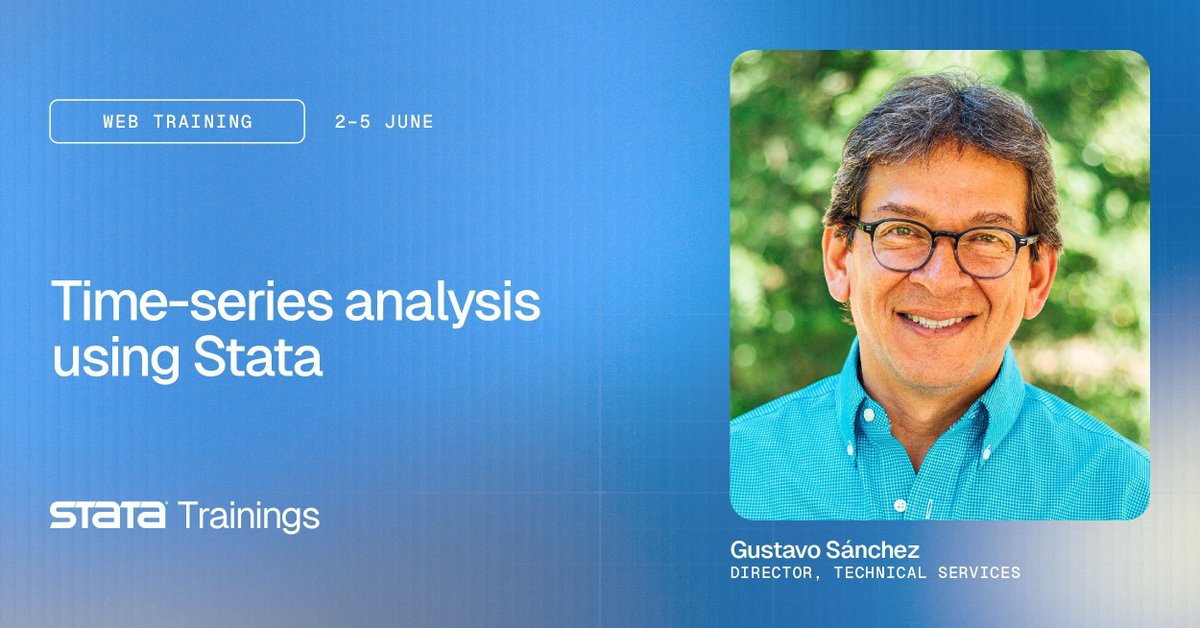
Learn methods for estimation, model selection, hypothesis testing, and interpretation for univariate and multivariate time-series models in our upcoming training.
Register: https://t.co/sBFKM1J0Kj
Stop manually formatting your tables.
Master the 𝗰𝗼𝗹𝗹𝗲𝗰𝘁 system to create publication-quality tables in Stata with Michael Mitchell’s “Creating and Exporting Tables in Stata”.
Get your copy: https://t.co/evoheMb6qP
Before fitting models, make sure your data are accurate and complete.
The latest Stata Blog post highlights four key commands:
▪️𝗱𝘂𝗽𝗹𝗶𝗰𝗮𝘁𝗲𝘀
▪️𝗶𝘀𝗶𝗱
▪️𝗮𝘀𝘀𝗲𝗿𝘁
▪️𝗺𝗶𝘀𝘀𝘁𝗮𝗯𝗹𝗲
Read more: https://t.co/WTzJIQ1Che
Explore some of our developers’ favorite features, including labels, Graph Recorder, model interpretation, reproducible results, and working with Word in our upcoming webinar.
Tips and tricks
19 May • 10:00 a.m. CT
Register ↓
https://t.co/Zv4tPaVbph
What happens when generative AI meets Stata?
Explore community-contributed tools, intelligent bots, and creative tutorials showing how users are integrating LLMs into their workflows.
Faster coding. Easier debugging. New possibilities.
Read more ↓ https://t.co/xFhjlBu1AY
Use the 𝗵𝟮𝗼𝗺𝗹 suite in #Stata19 to fit gradient boosting machine and random forest models for classification or regression.
▪️Tune hyperparameters
▪️Use validation or cross-validation
▪️Explain predictions
Learn more ↓ https://t.co/lhM1f7vmX6