$PNG.V / $KRKNF — Here's why I'm still very Bullish
Sentiment around Kraken Robotics has turned quite negative. Some larger well known holders have sold, the tape has been weak, and the story is now framed as “too slow.” I understand the frustration, however I do not share the idea of selling out the position.
The latest earnings left a lot of people focused on one missing item: no new up-listing update. That disappointment is fair. Most shareholders wanted a firmer date. What got lost in that reaction was a new long-term supply agreement to provide subsea batteries for extra-large unmanned underwater vehicles (XL-UUVs). That is not a footnote. It is another data point that Kraken is embedding itself in the platforms navies actually want to field.
Management has already said it intends to move from the TSX Venture Exchange to the Toronto Stock Exchange, with the process expected to complete in late 2026 or early 2027. A senior listing matters because it opens the door to institutions that cannot, or will not, hold a Venture name. Kraken has a decent record of hitting the dates it publicly commits to — the Covelya close is the most recent example. There has been no new announcement since, but the plan has not been withdrawn.
That leads to the more important point: the market is selling before it has seen Covelya in the numbers.
The $615 million Covelya acquisition closed on July 2, 2026. Q2 results were still standalone Kraken. The first quarter that includes Covelya will be Q3, expected in late November. I want to see the back half of 2026 with Covelya inside the results. That is the first real test of integration, cross-selling, and whether the combined company can convert a much larger product set into revenue.
People also appear to have looked over items on the Q2 slides. Kraken has shown its technology integrated with Saronic’s Corsair vessel. The exact scope of what Kraken is supplying is not fully disclosed, but any integration with a U.S. unmanned surface platform is, in my view, Bullish. It should be mentioned that Saronic was awarded a $392 million Navy contract in December of this past year. (It is unknown how much Kraken has/will make from this deal).
Separately, Kongsberg and Oceaneering were selected last month for the U.S. Navy’s XL-UUV CAMP program. Kongsberg already uses Kraken batteries on UUV platforms.
Zoom out and the pattern is consistent. Kraken has scaled quickly. Its SeaPower batteries and sonar sit on many of the leading AUV / UUV platforms. The market is fixated on Anduril, and that makes sense. What gets less attention is that Kraken often sits underneath a plethora of other UUV’s as well, for example, Kongsberg as I just mentioned.
What I am watching from here:
- How effectively Kraken Robotics can scale production at its new Nova Scotia battery plant to meet demand.
- How cleanly Covelya is integrated, given how complementary the two portfolios look on paper.
- What a full second half of 2026 looks like with Covelya included.
- What a full year of Kraken + Covelya looks like across 2027.
- Whether U.S. Navy-related awards start showing up in that window.
Management has already pointed to Q3 as a step-change quarter and left 2026 guidance unchanged at $290–$320 million of revenue and $65–$75 million of adjusted EBITDA, including a half-year contribution from Covelya.
Patience has clearly left this name. If Kraken executes on integration, delivers the up-listing, and keeps winning battery and sensor content on XL-UUV and related unmanned programs, I think the multiple expansion people wanted in 2026 is more likely to show up in 2027 and beyond.
This is not a trade for people who are looking to make a quick buck. It is a position for people willing to wait for the first combined numbers, a full year of the enlarged business, and whatever Navy follow-through actually materializes.
From this thesis, I still believe we are in for some asymmetrical gains over the next few years.
This is not financial advice, DYOR!
I’m huge in $ASTS, $RKLB, and $KRKNF, right now it definitely sucks knowing I’m down huge from my ATH, but when I sit back and think about why I invested in each, they’re all still executing. Nobody said it was an easy steady upward path forward. No company out there hasn’t had a drawdown or delays. It’s a buying opportunity.
What makes it easiest is just reading positive news, accepting delays and not checking my account every day. I still believe in each company and those who are patient will reap the benefits. Those who sell have their own reasons, maybe fear, maybe to invest in something they have more conviction in, it’s their own choices. But as for me, I’m in this for the long run and I knew the day I bought these that I had a 10-15 year timeline, if not longer. If it’s not money I was spending anyways then I should have no fears.
Kraken Robotics announces $102 million in new orders, bringing total announced orders in 2026 to $457 million.
“The acquisition of Covelya has materially expanded the technologies and solutions we can offer our customers, while integration activities continue to progress as planned. With the vast majority of these recent product orders expected to convert to revenue within the next 12 months, this activity provides meaningful visibility as we enter 2027.” �� Greg Reid, CEO of Kraken Robotics.
Kraken will release its Q3 2026 financial results on November 24, with a conference call and webcast scheduled for the same day.
Read the full press release: https://t.co/EFNLVCdjs2
Idk if this is bottom or not but my portfolio has been liquidated from 104k all the ways down to 46k since June.
I like being transparent, shit hurts a lot, it’s tough, but what keeps me happy and motivated is going out and enjoying life.
Having a good stable job is also what allows me to get up and take on the day. I still believe in $RKLB, $ASTS and $KRKNF big time. Taking the biggest beating due to macro but the fact that the indexes are at ATH’s do make me fear what’s to come.
These are normal feelings. This is why you need to know what you own!
ANDURIL UNVEILS $6.6 BILLION SUBMARINE INDUSTRIAL EXPANSION
Anduril says Arsenal-2 will be built at Tradepoint Atlantic in Baltimore County, creating 3,100 direct jobs and more than 11,000 indirect jobs.
Anduril and the U.S. Navy will invest $6.6 billion to expand America’s submarine industrial base and increase production capacity for the Virginia-class submarine program.
Initial Arsenal-2 operations are expected in 2030.
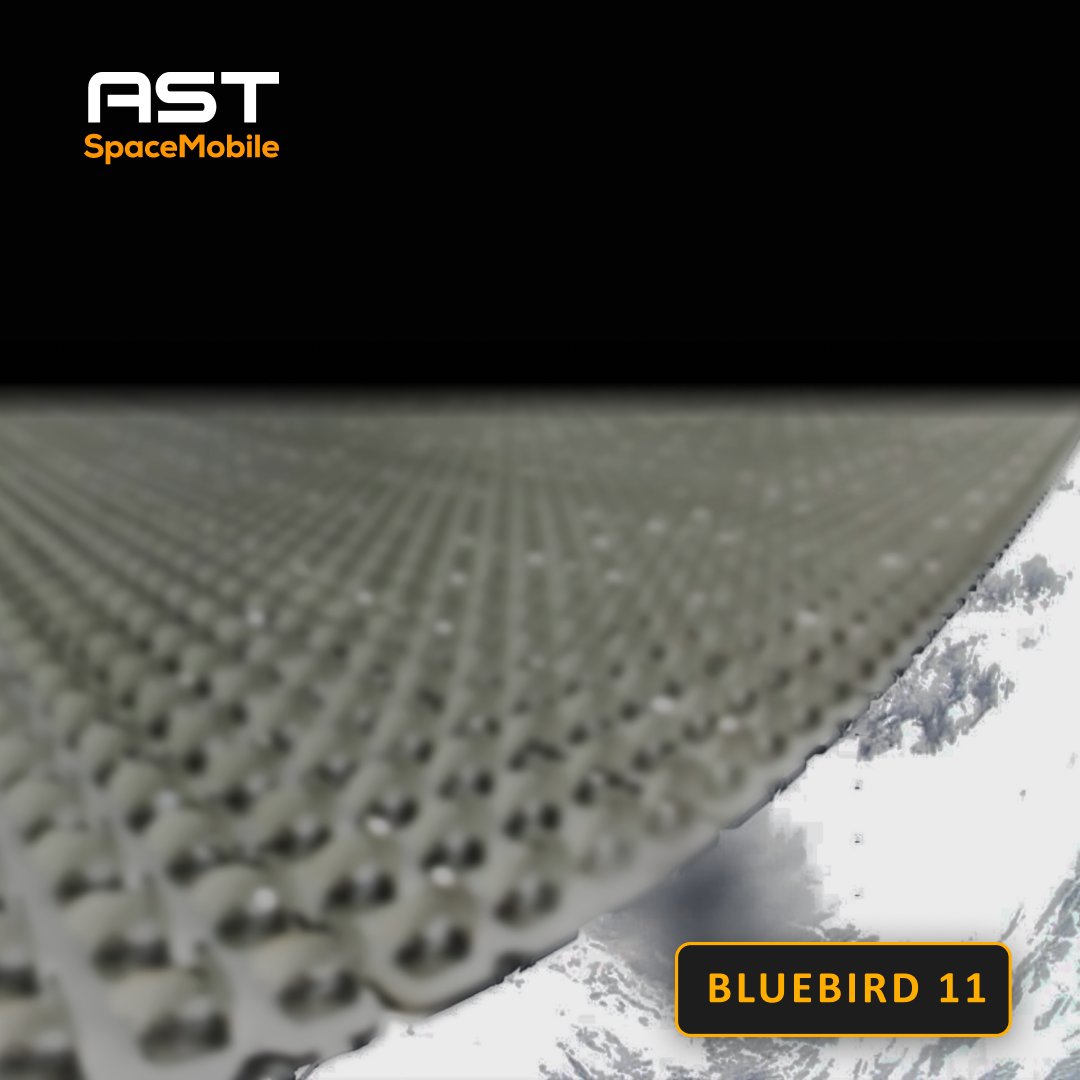
BlueBird 11. Fully deployed.
All 13 satellites - 20,000 sq ft of phased arrays in orbit - performing as planned.
American innovation built for space based cellular broadband, resilience, and security. 🇺🇸🌎📶📱
Another convoy is on the move.
BlueBirds 14, 15, and 16 have left our Texas facility and are on the road to Cape Canaveral.
Next stop: orbit. 🚀🚀🚀🚀🚀🚀🚀🚀🚀🚀🚀🚀🚀🚀🚀🚀
The largest commercial communications arrays ever deployed in low Earth orbit. A scalable platform to deliver space-based cellular broadband connectivity directly to standard phones, support secure government applications, and deliver a new third layer of connectivity.
In Midland, Texas, production continues to advance through BlueBird 50, with more than 20 spacecraft structures now being integrated as part of our assembly process.
One constellation. Connectivity. Resilience. Security. Built in Texas. 🇺🇸🌎📶📱
#ASTSpaceMobile #Broadband #ConnectingtheUnconnected #BlueBirds
I love both companies, I don’t understand why people even compare the two. They’re completely different, people who own ASTS should want Neutron to launch and hope they can be another launch provider. And RKLB investors should want the contracts from ASTS. Comparison is so stupid imo
Rocket Lab has filed a formal protest with the Government Accountability Office challenging NASA’s award decision for the Mars Telecommunications Network.
NASA’s award decision appears to be inconsistent with the eligibility criteria mandated by Congress. In addition, the agency’s punitive review of Rocket Lab's technical volume was inconsistent, making incorrect assertions and conclusions.
Procurement standards exist to ensure fair competition and protect public investment. We are pursuing this review to ensure those standards are upheld for critical infrastructure that will underpin American exploration at Mars for decades to come.
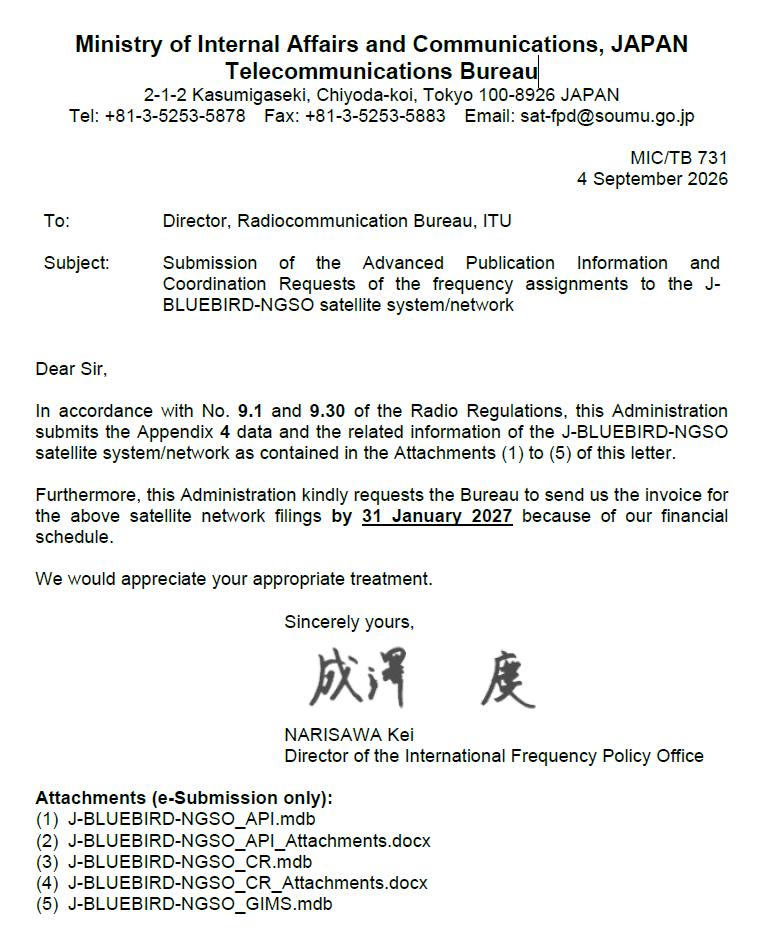
$ASTS: 🚨🇯🇵 JAPAN'S MINISTRY OF INTERNAL AFFAIRS AND COMMUNICATIONS FILES A NEW 136 SATELLITE CONSTELLATION AT THE ITU UNDER "J-BLUEBIRD-NGSO" DESIGNATION
On 9/4, Japan’s MIC formally filed a new satellite constellation with the ITU called J-BLUEBIRD-NGSO. This is not a third-party label or speculation --> the Japanese government itself is filing a constellation under AST SpaceMobile's BlueBird satellite name.
The filing package describes a steerable, high-gain communications system with broad frequency use and coverage across the visible Earth, and the associated constellation data points to 136 satellites across 34 orbital planes. That is not the footprint of a small pilot. That is the architecture of a full-scale sovereign communications constellation.
Now put this together with everything else we already know: Rakuten/RAST was selected for Japan’s J-LEO program, Japan has discussed up to ~$1B of government capital, Rakuten has said J-LEO is separate from its ordinary commercial AST service, and it has openly talked about creating Japan’s first “Japanese-flagged” LEO satellite. The pieces are starting to line up in a very big way.
AST SpaceMobile is looking at something far larger than just selling capacity to Rakuten --> it could be serving the government of Japan. Dedicated satellites, launches, ground infrastructure and a sovereign Japanese network built around AST’s platform. That is a completely different magnitude of opportunity.
The biggest takeaway. Japan is effectively saying, “we want our own BlueBird constellation,” and this could become the template for other countries that want sovereign space infrastructure without developing an entire LEO platform from scratch. AST may not just be building one global network — it could end up becoming the underlying platform for national satellite networks around the world for the US, Japan, the European Union, Brasil and more.
ITU reference: J2026‑83391