Peter Thiel makes a very important point in his latest interview: we moralise far too much. Think German Energiewende.
Thiel explains that moral judgement has increasingly replaced functional judgement. Instead of asking whether something actually works, we rush to classify it as morally good or evil.
The confusion starts with the word “good”, because it has two completely different opposites:
- The moral opposite of good is evil.
- The functional opposite of good is bad.
These are two entirely different axes. Yet public discourse increasingly folds them into one. Particularly the progressive left wants to occupy the moral high ground. So everyone virtue-signals — or pretends to, often without the slightest competence to judge the virtue in the first place.
Enter the climate crisis. Too much CO₂ is declared evil. Overnight, everybody knows we are in a climate emergency. Any doubt becomes morally suspect. After all, the IPCC consensus has declared it so. A Ferrari can now be declared morally “evil” because it burns too much fuel. Yet it remains an exceptionally good car.
And here lies the political trap: once something has been declared morally good, its advocates start treating that moral classification as evidence that it is also functionally good — that it actually works. And even if it works demonstrably worse, it doesn’t matter. It’s virtuous..!
But obviously the two may have absolutely nothing in common. A policy advertised as virtuous can be functionally terrible: incompetent, ruinously expensive or incapable of achieving its stated objective. Worse, once all its consequences are counted, it may turn out not to have been virtuous in the first place.
Germany’s Energiewende is the textbook example. Nuclear was morally branded “Hochrisikotechnologie” by @Die_Gruenen — high-risk technology — from the 1970s onwards. Dangerous. Irresponsible. Wind & solar became the virtuous alternative: “renewable”. And once that moral hierarchy was established, the engineering and economic questions became irrelevant: Does the resulting electricity system actually work better and cheaper?
Of course not. Nuclear power was one of the great scientific achievements of the 20th century: enormous quantities of cheap electricity from tiny quantities of energy-dense uranium, virtually no operational CO₂ emissions, little land use and dispatchable generation from massive rotating machines that also contribute to grid stability.
More importantly, it is also one of the safest forms of electricity generation mankind has ever developed. Yet German Greens spent decades morally slandering it. And Germany was hardly alone. Across much of the West, nuclear became something morally suspect rather than an extraordinary feat of engineering.
Doubt, rather than gratitude, accompanied nuclear. The doubt of the ignorant. Yet by some obscure moral code, ignorance itself suddenly earned a seat at the table. Expertise became optional; moral conviction became qualification. A child could command a global audience on questions of energy systems. How dare you?
Meanwhile, physics doesn’t care about false virtue signalling. A TWh of solar is not functionally identical to a TWh of nuclear — not at night, not in winter and not even at noon on a summer day if it is generated in the wrong place or exceeds consumption at that moment.
Why? Bc an electricity system has never been about producing enough TWh over a year. It has always been about timing and location too. Electricity must be produced at the precise time and location it is demanded, while generation and consumption must remain continuously balanced because the grid itself cannot store electricity.
That is Thiel’s message: The Energiewende — replacing nuclear with wind and solar — proved neither functionally competent nor virtuous. It was one gigantic $2 trillion amateur hour.
The yield curve has been inverted for over 500 days We’ve only seen this 3 times in history:
1. 2008
2. 1929
3. 1974
All 3 saw > 50% stock market drawdowns
ht g.o.t.
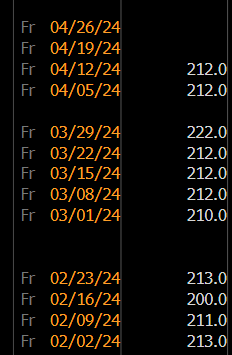
Below is the number of initial filings for unemployment insurance.
How is this statistically possible?
Five of the last six weeks, the exact same number.
Effectively the same number in the last 11 weeks, except for the holiday weeks (President's Day and Easter).
---
Consider
The US is a $28 trillion economy. It has 160 million workers.
Initial claims for unemployment insurance are state programs, with 50 state rules, hundreds of offices, and 50 websites to file. Weather, seasonality, holidays, and economic vibrations drive the number of people filing claims from week to week.
Yet this measure is so stable that it does not vary by even 1,000 applications a week.
Just the number of applications incorrectly filed out every week should cause it to vary more than this.
Putting this here rather than behind the stack paywall and doing it before 6pm because I am seeing a lot of really shit takes on why this was a nothingburger since Iran didn’t hit anything major, “all bark no bite,” and so gold and especially oil should be faded.
1/7
US 10-YEAR TREASURY YIELD RISES AFTER RETAIL SALES DATA, NOW UP 11.9 BASIS POINTS TO 4.618% ON DAY
US DOLLAR JUMPS AFTER RETAIL SALES DATA, DOLLAR INDEX REACHES 106.15, HIGHEST SINCE NOV. 3
BREAKING: Israel's Channel 12 reports that a senior Israeli official has vowed an 'unprecedented response' is coming to Iran's attack and tells Israelis not to 'go to bed due to what is coming'
(Via Times of Israel)
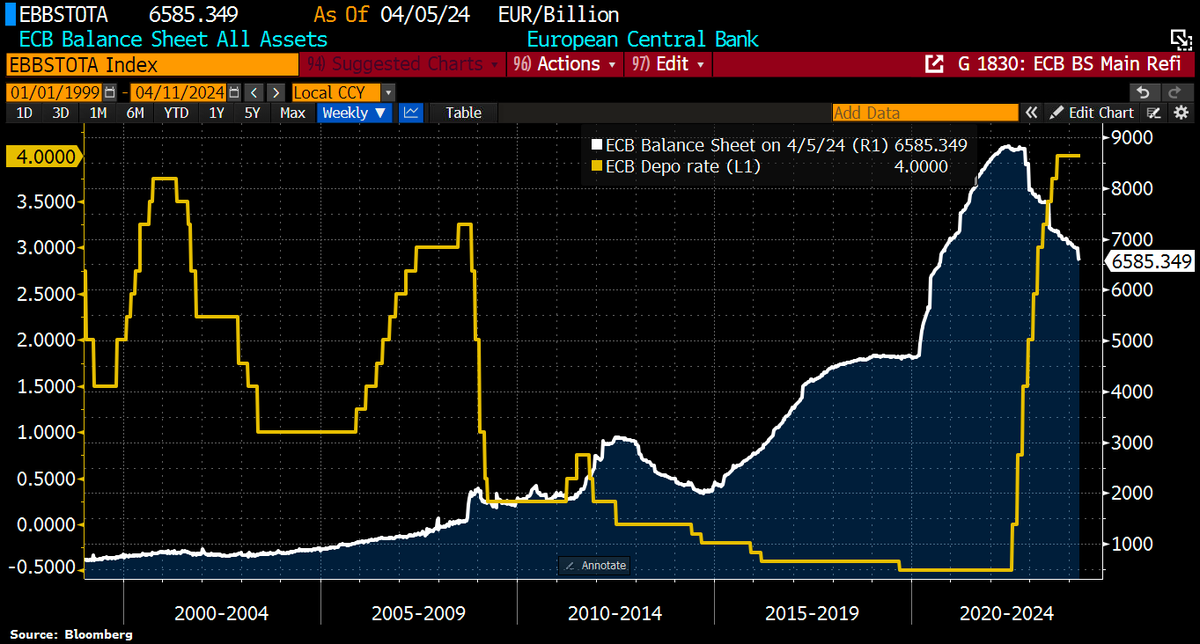
#ECB keeps interest rates on hold for 5th meeting as expected. Leaves Deposit Rate at 4.00%, ECB prepares markets for 1st rate cut in June. Euro weakened after the statement.
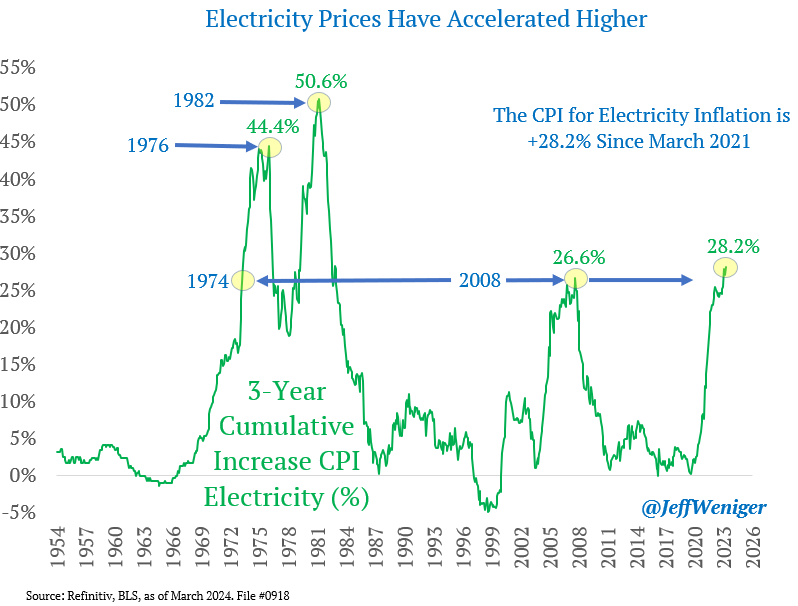
The CPI for electricity is zooming.
The first time we saw anything like this was in the wake of the 1973 oil embargo, with electricity prices running higher for the rest of the 1970s. Then we saw it when the "Commodities Super Cycle" busted the middle class into 2008.
Reminder draining the SPR helped lower gas prices and inflation.
SPR has not been refilled and not much more can be drained if oil does accelerate again.
Powell can say whatever he wants
And everyone can calculate inflation "ex this ex that"
Truth is that the percentage of items running at 4% or above never went below 50%
and this is not broadbased disinflation
and never was
ht @M_McDonough for the chart
@ThManfredi