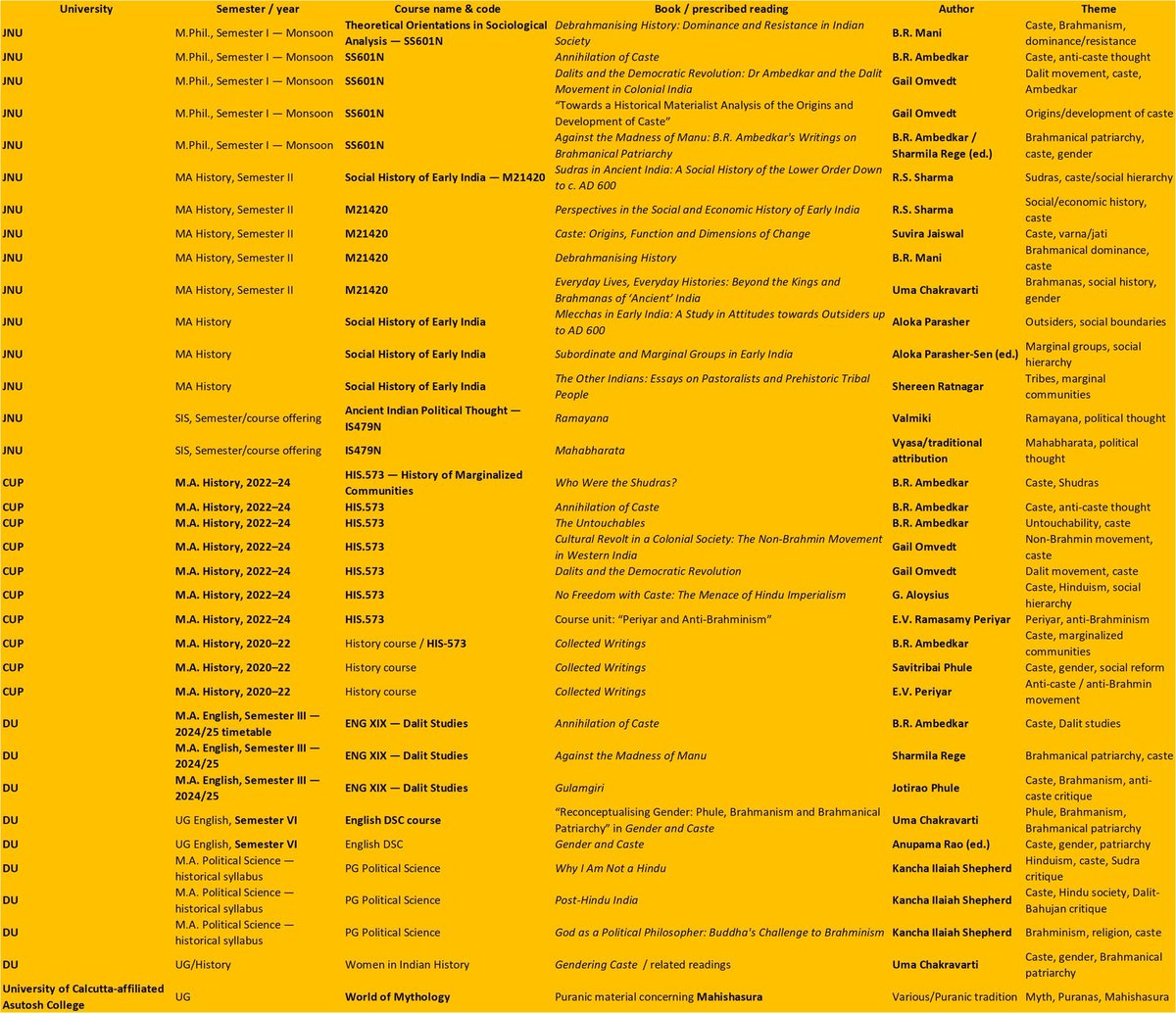
Topics being taught under Humanities in our Universities👇
-Brahminical patriarchy
-Caste & Gender
-BR Ambedkar writings on brahminical patriarchy
-Ghulamgiri by Phule
-Dalit History
-Against the madness of Manu
-Mahishasur-Ek jannayak
-Bharat ke Moolniwasi aur Aryans
Wonder whom to blame?
& Who pushed all this into the curriculum?
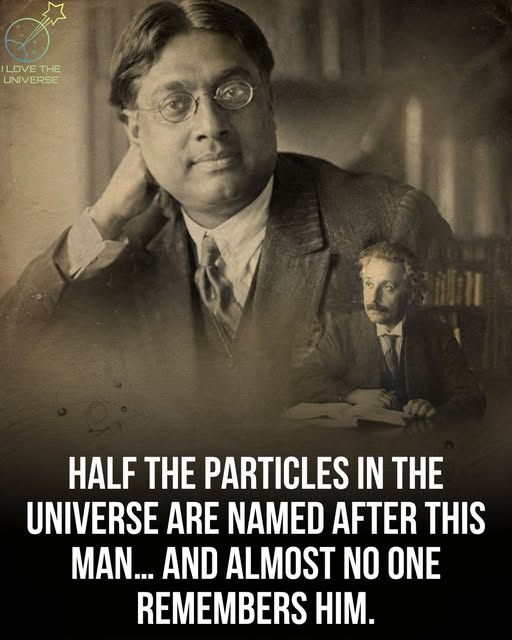
He changed the way humanity understands reality itself… yet most people have never heard his name.
In 1924, a young Indian physicist named Satyendra Nath Bose sent a short paper to Albert Einstein. What happened next would reshape modern physics forever.
Bose introduced a mind-blowing idea: what if some particles in the universe were so identical that nature itself couldn’t tell them apart?
Einstein immediately realized the brilliance of the idea. He personally translated Bose’s paper into German and expanded the theory further. Together, their work became what we now call Bose–Einstein statistics — the foundation for an entire family of particles known as bosons.
And here’s the incredible part:
Bosons are everywhere. They include photons — the particles of light that allow us to see the universe 📷 — and the particles that literally hold atoms together. Without Bose’s breakthrough, many of the technologies we take for granted today might never have existed:
Lasers
Superconductors
Quantum mechanics as we know it
Even the discovery of the Higgs boson
Half of the universe’s fundamental particles now carry his name… yet Bose never received a Nobel Prize.
But science remembers. Every beam of light, every quantum discovery, every glimpse deeper into the cosmos quietly carries a piece of his legacy.
Sometimes, the people who change the world the most are the ones history speaks about the least.
Would you have heard of Bose before today?
Remember, all Muslim countries today were once not Muslim.
When the Muslim invaders came, they killed the men, raped the women, enslaved the children.
That’s how those countries became Islamic. And that’s exactly what they are trying to do in Europe and America now.
August 16, 1946. Direct Action Day.
Survivor of Direct Action Day and Noakhali massacre, Rabindranath Dutta (92) recalls how naked, butchered bodies of Hindu women were hung from hooks at Raja Bazar beef shops.
Victoria College girls were raped, killed and their bodies tied to hostel windows.
Rabindranath Dutta told me how he stood watching heaps of slaughtered Hindu bodies during 1946 Noakhali pogrom, pools of blood around his heels.
Most women's bodies had breasts missing, just black bite marks at those places and their genitals.
It is hard to even listen to his accounts.
After his wife died, Rabindranath Dutta sold her ornaments to self-publish 12-13 books on Direct Action Day, Noakhali massacre, and 1971 genocide. First-hand experiences, rare research.
He says nobody in Bengal gave a damn...no politician, media, publisher, activist, or filmmaker.
We Hindus seem to have learnt no lesson from history.
2/10 Why "history" is never really about the past
A country's history is its mirror. Crack the mirror, and the country sees a distorted version of itself- forever.
George Orwell put it simply: whoever controls the past, controls the present and the future. The British understood this instinctively; Macaulay's 1835 minute openly stated the goal of English education was to create people "Indian in blood and colour, but English in taste, opinions, morals and intellect."
Political rule can be overthrown in a freedom struggle. Colonising the mind takes generations to undo, and honestly, we still haven't finished the job.
In 2012 Manmohan Singh gave an interview to prestigious Science magazine where he clearly blamed America based funding to Christian Churches stopping India's growth.
It is believed this interview made Sonia so angry she decided to get rid of Manmohan. She asked all ministers to stop listening to the PM altogether. For the last 2 years of his tenure, Manmohan had zero control over the state he ran on paper.
It's not #FCRA, its our very freedom!
Dharmendra Pradhan was the worst Education Minister.
Not for students.
For those who thought they owned education.
For decades,
One ecosystem decided what students should remember.
Which reforms were welcomed.
Which reforms were buried.
Invaders received chapters.
Heroes received footnotes.
Wounds were edited.
Wisdom was labelled mythology.
Bureaucrats shaped the rollout.
The ecosystem guarded the gates.
Because education was never just policy.
It was power.
Influence.
Business.
Graduates rolled out like an end-of-season sale.
Degrees everywhere.
Thinkers missing.
Then came 2014.
Modi tried ministers.
Smriti Irani.
Prakash Javadekar.
Ramesh Pokhriyal.
Each touched the machinery.
The machinery touched back.
Because education reform in India is not administration.
It is bomb disposal.
Then came Dharmendra Pradhan.
The man had already delivered LPG cylinders.
Into all corners of India.
2021.
Modi handed him education.
And Pradhan entered the building.
Quietly.
He saw files.
And landmines.
Under his tenure came:
NEP 2020 implementation.
The National Curriculum Framework.
PM SHRI schools.
PARAKH assessment reforms.
APAAR student identity.
Academic Bank of Credits.
The National Credit Framework.
Multidisciplinary education.
Indian Knowledge Systems.
New accreditation architecture.
The Radhakrishnan reforms.
Stronger examination laws.
And the VBSA Bill.
A Bill designed to dismantle the UGC-AICTE-NCTE nexus.
Naturally, everyone was angry.
But the real explosion was elsewhere.
Inside NCERT.
Ganita Prakash.
Kaushal Bodh.
Kriti.
Poorvi.
Indian names returned.
So did Indian knowledge.
Baudhayana entered mathematics.
Ancient science.
Architecture.
Tribal traditions.
Marathas.
Civilisational Bharat.
The Constitution grew stronger.
Rights were taught.
Duties were restored.
Citizenship became participation.
The Emergency entered Class Nine.
India was no longer shown only as a land repeatedly defeated.
India became a civilisation that created, questioned and survived.
That disturbed 5 established kingdoms:
Narrative power.
Institutional power.
Epistemic power.
Moral power.
Generational power.
Then came the paper leak.
The crime was real.
The anger was legitimate.
But the investigation became drama.
The crowd wanted a face.
Television wanted a sacrifice.
Politics supplied the cross.
On 25th July,
Dharmendra Pradhan resigned.
The crowd celebrated.
The ecosystem exhaled.
We crucified the man who was repairing the classroom.
And the real culprits watched from safer rooms.
Paper leaks must be punished.
Ministers must be accountable.
But accountability without investigation is mob psychology.
We rarely study the file.
We study the hashtag.
We do not follow chronology.
We follow choreography.
And young minds?
They are told whom to hate before being told what happened.
So ask one uncomfortable question.
Was Pradhan removed because he failed education?
Or because he had finally begun changing who controlled it?
CJP’s protest exposed something nobody is discussing.
The money.
I asked one simple question.
Who paid for all this?
A few months ago,
Abhijeet Dipke was in the US.
Then came a remark from the Chief Justice.
Then came a meme page.
Then came millions of views.
Then came coordinated amplification.
Bots.
Anonymous pages.
Influencers.
Reels appearing everywhere.
Suddenly, Dipke returned to India.
Permission was secured.
A protest site appeared at Jantar Mantar.
Tents went up.
Stages were built.
Food began arriving.
Then Sonam Wangchuk joined.
Celebrities appeared.
Political leaders followed.
Student wings mobilised.
The crowd grew.
The story changed.
What began as a NEET protest became a political spectacle.
So I stopped watching the videos.
I started calculating the bills.
The protest ran from 6 June to 20 July.
That is 45 days.
45 days of continuous operations.
Let us calculate the economic value.
Food and beverages: ₹13 crore.
Daily transportation: ₹3 crore.
Final-day mobilisation: ₹3 crore.
Stage, tents, sound: ₹2.5 crore.
Water and drinks: ₹2 crore.
Volunteer logistics: ₹1.5 crore.
Accommodation and boarding: ₹3 crore.
Senior legal services: ₹1.5 Crore.
Medical counters and emergency: ₹3 crore.
Banners and printing: ₹2 crore.
PR and digital production: ₹2.5 Crore.
Social-media operations: ₹3.5 crore.
Speakers and invited guests: ₹2.5 crore.
Administration and operations: ₹1.5 crore.
Technical support: ₹0.5 crore.
Contingency: ₹3 crore.
Special Fees: ₹5 Crore.
Subtotal: ~₹52 crore.
Then came 20 July.
Approx 50,000 people turned up.
As per Media.
50,000 people do not materialise from thin air.
They must be contacted.
Transported.
Directed.
Supplied with water.
Managed on the ground.
Another ₹5 crore.
Add the YouTube machinery.
Video teams.
Editors.
Content creators.
Social-media pages.
Real-time amplification.
Another ₹5 crore.
Add the wider digital amplification surrounding the final mobilisation: Another ₹5 crore.
Then came reports and visuals of celebrations and hospitality. Add: ₹1 crore.
The total Cost: ~₹68 crore.
Read that again.
₹68 crore.
This was not a few angry students carrying handmade placards.
This was an operation.
Money leaves fingerprints.
Logistics leave patterns.
Amplification leaves digital trails.
So who funded it?
If I answer that today,
my account may not survive tomorrow.
But one thing is difficult to ignore.
This was not spontaneous.
It was organised.
Resourced.
Planned.
The scale demands questions.
The logistics demand answers.
Someone financed this machinery.
This story is only beginning.
The funding trail is where I am headed next.
“The word 'dictatorship' is being used far too casually; a dictatorship is where speaking out against the government isn't even possible.” - Isha Koppikar
Spot on! 👏👏
Never been a fan of Dharmendra Pradhan, especially after the UGC regulations mess under his watch.
Regarding the NEET, I repeatedly posted that he should've resigned back then only. Taking accountability at that moment would have actually carried moral weight.
Resigning now, however, is a major L. His own resignation letter doesn't state that he is stepping down due to a failure of responsibility; instead, it claims he is resigning so that "anti-national forces don't take advantage of the situation." What is that if not a confession of helplessness in the face of chaos?
If the narrative is that he stepped down to prevent opportunistic elements from exploiting the protests, what does that say about the govt? What is the point of being in power for years if anarchists still hijack and dictate terms to you on national issues?
The right approach even now would have been to keep crack down on opportunists, while simultaneously inviting "only the actual students" to a live telecasted open forum in a major auditorium, acknowledge responsibility directly, announce a resignation, and reassure them that the new leadership will fix the system.
Bowing down to pressure only encourages lawlessness. Sure, you might buy a brief breathing room as this protest winds down, but you’ve given agitators another taste of success. They will be back, stronger next time. Hope you’re prepared.