Today I wanted to share a bit of tape reading — and how ICT concepts truly come alive when you apply them in execution, not just in theory.
I recorded one of my trades from the beginning (6am). No cuts, no sudden “I’m already in” moments — just clean, transparent process. Because that’s how trade videos should look if the goal is to actually teach, not perform.
It always makes me wonder… why do most clips start after they’re already in a position? Why not hit record from the beginning of the session, when the narrative, bias, and reasoning are actually built?
Maybe it’s easier to press record once the trade’s already running — after resetting the demo a few times, or after switching to a new challenge account.
But the truth is, credibility is built before the entry, not after it. Every second you record before pulling the trigger shows confidence, structure, and understanding.
That’s what I want to see more of in this space — traders showing process, not just outcomes. Because anyone can post an arrow… but only a few can show the story behind it.
This is just a sample of how an execution should be shared.
GLGT.
@DodgysDD It depends on what you want to compare.
Managing larger size is a skill and a facet of trading that requires experience and mental strength.
Or, if the comparison is strictly technical, the only fair comparison is through a risk-adjusted track record.
Bernoulli’s equation only holds if the flow is incompressible, inviscid, and steady.
In reality, those conditions change: the fluid can heat up, accelerate, or turn turbulent.
The general equation —Navier–Stokes— always holds; Bernoulli is just its local version, valid under certain assumptions.
Markets flow the same way. Their conditions shift every day.
Your system must be the general equation —able to adapt—
while models are the simplified forms you use when those conditions apply.
“Simple” or “complex” isn’t a property of the phenomenon,
but an opinion of the observer.
If you've studied what he teachs here: Advanced ICT Liquidity Concepts / October 11, 2025. https://t.co/CjqSKYhOrm You could've understood RTH Chart on ES :)
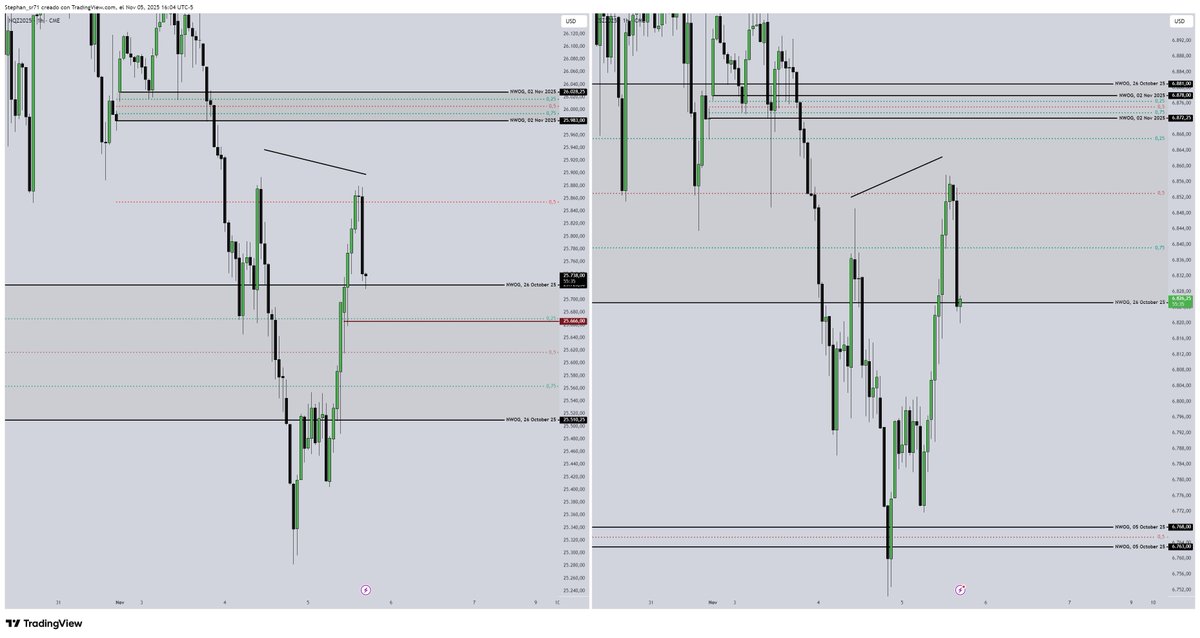
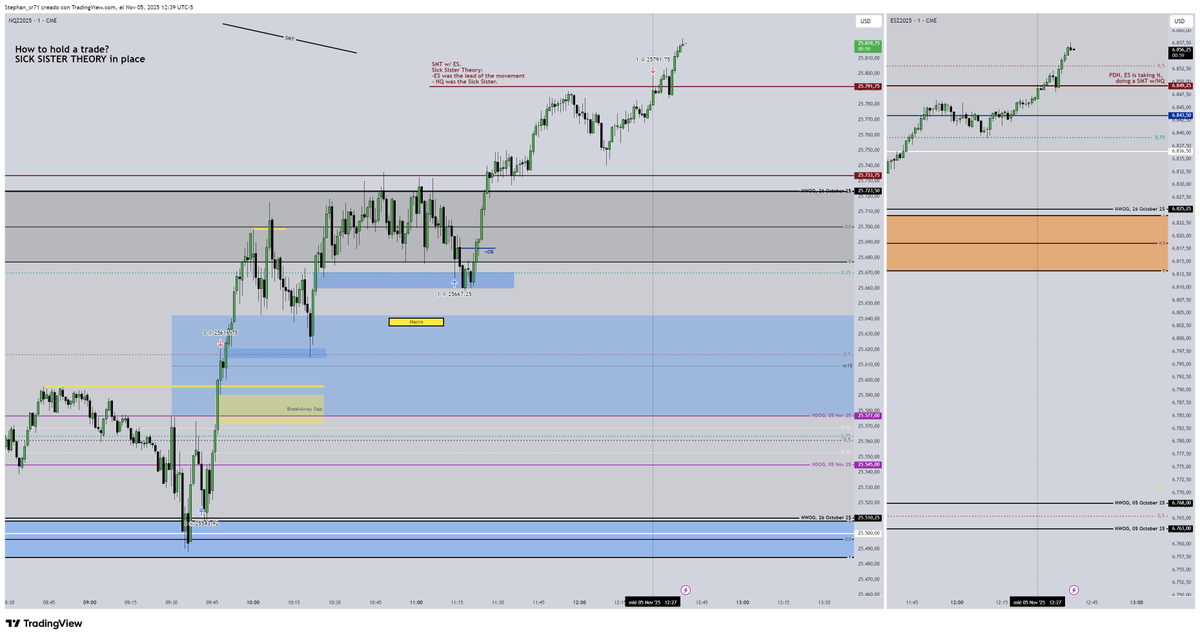
Following up on yesterday’s video — today’s price action was a clear Sick Sister Theory narrative.
There wasn’t really an OB on NQ, but it lined up perfectly with ES as the stronger sibling.
For scalping, I like watching GC and NQ, as you could see.
Following up on yesterday’s video — today’s price action was a clear Sick Sister Theory narrative.
There wasn’t really an OB on NQ, but it lined up perfectly with ES as the stronger sibling.
For scalping, I like watching GC and NQ, as you could see.
Aviation safety reminds me a lot of risk management in trading.
It’s not just about what happens in the air — safety is built into everything. From how an aircraft is designed and assembled, to the maintenance after each flight, to the meticulous pre-flight checklist every pilot must complete — safety isn’t an act, it’s a culture. It’s embedded in every single phase.
Trading should be the same. Risk management isn’t only what happens during a live session — it’s how you feel before you trade, how you prepare your charts, how you review your performance afterward. It’s the never-ending discipline that keeps you alive in the long run.
Most traders overlook this. But just like in aviation, it’s what guarantees continuity.
@gdayfx Niiice.
And even though trading is discretionary, if your system does not follow a pseudo code that could be partially programmed, something is missing.
ICT has hundreds of videos and hundreds of concepts — This is my opinion about how to face his work.
Obviously, you can’t study and memorize every single video or every note he makes. That’s theory. From there, you have to design a system that aligns with the theory, so you can then focus on the rules of that system — whether it’s simple or complex. There’s no need to remember every single thing he says; that would just lead to paralysis by overanalysis.
You need to understand the concept, the theory, and then build a system that leverages it. When you define one function, then another, and keep building your code, at some point you “forget” how each function is written — but you know why it exists and what purpose it serves. As you keep coding, you start seeing each function as a black box: you know what input goes in, and what output comes out. You don’t care about the internal details at that point because you trust it was defined logically in the first place.
ICT is the same. You have to assemble your own system — a system that, in my opinion (unpopular one), the market demands to be quite complex, counterintuitive, and deeply integrated with your own personality and “opinions” formed over months or even years.
Just like an engineer doesn’t need to remember every single formula or theorem from aerodynamics, thermodynamics, or structural analysis to know that the tools he uses — which are based on those theories — actually work. He knows that if he revisits how those tools were built, he’ll remember the theory behind them.
That’s how your interaction with your own system should be. When you define it, you’re working with the theory. But when you apply it, all that matters is focusing on the guidelines — the outputs — your system provides.
That’s how I see it.
@officeuse101 I have the Layouts that Michael says us:
- Weekly Profile
- NDOGs/NWOGs Layout
- ORGs & FPFVG Layout
- HTF OrderFlow Layout (W1/D1/H1) where H1 is “LTF”
- LTF OrderFlow Layout (H1/m15/m5/m1)
I don’t use the Layout m3/m2/m1/s30/s15/s5. (Sub-one minute Layout)…yet.
Scaling isn’t a sprint
It’s slow, intentional and uncomfortable
Everyone wants “bigger size”
Very few earn the right to use it
While you dream of 6-figure payouts
Real traders slowly build skill, confidence and size
You don’t need to jump from 1 lot to 10
You scale when your discipline scales
Big capital isn’t hard to get
Managing it without losing your mind is.