Hi @LatinXChem. My name is Stephanie Giraldo from
@UdeMedellin_ - Colombia in the research group
@ConMpac. This is my work: "Phosphorus adsorption using calcium-based adsorbent obtained from the calcination of orange peel and eggshell mixtures"
#LatinXChem#LXChemEnv#Env108
@ernanipinto@LatinXChem@UdeMedellin_@ConMpac Thank you. So far we have not quantified with our material how much Ca can dissociate in water, but there are different articles where it has been quantified, and in general if the calcium in Ca(OH)2 is soluble, it favors its interaction with phosphate and then precipitates.
Hi @LatinXChem. My name is Stephanie Giraldo from
@UdeMedellin_ - Colombia in the research group
@ConMpac. This is my work: "Phosphorus adsorption using calcium-based adsorbent obtained from the calcination of orange peel and eggshell mixtures"
#LatinXChem#LXChemEnv#Env108
@_ffsodre@LatinXChem@UdeMedellin_@ConMpac In answer to the second question, the adsorbent could continue to remove P from the soil, but it depends on the pH of the soil.
@_ffsodre@LatinXChem@UdeMedellin_@ConMpac thanks for your comment. The desorption of P from the adsorbent was evaluated with deionized water and 2% formic acid and in the bioavailability figure it can be seen that more P is desorbed in formic acid and less in deionized water.
Hola @LatinXChem. Este es mi trabajo: "Preparación de Ca-biocomposites usando cáscara de papa y huevo para la remoción de fósforo desde agua residual sintética y doméstica"
Research group @ConMpac en @UdeMedellin_#LatinXChem#LXChemEnv#Env013
Hi @LatinXChem. My name is Jhon Pérez. This is my work: "Removal and immobilization of Cadmium (Cd2+) from aqueous solution using water hyacinth (Eichhornia Crassipes) ashes" Research group @ConMpac in @UdeMedellin_#LatinXChem#LXChemEnv#Env063
Hi @LatinXChem. This is my work: "The role of Ca phases (Ca(OH)2/CaCO3) over time during phosphorus adsorption from aqueous solution using a Ca-biocomposite of eggshell-palm mesocarp fiber" Research group @ConMpac in @UdeMedellin_#LatinXChem#LXChemEnv#Env062
Hi @LatinXChem. My name is Moises Ulloa from @UdeMedellin_ - Colombia in the research group @ConMpac. This is my work: "Copper and Congo red removal using adsorbent materials obtained from lemon peels in mono- and multicomponent systems"
#LatinXChem#LXChemEnv#Env112
We are #researchers@UdeMedellin_ interested in molecular design of materials, use of agro-industrial wastes, removal of water pollutants, recovery and deterioration of materials.
#Science in #UdeMedellín#Colombia
For more information, please visit us:
https://t.co/MeJX2cEtLy
@sbriara@LatinXChem@UdeMedellin_@ConMpac El ZnCl2 fue elegido como agente activante debido a su disponibilidad y precio y porque es uno de los agentes activantes más utilizado en diferentes estudios para obtener materiales carbonosos modificados
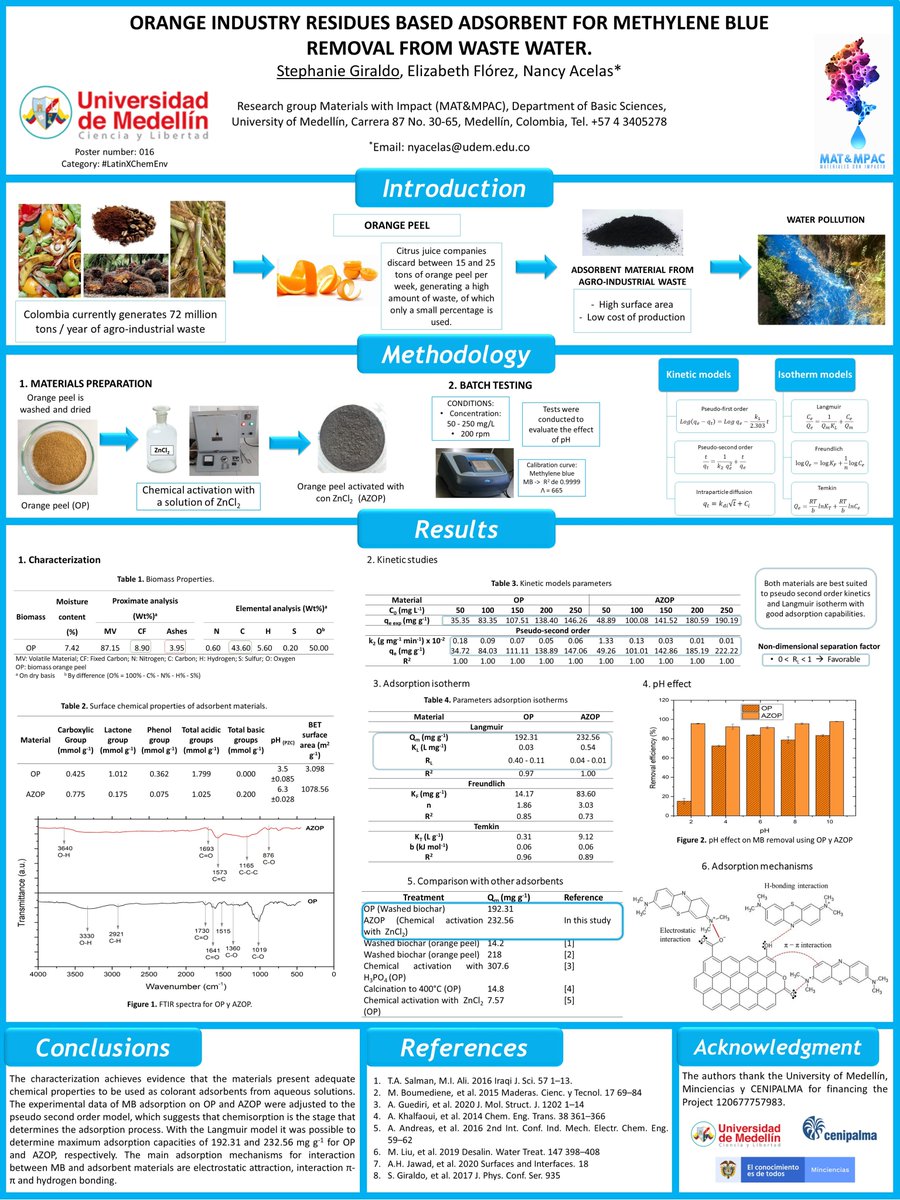
Hi @LatinXChem my name is Stephanie Giraldo Ardila from Colombia. I´m a master's student at @UdeMedellin_
in the research group @ConMpac . This is my work "Orange industry residues based adsorbent for methylene blue removal from waste water" #LatinXChem#LatinXChemEnv#Env016
@sbriara@LatinXChem@UdeMedellin_@ConMpac La activación con ZnCl2 puede aumentar la adsorción de MB debido a que este presentó una alta área superficial, y por lo tanto la eliminación del colorante se puede dar tanto por interacciones con grupos funcionales, como por la adsorción en los poros.
@daaliaa22@LatinXChem@UdeMedellin_@ConMpac Los experimentos de llevaron a cabo durante 72 horas. Se alcanzó el equilibrio después de 30 y 10 horas para OP y AZOP, respectivamente.
@cesar_nietodel Se escogió el azul de metileno como contaminante modelo ya que es una de las moléculas que ha sido estudiada más ampliamente en diferentes artículos y a partir de los resultados poder estudiar moléculas más complejas usando los mismos materiales adsorbentes.
@cesar_nietodel Es importante mencionar que el ZnCl2 es un eficiente reactivo de deshidratación que promueve la descomposición de materiales carbonosos, induce la aromatización del carbono y restringe la formación de alquitranes.
@cesar_nietodel El ZnCl2 fue elegido como agente activante debido a su disponibilidad y precio y porque es uno de los agentes activantes más utilizado en diferentes estudios para obtener materiales carbonosos modificados