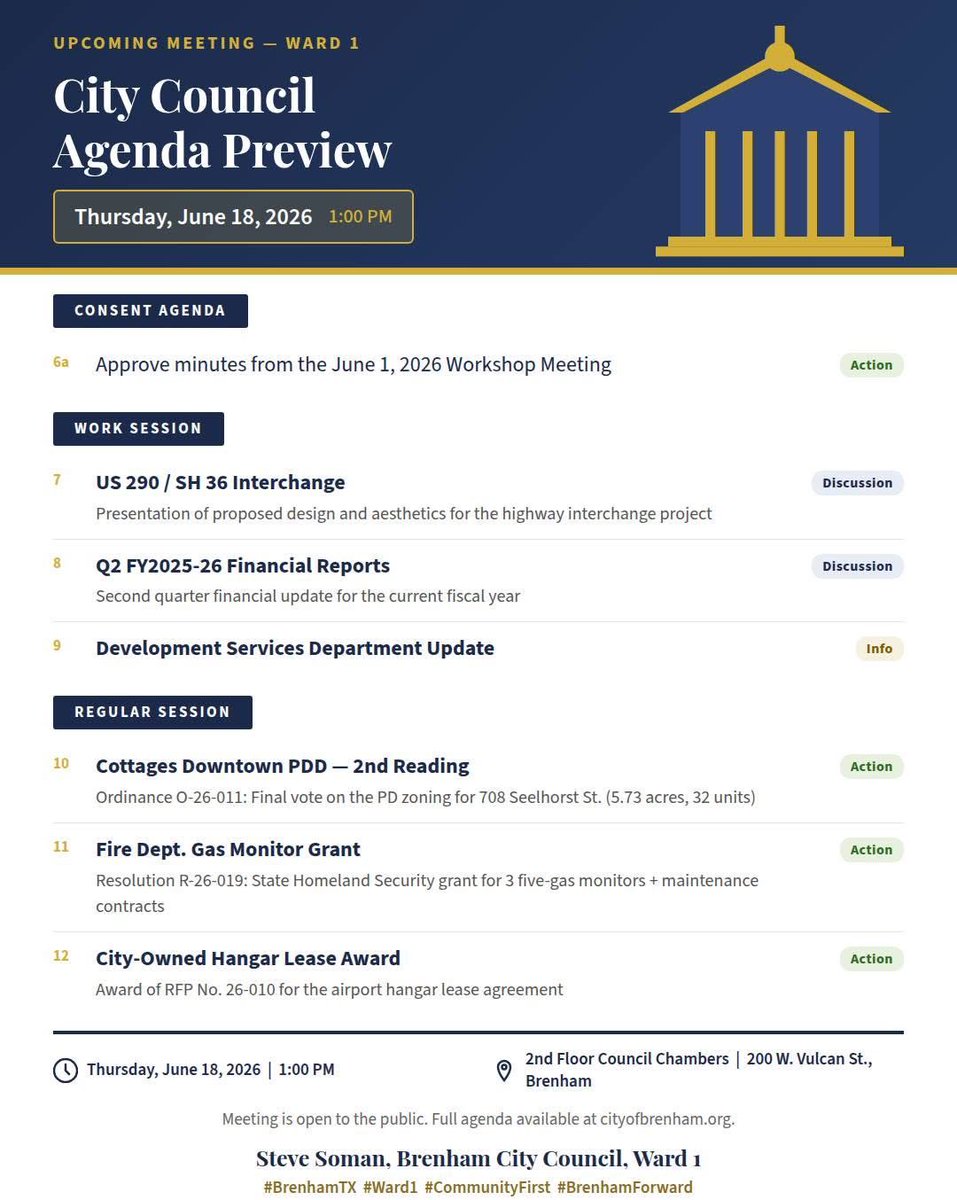
In a comprehensive departmental brief delivered to City Council, Development Services Director Stephanie Doland revealed that Brenham’s population has confidently surged to approximately 20,000 residents, expanding by a striking 16.13 percent over the preceding five-year interval.
This rapid demographic climb translates to an actual compound annual growth rate (CAGR) of 3.04%, dramatically outstripping the 2% growth rate forecasted by state and regional demographers when the city’s landmark Historic Past, Bold Future – Plan 2040 comprehensive blueprint was enacted in 2019.
https://t.co/pWUQ5Q23DE
Hey everyone,
I wanted to share a few thoughts after seeing some of the back and forth online lately about growth and new opportunities coming to Brenham and what a citizen emailed me last week (see his email screenshot).
We all care about this town. We want good jobs close to home so our kids don’t have to leave, housing that regular families can actually afford, and the kind of community that still feels like Brenham. The challenge is, sometimes the conversation jumps straight to frustration before we even get to talk about what might actually work.
I don’t speak for the whole City Council, I can only speak for myself. But as your councilmember, I listen to every idea and every concern that comes my way. Before I vote, I make my best effort to research the item, ask staff questions, talk to impacted residents, and review your emails, texts, and messages. Your feedback truly matters. It’s how we figure out what’s worth pursuing and what needs more work.
Here’s the thing though: if every time a company shows interest or someone proposes new housing we immediately come out swinging online, companies notice. They pay attention to how a community responds. We can ask hard questions and set high standards without turning every announcement into a fight. That’s the difference between scaring opportunities away and actually bringing good jobs and thoughtful development here.
What we need more of are honest conversations. Not just complaints, but real discussion about what Brenham needs: jobs that pay a living wage, housing that fits the people who already live here and the ones we hope will stay, and the roads, water, and services to support it all without losing what makes this place special.
I’m always open to hearing from you. Whether it’s at a council meeting, an email, or even right here in the comments. Let’s keep giving feedback in a way that builds instead of just pushes back. Present alternatives and what your vision is or what you want. That’s how we position Brenham to attract the right kind of growth instead of fighting it every step of the way.
Appreciate everyone who cares enough to stay involved and engage. Looking forward to hearing your thoughts.
#Brenham #BrenhamTX
Learn More
Residents can learn more about mosquito control and mosquito-borne illnesses by visiting the Environmental Protection Agency's mosquito control resources at https://t.co/XorGDwpFey.
The City of Brenham appreciates the community's assistance in helping reduce mosquito populations and creating a safer, more enjoyable outdoor environment for everyone.
For additional information, please contact the City of Brenham Public Works Department at 979-337-7400.
As warmer temperatures and seasonal rainfall create favorable conditions for mosquito activity, the City of Brenham is reminding residents that mosquito control is a shared responsibility between the community and the City.
While the City actively works to reduce mosquito populations throughout the summer months, residents can significantly help by eliminating mosquito breeding habitats around their homes and properties.
How Residents Can Help
Mosquitoes only need a small amount of standing water to breed. Residents are encouraged to:
· Eliminate standing water in containers, flowerpots, tires, buckets, and other outdoor items.
· Change water at least weekly in bird baths, wading pools, pet bowls, and similar containers.
· Keep swimming pools properly treated and circulating.
· Wear long-sleeved shirts, pants, and socks when outdoors, especially during dawn and dusk.
· Use mosquito repellents according to label directions.
· Consider using yellow “bug” lights outdoors, which tend to attract fewer mosquitoes.
City Mosquito Control Efforts
The City of Brenham uses a comprehensive mosquito control program during the warmer months, typically from April through September, when mosquito activity is highest.
Adult Mosquito Fogging
The City's primary mosquito-control method involves ultra-low-volume fogging with a pesticide called Kontrol 4-4. Applied from specially equipped vehicles, this treatment targets adult mosquitoes and is typically conducted three times per week when weather and wind conditions are favorable.
Spraying begins approximately one hour before sunset and continues for up to two hours after dark, when adult mosquitoes are most active. During a single evening, crews can cover approximately 20 to 25 miles of city streets. This timing also helps protect beneficial insects such as bees, which have typically returned to their hives by dusk.
Storm Drain Treatments
City crews also perform daytime spot treatments in storm drains and other dark, damp locations where adult mosquitoes commonly rest.
Larval Mosquito Control
To prevent mosquitoes from reaching adulthood, the City applies Zoecon Altosid Briquettes to standing water in drainage ways, rights-of-way, and other areas that cannot be easily drained. These treatments target mosquito larvae before they mature and become biting adults.
✅Bottom Line
Brenham currently has a reliable water supply with built-in headroom for the immediate future. We have an active treatment plant expansion, a new groundwater well in progress, and ongoing negotiations for additional BRA water. We're well-positioned to support current residents and the growth we're seeing, but it's a balancing act, carefully monitored across more factors than one social media post can fully capture. We need to continue making investments for the water future we want and continue to work ahead.
I'm happy to meet and talk if you have additional questions, this is a complex topic, and I'd rather walk through it directly than oversimplify it here.
#BrenhamTX #Ward1 #CommunityFirst #BrenhamForward
📍Public's Question:
Could the city provide an update on the well drilling project? Specifically, how is the first well performing compared to its original estimated output, and what are the projections for meeting the total water demand from current users plus all approved buildings over the next 1–2 years? Given that these wells draw from a shared aquifer also serving major new development in the Anderson area, how sustainable will this supply be?
My response:
💧 Brenham's Water Future: A Closer Look at Capacity
Thank you for your excellent questions on our well-drilling progress and long-term water supply. This is a vital issue as Brenham grows responsibly, and while it's complex to cover fully in one post, here's a clear overview.
🛡️The State Requires Proactive Planning
The Texas Commission on Environmental Quality (TCEQ) mandates that every public water system closely monitor these things:
1) Production Capacity - treating enough raw water for daily demand
2) Storage Capacity - reserves for peak use and emergencies
3) Pumping Capacity - delivering water through the distribution system
When a utility reaches 85% of its rated production capacity, state law requires immediate notification to TCEQ and a formal expansion plan. We stay well ahead of this threshold.
📅Where We Stand Today
• Our current average daily use is about 9 acre-feet per day.
• Separately, that same 9 acre-feet/day represents about 64% of our annual contract allocation with the Brazos River Authority (4,974 acre-feet/year, or about 14 acre-feet/day). That's a different number measuring a different thing — how much of our water rights we're using, not how close we are to a treatment limit — but it's part of why we're working to secure more BRA allocation now rather than later.
• The treatment plant is already being expanded to 8.35 MGD (about 26 acre-feet/day), which will add further headroom as the city grows.
🚰Diversifying Our Sources
We're not relying solely on Lake Somerville. The Loesch Street Groundwater Well Project is underway:
• Phase 1 — of the drilling is nearing completion.
• Phase 2 — the treatment facility that connects the well to our system — is planned to follow.
Once fully operational, the well is expected to add about 790 acre-feet/year (roughly 2 acre-feet/day, or 0.706 MGD) from a groundwater source independent of the lake intake, added insurance against any surface water disruption.
📊Future Capacity & Growth
City staff monitor connections quarterly to ensure stay compliant with TCEQ requirements. As of Q1 2026, we have 10,220 connections and below TCEQ’s 85% rule and well below the 100% connection capacity of 12,125 connections.
In December 2025, city submitted a Long-Term Water Needs Questionnaire to BRA requesting significant additional allocation. Additional BRA water, combined with the new well, will provide strong capacity for approved development and continued growth, but it's a balancing act that requires ongoing monitoring, planning, and infrastructure investment to stay ahead of demand.
🏗️Addressing Regional Concerns
Our sources tap into the same regional aquifer systems and water sources shared with broader development across the area. That's exactly why we're diversifying supply and planning years in advance rather than waiting for shortages. The Texas Water Development Board (TWDB) meets and maintains state/regional water plans and meets regularly with regional entities to monitor and adjust for changing conditions — and Brenham isn't immune from trends playing out statewide or regionally. You can find the 2027 draft State Water Plan from April 2026 here: https://t.co/tXthrZitE6 It is clear from the state’s plan that water conservation, reuse, and strategic surface/groundwater development are priorities if we want to avoid severe shortages and risk in the future.
@patrickbetdavid@realDonaldTrump Good news, hopefully Iranian hold their side of the deal instead of the constant back and forth along with a lack of true command and control structure over various factions vying for power
The flag reminds us to pray for our country and to honor those who have bravely protected it. As Christians, our truest citizenship is in heaven, but we are called to be the light of the world here on earth. May God bless America, and may we reflect His love, justice, and truth to all.
#flagday #america250 #brenham #brenhamtx #americanflag
A question I get all the time as a Councilmember is: “Can we get a new grocery store in Brenham?�� It’s a fair one, we all want more options for fresh food, better prices, and convenience without driving to the big cities.
The truth is, retailers like grocery chains don’t just pick spots on a map. They run serious data analysis on whether a location will actually make money long-term. If we fit their criteria then we may get some interest Here’s the kind of stuff they look at, and how our town stacks up.
What they usually check:
• Population and growth in the area — They want enough people in their “trade area” (typically a 5-15 minute drive) to support steady sales. Growing numbers are a big plus. Thus you will hear “have more rooftops” if you want a new store from retailers.
• Demographics and spending power — Household incomes, family sizes, age groups, and what folks tend to buy. They need customers who can afford their products and shop regularly.
• Traffic, access, and visibility — High car counts on good roads, easy in and out, plenty of parking. Nobody wants a store that’s hard to get to.
• Competition and market gaps — What’s already here, where the holes are, and whether there’s room without everyone fighting over the same customer base.
• Infrastructure and costs — Available land or buildings at reasonable prices, utilities, highways for deliveries, and supportive local rules.
• Overall vibe and stability — Jobs, tourism, community feel, and low risks like high crime or big economic swings.
Brenham actually checks a lot of these boxes pretty well. Our city has grown from about 17,300 in 2020 to around ~20,500 now, with Washington County pushing close to ~39,000. That’s solid, steady growth, and we’re right between Houston and Austin, pulling in some of that bigger metro energy.
Median household income sits around $65,000, with strong retail sales overall and a mix of families, locals, and visitors. Highway 290 gives great access, we’ve got ongoing infrastructure work, and our small town charm plus events bring in extra traffic. Tourism and local employers help create that stable customer base they like.
That said, it’s not automatic. They also look at specifics like exact site size, parking needs, seasonal boosts, and whether the numbers pencil out after all the costs. We’re not a huge metro, so sometimes bigger chains wait for the right moment or format that fits our scale.
The good news? Our growth, location, and community strengths make us more attractive than a lot of similar towns.
What do y’all think? Any particular grocery concepts you���d love to see here, or ways we can better highlight our strengths to attract them? Drop your thoughts below, I read them and it helps shape how we talk about this stuff.
We also have a lot of well-connected folks in our community. If you have ideas, contacts, or ways to help move this forward, please reach out!
❓Question: "With all the talk about growth in Brenham, why are we taking on more debt for infrastructure? Shouldn't we just freeze development and stay the small town we've always been? I'm worried we're turning into another Houston."
⚖️My Response:
📈Growth is coming to Brenham, whether we embrace it or try to freeze it. As I’ve shared before, we sit squarely in the path of expansion along the US 290 corridor between the booming Houston and Austin metros. Washington County and our city are experiencing real, measurable growth. City population has risen from about ~17,300 in 2020 to around ~20,500 today, driven by people seeking our small town charm, strong schools, historic character, and quality of life.
🛑Some voices call for freezing growth; burying our heads in the sand and hoping development passes us by so we can stay “frozen in time” as a tiny town. Past city leadership tried this approach. For past several years, councils and city managers avoided major infrastructure investments, skipped opportunities like low interest loans for upgrades, and focused on staying small. They thought inaction would deter newcomers and preserve the status quo.
But they missed the regional picture. Growth from Houston’s westward push and Texas’s broader boom didn’t bypass us, it arrived anyway. The result? We’re now playing catch up with water, wastewater, roads, and utility systems. And that growth is not slowing down.
🚧That’s why our current Council is focused on upgrading facilities, improving services, and building the infrastructure needed to handle today’s growth responsibly. Yes, this involves debt, but that debt reflects reacting to pressure after years of hesitation, rather than preparing proactively. We inherited the consequences of trying to ignore growth and hoping that it will just go away. Ignoring it now would only make things worse: strained services, higher long term costs, declining quality of life, and missed opportunities for our families and businesses.
Freezing growth isn’t a real plan. It hasn’t worked in the past, and it won’t work now. Not investing, not building, and avoiding smart financing left us behind the curve. I refuse to repeat those mistakes. We must plan ahead and invest wisely today so we don’t leave a bigger mess for our kids.
👨👩👧👦My vision is clear: Let’s keep Brenham as Brenham. A welcoming, family-oriented community with historic charm, churches, small businesses, and strong schools. Not Houston sprawl. Not Austin congestion. And certainly not the unchecked path some smaller neighbors have taken (we don’t want to be Hempstead, sorry).
Smart, managed growth means directing development where infrastructure can support it, enforcing strong standards, and making sure new growth pays its fair share without raising taxes on existing residents. It preserves what we love while creating opportunities and keeping our town vibrant and attractive to businesses and families.
Staying frozen in time, with no interest from new residents or businesses, isn’t sustainable either. We can build something unique, the Brenham of the future, while respecting our past.
🤝Together, we can grow responsibly - avoiding growth is not an option.
#BrenhamTX #WashingtonCounty #ResponsibleGrowth #BrenhamFuture #FactsOverFear
Disclaimer: The views and opinions expressed in this post are my own and do not represent the official position of the City of Brenham or the Brenham City Council as a legal entity.
Baylor Scott and White’s health plan exit from the exchange market will affect roughly 100,000 Texas enrollees, 2.6% of the state’s marketplace. Less plans, more consolidations, and fewer choices.
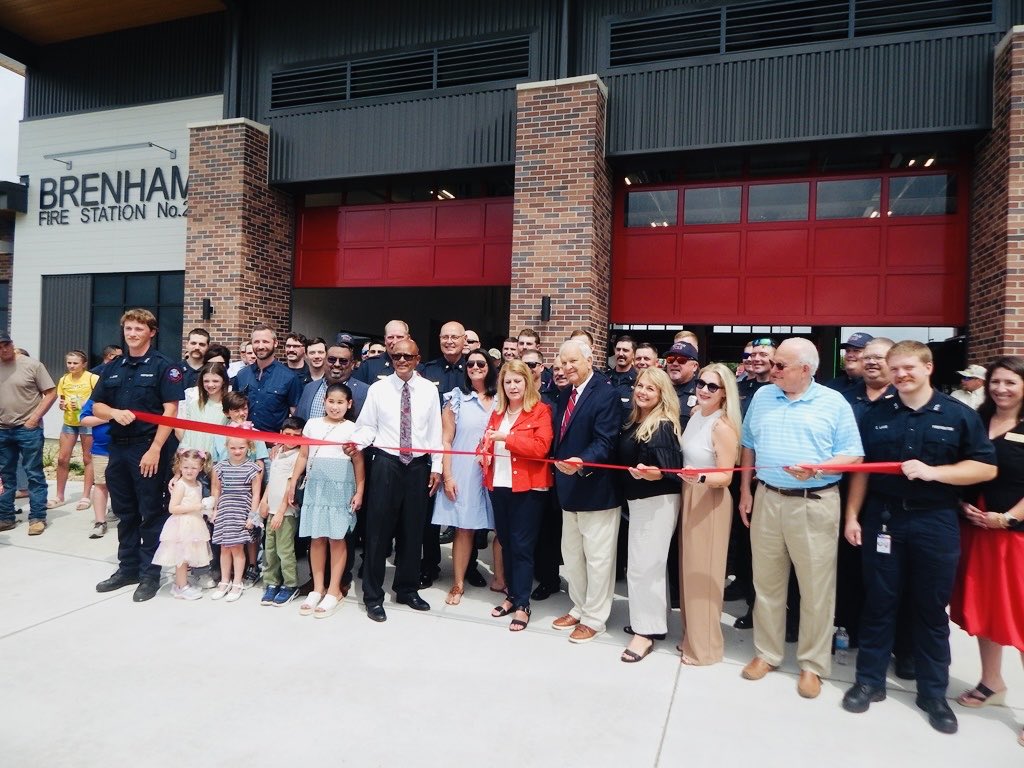
I’m thrilled to have been part of the grand opening of our new Brenham Fire Station No. 2 on June 5, 2026!
This impressive 10,335-square-foot facility at 3007 James Nutt Boulevard was designed by BRW Architects and built by Collier Construction Company. It features three apparatus bays, living quarters, an exercise room, training classroom, and support spaces. Staffed with four firefighters per shift (with room to grow), it’s a major step forward in serving our growing community and improving emergency response times.
Huge thanks to Mayor Atwood Kenjura, Fire Chief Mark Donovan, retired City Manager Carolyn Miller, and all the dedicated folks who made this happen. This is a smart investment in public safety for all of us!
Grateful for our outstanding first responders and what an incredible milestone for our community!
Data Centers in Texas: What’s Happening & How Washington County Can Respond
As your Councilmember, I’ve been closely following the rapid growth of data centers, hyperscale facilities, and high-performance computing projects across Texas, and the important questions they raise for our rural communities in Brenham and Washington County.
These developments can bring new tax revenue and jobs, but they also require substantial water for cooling, significant electricity, infrastructure investments, and can affect noise levels, traffic, and our overall quality of life.
Here’s a quick, balanced update on how other counties are responding:
Hill County passed a temporary moratorium on new data centers, power generation, and large battery storage projects in unincorporated areas. After being sued by a developer for approximately $100 million in damages — a federal lawsuit that remains active even after the moratorium was rescinded — they replaced it with a practical developer checklist. This requires detailed plans for traffic, noise, water sourcing, emergency response, and more, providing real oversight while staying on firmer legal ground than the moratorium itself.
Hood County and Hays County both attempted moratoriums but ultimately voted them down under legal pressure from state officials, including a letter from a Houston area state senator to the Texas Attorney General arguing counties lack authority to impose such pauses. Somervell County took a different approach, unanimously passing a formal resolution opposing data center construction until the Texas Legislature addresses the issue, which could be as early as 2027.
What can Washington County do? Yes, we have practical tools available. Our Commissioners Court can strengthen review processes for projects in unincorporated areas through developer checklists, plat approvals, road and heavy haul agreements, and environmental and health assessments.
The City of Brenham has already demonstrated effective use of zoning, as with the Viridien/CGG project, to manage a project and its impacts. The key is strong coordination between city and county, transparent public input, and ensuring any development protects our water resources, keeps electricity rates stable, maintains our roads, and preserves the character that makes Washington County special.
We’ve successfully managed growth challenges before, on water rates, car wash regulations, and more, by putting residents first. Growth is coming to our region. The real question is how we guide it responsibly.
What you can do:
•Stay informed and attend upcoming Commissioners Court and City Council meetings.
•Share your specific concerns — water use, traffic, property values, infrastructure — directly with county and city officials.
•Do your own research on proposed projects. The best path forward comes from informed community voices, not any one person’s opinion.
I’ll keep advocating for smart, transparent growth that benefits Brenham and Washington County families without compromising what we love about our community. Feel free to reply with questions or thoughts.
Let’s work together for responsible progress.
#WashingtonCounty #BrenhamTX #ResponsibleGrowth #LocalControl #CommunityFirst
Sad to see Memorial Hermann Health Plan exiting the commercial health insurance market in Texas. A valued regional player with deep local roots is stepping back amid industry headwinds and scale challenges.
This follows Baylor Scott & White’s reductions in Medicaid and individual marketplace plans. According to TDI data, the Texas market remains highly concentrated with HCSC (Blue Cross Blue Shield of Texas) holding over 26% of total premiums and dominating many segments.
While @txhealthplans highlights strong insurer competition in the ACA Marketplace (16 carriers for 2026), the loss of regional plans risks further consolidation. Larger national players can absorb regulatory and operational pressures more easily, while smaller and regional options struggle.
I’m concerned that well-intentioned laws, including aggressive PBM reforms, may be unintentionally squeezing these vital regional plans, accelerating vertical consolidation and threatening access in many communities especially rural and underserved populations. We must pursue balanced reforms that enhance transparency without creating healthcare deserts.
What are your thoughts on preserving competition in Texas healthcare market?
#TexasHealthcare #HealthInsurance #RuralAccess #PBMReform