Grateful to @MarleyKayden and the entire @SchwabNetwork team for having me on this afternoon.
We unpacked the biggest questions investors are wrestling with right now in the wake of earnings season and the latest Fed meeting — most notably: when does all this AI spending start showing up in meaningful returns?
I also shared why I’m constructive on three areas that still look mispriced: U.S. small caps, commodities, and emerging markets. Attractive valuations, inflation protection, and leverage to the global AI supply chain are a powerful combination, even with geopolitical noise still elevated.
Appreciate the thoughtful conversation, Marley. Always a pleasure.
#SchwabNetwork #Investing #AI #SmallCaps #EmergingMarkets
Watch the full clip here:
https://t.co/T50uHHE5gC
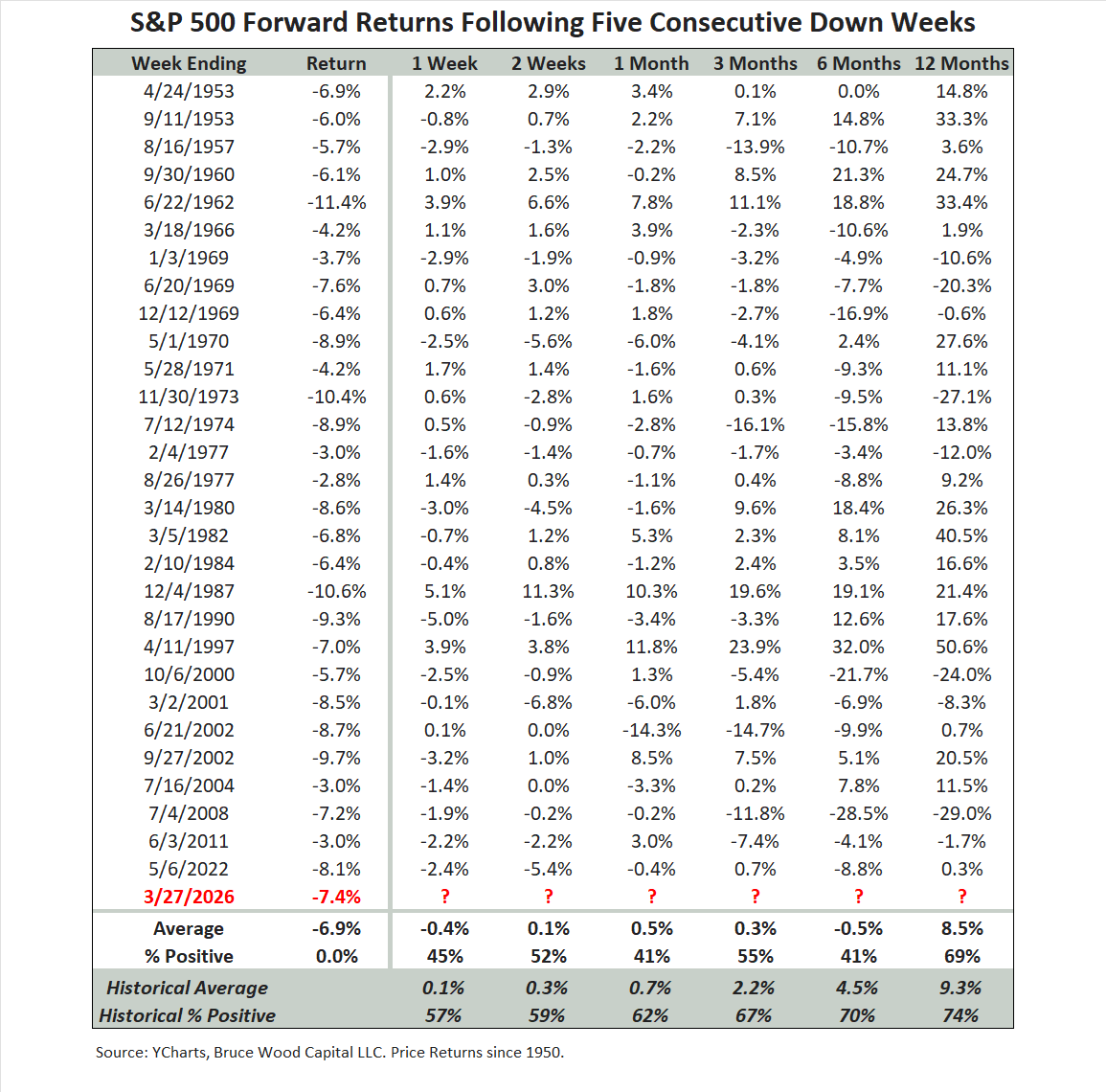
S&P 500: 5 consecutive down weeks (29th occurrence since 1950)
What tends to happen next?
• Forward returns (1wk–6mo) below average
• Lower probability of positive returns
• ~50% of streaks extend beyond 5 weeks
Not a timing tool—but a useful reminder.
Bruce Wood Capital
Systematic | Data-Driven | Long-Term
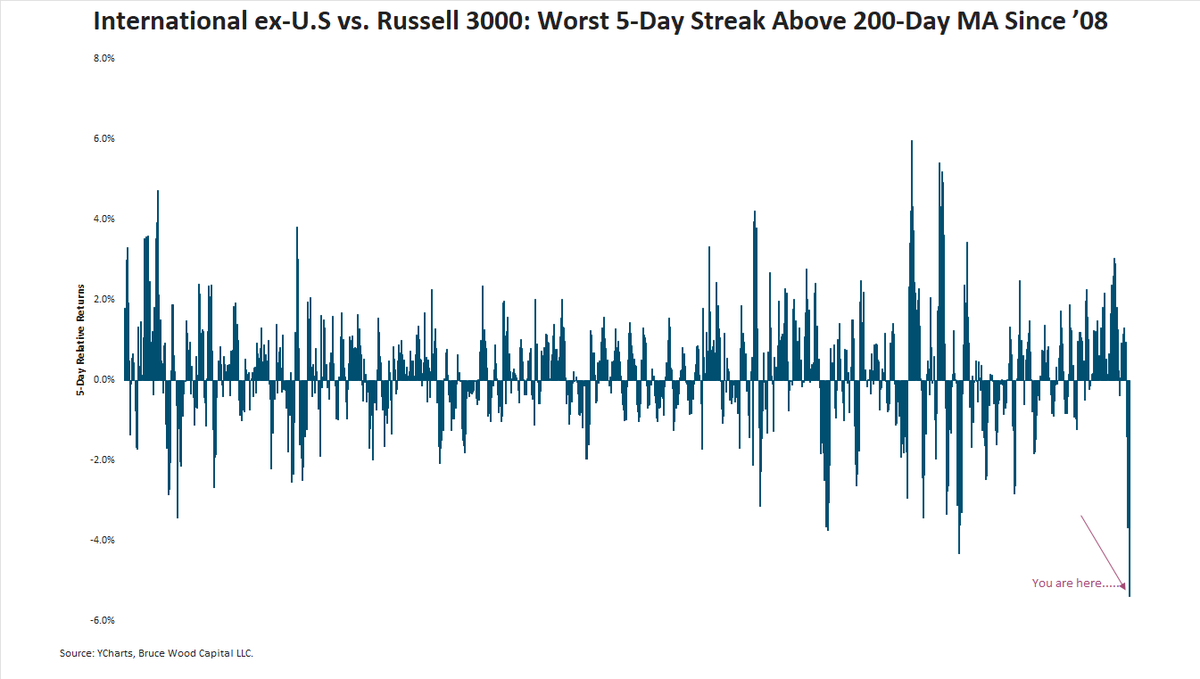
If you have meaningful international ex-U.S. exposure, this has been a rough week.
Since 2008, when int'l ex-U.S. vs. Russell 3000 has been above the 200DMA, the past 5 trading days rank as the worst relative return in that entire period.
Brutal.
Still believe int'l offers more upside long-term than U.S.
This drawdown could be a rotation opportunity.
(Not investment advice—just our view.)
Market leadership shifts as economic conditions change.
Our February 2026 Investment Outlook applies a rules-based economic regime framework across 11 indicators to evaluate relative asset class, sector, fixed income, and factor positioning over the next 12 months.
Current signals favor commodities, real estate, and small cap on a relative basis.
Full report: https://t.co/AaZngrRFwk
For 6+ years, owning mega-cap U.S. growth was the trade.
Now, Equal-Weight is starting to outperform the S&P 500.
When narrow leadership reaches historical extremes (think 1999), regimes tend to change.
Breadth matters.
For perspective, only 4 prior bear markets had larger drawdowns than today—and 3 of those exceeded 70%.
History doesn’t repeat, but it often rhymes.
Bruce Wood Capital LLC
Systematic Global Macro | Data-Driven Research
Another red day for Bitcoin.
BTC has now declined in 7 of the last 8 days and is down ~41% from its most recent all-time high—solidly in bear market territory.
Deeper bear markets tell a different story.
When it takes 100+ days to bottom (we’re at day 121):
• Avg drawdown: 59.2%
• Days to bottom: 215
• Days to new ATH: 531
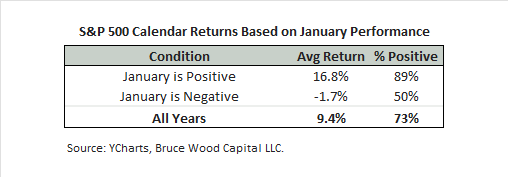
When January is negative?
• Avg full-year return: -1.7%
Tax dynamics? Momentum? Coincidence? Maybe.
But nearly 75 years of data says it’s a signal worth watching.
—
Bruce Wood Capital LLC
Systematic Global Macro | Data-Driven Research
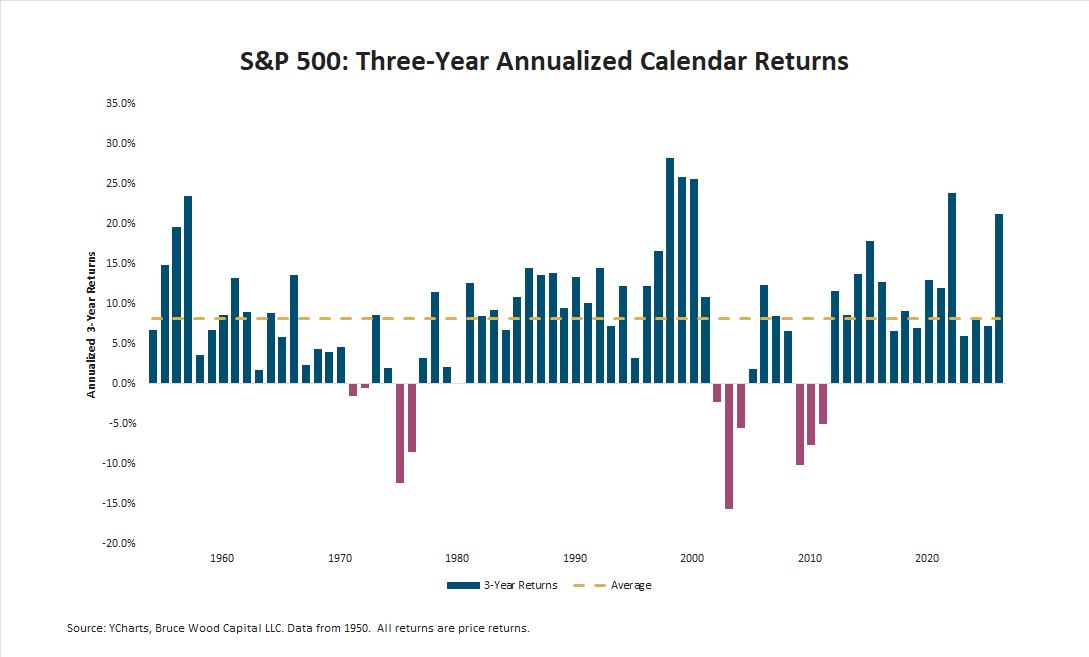
The past 3 years in the S&P 500 have been extraordinary.
📈 3-yr annualized return: 21.3%
📊 Long-term average: ~8.2%
Since 1950, only 5 periods have seen higher 3-year returns.
History doesn’t predict—but it does inform.
Expectations matter.
International equities had a standout year.
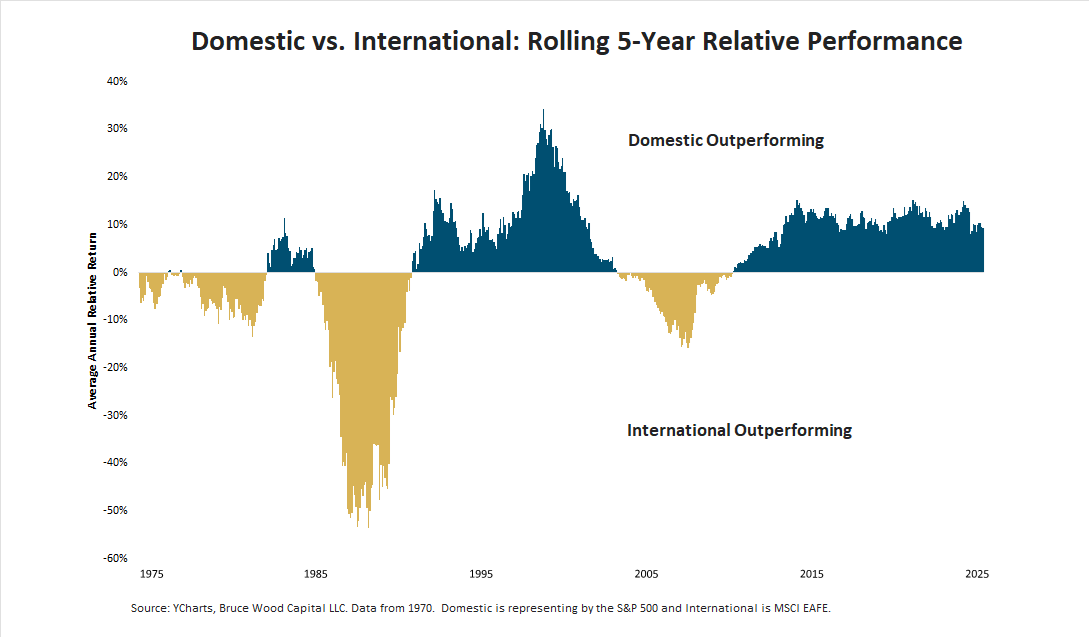
In 2025, MSCI EAFE returned 27.9% — its best year since 2003. More importantly for diversified investors, international stocks outperformed the S&P 500 by 11.5%, the strongest relative showing since 1993.
One year doesn’t make a trend.
That’s why rolling returns matter. Looking at rolling 5-year relative performance, international equities still have work to do — but 2025 was a constructive start.
With most portfolios heavily concentrated in U.S. large caps, relative valuations and the risk of a secular bear market in the U.S. dollar argue for expanding the opportunity set.
International equities aren’t just diversifiers — they may be a source of outperformance in the years ahead.
Does rising unemployment signal trouble for investors?
Historically, when U.S. unemployment rises above its 3-yr average, recessions often follow. Since 1950, that crossover typically occurred near the start of a recession.
But this cycle is different.
Unemployment has been above its 3-yr average since June 2024 — and there’s still no recession. The first time this signal has broken in 75+ years.
Here’s the surprise for investors:
• Avg S&P 500 return when unemployment > 3-yr avg: 11.3%
• Long-term avg: 9.3%
• Market positive 87% of the time vs 74% otherwise
Important caveat:
Rising unemployment ≠ bullish. These periods often bring higher volatility and deeper drawdowns.
Where the signal struggles is timing. It hasn’t reliably told investors when to get out—or back in.
Many of the strongest returns occur during uncomfortable, uncertain periods.
Economic indicators still matter for tactical decisions.
But long-term investors often do more damage reacting to macro signals than sticking to a disciplined plan.
Sometimes the hardest move is the right one: stay invested.
Q4 2025 US Economic Dashboard out now!
Resilient growth: Real GDP +4.3% annualized
Core inflation easing to 2.6% (lowest since '21)
Services strong, but manufacturing & housing soft. Labor steady at 4.6%.
Mixed signals heading into 2026 — download the full PDF for details:
https://t.co/yFgK0aRdLi
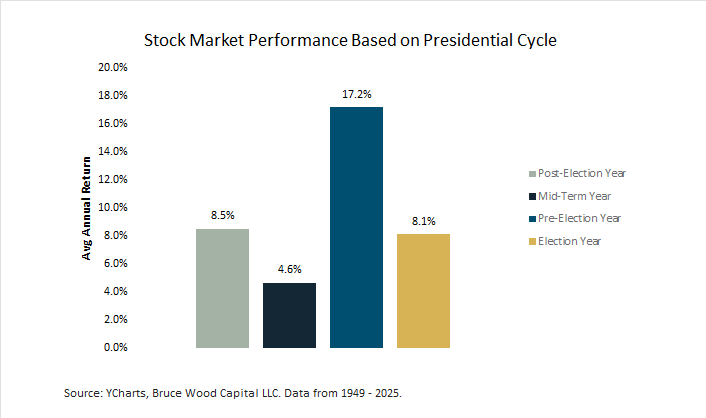
2026 is already a midterm election year.
Historically, midterms have been the weakest year of the presidential cycle:
• Avg S&P 500 return: ~4.6% vs. ~9.6% long-term
• Positive returns only ~60% of the time
Politics don’t drive markets—but policy uncertainty can shape volatility.
Worth keeping in mind as one input for 2026 risk positioning.
The upside? Post-midterm years have often delivered strong rebounds.
Bruce Wood Capital LLC
Systematic Global Macro | Long-Horizon Signals | Data-Driven Research
Time to Pause on Shorting the $USD?
Shorting the dollar crushed it in 2025—DXY down ~9-10% for the year. Everyone's piled in... and feeling confident.
But seasonality says: Hold up.
December is historically the dollar's weakest month (avg -0.8% to -0.9%). January? Typically the strongest (+0.9% to +1.0% avg)—often kicking off a solid run into spring.
Long-term, I'm still in the weaker-dollar camp. Fundamentals haven't flipped.
Short-term though? Heavy short positioning + classic January bounce could mean turbulence ahead.
Impacts:
US vs. intl stocks
EM vs. developed
Commodities
Crowded trades get tested when conviction peaks. Worth watching as start the new year.