Democratic systems may formally represent citizens.
But citizens often judge democracy through everyday experience.
Security.
Public services.
Economic opportunity.
This is why democratic legitimacy depends on more than procedures alone.
SMI | Governance & History
Many people assume democracy automatically leads to transformation.
It doesn’t.
Elections can happen in a moment—real transformation takes generations.
#Democracy#Governance#SMIGovernance
What happens when elections exist, butpower increasinglyserves networks rather than citizens?
I call it Myowncracy.
In thisnew op-ed,I examine whether Nigeria's 26year democratic journeyhas delivered democratic substance ormerely democraticform.
Read: 🔗 [https://t.co/5mbH9IN8oW
Has Nigeria progressed since 1999?
Nig has experienced more thantwo decades of democratic continuity and electoral transitions.
Yet manygovernance challenges remain.
Perhaps the question isnot whether there hasbeen progress or stagnation,but how both have existedat the same time.
Every election changes leaders.
But does it change how power operates?
Leadership matters.
Yet institutions, incentives, political culture, and entrenched networks often shape governance outcomes long after leaders come and go.
SMI | Governance & History
#Governance#Democracy
@benmurraybruce Security is one area where criticism and commendation should both be based on evidence. Where lives are being saved and communities secured, credit is deserved. Where insecurity persists, improvement must continue.
@NigeriaGov We salute the bravery of our troops and security personnel. Their sacrifice is undeniable. The best way to honour them is not only with words but with effective policies, adequate equipment,timely welfare, and a comprehensive strategythat addresses the root causes of insecurity
@adedayo_viktor Ajayi Crowther standardized written Yoruba; he did not create it. Political influence from Benin or Oyo should not be confused with ethnic identity
@adedayo_viktor Respectfully, this oversimplifies Yoruba history. Oyo was a major imperial power, but Yoruba identity and several Yoruba-speaking kingdoms existed before and beyond Oyo. .
@NoMaliceHQ The relationship is circular. Citizens produce leaders, but institutions also shape citizen behaviour. People often adapt to the incentives around them. The challenge is building a culture where integrity is rewarded and corruption is punished, regardless of who is in power.
@taiwoyedele Economic reforms may be stabilising the system, but stability alone is not development. The next phase must focus on converting macroeconomic progress into tangible improvements in welfare, productivity, and opportunity for ordinary Nigerians.
@taiwoyedele IMF approval is good news for policymakers, but citizens do not live inside economic indicators. The ultimate test of any reform is whether ordinary Nigerians can afford food, find decent jobs, and enjoy a better quality of life. That is the scorecard that matters most
@taiwoyedele The IMF's assessment is encouraging, but Nigerians will judge reforms by their impact on daily life. Macroeconomic stability is important, yet the real measure of success is lower food prices, more jobs, higher incomes, and improved living standards.
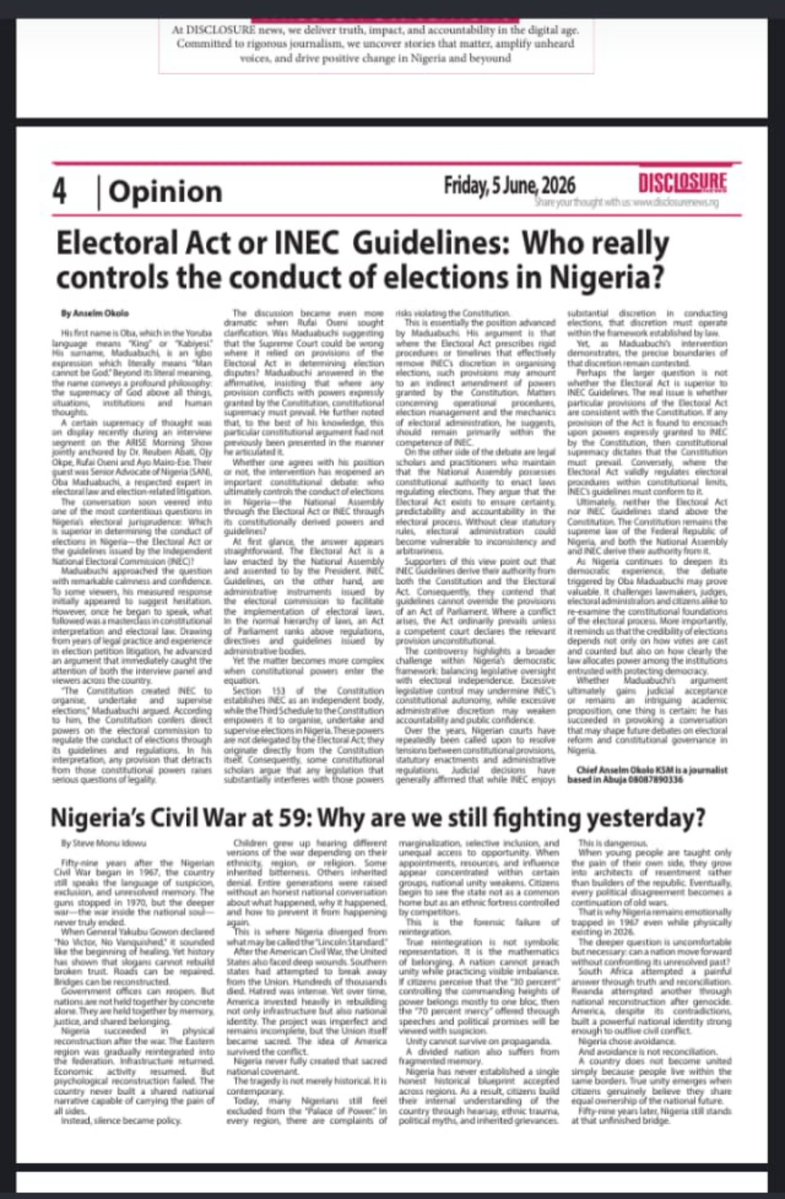
My latest published op-ed:
Nigeria's Civil War at 59: Why Are We Still Fighting Yesterday? (Part 1)
Fifty-nine years after the guns fell silent, Nigeria still struggles with unresolved memory, competing historical narratives, and questions of national belonging.
#NationBuilding
My central argument is simple:
A nation can rebuild roads, bridges, and institutions after conflict. But without rebuilding trust, shared identity, and a sense of equal ownership, the deeper wounds remain.
@NigAffairs@woye1 Beyond politics, it raises a deeper governance question: how should power and responsibility be distributed in a federal system to improve security while protecting democratic freedoms?